
Translated material
Sex with a leopard-werewolf
Translated science fiction September
The Chinese Magacademy, Afrofuturism with a human face and the Nigerian version of the Slavic fantasy: Once a month, Vasily Vladimirsky talks about the most interesting news of translation science fiction. Today we will talk about the books of Rebecca Kuang, Tade Thompson and Marlon James.  Rebecca Kuang. Opium war. M.: Exmo. Fanzon, 2019. Translation from English Natalia Rokachevskaya
The teenage girl Rin is a “child of the war”, an orphan from a deaf imperial province is not even by the sea. Her fate is to marry a fat old official, give birth to his children, cook food, follow the house and endure beatings. But for Rin, such a future is worse than death. Instead, she brilliantly passes the exam and goes to the most prestigious educational institution of the country, the metropolitan academy, where future generals are being prepared. The girl is almost the only commoner among the offspring of the imperial aristocracy, who were prepared for a military career since childhood. And this does not bother her, because Rin is uniquely gifted by nature, not over the years and is stubborn to fanaticism. The envious calls her ugly for thinness and dark skin, but we know that a real beauty is hidden behind this plain appearance, which is about to overshadow the most enviable brides of the empire. In addition, she has a hidden wonderful gift, which is able to discern only one of the teachers of the Academy, a former special forces, now practicing an ancient mystical teaching. In a word, Rina is a typical chosen one - Knock, Knock, Neo! - And this chosenness is written on her forehead with arshin letters. Not only does the girl go through the teeth only by children of governors and ministers, so she still manages to capture hand -to -hand combat in such a way that she cuts up rivals in the ring who studied martial arts from the age of five (if you forgot that we have fantasy here, in this place, will certainly remember the state from the crushing military defeat. True, at an expensive price, but this is the traditional problem of all the chosen ones, from Frodo’s hobbit to Harry Potter.
All this would be even curious if the story of Rin from beginning to end was not cast from the most running, wiped genre cliches. The novel begins as a typical “Magakademka” (a slang name for a fantastic “novel about relationships” with the participation of students of the Academy, not necessarily magical). The gifted provincial is of acute interest among the best teachers, captivates part of the classmates, awakens the burning jealousy of the "golden youth", and itself falls in love with the most talented and romantically mysterious old-style student. But this is not all: somewhere in the second third, the “opium war” imperceptibly flows into “Dark Fantasy” (see the novels of Joe Abercrombi and his countless epigones), and then-in the story of a detachment of killer ninja with super-resistances, there is such a popular plot in Japanese comic book cartoons. Rebecca Kuang could be complimented for the witty playing out the history of ancient and medieval China, but here the writer was not far beyond the framework of the school curriculum.
In Russia, there is a whole “bush” of book series, not the first decade of aimedly bombarding the target audience with “magicomas” with all possible variations, and kuang would have fit perfectly into any of them. Actually, it is worth paying attention to the debut book of a young writer of Chinese descent primarily because the “opium war” reached the final “Nebum”, the British Fantasy Prize and the World Fantasy Prize and was awarded several genre awards of the second row. However, such a choice speaks more about prizes than about Rebecca Kuang.
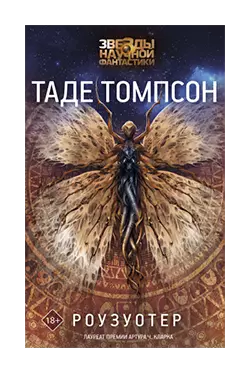 Tade Thompson. Roseoter. M.: AST, 2019. Translation from the English Roman Demidov
“The third angel was inhibited, and a large star, burning like a lamp, fell from the sky, and fell into a third part of the rivers and on water sources. This star is "wormwood"; And the third part of the waters became wormwood, and many of the people died from the waters, because they became bitter. ” For all the widespread in this forecast, John the Theologian waside. Claims of an alien creature, nicknamed the star of wormwood, in the smoke and flame of falling to the ground in the novel of Tad Thompson, are not limited to "the third part of the waters." With its disputes, it saturated the entire earthly atmosphere (except for the United States, which in time hidden under an impenetrable dome), which made possible telepathy and other curious phenomena that previously belonged to the category of supernatural. Well, after short wandering, wormwood itself settled in Nigeria - it was around an alien dome that the city of Roseoter arose, where the main character of Roman Tade Thompson lives. Caaro is a sensitive that knows how to read thoughts and, if necessary, telepathically influence someone else's consciousness. He began his career as looking for lost things, later he became a virtuoso thief, and is now working on the bank, protecting the data from the penetration of the chakras telepaths. But this is not his main work: Caaro receives a salary in a secret government organization, ten years ago, who is keenly interested in people with paranormal abilities.
 Tade Thompson
 was born in England, but he lived in Nigeria for more than twenty years, in the homeland of his ancestors Jairub. Perhaps that is why he, unlike other Anglo-American science fiction writers, highly carrying the banner of “Afrofuturism”, does not feed the illusions regarding the bright future of the African continent. Its Nigeria of the 2040–2060s is a country where corruption, poverty and unsanitary conditions reign, where the volatile government detachments secretly execute dissidents in the wastelands, and thieves and gays are linked under the hooting of the crowd, putting on the neck and setting fire to automobile tires. Thompson does not overshadow native exotic, his heroes do not color the faces of white clay, do not beat in Tamtam and do not appeal through the word to the spirits of their ancestors. Ordinary citizens of an ordinary third world country: not very rich, not very happy, sometimes not very smart, confused in their problems and relationships. Not dummy from the window of the museum of ethnography of the peoples of the world, but living people, even if they know how to fly, erupt the flame - or read other people's thoughts, like Caaro.
However, in the final, Tada Thompson shows that the Nigerians are still able to build a real utopia. But only - Surpraise! - With the active participation and support of aliens, pursuing their obscure goals. The writer with white skin, who finished the novel on such a note, would have to make excuses for a long time before the indifferent public for racism and colonial thinking - the Thompson was awarded the Arthur Clark Prize. Well, long live a positive discrimination. It turns out, and there is some sense from her.
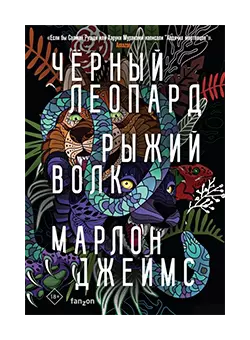 Marlon James. Black leopard, red -haired wolf. M.: Exmo. Fanzon, 2019. Translation from English Vladimir Misyuchenko
The protagonist of the novel “Black Leopard, the Red Wolf” is also a master to look for the lost. And, you will laugh, he is also from the people of Yorube, like Tad Thompson. Only unlike Caaro, penetrating into other people's thoughts, does he feel unusually acute - and follows the trail like a real bloodhound. A useful skill when you live in a village in the middle of impassable jungle, escaping from the city from the Tiranian father. Especially if these jungle are teeming with spirits, gods and monsters of all stripes. The new book of the Buker laureate Marlon James is a terrible story about fictional Africa, based on the folklore of the peoples of Nigeria and at the same time a novel of education, the story of growing up and searching for oneself. The story of how the naive young man-gorozhanin is gradually turning into a cynical sage, a cold-blooded killer and a ranger, for which great leaders and powerful kings turn to. He makes friendship with witches and dead, has sex with a werewolf leopard, is easily in the halls of the gods and scares demons with one look.
In the Anglo-American press, the Black Leopard is on duty compared with the books of J. R. R. Tolkien and George Martin, Neil Gaiman draws parallels with the Marvel universe and the stories of Robert Howard. But for Marlon James himself, this is primarily an attempt by means of a language to recreate the atmosphere of ancient fairy -tale Africa. Tart, thick, knocking down, choked prose with unpredictable rhythm and sudden retreats is a complex stylistic experiment with an exotic color. In part, this is the imitation of the most famous storyteller of the people of Yorub, Amos Tutole: who read his short novels “Travel to the City of the Dead”, “My Life in the Forest of Spirits” and “Curly Woman”, recognizes familiar motives. Most likely, Africa, recreated on these pages, exists only in the head of Marlon James: for example, there is a suspicion that the author slightly overestimates the tolerance of Yorube in relation to one -year sex - we recall the “execution of the collar” in the “Roseothel”. But this is not so important: there is nothing significantly about, but how it is written.
Perhaps in some places James even bend the stick. It is possible that this is the fault of this, but in this dense interweaving of exotic lexemes, some artificiality, deliberate, so as not to say falsehood: “Indoda is groomed. The sun reasoned, the beams of Bel Svetushka were melted ” - and further in the text. Fantasies on the topic “How to think and say a real yorub” performed by a person born on Jamaica and living in the United States of America do not cause much trust. “Black Jaguar” is a kind of Slavic fantasy that could compose a descendant of the Old Believers who fled in the 18th century to the Mongol steppes. But this is not our trouble and our problem is not our problem - let his fellow tribesmen deal with the Buker laureate. The same Tada Thompson: He is a psychiatrist by profession, experience with complex people not to occupy him.