
Translated material
"Linguistic units are thinking bacteria"
Three poetic news December
The second book of Bogdan Agris, a modern romance of growing up based on Stesichor and pond -wing posteronia in the second collection of Dmitry Gerchikov. Leo Oborin says about the most interesting poetic books published in December.Bogdan Agris. Povilik web. M.: Russian Gulliver, 2021
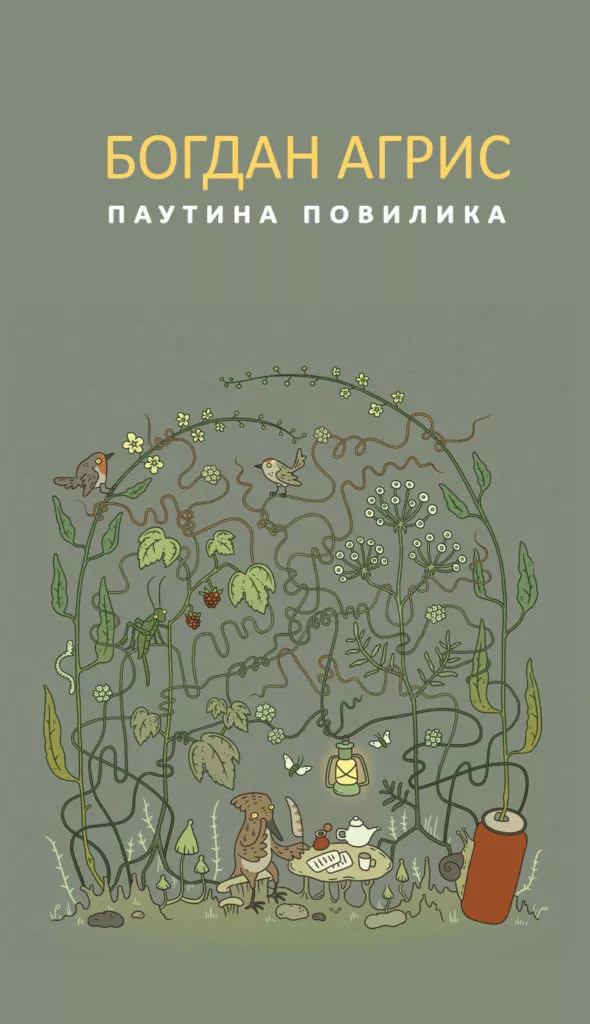 There is a rather slurred concept of “late debut” - as they say about the authors who began to write or publish already in adulthood. In the preface to the book of Bogdan Agris Valery Shubinsky, it indicates: “This poet should have debuted simultaneously with Igor Bulatovsky, Andrei Polyakov, Maria Stepanova, Polina Barskova - and made his debut a quarter century later, at the same time, who are a quarter century younger.” In the case of Agris, one could additionally problematize this concept: his poems are “late” for that “metaphysical” wave that arose in the 1990s and sounded quieter than most others. But they coincide with the work vector of the generation of young authors, whom critics are sometimes called neoconservatives - on the grounds that the social agenda in their texts almost does not play a role and they are guided by the classical projection. This, as often happens in criticism, a simplification leading to polarization, but it cannot be said that there is no oncoming movement on the back of the back side: the theoretical texts of Agris in the journal “Quarta” (which he founded along with Shubinsky) and the polemic posts in his Facebook, as it were, fall into the conflict script. Agris announces the inexhaustment of the modernist program and sharply turns off the typical Soviet poetry from Aidos poetry in general - on anthropological, let's say, grounds.
It would not be worthwhile to talk about all this in a review of a book of poems, but in the tone of Agris you feel the impendingness characteristic of modern craving for directing. Here is his second book “Povilik’s web”, dedicated to Alexander Blok, opens up with an explanation: what it is and how to read it. “This is precisely that the book, with an internal plot, and not just a collection of poems ... The plot of the book is a journey through seven (or how many?) Worlds, gliding through them according to the Tree River mentioned in the first poem.” During this journey, the hero of the book overcomes the internal split, inspired by the world lace in which the journey began; This also affects the emotional system of the book. Left “Tikhod”, which at the beginning of the book entered “into its secluded subsoil growth,” this growth completes. “The Wanderer found his house. The book ends with a kind of eschatological code, in which the hope of a somedeme-grunt reunion and reconciliation sounds. ”
Write, describe this is an ambitious task, requiring a deep understanding of how mythology works: Agris, having this understanding, interferes at different levels, from phonetic to the plot, images of the myths of Ireland, Israel, Russian folklore, and at the same time gives tribute to the author’s myth -making of the 20th century, from the Bloc and Sologuba Pod Schwartz and the Sunses. For example, a little fellow star appears, a relative, it seems, Sologubov star Mair, who also blesses the world with its light.
A similar alloy causes thoughts about the teachings of New Age, in which a sense of ownership of secret is sometimes more important than revelation itself. For poetry, such a comparison is more natural and effective than it might seem (unlike, for example, from politics and even a lifestyle). The plot in the book of Agris is sprinkled from individual poems, but at a certain moment a fairly universal scheme really begins to see behind them. Say, in the middle of the book there are poems that can be interpreted as replicas on the path of the hero into the afterlife, right along Campbell.
where is the river row on the day
And mature hells
where strict courts got up
And long ponds
where is Pliocene and linen
The moon becomes sniffs
barely spent
The estimated beard
There is a ball of the earth
On the false district
There is a protracted hair clip
hung over the veche princess
and a monogram is carved with carved
Above the golden rattles
Such texts make an impression of its own sound, a certain really carved baroque luxury. But with all the numerous images, there are not so many figurative categories. All of them are from the field of fundamental mythological symbolism. Forest, Moon, animals, for example, a fox-and especially a lot of birds loved by Agris, messengers and embodied souls. “Suddenly, my sparrow sleep will come down to me”, “The name has long been lost there, / where it is good for the kaples”, “Konoplyanka played / in overturning times”, “The owl / inside the living zodiac runs.”
Oh Lastonka fly
where is Antinin
In the Rosian mountain ash
Parks are pigeons
The poem from which the last quote is taken is the epigraph from Oleg Yuryev; Yuryev is an extremely important poet for Agris, Agris adopts his confidence that in modern conditions an exalted, archaic, sometimes priestly dark vocabulary can work:
Oh, I am still far away
Oh, is it sole with the lazy Pio
I am Eliseis these moths
in Paranets of the May sunset
At the same time, complication is associated with the plot: it is more where the hero overcomes difficulties, less - where he is close to the goal. This goal, perhaps, is to recognize that human teleology is poorly applicable to the natural grandeur:
Slices of ring smoke,
bevels of contour heaven.
Pines splashed past
Malachite plumb line.
Air - matte mycelium -
Not yet swollen yet
And they stand without any purpose
Screw clouds.
<...>
There is already a spin
Light fiber.
Vyakhir, my vortex my Vyakhir, -
Return to the window.
Stars sprinkled with millet,
Pines are a careful law ...
This is the wing of your sketch
troubled and time.
The bird, in the end, just sings; The manifestation of the bird's face on the face of the singing hero ends and the book of Agris ends - the tribes and knees that reports, that harmony is possible, but in order to comprehend it, an internal effort overpowering life is necessary.
Anne Karson. Autobiography of red. M.: No Kidding Press, 2021. Translation from English by Julia Serebrennikova, ed. Sergeya Bondarkov
 If Bogdan Agris presents us with Per SE mythology , then for Anne Karson not the most battered mythological plot about Hercules and Gerion is an occasion for more applied work. In the “Autobiography of the Red”, written in 1998, the Canadian poetess, a classic philologist by education, is repelled from the history of the tenth feat of Heracles and preserved only in the tiny fragments of the poem by Gerioneid . There was almost nothing left of Stesichor - the stronger the scraps of the poet written by the poet, whom ancient readers called Homer's worthy heir, tease the imagination. “The fragments of the“ Gerionids ”are read as if Stesichor wrote a large poem, then tore it on pieces and burst in the box along with the texts of the songs, notes to lectures and meat scraps,” Carson writes in his preface to his book. She clearly refers to a much more modern - Dadaist - way of creating works. The mythological material in the “Autobiography of Red” is also modern: the plot becomes a canvas for the novel of growing up (some reviewers talk about LGBT-iUng-Udult-Roman), and here a character surrounded by completely recognizable, modern realities, the gift that calls him Gerion.
The very displacement of attention from the main character (Hercules) on the secondary also looks like a modern technique: today you read all the same about remakes of classic works “on behalf” of non-main characters, usually those to whom the era of the original assigned a passive role. But here Karson follows antiquity. After all, Stesichor dedicated his poem to Gerion, and the preserved text ends with a marvelous expanded metaphor: “Gerion’s head bowed to the Dole, / like a poppy, fading when he / suddenly loses its beauty, / at once all the petals showering ...” (per. B. Yarho). Karson processes this text in the spirit of Gertrude Stein:
Gerion passed his red mind from end to end and answered no
It was a murder and a spectacle of a fortified herd
All my dear Gerion said and now I
<...>
Arrow means murder, she shared the skull of Gerion as a comb
Put the boy's neck to one side at a strange slow angle like that
The poppy flower is dishonored under the wander of a naked wind
Stesichor, writes Karson, released adjectives, allowed them not to follow the rhetorical canons of Homer's poetry. The more striking the persistent repetition of the epithet "red". The “red” was called Gerion Erifia’s sunset island, the cows were red red, which Hercules abducted from him, crossing the island in the rook of the Helios Sun. The whole myth speaks of red as a beautiful : red is distinguished and fading, the color itself determines the tragedy of the plot. Applying this plot to the story of a young man who, in childhood, was subjected to sexual violence by his brother, and then fell in love with another young man (Hercules), Karson demonstrates the inevitability of antiquity, its doom of the return, her ability to awaken in modern times. Nature reminds of this no worse than human relations:
Along the lower edge of the photo
Gerion saw skeletons of pine trees,
Destroyed by ash falling on them. "Red Patience." Photo,
on the fixed surface of which
Fifteen different moments of time, nine hundred seconds are compressed
bombing upwards,
and falling down ash
and dying pines.
We are talking about the photograph of the volcano taken by Hercules's grandmother: the disaster described in the book refers to the real eruption of the Mon-Piel volcano, which destroyed the city of Saint-Pierre on Martinic, and through it-to the eruption of Vysuvius. The volcano is an attractive symbol of destructive passion, and it is precisely in the metaphorical volcano Karson that leaves his heroes. However, in addition to passion, Karson describes many more states - complex, borderline, characteristic of a lonely young man. “Gerion’s life entered in the numerous period, froze between language and taste. / He got a job in the local library to put state documents on the shelves. / <...> Gerion flickered / between the rows like a ball of mercury and snapped switches. " The “Autobiography of the Red” is arranged as an alternation of flashes and interludes, which, ultimately, can also be tied to an ancient tradition, only theatrical one. Another key motive for Karson is a photograph, again involving a flash, but allowing to tame, stop boiling time.
Perhaps it is worthwhile to offer an unorthodox, even somewhat brutal interpretation of this book: it is not so much about modern people and their ancient prototypes, but about the poet’s attempts to combine the zone of his living interests with modernity. It is not a fact that the epic is the most suitable for this: say, Louise Glik has such a synthesis very convincing when working with lyrics, landscape, impression.
Dmitry Gerchikov. Birthday of time. SPb.: Word Order, 2021
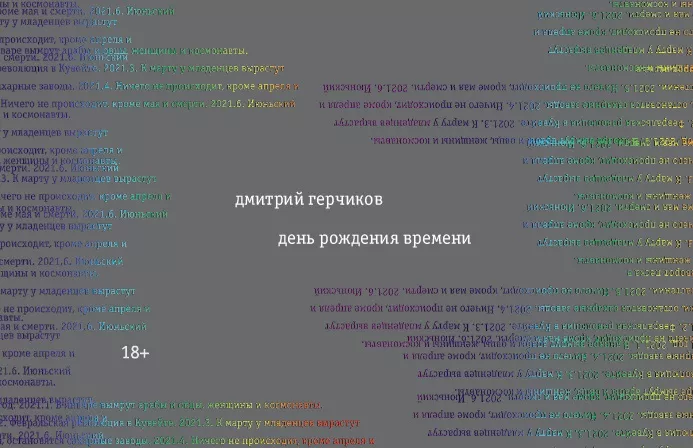 Modern Russian laws significantly complicated the review of poetry - and, on the other hand, created a place for exciting lack of nothing. The second book of Dmitry Gerschikov opens with lines “If I, my beloved, was, for example, a vagina, / you would ... Suppose, my face” - that immediately sets up the attentive reader of modern Russian poetry for a certain perception, but expectations will be deceived. Gerchikov, as in the debut book “Make Poetry Great Again”, mixes formal techniques, encounters pop culture, Internet communication and politics, works with ready-made texts and serialism.
Nevertheless, the new book is more ordered - and more convincing - than the previous one. Largely because at the forefront here is the lyrical “I”, busy with poster self -determination. We will call two, perhaps, the most characteristic text. Firstly, the love “poem” with the refrain “Who were you in the zero?” And "Whose War is a soldier?" / "Whose war we are soldiers?" The questioning interrupts both the prose story of acquaintance with the future wife, and the modeled excerpts from the “typical” verses of the “elderly poet-metarelist”, written from the prospect of “peace that is weakly reminiscent of ours” (stylization in these passages, of course, navigable, bringing to mind the poem of the Gerchika Book of Sungatov about the veteran of the second Chechen war, which is, which “I undertook to write relevant poems”). In the finale of the “poem”, this discord merges into a single message that affirms the historical memory and living of the historical moment - as personal, divided for two experience:
That day I saw you for the first time. I saw under the voices of the Blovezhsky agreement and the rattle of tanks in Czechoslovakia, the echo of the Karabakh conflict and the rain of the Chernobyl disaster, the sound of crutches and the brilliance of bullets flying through us. The border is a touch. Love is a poem. The state applies to the state, the law applies to man, the lips relate to the abdomen.
How many times we will touch each other - so many times will split into parts. Wireless networks will entangle air, liquid mechanisms will improve blood, the information will become sweet as almond milk, but we will touch each other while explosions are heard on the border between the nineties and zero, life and death, the homeland and the Russian language.
The second indicative text is a “resume”, which is really built as a resume. Autobiographic hero Gertchikov Dmitry Aleksandrovich, born in 1996, lists several works, none of which he has not been delayed for a long time, and for each gives an explanation: “The Bookstore“ Phanster at the Winery ” / (June 2017-May 2018) // Position: Seller-administrator // In fact, this position is called farting on a chair . If the employers officially introduced this wording, then the applicant would immediately understand that he was promising a cashier’s vacancy in an independent cinema or in the chamber exhibition hall ”; “Position: moderator // Moderator - a fashionable word for the word guide,” and so on.
It is easy to see here an autocomotion for the experience of a modern precarry, but this auto -combination is turned into a performance. The effect of the new verses of Gerchikov is precisely the jump from the game to serious and vice versa, and not always within the same text. Between these approaches, relationships - a distinct break, and in order to overcome it, each time an effort is required, hidden behind the extravagance of specific solutions. In relation to social and political poetics, for example, Daria Serenko or George Martirosyan, Gerchikov’s texts are shifted towards the Prigovsky “flicker”, the ambivalence of the author’s position-which is hinted at the Full name of “Dmitry Alexandrovich”, smartly carried out at the beginning of the text (and that, indeed, Dmitry Aleksandrovich, indeed written at the beginning of the resume). The reader of the “Birthday of Time” - including the text that the title gave the book - you have to constantly make an amendment and remind yourself that the direct simplicity of the statement (“She says that we are pregnant while we are watching a video about Putin’s palace. <...> Today is the day of the rally, today you told me that it is pregnant”) becomes a poetry, just when the layer is a step, “like we are further than journalism:“ as we are further than us Explain to our future daughter or son, why are there those who go to rallies, and those who break their backs? <...> // Who crawls from a plastic cup into a porcelain, laughing and buying up all our archives? What will we answer to our children when they ask where the wind carried us away? "
This also works with other techniques - including again with the Prigovsky splitting of familiar words or with imitation of neural networks. The final text “Conspiracies of the Future” is arranged as a catalog of predictions, initially reminiscent of Twitter “Neuromedus” : “2022.2. Moon, Betelgaze and the Southern Cross will become citizens of the Russian Federation ”,“ 2022.9. In the autumn Kemerovo, workers will require bread, but breathing will give a voice to the answer. ” Gradually, the murmur of the infosphere is reduced to lapidar eschatology, as if neural networks fed the “Notes of a Madman” and “Logical and Philosophical Treatise”: “2030.7. Mathematical axioms are a wasp and drops. 2030.08. Linguistic units are thinking bacteria. 2030.09. September did not come. 2030.10. October did not come. 2030.11. The year ended in August. " Let's see how it will be - and will the next jump be far.