
Translated material
How to read Ovid
The author of "Metamorphosis" is a postmodernist, a critic of consumerism and a singer of human weaknesses
During the two thousands of years, which have passed since the day of the death of Ovid, his works were read differently: “metamorphoses”, for example, for someone were aesthetic fun, for some-a warehouse of mythological plots, and thereby it’s more difficult to find a key today. However, in this text you will not find either instructions or sequential attitudes - as in the chapter from the corresponding textbook. Alexey Lyubzhin, a classic philologist, the head of the program “History and Antiquity Culture” of the University of Dmitry Pozharsky , offers a different approach: instead of simplifying generalizations, he recommends paying attention to the characteristic subtleties and, in particular, which will help to look at Ovid's texts in a different way.First of all, it must be said that the following essay does not at all claim to be a comprehensive or at least consistent characteristic of Ovid's work. The Russian reader who wants to have it has a great opportunity recently: this is the book of large philologist Michael von Albrecht translated by us “Ovid. Introduction ”, published in 2018 at the publishing house of the Greco-Latin cabinet. Moreover, our essay will focus on some “spots”, possibly not the most famous, but, in our opinion, very characteristic of the poet’s work. At the same time, we will consider more an early period of creativity, less mature (primarily “metamorphoses”), and even less - late, “mournful elegy” and “Pontic messages”. We will allow ourselves to write this essay in the form of disparate thoughts and observations of a completely different volume; This will not give the reader the opportunity to make an integral idea of the poet, but will help to slightly adjust the one that could arise in the usual way. We will divide these thoughts into four groups - about the work of Ovid in general and about its three periods separately. Note that the coming from Ovid is one of the largest poetic buildings of antiquity.
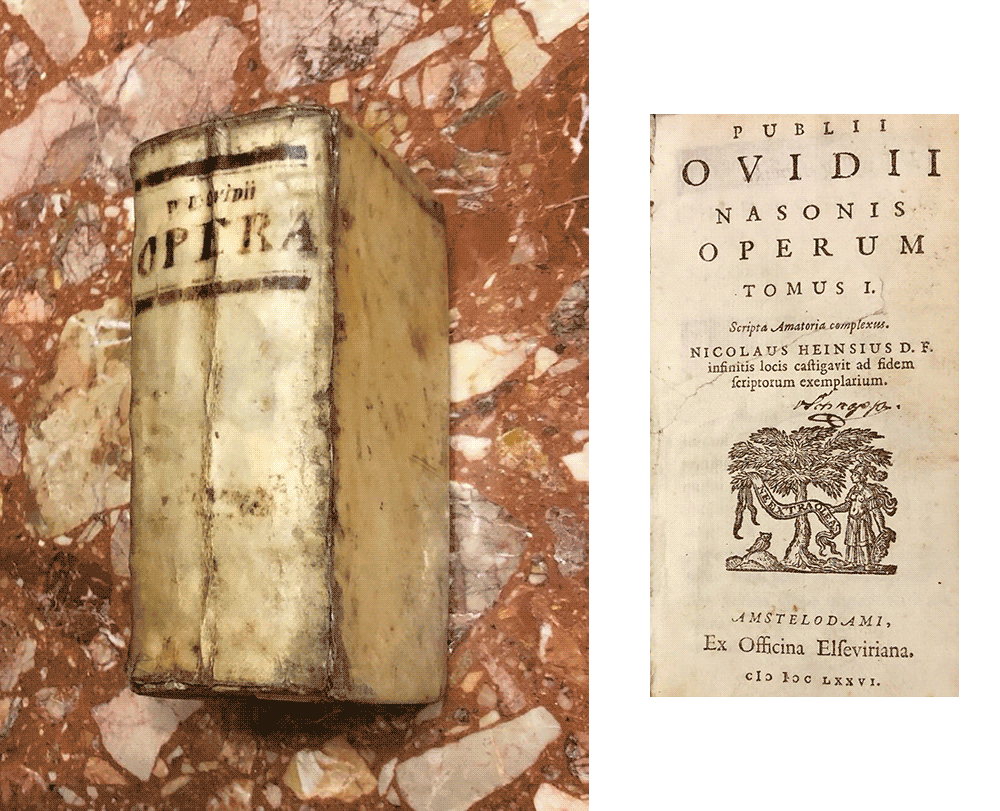
Unfortunately, in my library there are no interesting publications of Ovid. The relative bibliophil value is only the Elsevir three -volume of 1676. But it is so small and printed in such small print that it is almost impossible to use it for its intended purpose.
 1. About the work of Ovid in general
A very important feature of Ovid is his attitude towards brothers in Peru. Never, nowhere, he expresses ill -wishes in relation to other poets. In an autobiographical poem (“Gority Elegy”, IV, 10), he notes as an important part of his life poetic friendship (including fleeting acquaintance, as with Virgil, or relations with poets, which we would hardly be classified as outstanding today). In this, he is close to Ariosto, who, in the last book of The Furious Orlando, created a monument to his many friends. Ovid surpasses with imagination and imagination all the ancient literature, Ariosto - the whole latest; Is it by chance that these two features are characteristic of both one and the other?
* * *
Ovid is very bright, two poles are felt at the limit, the tension between which creates poetry: on the one hand, it is a powerful and powerful poetic will (like any ancient poet, it manifests itself primarily in rhetorical forms), on the other hand, the medium, self -awareness of the instrument of higher forces: “God is in us, and the fire flashes in us when he sets us in motion” (“Fasts” (“Fasts” (“Fasts” (Fasts, VI, 5).
* * *
A. A. Blok wrote about the poet: "Ovid belongs to that undoubted and" saint "(Pushkin), which should shine for us" dawn all night "." He left a very insightful characteristic: “The poet of Ovid ... He knew, obviously, the state of transformation; Otherwise, he would hardly have been able to write his fifteen books of metamorphosis; But the people around the Ovid have already sank to the bottom of life: Ovid's works were at best for them the subject of aesthetic fun, near the beautiful pictures, where they were occupied by the plot, style and other shameful virtues, but where they no longer recognized themselves. ”
* * *
The peculiarity of Ovidi's description of pathetic situations, primarily love, is an indispensable pun in the seemingly inappropriate place. “The Minotaur’s horns could not pierce your heart, the ungrateful the Thefts,” complains the Ariadne, thrown on the island of Naksos Ariadne, and the fact that she sets out her complaints in a letter that she intends to send from an unheated island (such a rhetorical task of Ovid), only emphasizes the artificiality of the situation, “they could not pierce your heart because it is iron.” The comrades of Acton in Metamorphoses, rejoicing in the successful persecution of a deer, call him and pity aloud that he is not. Acteon would like him to be here; But he is here. Alkion, worried about her husband, who went on a marine journey, asks the gods to be intact to return, so that he would not prefer anyone, and the poet immediately remarks: only this last could be fulfilled from all her desires.
* * *
He is a singer of the human soul not in her strength, but in her weakness, even, to be precise, in her weaknesses. And in this, he, perhaps, does not know equal in all European poetry.
2. Early period
At first a little - about the title of ARS Amatoria . The word ARS , like the Greek τέχνη, means both crafts, art, and a textbook at the same time; It is necessary to make a great cunning for translation into any of these languages of Pushkinsky "I put the art of art." Already noted the similarity of the name with the typical heading of the Rhetoric textbook ARS ORATORIA . There are structural parallels: the first book is devoted to instructions on how to find a girl (this is a part of the rhetoric, which is called inventio - “finding”, “invention”). The second is the art of retention (there is also a rhetorical analogue - Memoria , the art of holding in the memory of the composed material).
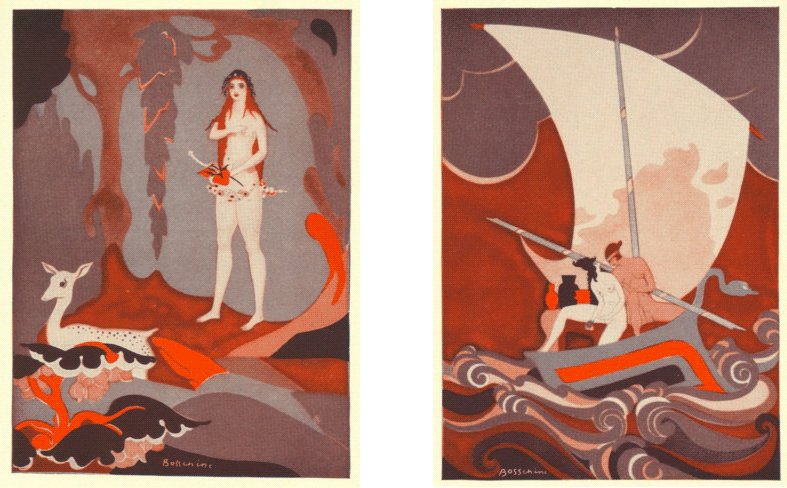 Jean de Bossher. Illustrations for the first and second volumes
"Science of love"
* * *
In the "Love Eleigius" Ovid made with the Roman love elegy the same as Heine with German romanticism - this was the murder of a thin poison of irony.
* * *
In ARS (III, 121–2, 125–8), Ovid expresses a decisive preference for the present: “Let antiquity gives pleasure to others, and I congratulate myself on what was born now: this time is best adapted for my customs ... not because the mountains disappear from where all marble is obtained, and that the embankments drive out azure water, but because we are civilization (so we translate a complicated word CULTUS , where there is no city in the root, is the verb from which it comes to cultivate ( field ), then respect , reverence , it could be reliable ; In paradoxically, the praise of the era of Augustus was a sign of non -radiation in the eyes of August, almost a crime: he strove for the reputation of the reducing agent of the former customs.
* * *
Pasifai’s passion is described with thin psychological details: “Why do you, Pasifaya, precious clothes? This beloved is insensitive to wealth. Why should you mess with a mirror if you harass a livestock living in the mountains? Why, stupid, you have already put already combed hair! Believe it, finally, it tells you - you are not a cow. How you would like to look in the mirror so that you have horns! If you like Minos, do not change him on the side: and if you want to deceive your husband, deceive your husband. And here? Leaving the chambers, the Queen of the Strength rushes into the mountain valleys and groves, like a bacchanka, stung by the Aonian god ... Ah! How many times, looking at the cow, you said to yourself: “Why do my master like her? Take a look only how she frolic in the green grass! I have no doubt that she, stupid, considers herself beautiful!” She said this, and without guilt ordered her to remove her from the herd and bring her under Yarmo or sacrifice from the altars. ” Here we see a classic Ovidian contrast: a mythological situation, completely impossible in life, is equipped with equally plausible psychological details. In general, the Ovid's mythology is a postmodernist who responds to her modernist criticism. That's how it really was what was not and could not be.
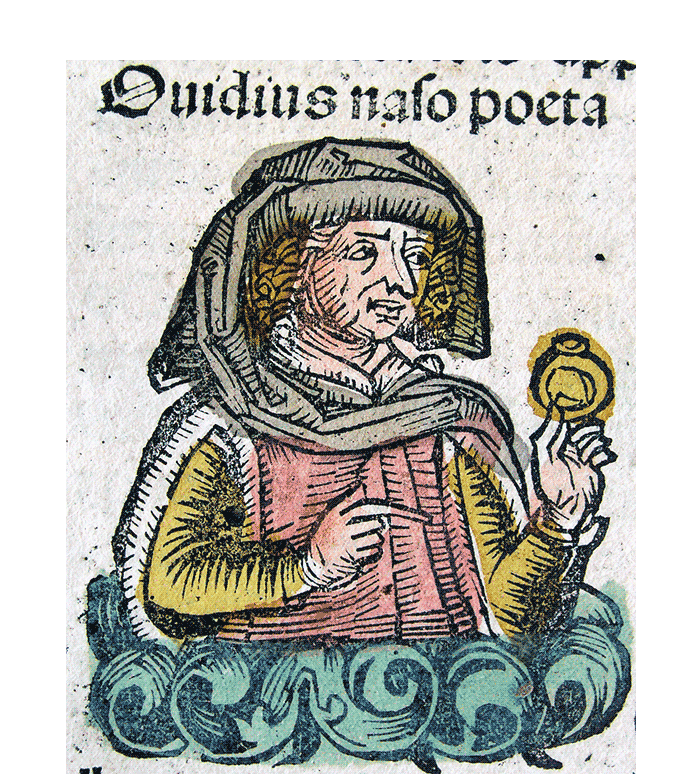 Ovid in the chronicle of Nuremberg
* * *
Take another passage from the same poem. “A nailed loader will come to [...] to the lady. He will lay his goods in your presence; She will ask you to see to check your taste; Then he kisses, then he will ask to buy. She will take an oath that she is pleased with this for many years, but now she needs, and now buy very well. If you refer to the fact that you do not have that kind of money at home, she will ask for a borrowed letter; And you will regret that you can write. ” What is going on was subsequently reproduced by Gogol (possibly not directly from Ovid, this is a “common place” of ironic Roman poetry): “Well, what can I say about the birthday - it is born as many times a year as it needs?” We missed one adjective in the translation, leaving square brackets, since it does not have a full -fledged Russian counterpart. This is EMAX - the education from the verb “buy” with the suffix denoting the intensity of action. There should have been a “jubble”, but the official version of the Russian literary language does not contain such a word. We have to resort to descriptive options, such as "prone to shopping." But the situation is recognizable in itself; Our contemporaries are depicted, a society in which we easily recognize ourselves and our own. Even a little more advanced (in Latin there is a special word, but we do not have). The block caught this very well - just in ARS it is more noticeable than in "metamorphoses". We will go to them now.
3. Mature period
The uniqueness of “metamorphosis” as a genre made from them a kind of focus of all ancient culture. Two hundred plots absorbed a whole bunch of early influences - and had a decisive influence on the later culture, not only on literature, but also on music, painting, sculpture. Sometimes we forget about the Ovidian origin of one or another phenomenon of our individual everyday life: if it were not for “metamorphoses” (and ARS ), humanity would hardly remember Ikar, although when we turn to it, as a rule, we no longer think about Ovid.
* * *
The puns of Ovid - very numerous - for the most part can be described by several simple schemes. One of the most spectacular is the same face in two different functions in relation to the same verb. "Why are you taking me out of me?" - asks the unfortunate Massius at Apollo, who turns his skin from him. Hunger inhales himself into Ericicichton's veins. Mestra rejoices that they ask her about her. Sleep shakes himself out of himself. Another beloved scheme of the poet, much more common, is two different additions of one function to one verb: concrete and abstract. “Use our advice, not a chariot,” Helios says to his unreasonable son, and Zeus knocked him out at the same time both from the chariot and from life. Kadm simultaneously lost both complexion and self -control. He is forced to avoid both his homeland and his father's anger. “Oma together both the head and the crime,” the Wacc addresses to Midas, freeing him from a fatal gift - the properties to turn into gold everything that he touches. SCILLA complains: “My words addressed to you, Minos, take away the winds - and they are alas! “Your ships take it into the distance!”
* * *
In “Metamorphoses” there is one purely rhetorical passage, where oratory is used not only as an instrument for extraneous goals, but completely directly: the Ajax and Ulysses for the armor of Achilles. However, as a rule, rhetorical tools serve as the goals of psychology - including within the framework of internal monologues. SCILLLA, the daughter of the Megarsky king Nisa, in love with the besieging the hometown of Minos, is experiencing a conflict in the “metamorphoses”, which in the tragedy of P. Cornel's “Sid” will become the hallmark of the French theater - a conflict between love and debt. “Whether to rejoice or grieve because of a multi-bearing war,” I doubt it. It is bitter that Minos is an enemy of a lover; But without war, he would be completely unfamiliar to me. However, he could, taking me hostage, stop the war ... I would be happy if I could move on wings by air and, finding myself in the camp of the Cretan king, would say who I am and admitted in my love fire! I would ask what kind of dowry he wants? If only he did not demand his father’s fortress. Let the coveted marriage disappear lost - not to become a happy at the price of betrayal! ” But gradually her thoughts are changing: Minos wages a fair war, he is a meek, and the power of a meek winner often benefits defeated ... "No, even if it is better he will win without spending time and blood." The other in my place would have succumbed to such strong love for a long time and happily destroyed everything that prevents her. ” SCILLA cuts purple hair from his father’s head - it was a talisman who made megars impregnable - but does not achieve his: taking advantage of the fruits of betrayal, Minos did not want to reward the traitor: “About the impotence of our century!”
... Take Medea - one of the beloved heroines of Ovid, who shared in this respect the preferences of late antiquity, which clearly preferred Euripides to the rest of the great tragic. The internal monologue contains the argument of this kind: of course, to help the stranger is the betrayal of the father, but the father of the harsh, and the betrayal of the Motherland, but the homeland is a barbaric country ... Jason at Euripides, Sophist and Cynic, could persuade his media in this way - on the stage of the Dionysus Theater, these were traces of the Athenian air, with signs of a particular place and concrete time, however, so that Medea herself persuaded Medea, and so that Medea herself and Medeeu and Medeeu. Persuaded - myself with such rational arguments?
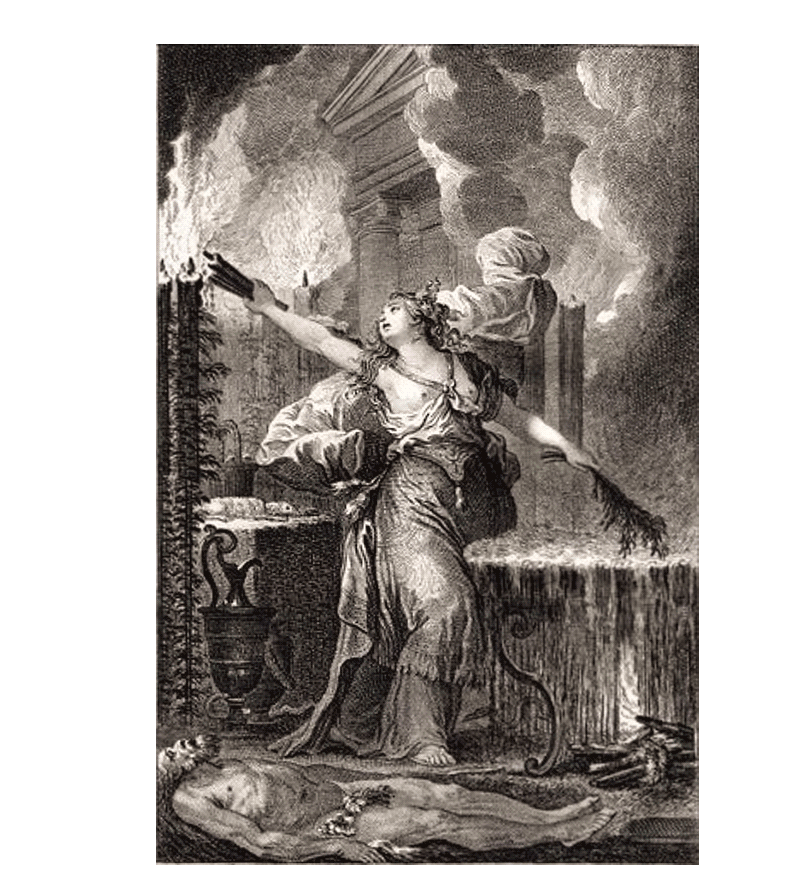 Metamorphoses. Medea returns youth to the father of Jason Eson. Formation, 1767
* * *
Plutarch at the beginning of the Biography of PeriLe says such an anecdote: “They say that once Caesar saw in Rome how some rich foreigners wore small monkeys and caressed them behind the bosom. He asked them, do not women give birth to children? With these words, quite worthy of the ruler, he gave instruction to those who spend on animals the need for love and tenderness inherent in us by nature, while it should belong to people. ” Ovid noted such love and tenderness - but made the addressee the mythological monsters: Jason strokes the loads of fire -breathing bulls, Medea - the neck of dragons drawn in a chariot.
* * *
... In “metamorphoses” Ovid writes about how the slave of King Midas, who saw the long ears of his master, could neither keep silent about this or inform any of the people. He entered this secret into the erased earth, and the reed, which grew up in the place of a covered pit, disclosed the forbidden with his rustle. From this reed Ovid and made his forend.
4. Late period
Andre Chenier - who, in much more severe circumstances, himself showed much more courage than Ovid, and persecuted the triumphant revolutionaries with iambic poems in the spirit of the Archilokh, reproached the author of the "mournful elegies" in cowardice:
You are wounded the most, but you are hiding the wound.
Sunny, you could answer the tyrant,
Il Archilokhov Anger Flexible Yavi
And his vengeful iambic in his blood!
Not imperious over you, he still worsens,
And your hatred only inspires the complaint.
Worthy of your troubles, you can’t be silent,
Neither take revenge on him, nor his life!
However, not all poets tried so severely. Pushkin, who can’t refuse courage, was much more condescending.
5. The result
In the time of Ovid, it would never have occurred to anyone to demand from the poet indispensable exalted feelings, mandatory originality, immediacy and sincerity in the descriptions of passions and the authenticity of experiences. These requirements were generally not for poetry for a long time - and if we look differently at earlier works and find in them what we are looking for, this does not mean that the search subject has always been the same. (True, from Latin poetry in this case there will be only Catullus, shaded by quite sincere and direct Martial anger.) On the contrary, and direct feelings, and thematic originality, and “fresh images” would rather seem in antiquity a bad tone, since the poetic task is generally a difficult task, its difficulty is the very possibility of its solution, and therefore there should be strict genre, metric and many other things. Frames: In their observance, only true dignity can affect, while incapable of showing it in a given field, playing according to generally accepted rules, of course, strive for a creative experiment. None of the great Roman poets have direct feelings: they were not interested in the muddy water of the unenlightened passion, but the fragrant, aged wine of the wise passion, enlightened by long life experience and ascosis of prolonged silence, which was brought to the world, which will come to the time than it will achieve proper maturity and turn out to be worthy of human attention. The cry of joy and pain is not yet poetry.
Овидию было дано уловить и выразить — независимо, а во многом и против своей воли — букет мелких человеческих слабостей, зависти, ревности и измены, рациональность поведения, которая пришла на смену древней героической цельности, невозможность выдерживать прежнюю высоту и веселый отказ от нее ради достижений менее героических и более обыденных, нежели те, которые римляне чувствовали своим национальным (при всей условности этого понятия) заданием. У Овидия был мягкий характер, несвойственный римлянину; таким же мягким и пластичным был его поэтический дар.
Чувствующие подлинность его предмета собратья по цеху по достоинству оценили его — в то время как многие предвзято настроенные филологи и критики, искавшие того, чего Овидий дать не мог ни в коем случае, и упускавшие из виду подлинные его достоинства в силу своих профессиональных «очков», отнеслись к автору «Метаморфоз» со строгостью, которой этот самый крупный специалист по мелким человеческим слабостям вовсе не заслужил.