
Translated material
Winston - Fan of Winston
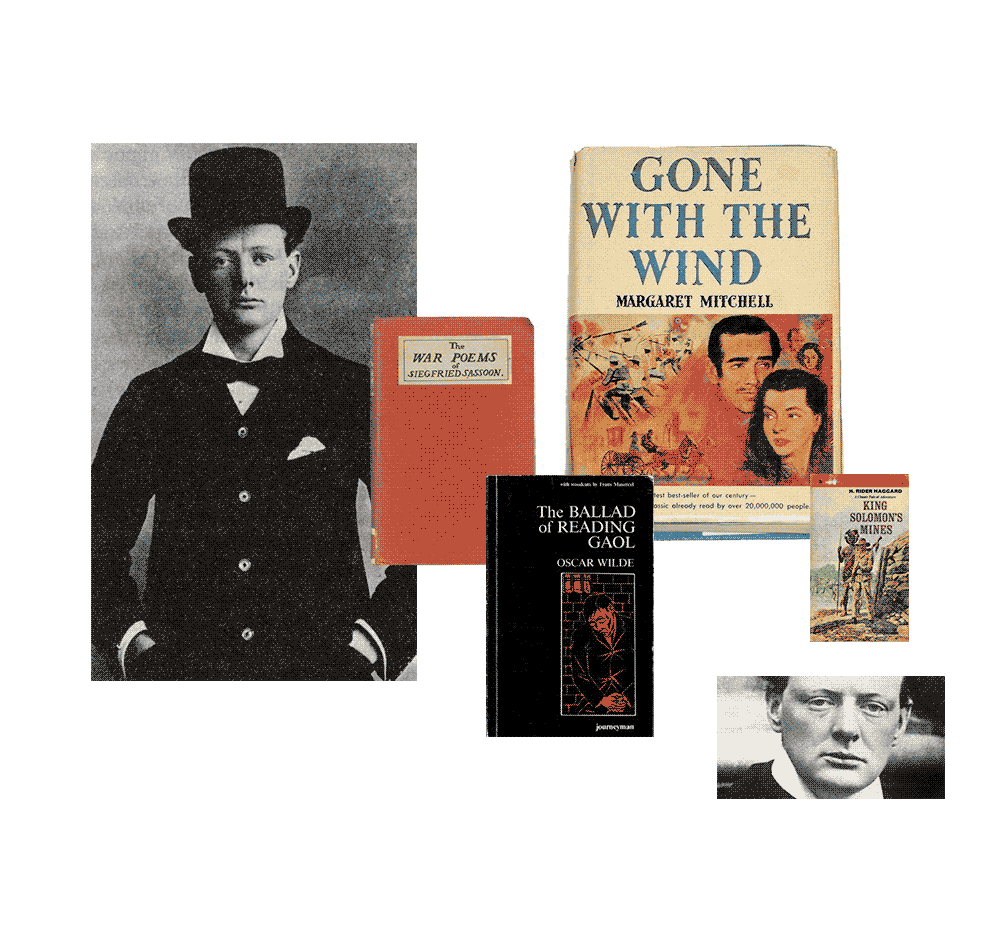
Churchill's favorite books
Gorky continues to explore the libraries of famous historical personalities. Today we will talk about the books that the British Prime Minister Winston Churchill read.Winston Churchill was a man of various talents. Of course, he is most known as a successful political and military leader, and it was crisis times: his activities in the post of the Treasury Chancellor ended in grandiose Fiasco, and the return to the post of prime minister in the early 1950s was not the most successful. In addition to his political career, Churchill was engaged in painting, tried to master farming, and studied the profession of a mason.
And, of course, Churchill wrote a lot: not only successful political speeches, but, as they would say now, historical non-fiction (although artistic works too). I had to write for a purely pragmatic reason: when he began military service, he realized that he needed an additional 500 pounds a year. The first time - as a journalist and documentary, and later composed works about the history of England and his family, the first and second world wars. In 1953, he was even awarded the Nobel Prize in literature "For his high art of historical and biographical description, as well as for brilliant oratory in defense of exalted human values." Like any writer, Churchill was a passionate reader: in his life he read a huge number of various literary works. We will talk about some books and authors here.
Siegfried Sassun, poetry collections
A graduate of Cambridge, a participant in the First World War, awarded the military cross, a poet who fiercely denounced the war and frankly described it horrors. That was Siegfried Sassun - a young bohemian poet who, from patriotic feelings as a volunteer, went to the First World War. There, he bravely fought - he was always in the forefront and did not hide behind other people's backs: many colleagues have a memorial case when Sasssun alone captured a German trench and put six German soldiers.
But after his close friend died first, and then Siegfried himself was seriously wounded, the poet decided that he was enough. During the treatment in the British hospital, he wrote a letter to his commander, entitled as follows: "Enough war of me: a statement of a soldier." This letter gained wide popularity - it was even read in parliament. Sassun became a controversial figure: many condemned his anti -war statements and verses, saying that they were “amazing” and “treacherous”.
It would seem that Winston Churchill - with his love for the empire and order - should brand Sassun. However, he treated him and his work with great respect and even offered Siegfried a post in the Ministry of Arms. Churchill read his poems publicly, said that he was ready to support him (due to the ongoing attacks in the press), and answered puzzled questions like this: “I am not afraid of Siegfried Sassun. This person knows how to think, and I am only afraid of those who do not know how. " The poet left memories of a meeting with Churchill: most of all he was surprised by the interlocutor’s readiness to listen to another point of view, although he noted that Churchill's behavior made him think that he was talking with his regimental commander.
Jane Austin, "pride and prejudice"
On September 12, 1908, in the Portland Portland, 52, in the prosperous district of London Marielbon, a wedding banquet was held. Among the guests are the political elite of Great Britain: ministers, members of the parliament, lords, representatives of King Edward VII and the country's Prime Minister Herbert Askvit himself. On that day, the wedding of Winston Churchill and Clementine Khozier was celebrated there. Gifts to the young were distinguished by diversity: someone without adventure gave money, others-scarves and cufflinks, a cane with a gold knit was delivered from the king. But the Prime Minister presented the complete works of Jane Austin.
It is clear that Churchill did not always have a free time to read, but he read Jane Austin whole. By the way, Churchill was completely devoid of such a biased attitude to Austin as exclusively a female author, which was a fairly common prejudice in those days. He did not really like “feelings and sensitivity”, but “pride and prejudice” - impressed.
In December 1943, Churchill was in Tunisia, where he went to bed with pneumonia: while he was recovering, his daughter read this book aloud to him. Most of all, he was delighted with the calm of the lives of the characters of Austin: the horrors of the French revolution did not invade their life - this allowed them to reflect on manners, etiquette and feelings.
Margaret Mitchell, "carried away by the wind"
As you know, Churchill was half an American, and events in the United States were always deeply interested in him. Like the history of America, first of all, the history of the Civil War in the United States. He probably read almost all the historical works dedicated to this topic, and always tried to find out something new about the confrontation of the north and south.
It is not surprising that the book of Margaret Mitchell, published at the end of June 1936, immediately attracted the attention of Churchill. He read it (more than once) and several times made references to her in his speeches: in 1938, when Germany invaded first to Czechoslovakia, then to Austria, he summed up the policy of peace of the angry Philippic, in which he said that all the efforts to preserve the world were carried away by the wind, and now, if not to act, could be blown away and all historical conquests British Empire.
By the way, the Hollywood film adaptation of the novel Churchill also really liked: the emotions and feelings of the film made a great impression on politics. And the performer of the role of Ashley Wilks, actor Leslie Howard, in a sense, died because of Churchill: in June 1943, Hovard, along with his friend Alfred Chenels (outwardly somewhat similar to Winston), had to fly because of Lisbon to London, German agents in Portugal took the actors for Churchill and the Luftwaffe, and the Luftwaffe was killed by the plane. Churchill wrote about this in his diary: "Only the stupidity of their agents can surpass the brutality of the Germans."
 George Orwell, "1984"
It seems that it is difficult to find two people more different than Orwell and Churchill. One is a convinced Levak, who went to fight for socialism for the fronts of the Civil War in Spain, a fighter with injustice; Another is an imperialist who is capable of without much compassion for both the starving Indian peasants and to the French sailors who die on his orders. But despite their diametrically opposite political positions, they had what brought them closer: the desire and ability to tell the unpleasant truth - both supporters and opponents.
Be that as it may, Churchill was a great fan of Orwell’s novel. And not only for the reason that the main character of the book Winston Smith got his name in honor of Churchill, but also because he felt: this novel - and the exposure of gloomy dictatorial regimes, and the warning of England, the country, which was led by the Labor, vigorously engaged in an increase in the role of the state in the economy. The railways, the Bank of England, the steel and mining industry were nationalized, and the state healthcare system was created. All this seemed dangerous to Churchill: after all, back in 1945 he said that perhaps the post-war England would rule "some form of Gestapo."
In 1984, Churchill discovered a consonant and understandable type of thinking; In the end, it is no coincidence that the name of the novel was redone from 1948, in which two numbers were only changed places. Churchill repeatedly returned to this book, re-reading it during his second premier-in the early 1950s.
Oscar Wilde, "Ballad of the Reding prison"
In the early 1890s, the famous British palmist Miss Robbinson, taking Oscar Wilde's hand in his own, told him that he sees four plays written by Wilde, which will be successfully set up, then Wilde’s future becomes foggy and disappears. And so it happened: from 1892 to 1895, Wilde wrote 4 successful plays and was arrested two months after the premiere of the fourth (“how important it is to be serious”). Then he served in prison - and died three years after the release. It is interesting that around the same years, the same chiromantic, hesitated to Churchill, so brilliant future that she even wanted to tell about this prediction in her book about palmistry - but Churchill forbade.
The palmist is not the only common Churchill and Wilde: the poet and writer were a good friend of Churchill's mother, Jenny, their correspondence was preserved. Churchill himself Wilde inspired his ability to write and speak - he tried to learn from him, adopt some tricks and tricks, comprehend rhetoric on the samples of his texts. In addition, soon after the arrest of Wilde, Churchill even wrote an essay about the aesthetics of rhetoric (but did not dare to publish it), in which he cited many examples from Wilde's works, agreeing with his view of how to write and speak, and directly quoting Wilde himself.
The Ballad of the Reding prison made a great impression on Churchill and, possibly, influenced his views and attitude to homosexuality: Churchill was rather liberal in this matter. Back in the 1940s, he reflected that restrictive legislation in relation to homosexuals should be canceled, and in 1954 this issue was discussed at a closed meeting of the government-but Churchill’s ministers were not as broad views as he himself. However, Churchill was sure that the abolition of these laws was not far off.
Henry Ryder Haggard, "Cop of King Solomon"
Young Churchill read the book for the first time at the age of 11, and he liked this adventure novel so much that he even wrote a letter of thanks to the author. In general, Churchill was very fond of novels and stories about the British Empire: they always touched him so deeply that he could not always divide the literary image and real life, therefore, on some issues of the life of the empire, he had an idea completely based on literary works.
Churchill re -read the novel 12 times, considered him the best book by Haggard. Interestingly, with personal communication with Churchill, Haggard could not answer some questions of Winston about the meaning of certain details of the plot. However, Churchill was still delighted with a writer, a novel, and his main character: after all, Alan Quotermein in the book realized Churchill's dream - he threw his studies and went in search of adventure in Africa.
Although there is a stereotype about this book - they say that it glorifies imperialism and belittles everything else - modern researchers agree that the meaning of the book is somewhat more complicated: it has a place for racial unity and support for African independence (this explains its great popularity among African readers). In general, it can be assumed that Churchill, who re -read the novel so many times, found him not just an imperialist agitation.
