
Translated material
Books are pouring to me
Book regiment Sergey Eisenstein
Eisenstein loved detectives, believed in psychoanalysis and palmistry, and did not advise writers to engage in scripts: in honor of the exit of the guide to the house and personal things of the director, entitled "in the house of the master. The world of Sergei Eisenstein ”, Gorky talks about his favorite books by Sergey Mikhailovich.In the house of the master. The world of Sergei Eisenstein. Aut. -Sost.: V. Rumyantseva-Klaman. M.: LLC TD "White City", 2018
Sergei Eisenstein is known as a director, theorist, teacher, finally as a drawingman. And much less - as a reader and bibliophile. In memoirs, he recorded a characteristic chopped line with a characteristic chopped line:
“Birds fly to some saints: in Assisi.
To some legendary characters, animals run away: Orpheus.
Pigeons are pouring to the old people in the Square of St. Mark in Venice.
To Andrrole - the lion stuck.
Books are pouring to me.
They fly to me, run away, pester.
For so many years I love them: large and small, thick and thin, rare editions and pennies, squealing with bags or thoughtfully immersed in solid skin, as in soft shoes. ”
Then he wrote and crossed out:
“I can steal them. I could probably kill. They feel it. "
Having approved as the library one of the rooms received in the mid -thirties from the Mosfilm film studio of his own apartment, he discovers that "step by step, the room behind the room begins to ward off with a book hoop." Walls covered with open shelves with books turned into his imagination into their own skull box, carried out: "The currents move from the cells of the gray substance of the brain through the cranial box into the walls of the cabinets, through the walls of the cabinets - to the core of books."
These paper continuations of the Eisenstein brain for the first time, along with other objects of his life, became a full part of his biography in the book of Vera Rumyantseva-Klaman “In the house of the master. The world of Sergei Eisenstein ”, released by the Museum of Cinema and the publishing house“ White City ”.
Here are just a few books that were related to the key events of the life and work of Eisenstein.
1. James Joyce, Ulysses
Edition: James Joyce, Ulysses. Paris, Shakespeare and Company, 1928
On February 15, 1928, Eisenstein wrote in his diary that he received a copy of Ulysses, this “Bible of the New Cinema”. The copy was brought by Ivy Litvinova, the English wife of the Minister of Foreign Affairs of the USSR. A month later, Eisenstein was completely sure that Ulysses was simply indispensable for the formal side of his new project - the Capital Film version of Karl Marx, and at the end of the same year he even conceived to write his own autobiography in the ultra -precise and detailed manner, in which Joyce describes Bloom.
A year later, on November 30, 1929, the director and writer met in Paris on the recommendation of the publisher "Ulysses", the owner of the famous bookstore Shakespeare & Co Sylvia Beach. Almost blind Joyce set Eisenstein a record with his own reading of the chapter of Anna Libya Plusbel from the future novel “Fools in Finnegan” and almost inquires to him schedule the instance of Ulysses: “Joyce. Paris. 11/30/1929 ". In this copy, Eisenstein did not even cut the pages.
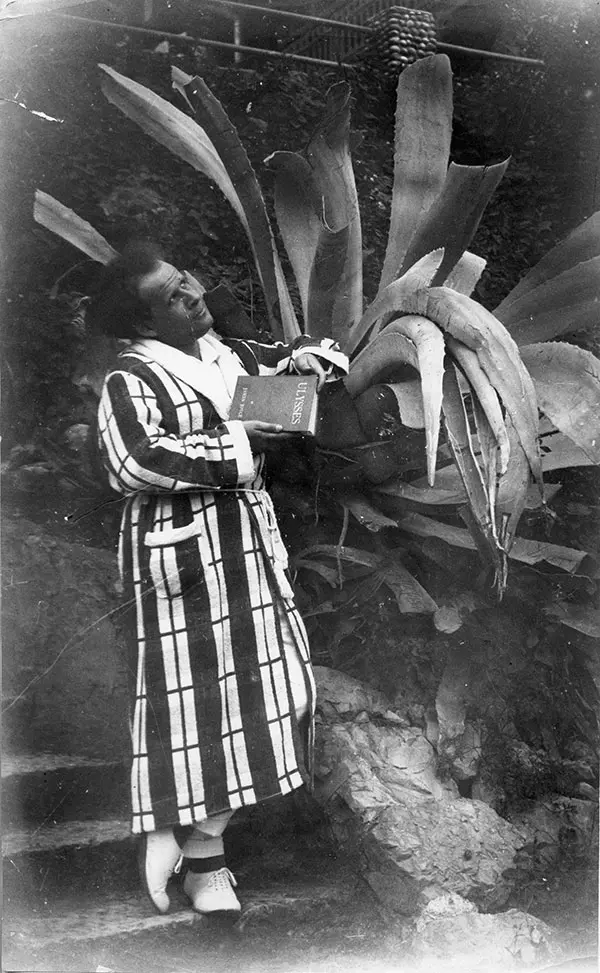
Sergey Eisenstein reads Ulysses near Agawa
Photo: provided by the Museum of Cinema
Later, Joyce, who once in Ireland, who served as the director of the cinema, said that only two directors could film his most famous novel: German Walter Rutmann, the author of the Berlin, Symphony of the Big City and the Soviet Eisenstein, author of the Bestanomers Potemkin.
In 1930, in Hollywood, Eisenstein re -read Ulysses, deciding to transfer him so shocked his “internal monologue” to the cinema - to his film adaptation of another modern novel, the “American tragedy” of Theodore Dreiser. In the directorial development, he wrote: "Joyce - in literature, [Eugene] O'Neill - in the theater, we are in the cinema."
When in 1934, Karl Radek took the attack on Joyce as a formalist, Eisenstein complained to the students that he was now the current translation of Ulya will not be completed (and turned out to be right). At a time, when, according to him, “he was blocked in formalists as in recruits,” he considered Joyce much closer to realism, especially his socialist -realist production, which was recommended officially. Eisenstein loved to joke a person who is engaged in formalist, a formalist, "as unpromising hastily, as people studying the manifestations of syphilis ..." syphilitics "."
2. Sigmund Freud, "One early memory of Leonardo da Vinci"
Edition: Professor Z. Freud, “Leonardo da Vinci. Childhood memory. " M.: Book publishing "Prometheus" by N.V. Mikhailov, 1913
At first, the Russian translation of this book of 1913 became interested in Eisenstein, not yet the name of the author unknown to him (with the “Name borrowed from the“ Nibelungs ””), but by the portrait of Leonardo da Vinci on the cover and his name in the title. The young man Eisenstein loved to draw and was long interested in the figure of Da Vinci, with whom in the future it would not be joking to associate his own position in the field of new art - cinema.
In memoirs, Eisenstein described, with the complete awareness of the “subconscious” overtones of his images, the first acquaintance with Freud’s book and “Introducing Psychoanalysis”:
" 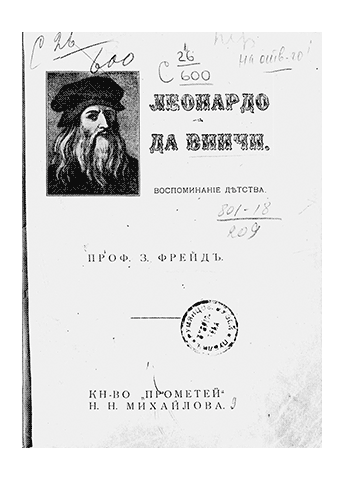 I even remember exactly when and where. Almost in the early days of the official creation of the Red Army (spring 1918), which made me as a volunteer in military construction. In Gatchina. Standing in the carriage on the way on Saturday a visit home. As I remember now. Corridor of the car. A backpack on the back. Dad - smelling of a dog. And a quarter of milk inserted into it.
Further on the tram site, in a frantic crush, I am so absorbed in the book that I do not notice how long I crushed my quarter of milk and through the dog’s papa papai and hucks of the backpack the drop of milk o'clock in a drop. ”
Although Eisenstein later considered Freud's fixation to sexuality (or, as he had heavyly reinterpreted in his youth, “swan”) only the most initial and boring from the stages of work with the subconscious, or, in his terminology, “the primary impulse fund”, and appreciated the books of his students (especially Otto Ranka and Hans of Zaks), he still preferred Freudianism to Jungianism.
One of Eisenstein's satellites on a three -year foreign trip and the future master of the Soviet musical Grigory Alexandrov loved to recall that among many significant meetings of Eisenstein, a meeting with Freud was also a meeting abroad. This actually was not and could not be, because Eisenstein did not reach Vienna, despite the fact that he and the father of psychoanalysis had many common acquaintances, and Stefan Zweig eagerly undertook to introduce them to each other. Instead of the failed meeting, Eisenstein received Freud’s autobiographical essay sent with an autograph, which was put next to the Tom of the Grafology Tom, famous at the beginning of the century by Hiromante Cheiro (Count Hammond). Eisenstein met with Cheiro in Hollywood and believed in his own hand analysis no less than the achievements of psychoanalysis - that is why these books were on the shelves nearby. Even more than the selection of books in his library, he was proud of their combinations.
3. Detectives G.K. Chesterton, Dorothy Seyers, Elleri Quin, S. S. Van Dain and others
Publications:
Dorothy Sayers, Hangman's Holid. London, Victor Gollancz, 1942
SS Van Dine, The Greene Murder Case. London, Toronto, Melbourne and Sydney: Cassell and Company, 1931
GK Chesterton, The Incredulity of Father Brown. Leipzig: Bernhard Tauchnitz, 1929
Ellery Queen. The Chinese Orange Mystery. A PROBLEM In DEDUCTION. New York: Frederick A. Stokes Company, 1934
In his biography of Eisenstein, Viktor Shklovsky says about their simultaneous childhood:
“There were newspapers at the corners. Behind the newspapers on the walls hung newspaper numbers and colorful covers of books about Nate Pinkerton and Nick Carter and many others; The adventures of all detectives were very monotonous. The same adventures were shown in the cinema - multi -part, repeated, abbreviated and at the same time leisurely. ”
“Detective novels” were one of the first beloved Eisenstein genres, but by the beginning of the twenties, the enthusiasm for detectives entered the asset of his theoretical reflections on form. “Detective is the most potent remedy, the most cleaned, honed construction in a number of other literature. This is the genre where the means of exposure are bare to the limit, ”Eisenstein believed. He himself often compared himself to the detective - both in the work of the director and in the work of the teacher.
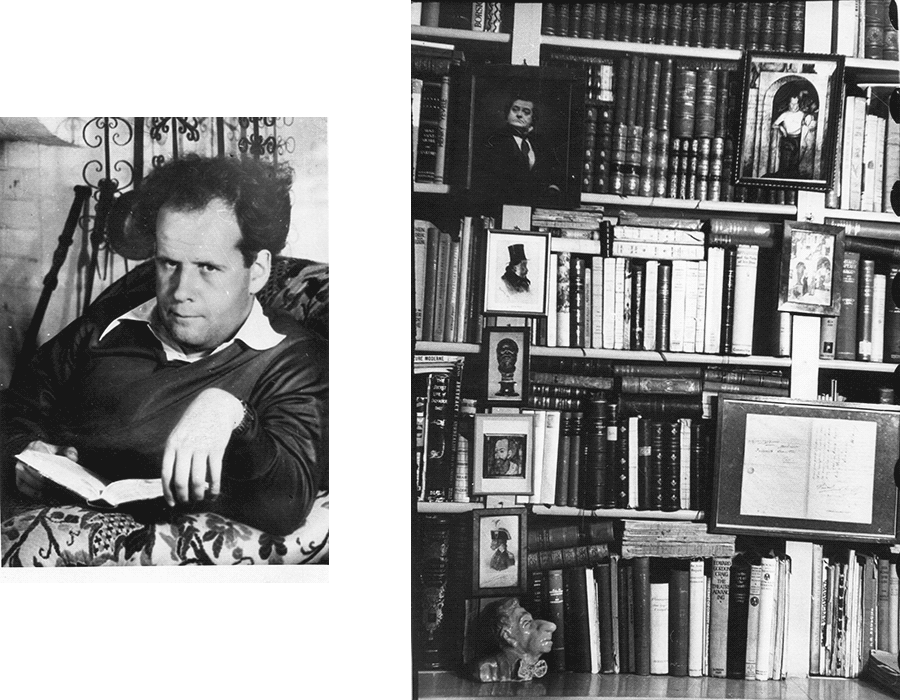
Book regiments of Sergey Eisenstein
Photo: provided by the Museum of Cinema
The structure of the detective genre attracted it almost more than the content of any detective’s arm: from Edgar Allan to to the latest samples of the genre - Raymonda Chandler, Dorothy Seyers, Elleri Quin and S. S. Van Dain.
In the evacuation in Alma-Ata, where Eisenstein simultaneously worked on Ivan the Terrible and the book “Method”, he, in his own words, took only five books from his entire richest library: “As always, setting on the way-detective novels. Nothing more. " Even if you consider this story with an exaggeration (he immediately attributed: “This, of course, is terrible. The“ Theater is terrible ””) and recall that Eisenstein took out from Moscow at least part of the archive of Vsevolod Meyerhold, in Alma-Ata, he really read a lot of detectives-in particular, from the Brick Book of Bright Assembly. foreigners who left Moscow in 1941. It is not surprising that Ivan the Terrible turned out to be not only a criminal, but also a detective.
4. Emil Zola, a series of novels "Rugon-Makkara"
Editions: Emil Zola, Germinal. Moscow: Earth and Factory, 1929 and others.
In the late autumn of 1929, Eisechestein gave a course of lectures for young London filmmakers and future practitioners of British cinema. One of them, Basil Wright, then recalled a clash of expectations and impressions of these lectures:
“Here we were sitting with our notebooks and pencils, passionately thinking about the cinema, a great new type of art ... He stood, with a chalk by the board, ready to reveal the hidden, Eleusian secrets of the film art.
He talked about the plays of the Japanese Kabuki Theater, about William James, Darwin, Toulouse-Lore, Daumier, <...> about Ponson Du Terrai Rocambole, about Arsen Lupin Leblan, about Stefan Cweiga, Zola and James Joyce. ”
London filmmakers became deep confused. But just like French adventurous and detective novels and James Joyce, Zola was far from accident in this list. Having begun to read the Rugon-Makkars as a child, Eisenstein seems to have not been able to stop. In 1928, in the questionnaire of the magazine “On the Literary Post” (“1. How are you familiar with modern literature? 2. Literature and cinema. 3. Does modern literature affect the movie? 4. What do you need cinema from literature? Do you feel the general style in the development of ways of literature and cinema? 5. What can you say about modern criticism?”) Eisenstein, probably, surprised his Soviet fans at least London, saying:
“For the cinema, Zola did the most. <...> I read it a lot.
I re -read.
Before each new work, the corresponding volume from his encyclopedia.
Before the "Stick" - "Germinal".
Before the “General Line” - “Earth”.
Before “October” - “defeat” for the offensive on June 18, 1917 and “I will give happiness” [“Damian happiness”] - before the “cutting” ... of the Winter Palace ”.
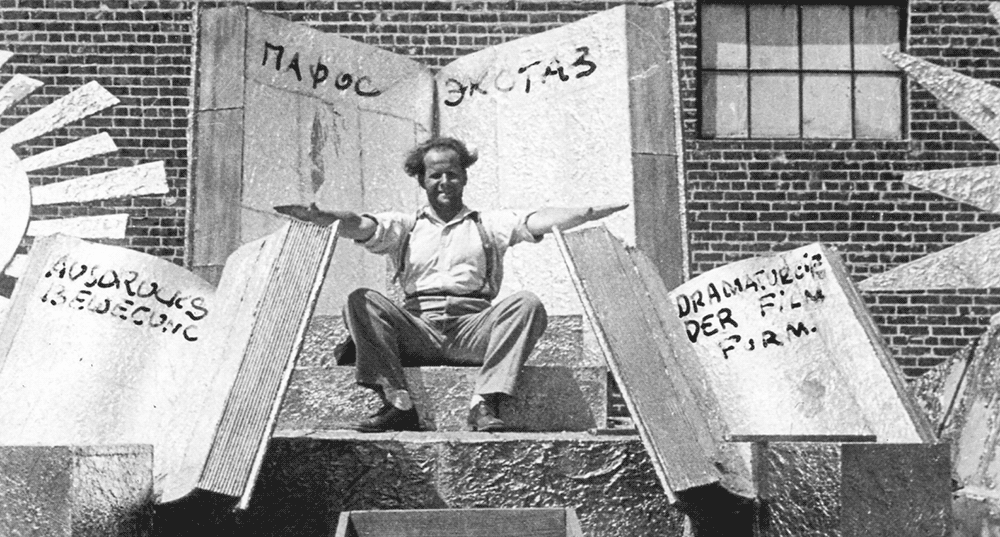
Cergea Eisenstein
Photo: provided by the Museum of Cinema
His first, “instructor” directorial workshop in the future of VGIK (it included, for example, Grigory Alexandrov, Georgy Vasiliev, Leonid Obolensky, Alexei Popov) in 1928-1929. Eisenstein handed out one of twenty novels Zola from the Rugon-Makkara series for analysis to answer the question: “How is pathos done?”
When in the 1930s. Suddenly it turned out that the classics of Marxism - in particular, Engels - prefer Balzac Zola, Eisenstein had to protect his own preference:
“Zola sees objectively. He writes people, windows, shadows, temperatures ...
The Zola page can simply be displayed in the mounting sheet and distribute in parts to the utility workshops in parts. <...>
Malicious “Zolyaism”?
However, as “Zolyaism” do not sharpen my teeth for me, I will not stop recommending and ... to continue to learn the art of seeing the art of seeing all five feelings. ”
5. Andrey Bely, "Gogol's skill"
Edition: Andrey Bely, Gogol's skill. Moscow - Leningrad: Ogiz - Gikhl, 1934
This began in childhood, with trips on vacation from father in Riga to mother in St. Petersburg and vice versa:
“Book and road.
The path through the pages and the path through the mountains, steppes and plains.
I do not understand poetry and never dealt with them.
But the knock of wheels and the rhythm of prose - for me the combination is necessary. ”
The very first “reading” on the road, according to Eisenstein’s memoirs, was the Gogol “Wiy”, and with him “Old Fine landowners”, “The Tale of how Ivan Ivanovich quarreled with Ivan Nikiforovich” and “Enchanted place”: “... and, of course,“ terrible revenge ” - in Pavlenkov’s publication with pictures.”
He re -read Gogol all his life and therefore became so interested in when, on the next rest in the sanatorium of the USSR Academy of Sciences, in the near Moscow, his neighboring room was one of the editors of the publishing house, which was about to release a book about Gogol. The writer Bugaev wrote the book that had just emerged to a new life and to a brief dying outbreak of creative shine. He is Andrei Bely. "
Eisenstein really never engaged in poems, especially symbolistic - except for the numerous references in his theoretical work to Pushkin, Mayakovsky and Walt Hitman, so he first saw and heard Bely in the publishing house, where he read excerpts from the still not released book for the elect.
He turned out to be conquered by the analysis of Gogol images:
“A brilliant commentary of a white or a bold hypothesis, then an immutable fact, then an unexpected quote shows a stadial connection, modification, rethinking, developing into a new quality of the initial motive, the original image, which flourishes from historical and heroic, dulling in petty-wide vulgarity (Taras-Ivan Nikiforovich), from fantastically, from fantastically) Frightening with a simple alien-threatening with imported industrialism the patriarchal-take (the wizard-Kostanzhoglo). <...>
And then suddenly the White suddenly collapses the table behind you behind the table, calculations and numbers. What?!
The percentage of different colors in the Gogol palette at different stages of his work. <...>
Miracle. Miracle.
A miracle of painstaking and attention. A miracle of care and respect.
A miracle of insight and poetic affinity with the soul of the author. ”
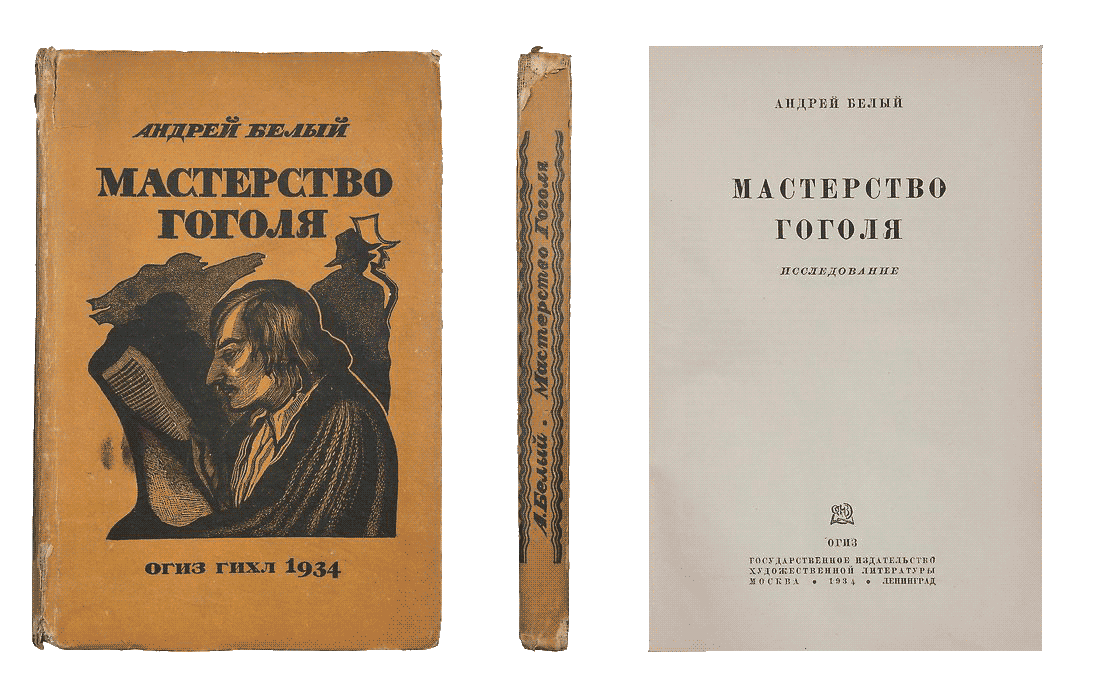
Photo: provided by the Museum of Cinema
Eisenstein met Bely and even ventured to ask why he did not compare in Gogol’s book with Joyce:
“A striking similarity in the method of writing this little Russians, who became the largest Russian writer, with this Irish, who became the pride of English literature, has long surprised me. Bely does not know Joyce. ”
After that, they met and talked several times, and Eisenstein even led the evening of White in the Polytechnic Museum in February 1933. A year later, shortly before the release of the book, Bely dies:
“And only a piercing yellow binding-Ogiz-Gikhl, 1934-“ Gogol’s skill ”, like the memory of these wonderful few months of living impressions“ in Gogol ”.
The yellow binding burns on the table, like the cover of the "Germyni Laserte" of the Goncurs in the portrait of Dr. Gashe brushes Van Gogh.
In the frame of the solar book - the jewelry of white observations. "
Already in the middle of the forties, having read “Nameless Love” by Yuri Tynyanov, Eisenstein decided to remove the film book of Pushkin, “The Love of the Poet”, built on the principle of color movement (like Belo in the analysis of Gogol). This film was not implemented, but Eisenstein still managed to test his ideas of “not color, but color” cinema in the second series of “Ivan the Terrible”, where the scene of the feast of guardsmen is built in three main colors: festive gold, bloody red and sinister black.
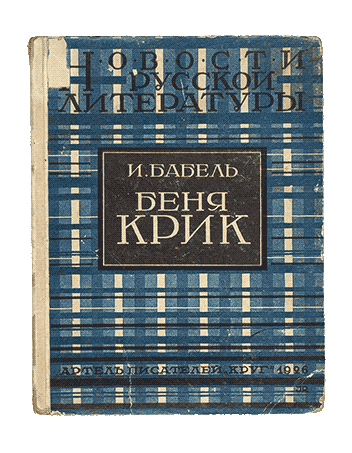
6. Isaac Babel, Benya Scream
Edition: Isaac Babel, Benya Scream. Cinema. " Moscow: Artel of the writers "Circle", 1926
In 1928, in an interview with the magazine "At the Literary Transcount", Eisenstein announced:
“On the question of the fact that cinema is needed from literature, one can say with certainty, in any case, one thing:
T [Ovarischi] writers, do not write scripts!
Production organizations force to buy your product with novels.
Sell the right to the novel.
And the directors should be forced to find movie excits to these works. ”
He continued with an example:
“Writing a script is like calling a midwife on a wedding night. These are the golden words of the Babel of the period when we made the script “from” “Beni Scream” ”.
 In 1924, Eisenstein planned to film the Babel Konarmia, which had just been published in Lefe (adding an iron stream there, Alexander Serafimovich), but was distracted by the "armadillo" Potemkin ". Then the Directorate of the Moscow Studio "Goskino" seemed that since Potemkin would act in Odessa, Eisenstein could easily remove something with local coloring at the same time-for example, Benya Scream.
Then, at the country in the village of Nemchinovka (next to Kazimir Malevich), Eisenstein and Babel sat down to write a script - in parallel with the Potemkin script. This turned out to be completely painful: the Babel "brilliant novels" were not transferred to the traditional "license plate" script. Через неделю Эйзенштейн сдался, сказав, что Бабель может написать, что угодно, и отдать на студию, а снимать фильм он все равно будет по «полнокровной новелле, а не по рахитичному «расписанию кадров», лишенному установки, тенденции ритмов, темпов и физиологической ощутимости того, за что стоит платить деньги авторам».
По словам Эйзенштейна, при постановке — в кино или на сцене — бабелевских текстов, «надо в первую очередь воспроизводить мизансценой расстав его слов. И целиком — их фактуру». Киноповесть «Беня Крик», вышедшая отдельной книгой в 1926 г., по словам Эйзенштейна, оказалась «абсолютно сухой вещью», где ничего не осталось «от бабелевской прелестной новеллы».
В 1936 г. Бабель работал над сценарием второго варианта эйзенштейновского фильма «Бежин луг», который затем был запрещен и уничтожен так же, как и первый. Они продолжали дружить до самого ареста Бабеля в мае 1939 г.
7. Константин Станиславский. «Моя жизнь в искусстве»
Издание: Konstantin Stanislavski. My Art in Life. Boston: Little, Brown and Co., 1924
Одним из свойств характера Эйзенштейна было то, что он характеризовал на разных привычных ему языках как yo también, me too, или «я тоже». «Я тоже могу», — говорил он сам себе, видя чьи-то успехи и используя зависть как толчок для собственных достижений в том же направлении. Так, вечно стеснявшийся говорить на публику, он заставил себя читать лекции на нескольких европейских языках, услышав, как это делает один из партийных деятелей в Советском Союзе.
Одним из неожиданных катализаторов такого чувства «я тоже могу» стала книга Константина Станиславского, «дедушки» Эйзенштейна в искусстве, — своим учителем и в какой-то мере духовным отцом (со всеми присущими эдиповыми комплексами) он считал Всеволода Мейерхольда, а тот был учеником и «блудным сыном» Станиславского. Оба ученика покинули учителей, пошли дальше в своем искусстве.
В 1924 г. основатель МХАТа, находясь на гастролях в США, выпустил на английском языке книгу My Life in Art. В 1927 г. она вышла на русском языке в переработанном виде под более привычным названием «Моя жизнь в искусстве». Для Эйзенштейна Станиславский представлял крайнюю противоположность тому, что должен делать современный театр и тем более современный кинематограф. И он решил, что напишет книгу, которая совместит теорию и биографию, но называться будет наоборот – «Мое искусство в жизни» (My Art in Life). Наум Клейман эту задумку 1927 г. называет самым ранним предвозвестником эйзенштейновских мемуаров сороковых годов — а к этому времени Эйзенштейну доделал только «Стачку» и «Броненосца „Потемкина”». Книга должна была стать не просто автобиографией, но и скомбинировать автобиографию с теорией, чтобы она легче воспринималась читателями.
К 1929 г. именно идея книги в стиле «анти-Станиславского» начала принимать самую смелую у Эйзенштейна форму — «книги-шара», где главы, предвосхищая гипертекст, свободно отсылали бы одна к любой другой, давая читателю представление обо всех темах книги разом. Он продолжал работать над этой книгой с перерывами еще пару лет, но так и не доделал. В очередном предисловии к ней он написал: «Увы... Книжки не пишутся шарами».
16 февраля, в 14:30, в московском кинотеатре «Иллюзион» пройдет презентация книги «В Доме Мастера» о квартире Сергея Эйзенштейна, где биография и творчество режиссера рассматриваются через призму многочисленных сохранившихся предметов быта и искусства, а также книг, наполнявших его дом. Книгу представят ее автор-составитель, куратор мемориального кабинета Эйзенштейна в Музее кино Вера Румянцева-Клейман и многолетний хранитель и исследователь эйзенштейновского наследия Наум Клейман. После этого будет показан сборник уникальной кинохроники с участием Сергея Эйзенштейна.