
Translated material
Russian Exupery
Neoplatonism of Vladislav Krapivin
The prose of Vladislav Krapivin is often talked with Yernicha. Philologist Maria Eliferova undertook to prove that Krapivin is worth a two thousandth intellectual tradition and that he is the only Russian neoplatonik. In addition to the traditional accusations of Sovietness and ideologization, which almost all authors of children's (and not) books about friendship are subjected to Krapivin, transparently veiled suspicions of pedophilia are brought down-that is, as it were, the confusion of the “trembling veins” and other bodily details in its novels.
Well, these suspicions are non -original, and Krapivin has long responded to them himself in his late novels “Tales of Fishermen and Pisces” and “Passing Venus on the Disse of the Sun”. But after all, the “little prince” of Exupery can be read in this spirit: what kind of strange relationship between a golden-wing alien boy and adult uncle-lieutenus?
Yes, the attitude of Krapivin to his young heroes is erotic - like any good writer to his heroes in general. The top of vulgarity reduce the concept of eros to concern: where to stick his own, sorry, God, a jade rod. This is a symptom of complete misunderstanding of the nature of the literary text.
Any artistic work belongs to a certain tradition. In the case of Krapivin, it is quite obvious that his books are inherited precisely by the “little prince”, which became the literary sensation in the USSR of the turn of the 1950s and 60s-just when Krapivin began his writer's career. In the late Crapivine work, boys will increasingly find themselves, like the hero of Exupery, real aliens from space (“White Ball of the sailor Wilson”, “Silver tree with a singing cat”). But what is the Little Prince itself? Where does Exupery have such a mysterious story about a boy living on an asteroid and incomprehensible by getting to the ground? And why should the little prince die to return home?
All this ceases to be mysterious if you recall the philosophy of Plato. In the dialogs of Timey and Fedr, Plato developed his own theory of the soul, according to which human souls belong to the eternal perfect world of ideas and live on the stars. They get to the Earth as a result of the fall, and it is not easy to return there (according to Fedra, the process takes from three to ten thousand years, but in “Tima” Plato allows the return immediately after death). But if something beautiful is found in earthly life, then the soul recalls the beautiful world of ideas and yearns for it. Looking back at Plato, it is easy to understand who the rose is, the king, and the lantern is nothing more than the ideas of a rose, king and a lantern in general. Therefore, the narrator reports the number of kings and lamps on Earth, and the little prince shows, seeing a garden of thousands of roses. The plural is only a shadow of unity, the earth's roses are only the shadows of the same rose.
Exupery made an amendment to modern astronomical knowledge and replaced the stars with asteroids; The word “asteroid”, however, means “star -like object”, and the snake says so that the little prince “came from the star”. The whole manual for Platonic philosophy has compiled into an ingenuous fairy tale.
Here, the reader, heard about Plato, grins, mindful that Plato is known as a theorist of homosexual love. But do not rush to grin. Between Plato and Exupery - two thousand years of development of European literature. Already Plato himself wrote about the exalted kind of love, alien to lust. In the subsequent tradition of neoplatonism, which was closely interacting with the Christian one, the Platonic view of love came off not only from homosexuality, but also from sexuality as such. The greatest love story in European literature - Petrarchi to Laura - has nothing to do with the "traditional orientation", as some officials understand it. Laura for Petrarch is a reflection of the heavenly world of perfection and an incentive to self -development. The most complete expression is the non -Platonic theory of love as personal growth will receive in the treatise Jordano Bruno, known in our title “On Heroic Enthusiasm” (the original, of course, is not enthusiasm, but passion - Furore). By the way, Bruno believed that Platonic souls on the stars are aliens living in other worlds.
Yes, a little prince is an idea, the idea of all the best that is in a naive unspoiled person. Here is a solution to why his body disappeared without a trace: he still did not have a truly material nature. The notorious Krapivino boys, of course, are not real boys, but Platonic ideas. In the White Ball of the Sailor Wilson, Krapivin admits this openly. The hero of this novel Yashka is a reasonable thinking star in the literal sense of the word. At some point, he is embodied on Earth in a boy, and his physical appearance is copied from the ancient statue (another greetings to Plato). Having lived his earthly life, after death, Yashka again becomes a star. But Krapivin argues with Plato: not low thoughts, but compassion are discarded to Yashka. From space, he feels the loneliness and despair of an ordinary boy Stasik Skitsyn - and first visits him, and then decides to stay with a friend for good. Moreover, at first, Yashka on Earth has magical abilities, when the decision is made, he loses them, finally turning into a person. But he becomes an astronomer - the contemplator of the stars.
The nature of the stars in the “White Ball” is especially interesting: “Work was to capture and send impulses of different stresses and frequencies to other balls. These impulses were bizarrely intertwined and intersected, formed a living string network, the trembling of which determined the life of this crystalline face. If a successful impulse brought this trembling, this music, to the universal initially set frequency of the great crystal, there was a long -awaited resonance. ”
The Krapivinian concept of the Universe as a great crystal is nothing more than an artistic rethinking of the astronomical views of Johann Kepler, who, like any self -respecting Renaissance thinker, was a neoplatonian. Kepler's key work “Harmony of the World”, where the theme of crystalline faces of the universe and heavenly music develops, has not yet been translated into Russian, but a huge number of popular science articles about Kleper that published in the 1970s were available, in which all the main provisions of this theory can be found. The canonical world of Krapivinsky science fiction develops after the 400th anniversary of Kepler (1971). And if in the pre-perestroika era it was risky about the immortality of the soul directly, then since the late 1980s, Krapivin declares his beliefs openly-not only in art prose, but also in journalism.
A peculiar experiment on the Platonic theme is the story “Silver Tree with the Singing Cat”, where this time the hero does not come from the macrome stars, but from the microworld of reasonable drops living on the lines of the magnetic field. Here, on the contrary, a lonely lost drop is saved by the company of children. Having been a man, Antoshka-Kapelka returns to his planet, but continues to visit friends. On his own planet, people have not yet reached - they are something like Swift Yehu. At first, it seems that drops are the highest race in relation to people: drops are unknown to egoism, their life is subordinated to the task of creating good and harmony. But it turns out that drops have something to learn from people, and two planets establish a “exchange” of visits. The hierarchy of the highest and lower in this story is not so obvious. However, even in the “Pigeon in the Yellow Polyana” it is said: “Some scientists believe that it is infinitely large and infinitely small - this is one and the same. That they merge somewhere in infinity. ” The worlds of Krapivin, unlike the worlds of Plato, are initially not hierarchical.
In the novels written already in the zero years, “Passing Venus on the Disse of the Sun”, Krapivin refuses the language of science fiction, impressively saying: a character named Vovka is an angel. The real guardian angel, who appeared at the call of the narrator-an adult who fell into a difficult position. But at the same time, Vovka is the soul of a real child who has died a day. He was tired of heaven - he wants to be alive and grow up. Neoplatonism is crossed here with the popular believes, according to which dead children become angels. As in the “White Ball of the Sailor Wilson”, human affection helps the hero to embody: in the final, Vovka resurrects from the dead for real. And, too, like Yashka, loses magical abilities in the final embodiment - this is a fee for a break with the heavenly world. Kapivin continues to argue not only with Plato, but also with eczuper, hurrying to send a little prince back from a sinful earth: eternity will not run away, we will all be there sooner or later, and love is needed here in this universe. Only the identity of truth, goodness and beauty remains from Plato, and from neoplatonism - the cosmic significance of love for an individual person.
So - no, this is not a "pink snot." And the two thousandth intellectual tradition of European culture. Which Krapivin has mastered deeper than any of the Russian writers who mainly remained at the level of playing the cult of a beautiful lady. Probably, Krapivin is almost the only real Russian neoplatonik.
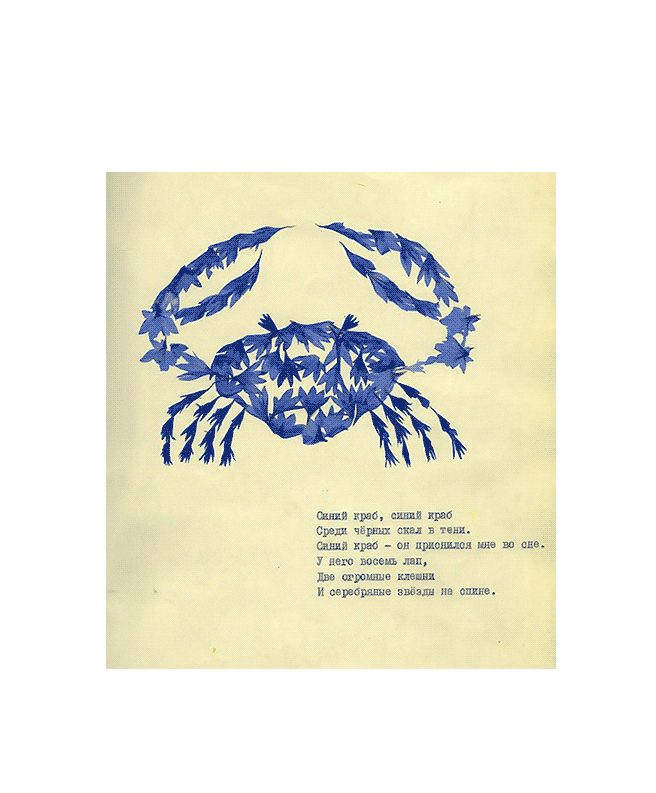
Blue Crab-the almanac of the press center and the sailing flotilla "Caravel", created on July 2, 1961 by Vladislav Krapivin and a group of children in Yekaterinburg
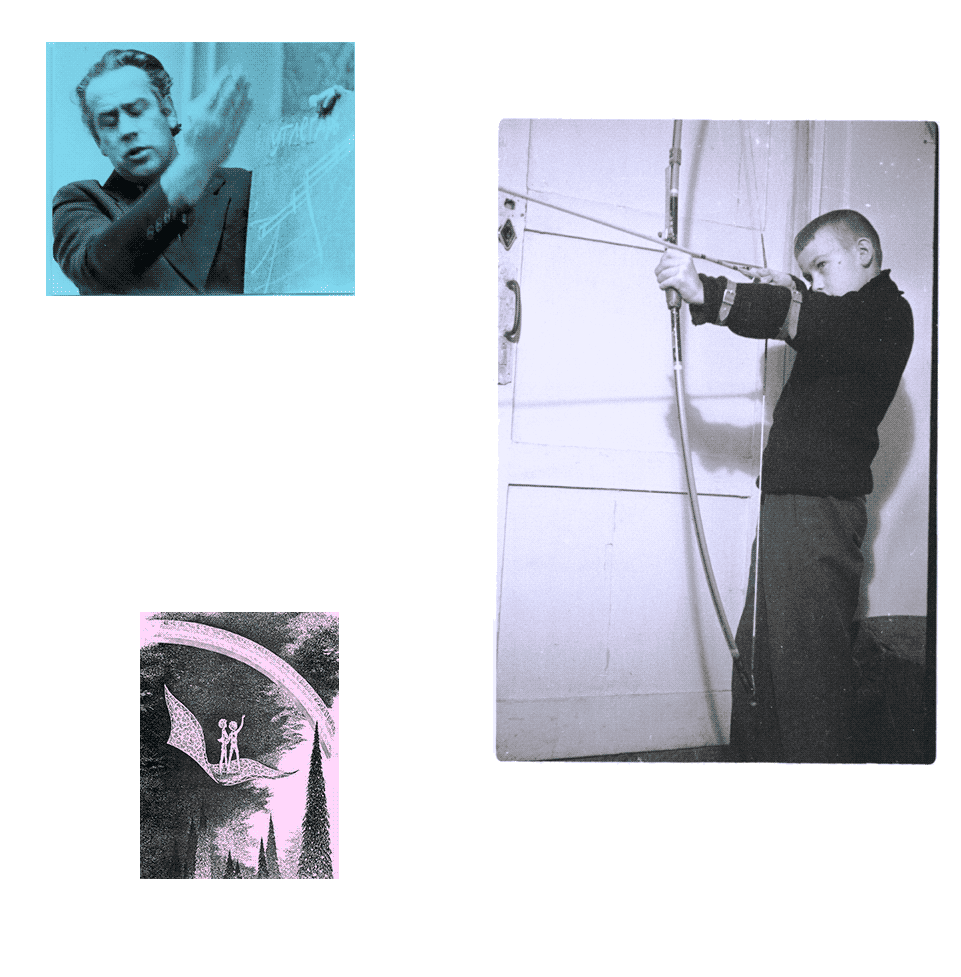
Photo: Press Center of the Caravel detachment / carabela.ru / rusf.ru / vk.com/club4468110