
Translated material
Americans did not destroy the USSR
Nikolai Protsenko about the book by Stephen Kotkin about the collapse of the Soviet Union
A small book about the causes and mechanisms of the collapse of the USSR is the first monograph by Stephen Kotkin, one of the main American experts in modern Russia translated into Russian. His name is familiar to domestic historians and political scientists, but it was frankly unlucky with print publications in Russian Kotkin: in Russia he regularly happened since 1984, but until recently only a few of his articles have been published. Although there is no shortage of Russian -language reviews on Kotkin's main books, most of our readers have a meeting with them. The most long -awaited of them, of course, is the biography of Stalin, and the “prevented Armageddon” can be read for seeding before this monumental and not yet complete labor. 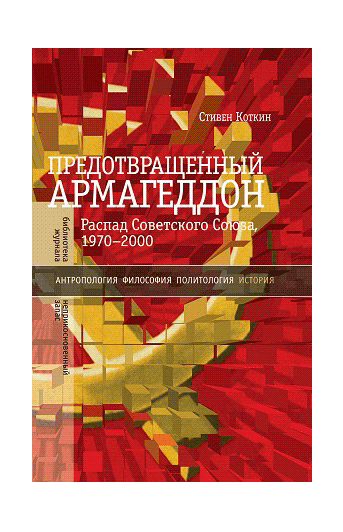 Inevitable, but optional end
This book could get to the Russian reader at least twice: in 2001, when she published at the publishing house of the University of Oxford, and in 2008, when the author revised it and brought chronologically to the beginning of Dmitry Medvedev’s presidency. However, the main question of the book - why the Soviet Union broke up so suddenly - has not received a universally recognized answer, and in this sense the output of the “prevented Armageddon” in Russian cannot be called untimely. Although the contexts of perception of Kotkin’s argument over the past years have certainly changed.
In the era of Brezhnev, among American scientists and politicians, the collapse of the USSR was considered a probable, but the specific temporary horizon of this event was pushed into an indefinite future. In the famous article by Randall Collins of 1980, the collapse of the USSR as a result of geopolitical stress was predicted for several decades, somewhere closer to the middle of the 21st century. In the equally known article "Will the Soviet Union be overcome until 1984?" Soviet dissident Andrei Amalric also rested on geopolitics, the main problem of which was the growing confrontation of the USSR and China.
At the basis of Kotkin’s argumentation is the belief that geopolitics in the collapse of the Soviet Union did not play a significant role, its influence was felt indirectly, through the prism of the global economy, in which the USSR since the mid-1970s began to lose more and more in competition with the West. As a countermer, Kotkin gives India, which was in the worst economic situation in the 1980s than the USSR, but not drawn into a global confrontation with the United States and its allies, which in the case of the USSR was not only economic, technological and military, but also political, cultural and moral. But this circumstance only emphasizes the main, according to Kotkin, the mystery of the collapse of the USSR: “Why did the numerous Soviet elite, who had the internal troops armed to the teeth and faithful, despite all its power, was not able to protect either socialism or union?”
The catastrophic events of the line of the 1980-1990s forced many analysts to look for their prerequisites in the realities of the Brezhnev, or even Khrushchev era. But Kotkin rejects this hypothesis from the threshold: in his opinion, the assertion that the collapse of the Soviet Union began until 1985-the misconception, the same as the statement that it ended in 1991. “The problems that the Soviet leaders are trying to solve simply do not have a decision ... However, Soviet leaders are not going to commit political suicide,” Kotkin quotes the statement of another dissident, Vladimir Bukovsky, who made him in 1989, when the Soviet Union no longer seemed indestructible, but did not show signs of ambulance.
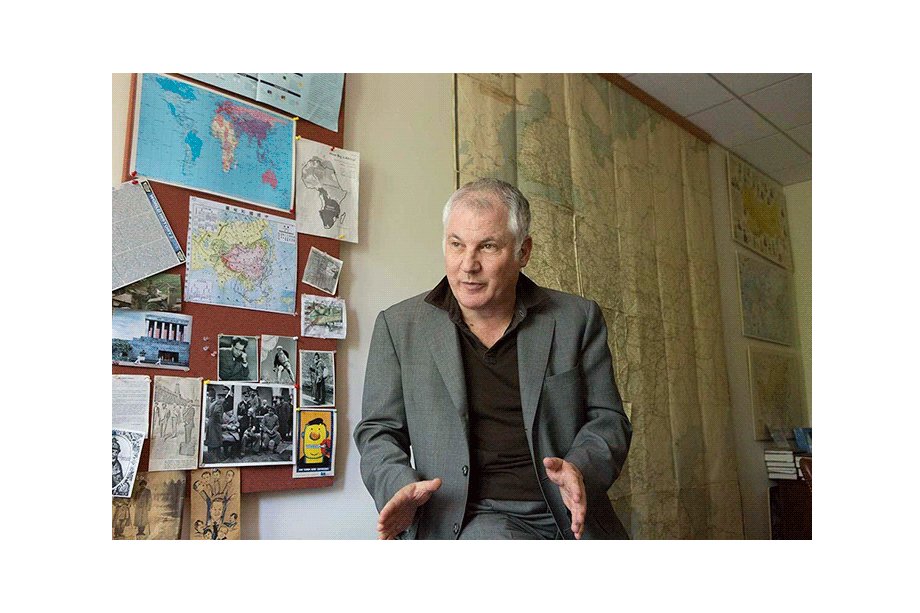 Stephen Kotkin
“The majestic collapse of the second world ... was provoked not by a race of weapons, but by a communist ideology. And the KGB and (less intelligently) the CIA reported in their secret reports that since the 1970s the Soviet Union has been in a deep crisis. However, although Soviet socialism clearly lost his rivalry with the West, he possessed a certain lethargic stability and could continue to exist for a long time or could resort to a defensive strategy in the spirit of Realpolitik. To do this, it was necessary to limit great -power ambitions, legitimize the market economy and thus restore its economic power and maintain the authority of the central government with the help of political repression. Instead of all this, the Soviet Union embarked on romantic searches, trying to fulfill the dream of “socialism with a human face”, ”Kotkin’s argumentation sounds briefly.
In other words, the USSR really broke through, but not geopolitically, as Collins predicted, but simply, due to the inability to “catch up and distort” within the framework of existing institutions and structural restrictions. The understanding of this, in essence, arose already in the 1970s, and one of his evidence is the famous joke about the Japanese visit to the Soviet “high-tech” production when, after a tour of the enterprise in response to the director’s question: “Well, how much years we lagged behind?” The Japanese answer: "Unfortunately, forever." But, Kotkin believes, it did not follow from this that the USSR would die suddenly - an inertial scenario would be much more likely, in his opinion.
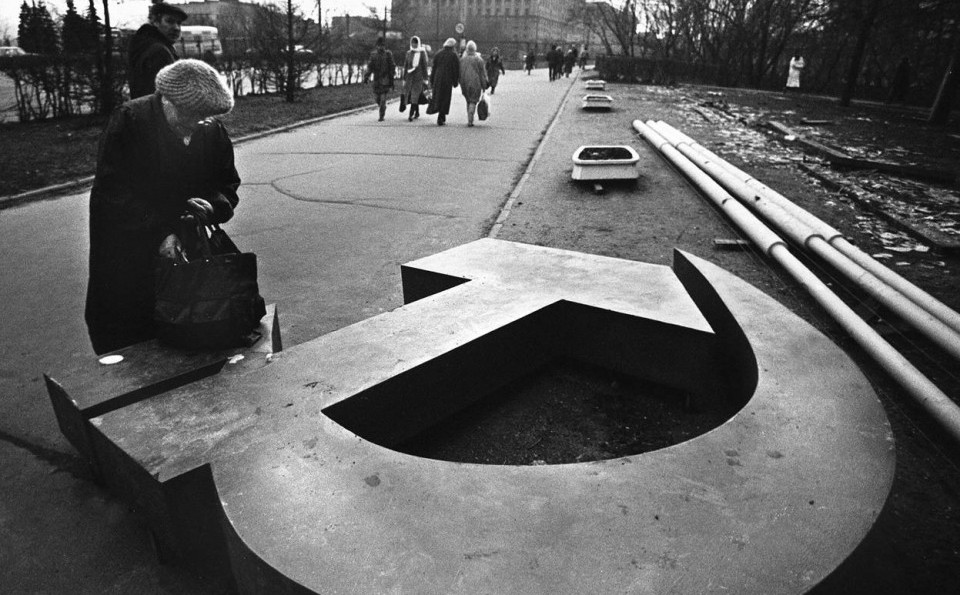 “The leaders of the country of Brezhnev times safely ignored the growing lag from the United States, and so it could last a long time. Compared to the West, the planned economy was ineffective, but it ensured universal employment of the population, and the standard of living of people, by Western standards, seemed to be tolerant by most residents of the country (given that there was nothing to compare it with censorship and restrictions on foreign trips). There was no tension in the country. National separatism existed, but did not pose a serious threat of stability. A small dissident movement was defeated by the KGB. The numerous intelligentsia grumbled continuously, but, fed by the state, was generally loyal to power. Respect for the army was extremely deep, and patriotism was very strong. Soviet nuclear weapons would be enough for the repeated destruction of the whole world. The immediate danger was only a weakening of the socialist system in Poland, but even this threat was delayed by the introduction of martial law in this country in 1981, ”Cotkin claims that there was no“ pressing necessity ”in perestroika, which Gorbachev stated in 1987.
Gorbachev like Arbat Matryoshka
The assessment of Gorbachev’s personality in Kotkin’s book is far from the usual liberal stamps in the spirit “He gave people the most important thing - freedom”, and this is doubly remarked, since Kotkin openly declares his loyalty to liberalism. However, he has a purely institutional understanding of liberalism: the liberal order for Kotkin suggests the presence of institutions that ensure the rule of law - a strong parliament that controls the expenditure of funds, an authoritative judicial branch capable of interpreting the laws adopted by the Parliament and to be guided by them, a professional executive branch, which sequentially implements laws. Therefore, liberalism for Kotkin - here he appeals to such a classic as Alexis de Tokquille - more important for creating a viable state than democracy.
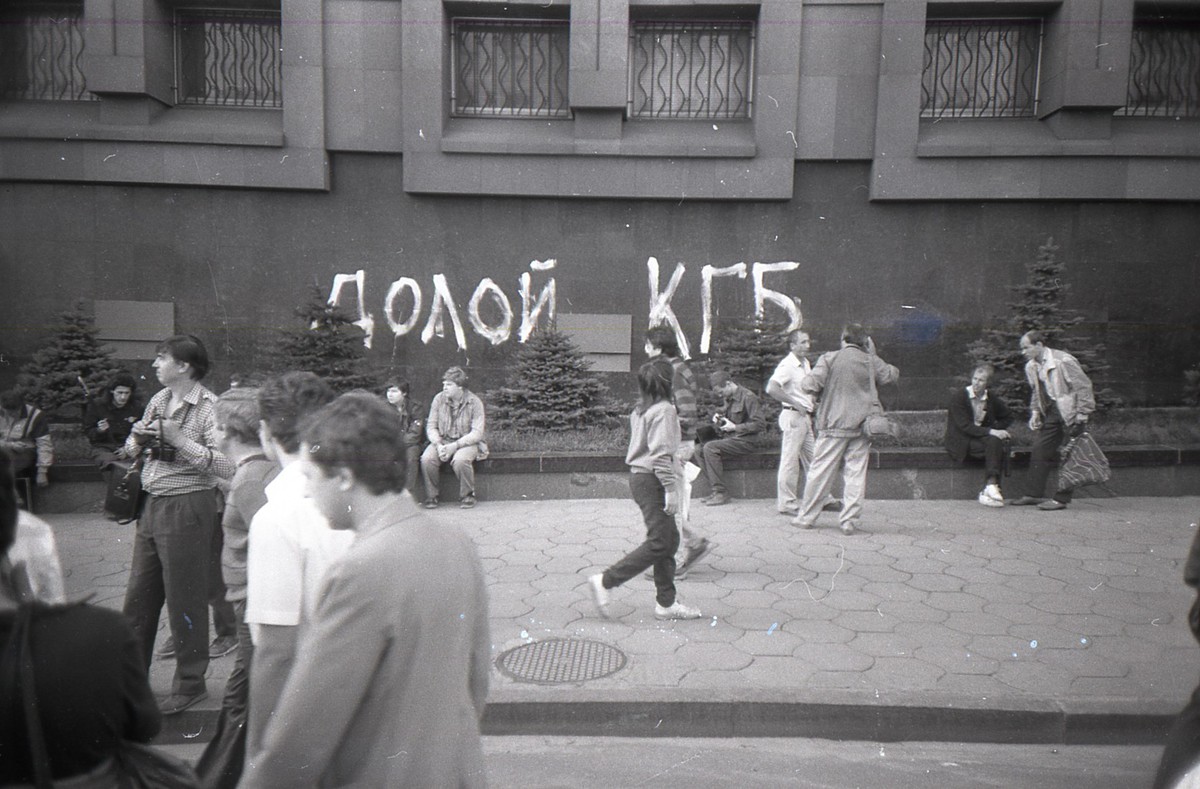 KGB building on Lubyanka
What place in this design occupies the notorious freedom? Obviously not the primary. The victory of the “Democrats” over the “Communists” in August 1991 is a myth, Kotkin believes: long before the start of the puff, freedom of the media and alternative elections - the main formal criterion of democracy - firmly entered the political life of the country. However, Kotkin proposes to look for the essence of the USSR in the last years of the existence of the USSR that now there were several surnames in the ballots (and not one, as before), but in a fundamental change in the structure of the state institutions that Gorbachev started.
Therefore, the author insists, the main object of perestroika was actually not at all the economy (although it was in this field that the restructuring at the April Plenum of 1985 began, where Gorbachev announced the acceleration of socio-economic development), and the Communist Party. The accents were rearranged after the economic reforms seemed to be carefully planned, crashed and only worsened the situation in the country, but the weakening of central control over enterprises and economic activity of the population created a situation in which the old mechanisms did not work, and new ones did not appear. An additional contribution to destabilization was made by publicity, which, according to Kotkin, showed that until 1985, most residents of the USSR, despite endless complaints, adopted many basic principles of the Soviet system. But their identity, beliefs, victims were devoted - precisely when their expectations grew sharply.
And it was at that moment that it suddenly became clear that only “opponents of reforms” were openly ready to protect socialism and the Soviet Union, the potential leader of which could be the secretary of the CPSU Central Committee, in ideology, Yegor Ligachev. But Gorbachev will be ready to meet the conservatives only by the end of 1990, when the collapse of the USSR was actually inevitable, and in early 1988, Gorbachev was not ready to turn off the reform course. The reason for the neutralization of Ligachev, who was hanged by all dogs in connection with the failure of the reforms, was the famous article by the Leningrad teacher Nina Andreeva “I can’t get the principles”, supposedly published in the newspaper “Soviet Russia”.
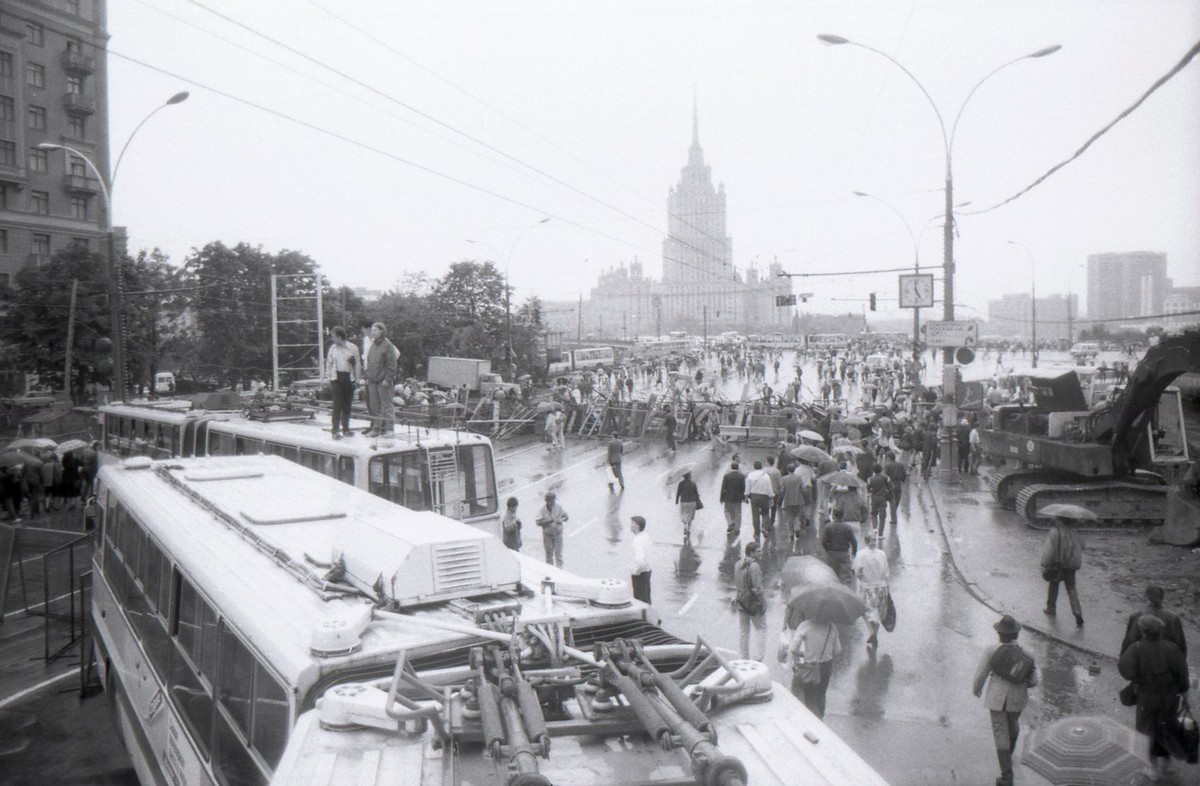 The beginning of the construction of barricades and blocking the travel to the Government House, August 19, 1991
But this tactical move of Gorbachev, who was engaged in the hardware struggle, ultimately launched the dismantling of the CPSU: “The“ resistance ”of the conservatives was not too skilled, but the Gorbachev“ sabotage ”of the system, although mostly unintentional, turned out to be a masterful. Thus, the “true drama of the reforms”, pushed into a shadow with a glance on conservatives, was that one talented tactician involuntarily, but extremely skillfully dismantled the entire Soviet system: from a planned economy and ideological commitment to socialism to the Union itself. ” In order to further weaken the CPSU Central Committee, Gorbachev, under the slogan of returning to the “Leninist principles”, decided to strengthen the advice as opposed to the party’s apparatus, announcing the election of the congress of people's deputies on an alternative basis, and on the eve of these elections, in the summer of 1988, began the reorganization of the Secretariat of the Central Committee. The consequences of this were manifested immediately: as it turned out, it was the party vertical that was the only institution that ensured the unity of the USSR, and the authorities of the Union republics, according to the Constitution of the USSR, did not have direct subordination to the relevant allied institutions.
“Now, with a destroyed central party control system, discredited by party ideology and a paralyzed system of planned economy, Gorbachev discovered that the Supreme Councils of the republics began to act in full accordance with the role that he himself involuntarily endowed them: they became parliaments of the actually independent states,” Kotkin describes the state of affairs in March 1990, when Gorsbachev was the Gorbachev. elected by the President of the USSR. It was at this moment that the central power in the country was already dispersed (Gorbachev’s statement in the new position was preceded by the abolition of the 6th article of the Soviet Constitution on the “leading and guiding role of the CPSU”). At this moment, the future of the Union itself was in question, because it was the CPSU, seemingly excessive from the point of view of public administration, that actually ensured the integrity of the state - therefore the party was like a bomb laid down in the core of the Union. ”
By and large, Kotkin spares Gorbachev and does not admit directly that the last Secretary General was blatantly incompetent in matters of the country's management, which fell into his hands in a situation where not one of the members of the Brezhnev Politburo could become a new leader due to age and state of health. True, in some places of the book, Kotkin indicates the specific “talent” of Gorbachev - the ability to sacrifice to the sacrifices to hardware (for example, when the Minister of Internal Affairs of the USSR Eduard Shevardnadze, who had previously had any experience both in diplomacy and in the central authorities). But in general, Kotkin’s Gorbachev is rather a hostage of the system, which was formed long before him, a hostage, naively believed that his romantic impulse to “socialism with a human face” is able to give this system a new dynamics.
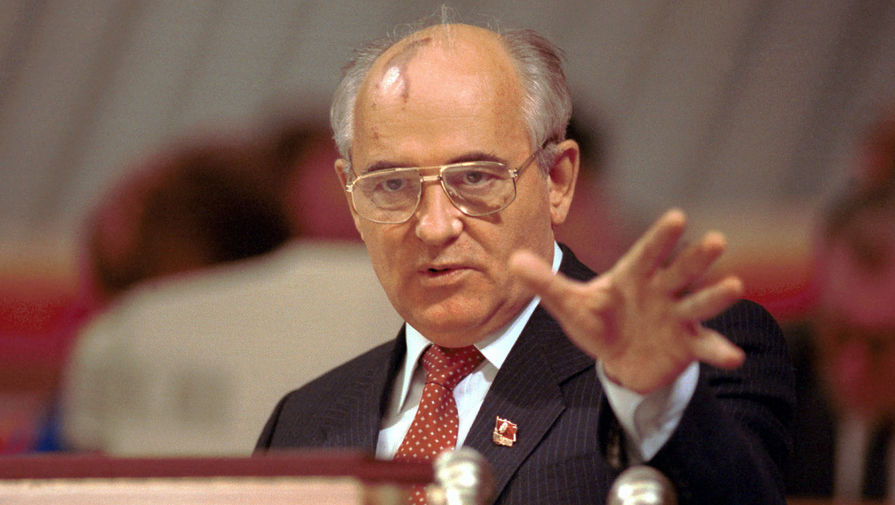 Mikhail Gorbachev
“Like the Arbat souvenir nesting doll, Khrushchev was inside Gorbachev, inside Khrushchev was Stalin, and Lenin was inside this last. Gorbachev's predecessors built a building, stuffed with mines-traps exploding from reformal impulses, ”says Kotkin. That is why Gorbachev perceived the restructuring "not as a meaningless attempt to find the quadrature of the circle, but only as a dramatic confrontation of reformers to conservatives." But at the moment when Gorbachev finally refused to meet the latter, they were already ready to act independently. In August 1991, the Gorbachev isolated in Foros became a meaningless figure in all respects. His last real attempt to cling to real power was the March 1991 referendum on the preservation of the USSR, which Yeltsin failed to block. However, on the territory of Russia, the question of creating the position of the President of the Russian Federation was added to the ballot for voting, and in this election, Gorbachev initially did not shine: the candidate associated with him, the former Prime Minister of the USSR Nikolai Ryzhkov, lost to Yeltsin with a huge break.
Enjoy Russia
Kotkin and the notorious point of view also examines in detail, according to which nationalism, which is magnificent in the Union republics, is to blame for the collapse of the USSR, shortly after the beginning of perestroika and publicity. Yes, the collapse of the USSR was national, Kotkin admits, who calls the union the "empire of nations" - but only in form, and in terms of content it was opportunistic.
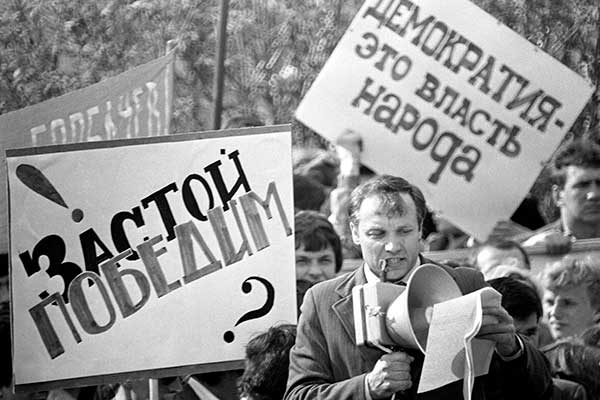 The author of the “prevented Armageddon” illustrates this thesis on the example of the introduction of a presidential post in Russia in 1991. Initially, his appearance, Kotkin believes, did not mean replacing the Russian President of the Union (that is, Yeltsin Gorbachev). However, the new institutions, the parliament and the President of Russia, was fatally influenced by the fate of the Union: as soon as Yeltsin’s success in the creation of new, republican institutions of the authorities became obvious, he found the support of not only the notorious “democrats”, but also a much more large Soviet bureaucracy, which saw in this a chance to preserve or even strengthen his power.
The same thing happened in other key union republics - in Ukraine, Kazakhstan, Turkmenistan, Uzbekistan. “The fateful for the fate of the USSR did not become nationalism as such, but the structure of the state (15 national republics) - primarily because nothing was done to prevent the use of the Union’s structure to weaken the center to prevent the center. “Reforms” included intentional redistribution of power in favor of the republics, but this process was unintentional radicalized by the decision not to prevent the collapse of the Warsaw bloc in 1989 and the speech of Russia against the Union, ”Kotkin notes. But even despite these factors, the collapse of the Union, in his opinion, was not inevitable - the main thing was that the Soviet leadership under Gorbachev not only could not draw a line that separates “normal” nationalism from separatism, but itself unintentionally contributed to the spread of nationalism. In the latter case, Kotkin refers to attempts to hold laws in Georgia in 1989 and in Lithuania in early 1991, who attracted many doubts to the side of the separatists and put Moscow in the position of the defending side, demoralizing the KGB and the army. It is Kotkin’s unpreparedness to consistently use the power of Gorbachev and considers the main reason that the collapse of the USSR was not as bloody as the collapse of Yugoslavia - hence the title of his book.
But Gorbachev’s inglorious departure from the political scene in 1991 (subsequent caricature attempts to become president of Russia or to lead the “Social-Democratic” party did not at the expense) did not mean at all that it was a thing of the past and restructuring-in the sense of perestroika of state institutions. As Kotkin shows, the foundations of today's design of the Russian government were laid precisely by Gorbachev.
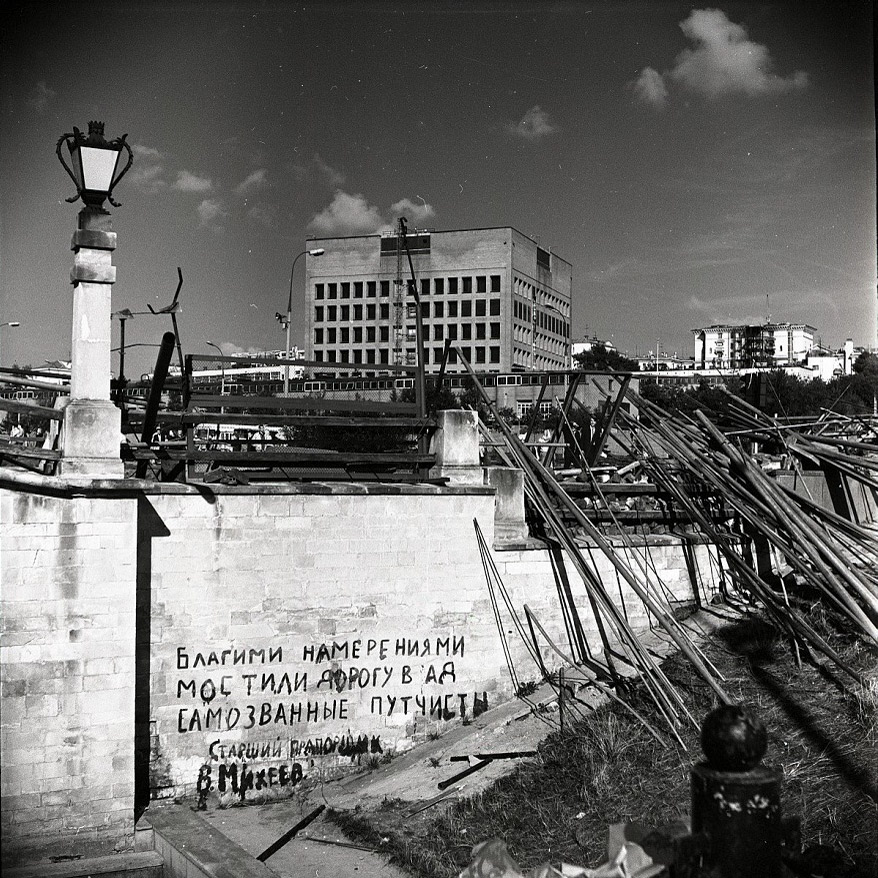 Photo: pastvu.com
At the time of the approval of the President of the USSR, Gorbachev believes, the author believes, allegedly took as a model the French hybrid presidential and parliamentary system, where the government is responsible simultaneously to the president and parliament. Затем, не удовлетворившись этим, Горбачев преобразовал Совет министров в кабинет, прямо подчиненный президенту (на этот раз предположительно по американской модели), а в феврале-марте 1991 года он выселил это правительство из Кремля, освободив место для собственного президентского аппарата, чьи отделы дублировали министерства. Не важно, что к тому моменту реальной властью Горбачев уже почти не обладал, — главное, что ту же самую институциональную структуру скопировали новые российские власти, которые, казалось, были непримиримыми антагонистами Горбачева. Конституция 1993 года сделала Российскую Федерацию «суперпрезидентской» республикой, а кроме того, в подчинении президента оказалась еще и собственная администрация, чьи департаменты отчасти дублировали соответствующие министерства — «точно так же, как это происходило в недолговечном аппарате единственного президента СССР, а до того — в ЦК КПСС. Заполучив те самые здания, в которых когда-то располагался ЦК, ельцинская администрация разрослась до еще больших размеров, не уместившись на Старой площади и заняв еще и часть Кремля. А в новом Управлении делами администрации президентская власть обрела такую независимую от госбюджета финансовую основу, которая и не снилась царям или Политбюро».
Здесь логика рассуждения Коткина вновь заставляет вспомнить о Токвиле, который, как известно, акцентировал момент преемственности, а не разрыва между Старым порядком и Французской революцией. В переходе от Советского Союза к Российской Федерации Коткин не видит ничего похожего на революцию — этот процесс был просто «каннибализацией прежней советской реальности», в связи с чем рассуждать всерьез о каких-то «либеральных» или «неолиберальных» реформах применительно к началу 1990-х годов, по его мнению, просто не приходится. «Таких реформ никогда не было и не могло быть. То же самое можно сказать и о благих „альтернативах” этим реформам. Противники российского риторического неолиберализма не были в состоянии определить, кто же именно должен был воплотить в жизнь рекомендуемые ими „постепенные” реформы. Уж не миллионы ли чиновников, предавших советское государство и занятых самообогащением? Никакое российское руководство, придя к власти в результате нараставшего коллапса центральных (советских) институтов власти, не смогло бы предотвратить последовавшего за этим коллапсом полного разворовывания банковских счетов и собственности, которыми на бумаге владело государство, а на практике — ничем не ограниченные должностные лица».
Однако Коткин не согласен и с еще одним известным тезисом по поводу распада СССР, согласно которому приватизация государства советскими чиновниками началась еще при Брежневе (а то и раньше), когда сформировались основные коррупционные сети, затем уже открыто прибиравшие к рукам активы, созданные всем народом. На самом деле, утверждает автор, ворота, открывавшие путь к обогащению, до роспуска СССР только начали открываться — и уже после того, как республики отправили на свалку остатки Союза, а стремительный поворот к рынку стал официальной политикой, процесс захвата государственного имущества начал развиваться бешеными темпами. Именно поэтому Коткин настаивает на том, что коллапс СССР был именно распадом, а не свержением социалистического общественного строя (как, например, в Польше), и в постсоветской России этот распад продолжился, полагает автор, вспоминая о драматических отношениях между центром и регионами в период президентства Ельцина. «Решение президента Путина вернуться к системе назначения региональных руководителей из центра действительно ограничило наиболее вопиющие случаи поведения региональных руководителей», — признает Коткин в издании 2008 года (разумеется, он не мог знать о возвращении губернаторских выборов в 2012 году). «Однако Российская Федерация — сложный продукт советской эпохи, распада Союза, импровизированных сделок и путинской рецентрализации — по-прежнему далека от сплоченности и единства».
К сегодняшней российской власти Стивен Коткин не испытывает симпатий, однако добросовестность исследователя фактически заставляет его признать ее достижения — и здесь политический реалист явно одерживает верх над абстрактным институционалистом. На последних страницах книги Коткин констатирует: «Только фантастическая наивность как Горбачева, так и Ельцина позволяла им рассчитывать, что Россия будет допущена в элитарный клуб мировых держав просто из симпатии. Путин казался бóльшим реалистом, не питая иллюзий по поводу „партнерства” с США и обоснованно соотнося интересы своей страны прежде всего с Европой, хотя и не забывая о российских интересах (и прежних рынках) в Азии — от Ирака и Ирана до Индии, Китая и Корейского полуострова».
Однако на вечный вопрос «куда идет Россия?» Коткин дает короткий и очевидный ответ: «Она в Евразии» (опять же, написано это задолго до появления Евразийского экономического союза). А вот на вопрос «куда идет остальной мир?» у Коткина нет определенного ответа. «Капитализм — необычайно динамичный источник бесконечного созидания, но также и разрушения. Взаимные связи увеличивают общее благосостояние, но повышают и риски. Да и сами Соединенные Штаты еще более увеличивают эту непредсказуемость, сохраняя колоссальную военную и разведывательную машину, так и не демобилизованную после окончания холодной войны, демонстрируя горючую смесь высокомерия и паранойи в ответ на предполагаемые вызовы их глобальным претензиям и с упрямством пренебрегая теми самыми правительственными институтами, которые обеспечивают их мощь».