
Translated material
God as an atomic bomb
Translated science fiction October
A man with a scam to a rendezvous crab, Iraqi exotic and the return of the king: once a month Vasily Vladimir looks at the news of fantasy. Today we will talk about the books of Drew Magari, Ahmed Saadawi and Robert Jackson Bennett.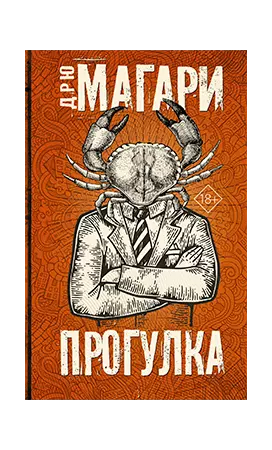
Drew Magari. Walk. M.: AST, 2019. Translation from English Suzanne Alucard
Drew Magari for fans of science fiction is not just a stranger: back in 2012, his debut novel “The Postmortal” (can be translated as “Immortal”) in the final of the Philip K. Prize and the Arthur Clark award. But for some reason, domestic publishers decided that the second book of the American writer will be more interested in readers, “Walk”, which was not nominated, did not bring any special buns to the author and generally slipped past most of the genre observers. Maybe they, publishers, are right: the novel is definitely not devoid of charm. True, the charm of the specific, slightly crazy.
The protagonist of Benjamin is an unremarkable person: 38 years old, married, three children, his own house somewhere in Pennsylvania, the work is so boring that the author does not even consider it necessary to mention what Ben does. The only special sign is the ugly scar for half a face, and he was obtained in childhood, by stupidity and negligence. Life sharply ceases to be monotonous and predictable one evening, when Ben is settled in a country hotel in order to meet a business partner in the morning, and goes a little to go to bed. The walking path turns first to the abandoned house, where maniacs in dog masks are busily cutting a girlish corpse, and then even in some unprecedented, fabulous space. Further, the action develops more likely according to the laws of the dream: nothing is impossible here, but Ben firmly make it clear that there is no road back, he must go to the end - and only then he will be able to return to the usual life, to his wife and children. On the trail, he will meet with a talking crab, who is not a crab at all, a giantess-cereal, Spanish Idalgo of the XVII century, adolescent zombies, long-gigged friends of childhood and a mass of other absurd, inappropriate, nightmare characters. To save life, he will have to use seeds that at a critical moment should be thrown to the ground so that they turn into a charged gun or wall of fire, a bottomless backpack, as well as reducing and increasing potions in the assortment (this detail gives readers a reason to compare the “walk” with the “Alice in Wonderland”). In the final, Ben offers a traditional choice for the genre: to become an omnipotent God and forever leave this world - or wake up in the morning in his bed, next to his beloved wife, as if nothing had happened. Typically, at this place, fantasy writers let the tangible rooster, get off with thoughts, but Magari decides the dilemma of the “red and blue pill” nearly brilliantly-and absolutely unpredictably.
 The game, of course, but the game in the good sense of the word: acidic Gogol-mogol of folklore motifs, literary allusions, Jungian archetypes. And all this is at a good pace, witty, with jokes and jokes, without boring didactics. Perhaps the main problem of Drew Magari is that the “walk” was ahead of her time. The author and publishers hurried a little and missed the trend-in a world where the schizophrenic series "Legion" has withstood for three seasons, this story, I think, would have met with open arms.
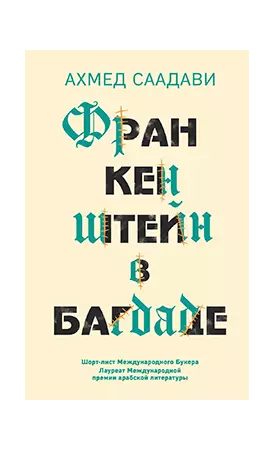 Ahmed Saadavi. Frankenstein in Baghdad. M.: Exmo. Fanzon, 2019. Translation from Arabic Victoria Zarytovskaya
It turned out entertaining with this "Frankenstein in Baghdad." On the one hand, the book is marked by the French Grand Prix de l'maginaire for the best translated science fiction of 2017, the British The Kitschies as the best fantastic debut, entered the Board List List List of Arthur Clark. On the other hand, the composition of Ahmed Saadawi was nominated for the International Buker Prize and again safely reached the final. That is, read what you want: either as a parable, or as oriental fantasy, or as a Gothic novel in the decorations of the modern Middle East.
If we talk about a naked plot, this is a rather ingenuous story. In Baghdad, on AT-Taicaran Square, the next explosion is rattled, one of the series of terrorist attacks organized by suite-suits. A half-crazy junk man, known to neighbors as Hadi Baryshnik, secretly collects parts of the bodies and connects them together in order to bury them humanly. But here is the cadavre, who received the nickname of the Bezmyan, miraculously comes to life - which is remarkable, without any science -like tricks and black magic in the spirit of Lovecraft, exclusively by the will of Allah, the gracious and all -mall. And he begins to restore justice, as he understands it, that is, straightens with the offenders of people whose flesh is sewn. Well, then, as usual: the police and the special services arrange a hunt for a mysterious killer (to no avail), journalists fan the sensation (loving with three boxes), the regulatory bars spread frightening rumors.
Written in Arabic “Frankenstein in Baghdad” has little to do with the usual oriental prose. Ahmed Saadawi does without the intrusive (and expected) re -marks “thousands and one night”, without magnificent metaphors and an encircling plot. The inhabitants of the Al-Batavin quarter, where the main action of the novel unfolds, resembles the inhabitants of the Arbat communal apartment or the post-war Odessa courtyard, where everyone knows everyone, gossip together, intrigue, borrow money to salaries and pouring potassium permanganate in soup. Either the holy, or the crazy old Christian, who is waiting for the son who disappeared in a long war; The crooking nouveau riche, by holy or by crook, squeezing real estate from neighbors; a young journalist who exchanged birthright for lentils; a corrupt colonel involved in political murders by order of Americans; Police who are knocked out by torture are, in fact, “Frankenstein in Baghdad” is about them. Beamymyan is an allegorical figure, a symbol of a modern Iraq, torn to shreds, somehow collected together, not remembering himself, obsessed with the idea of revenge, it is not clear who does not know what. The heroes of Saadawi without any sympathy belong to the “previous regime” and the new government established after the American invasion. Was there the "previous regime" of criminal? Probably yes. Is it better after his fall? Definitely not. Will it be better in the future? Perhaps, but definitely not in the coming years. The opinion, to put it mildly, is not the most popular in Europe-it is clear why, in 2018, Frankenstein lost the “international boker” “runners” by Olga Tokarchuk: it is amazing that at least a short leaf reached such views.
 Robert Jackson Bennett. The city of miracles. M.: AST, 2019. Translation from English Natalia Oyoyan
The novel "City of Stairs", the first part of the Trilogy "The Divine Cities", was published in Russia in 2017; We wrote about the second here ; The final book of the cycle, “The City of Miracles”, is just, in the late autumn of 2019. During this time, in the world invented by Robert Jackson Bennett, about two decades took place. The continent learned to live without the gods, the Saypur archipelago no longer runs the conquered lands with an iron hand, but still remains the technological and economic center of the universe. The scientific and technical revolution continues to rapidly gain momentum, humanity has already stepped from the seventeenth century to the twentieth and is not going to stop there. In each city, skyscrapers stretch to the sky, cars are wying around the streets, high -speed cableways cut through impassable mountains. However, the Divine Heritage is not yet obsolete: the supernatural everything is less likely to come across the eyes, but those who are put by the post understand well that at any moment the next still not neutralized miracle can make itself felt - and lead to the victims and destruction, comparable to the effect of the explosion of a small atomic bomb.
Changes take place too quickly, it walks too much around the sparkling cities of people born in a completely different era: former punishers, former spies, former saboteurs. Not all of them lost their old skills and forgot the old grievances. If there is a force that calls them out of the darkness, they willingly appear at the call. One of the fragments of the former world is Sirudy Ye Harkwaldsson, the third -stage character of the City of Stairs and the secondary hero of the City of Swords, who managed to visit the King of the Northern Islands, prisoners, pirate and a professional sabotage in the service of the Sipure Republic, during his long life. For the last twelve years he spent in impassable wilderness, in a voluntary link, but now he returns to the big world to do what is best done to him: to look for signs of the Divine, to survive in absolutely hopeless situations, to lose everything that he has, and most importantly, to track and kill those who attacked his few friends. Actually, Sigurd is doing this throughout the novel, so the “city of miracles” with its non -trivial fantasy setting turns into a dashing spy thriller - however, like the two previous books of the trilogy.
Even if the author was limited to this, there would already be something to talk about. But the advantages of Robert Jackson Bennett are not exhausted by the twisted intrigue. The through theme of the cycle “The Divine Cities” is a tough, to a cod, a clash of human and superhuman will. Bennett is not against the divine presence as such: regardless of gender, race, social status, people inevitably create gods, this is laid in our nature. Its heroes are not so much scared by the supernatural, wonderful, as the prospect of the appearance of a monopoly god, actively interfering in human fates-the ubiquitous, omnipotent and by no means all-wounded. You can kill the gods to infinity, but, as the history of the relationship of Sepur and the continent shows, this does not remove a fundamental contradiction. Bennett finds a non -standard and relatively humane exit from the path position, so that the final episodes of the “Cities of Miracles” partially echo with the finale “Walks”. Perhaps, after such a denouement, it would be possible to stretch a series of another ten a la George Martin, but to the author, to his honor, the willpower was enough for his will to roundt in time. And that is true: little by little.