
Translated material
Inexhaustible Huken
Tyumen as eternal nowhere on the literary map of Russia
Tyumen was once a gate to Siberia, a pier where prisoners from wagons were transplanted to barges, and already in Soviet times it became the center of development of West Siberian oil fields. And all this time, the big literature stubbornly did not notice the city, which is willingly, although evasively, was written in feuilletons, newspaper articles and blogs. Nevertheless, Tyumen has its own literary appearance, consisting of game nicknames, mentions in diaries and letters, defaults and prose of Vladislav Krapivin. Read more in the framework of the Gorky project and the Mikhail Prokhorov Foundation “Little Russia” about the literature of his hometown was written by historian and poet Fedor Raranteus.There is nothing worse than the Istered cliches. You will say for a millionth time “Tyumen - the capital of villages” - and nothing will respond, the meaning of these words seems to be lost for a long time. So it will not work. The country sometimes needs to be sharpened. Of course, in fact, this is a dismissive Soviet definition is true. Big village. Something inexhaustible. “Tyumen, yes mother -in -law, yes Marina Grove,” wrote Yan Satunovsky in 1964, such a chain of associations. The same village, which, according to the fraud, cannot be taken out of the girl ... But there is something else in these villages, not so much cultural and hierarchical as spatial ... What is the villages, why Tyumen?
We will not use the word "province", an ended to no less and equally loaded. Let's say we’re more strange. The inexhaustible “capital of the villages” symbolizes the center of Khal -Telenda - to anyone not known, merging into a single illegitimate territory located behind, in addition to recognizable, large, real cities. In the 1970s. Vladimir Britanish, the Leningrad poet and geologist, recalled the country of villages, which he had opened in his childhood during the evacuation (“rear” is another suitable word): “During the war years / it turned out how great Russia is. / Between Tyumen and Omsk, / along the railway / and even far away from it, / Villages stood every 10-12 kilometers / stood / in the huts, / people let them warm up, / live. ”
It always seemed to me that it was this indistinguishable “country of the villages” that was reliably hidden by the clouds, over which the B-52 made from the film “Dr. Streinzhlav” from the film. In 1960, above her, near Sverdlovsk, they shot down Powers. In the eighties, when I came from Tyumen to my grandmother, this was still the subject of living memories. The south of Western Siberia is large gray villages, and between them - endless plains, birch chips, a secondary forest, which grew up in places where the former people were either cut down by a steady, or a forest -steppe plowed. In the forest, on hayfields, you sometimes hear an alarming rumble-you look into the sky, but there is no plane, somewhere it flies, this airplane.
The “inexhaustible” Tyumen of Khalkhinada appeared in the literature in the 1860-1870s, with the onset of the era of provincial commercial journalism. In the “real” Russian literature, canon, the Fiction area, closed to the texts of “non -classical” genres, it practically did not hit. The only exception is the Tolstoye Katyusha Maslov and Nekhlyudov from the "Resurrection" (1889–1899), who traveled through the Tyumen transit prison on their way to spiritual transformation. However, in fact, this is a single mention, like other single mention, in Dostoevsky in “Notes from the Dead House” (1862), Leskova in “Islanders” (1866), Nekrasov in “Russian Women” (1871), Chekhov in essays from “New Age” (1890), etc. - fragments of another context, “inaccessible” literature, that, that, that, that, that, that, that, that, that, that What literary critics call conditionalist poetics, non-fiction, journalism-travel essays and feuilleton. The “Capital of Villages” was first described in feuilleton.
In Siberia, the “feuilleton” culture was introduced by regionalists and their competitors-the first truly educated Siberian citizens who instilled in merchants and philistines, in addition to interest in the details of the legislation of the British colonies and French domestic policy, interest in themselves. At the end of the XIX century. Each Siberian city, who did not even have, like Tyumen, his own newspaper, had an established newspaper reputation. The readers of those times were sensitive to negative reviews in the press, so journalists spoke allegories not only about people, but also about entire cities. Tyumen was often called Tittych, referring to the Ostrovsky (“In someone else's feast of a hangover”, 1856; “Hard days”, 1863) the image of a tyrant-buyer, a zealot of patriarchal values and practitioners, and in this capacity they compared him, for example, with Omsk, who was attributed to the features of the Gogol Akakiyevich, an inhumanist Zapetakan official (Grigory Potanin. "From the notebook of Siberian", 1876).
Another symbol of the feuilleton Tyumen, probably due to the "natural" rhyme, was dumplings. Tyumen rhymes with the dumplings many times, including such poets as Nikolai Aseev (“Song of the Ski camp”, 1938), Evgeny Dolmatovsky (“Duet of Andrei and Nastya” from the film “The Legend of the Earth”, 1947) and Boris Ryzhiy (“The Missing of Lermontov”, 1997), however, in the “fuel” period ” The case was not limited to rhyme. The city of Pelmen, by which was meant Tyumen (as the scratch meant Saratov, and by one and a half - Yalutorovsk), became a literary double of the city, which often appeared on the pages of Siberian newspapers and books. This name, in full accordance with the theory of a cognitive metaphor, cartoons of the Tyumen, turning them into near -fans of inexhaustible feasts, as in Fyodor’s poem “Heine from Irbit” Filimonov (“Masquerade in the Pelmen”, 1884): “Only wherever you look - all the cartoons. / Here is a skinny figure dressed with a fox. / This mask quietly made his way to the fat / citizens of the dumplings, at the table vast / sitting, it is important ... ”The register Nikolai Yadrintsev distributed the Tyumen metaphor for all Siberia:“ ... as it follows the dumplings / was with long ears, / and lay between the Urals / and the cupids of the coasts ”(“ Pelmen ”, 1873).
In the center of the “feuilleton” culture, there was a conflict - its creators were dusty intellectuals, abandoned into the prose world of merchants, bourgeois and provincial officials. The names of the essays depicting the city in the press were both an instrument of criticism of the myiz -envelope lifestyle of neighboring estates, and the slogan called for the best, enlightened life, and a lone self -portrait in white against the backdrop of the wide dirty streets of the first Siberian city. You can’t even read these emotional texts to understand what it is written in them: “The Tylet’s Life” by Nikolai Yadrintsev (1866), “Tyumen as a nest of folk ignorance” by Peter Golovachev (1894), “In the Deaf places” of Nadezhda Lukhmanova (1895), etc.
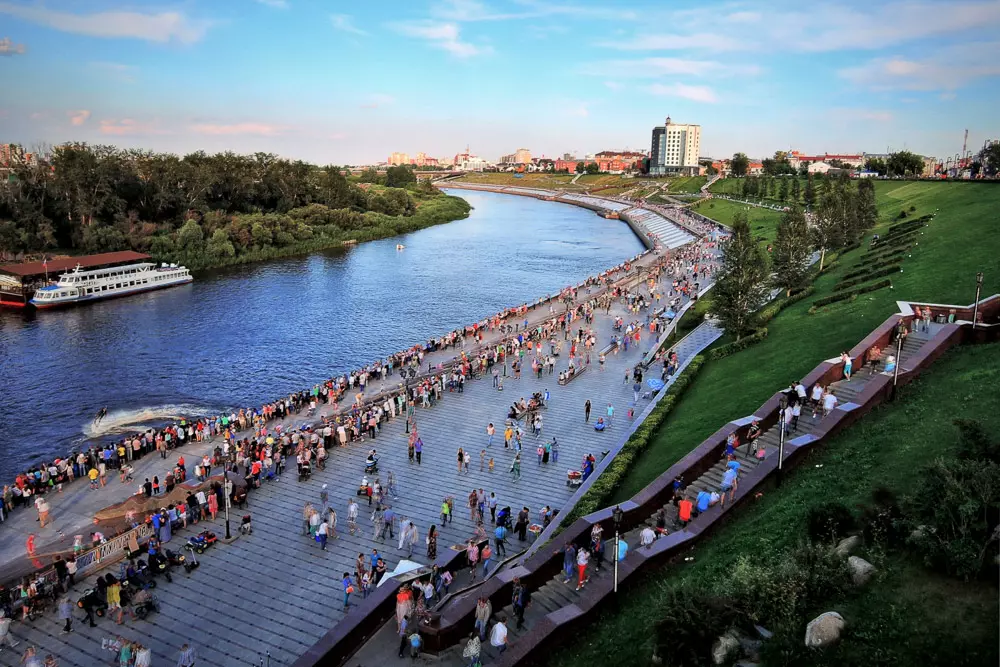 Miner Tyumen. Embankment of the Tura River
This critical tradition continued in the Soviet period, however, having disappeared from the public discourse - Soviet newspapers also did not like negativity in the press, and the feuilleton turned into a weapon of state terror. Personal letters and memoirs of the audible Soviet intellectuals, who, as a rule, were not by their own free will, differed no less shock than the pre -revolutionary authors, aphorism, behind which the same incredible loneliness was hidden. Naum Korzhavin, who suffered in Tyumen after the end of the camp period, dubbed the city with “white silence” (1948, quotes of memoirs of 2005): “... to get a job and live. How was it to do if I have no more exaggeration here with no one to grind a word with? <...> there was no way out. It remained to wander around the city, like a wolf in a cage. So not in the icy desert of Alaska, but in the people's Russian city, I was surrounded by “white silence”, a dense wall of absolute alienation . ” Five years later, Tyumen was printed by another aphorism by Mikhail Levin, a physicist prone to the lyrics, who came to the city under similar circumstances. “Until now, Tyumen is almost not mentioned in Russian and world poetry,” he wrote in a letter to his beloved (June 4, 1953), recalling the above verses by Aseev and Dolmatovsky, as well as quoting Mikhail Matusovsky’s poem “Family Album” (1939): “You will meet with the uncle, you will meet your sister, returning to your sister, returning Back, / then suddenly under Tyumen there is accidentally / pretty decent cousin. ”
From the point of view of the context of the current context, Levin was absolutely right. In the Russian poetic corps of the first half of the Soviet period, Tyumen appeared almost exclusively in the same quality as in Matusovsky - as part of the lists of toponyms, representing, in the words of the historian, not themselves, but the “collective image of the Motherland”. At the same time, it was not important where, in fact, the poet was presenting this image - in emigration, like Marina Tsvetaeva, who wrote about the burned White Guards (Perekop, 1928–1929): “Stone - only ribs - / God - once, and two - Markov. / Ivan? Sergey? Fedor? / Moscow? Tyumen? Kharkov?/ Nobody. Nameless ” - or at the Gorky Literary Institute, like Vadim Strelchenko, who had folded the ode to the Soviet anonymus (“ Man ”, 1939):“ He is thick and thin, idle and married, / born forty years ago. / Born in Minsk, in Kharkov, in Tyumen. / Here he walks along the street, look: / sometimes the order on his chest, / sometimes only a branch of lilacs. " It turned out, as you can see, the same thing.
During the misfortunes of Korzhavin and Levin, a boy named Vladislav Krapivin, who later became a children's writer, lived in an incorrect city. The "capital of the villages" was very lucky with this author. Krapivin depicted the landscape of his childhood dozens of times, trying different forms: from ideologically faithful sugary pioneer stories with a note of existential anxiety in the manner of Gaidar to good suitable fairy tales and psychedelic things with exits to Hallowean horror, resembling the provincial children's narratives of the Americans Bradbury and King.
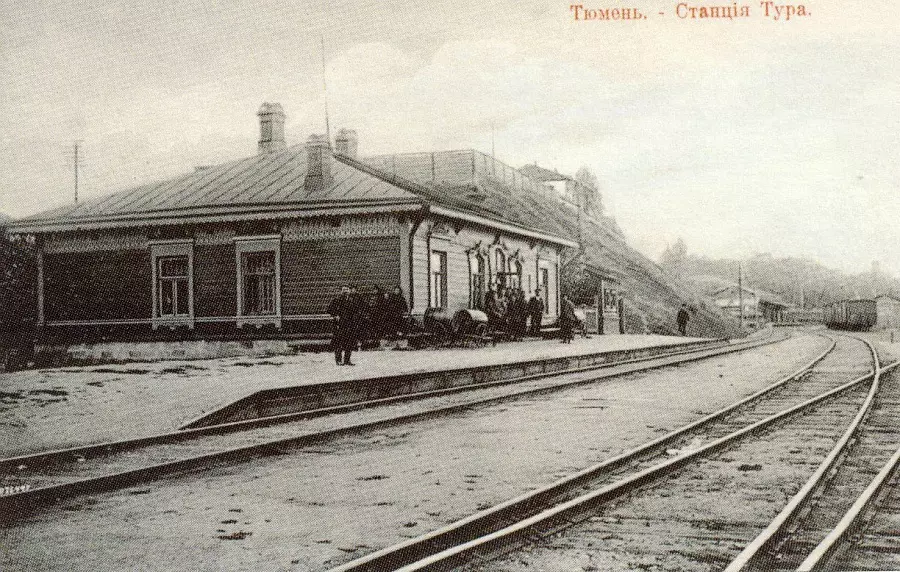 Tyumen. Station "Tura", place of overload of railway goods to river transport (c. 1910)
“ The town was wooden, with plank sidewalks along the test fences, with cunning patterns on the ancient, rickety gates. Spacious courtyards hid behind the gates. They overgrown with soft grass and dandelions, and along the edges - impassable burdock and nettles. In the courtyards there were sheds and towered long logs of pine and birch firewood ”(“ Carpet-Samlet ”, 1975). Reading Krapivin in childhood, I constantly saw such pictures around. The wicked poplar “capital of the villages” stood nearby, recalling the beloved technique of this writer - a situation of discovering incredible secrets (and maybe injuries), hidden behind the rickety routine of Soviet barracks. This usual reception for children's literature is most often associated with the acquisition of control over the movements between different spaces, until oddly similar to each other by the faces of the great crystal (novel by 1988–1991), in the depths of each of which the author of the author’s childhood is expressed. Its heroes discover wonderful Persian carpets (“Carpet-Samolet”, 1975); ancient books, including part of the Robinson Crusoe, telling about the journey through Siberia ("Cranes and Lightning", 1982); The disappearing bridges under which rusty witches dance (“Pigeon in the Yellow Polyana”, 1983–1985); The railway station nonexistent in the schedule (“outposts on the anchor field”, 1988) - each time falling into some power fields that take them to incredible Dali. The antique alevory of Alexandrogrinovschina - all these frigates, astrolabia and filibus - not to attribute to the writer’s personal obsession - a characteristic of these finds. Gosparovskaya Street ("State Shipping Company") and the mysterious "Tura station" still have not disappeared from the city landscape. Kapivinsky heroes find traces of a forgotten era described by another rytable cliche in the attics of the “capital of villages”: “Tyumen is a gate to Siberia”.
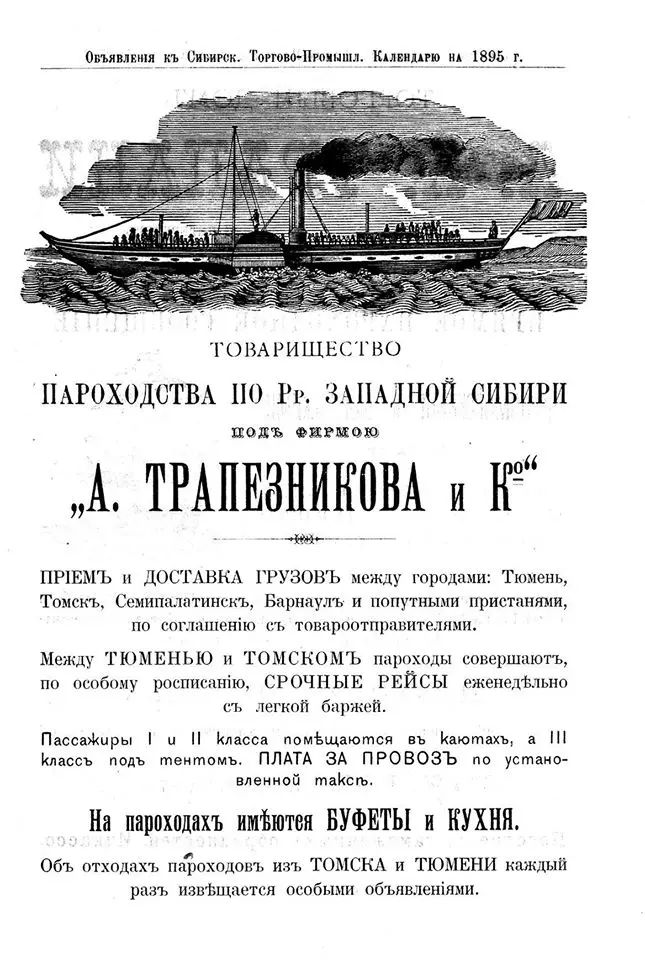 Tyumen. Station "Tura", place of overload of railway goods to river transport (c. 1910)
After passenger aircraft appeared, to understand that this Motto really meant was also quite difficult. On the coat of arms of the city of Catherine times, the same thing was said much more definitely: "From this city begins swimming along the rivers of Siberia." At times when the waterways were the norm, not exotic, Tyumen was the first colony of the Russian Empire in Siberia, the outpost of river expansion in the Ground Ocean of North-East Asia, the place from where numerous expeditions, including the sea, along the northern sea paths, were sent. The climax of this era was the “feuilleton” 1880s and the beginning of the 1890s. At that time, the railway began to the city of Pelmen, which began in London, Paris, Moscow and St. Petersburg, and he all turned into a continuous transplant from a steamboat to the steamer, transit space, which gave rise to the real boom of the city’s representatives in the “fake” literature - journalism, blanket essays, cheap fiction.
The context of these representations was no longer only in the regional Siberian, and not even imperial, but truly global. After the wife of the French envoy, returning from China, drove through Tyumen in 1862 (the Tyumeners remembered Madame de Burbulon as a lady in his pants), her notes came to the eyes of Jules Verna. So the city became one of the settings of the famous “Russian” book of Vern “Mikhail Strogov” (1876). The description of Tyumen, made by American journalist George Kennan, who went to Siberia to explore the prison and exile (1885), became a text that for a long time determined the stereotypical image of the Russian Empire for the whole world. This image was severe. In Tyumen, Kennan was mainly interested in two locations - a transit prison and a marina, with which the prison barges were sent. Mark Twain cried, listening to Kennan's lectures, and used the story of the Tyumen prison, describing the sad procession of slaves in the novel “Yankees at the City of King Arthur” (1889). It is important to remember that the representatives of the educated class like Kennan who followed at the end of the XIX century. Through the Tyumen pier, and then mentioning this in the books (including Korolenko, Stanyukovych, Uspensky, Chekhov, Garin-Mikhailovsky, etc.), were just a small admixture in the silent stream of exiles and immigrants who did not leave behind a line. Numerous descriptions of the crossing of imperial muddy shadows in the Siberian Tours to the Siberian “heart of darkness”, composed by future classics and their contemporaries, did not fall into great literature, passing through the department of journalism, which now only interests historians. The exception was the holy story of Dmitry Teleshov “The Christmas tree of Mitrich” (1897), which a few years earlier saw in Tyumen the consequences of the cholera epidemic that devastated the resettlement camp. After the end of navigation in the resettlement huts, there were many nobody children left, and the watchman arranged a Christmas tree for them.
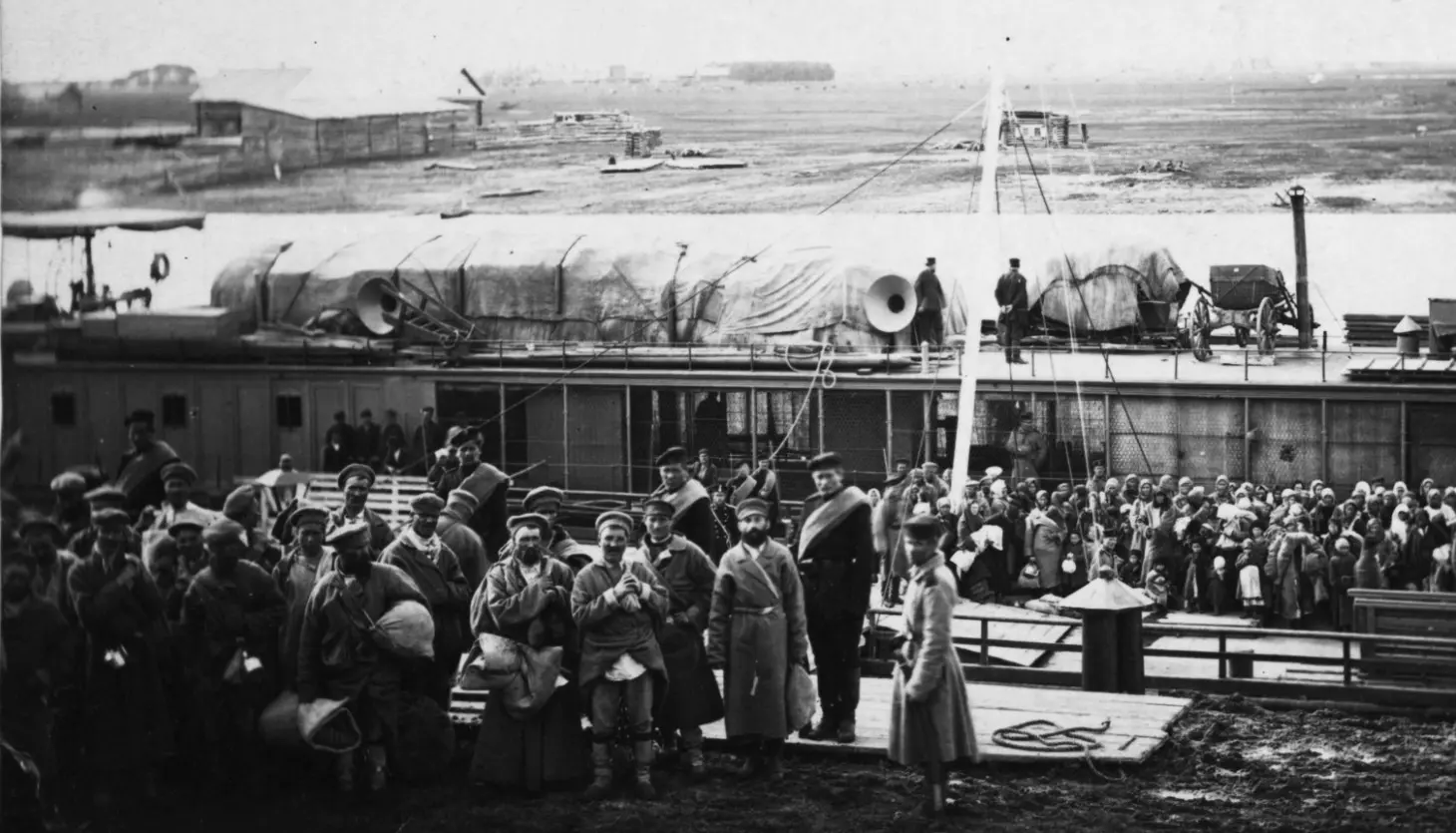 Party of the party on the prison barge on the Tyumen Pier (1885)
After the construction of the Trans -Siberian Railway (1894), which made the old river path irrelevant and eliminated writers from the city of the city, the representative boom ended. The town fell into mysterious lethargy, from which even war and revolutions did not arouse. In 1915, Tyumen, as part of a Siberian tour, was visited by Konstantin Balmont to speak in the club of clerks with a story about a trip to the Pacific Ocean. It seems that there were few spectators. On the eve of the goat wandering along the central royal street, the posters were gobbled up, announcing this event. In the evening, sitting in an empty hotel, Balmont wrote to his wife: “ The only sounds that I hear, the ticking of the wall watches in the corridor (such a home sound) and from time to time the choral singing of soldiers. They sing a lot in all these snow cities . ” Over time, the transit prison, fading with additional walls, disappeared from the eyes, turning into a Soviet colony, which was going around the city of the railway branch, which once brought the compositions directly to the river for overload-the prototype of the Kipinsky rails leading into infinity-disappeared in the thickets with which the former lays have overgrown.
When oil was found in Western Siberia, completely different representations were important. Since the beginning of the 1960s, trying to attract working hands to the deposits, the Soviet government used to propagate new cities that grew up in the north of the Tyumen region, the industrial capacities of the Writers' Union. Participants in the literary brigades who were traveling through Tyumen to the north in order to sing the working feat of the Buroviks, with the Soviet cunning stated: “Tyumen - the capital of villages? / Old, my friend! From now on / on the map - a new Tyumen, / and the previous one is not at all! " (Dmitry Filimonov, "Tyumen - the capital of villages?", 1985). Geography did its job again. The meaning of the regional capital was from now on its borders, in the Surgut taiga and the Nadym tundra. The name of the city was transferred to the northern expanses, which were declared fresh, empty with land, and described with enthusiasm that Hunter Thompson would envy: “ Tyumen is a new land that has never belonged to our contemporaries and could not belong. Similarly, what happened in space, Tyumen is also the extended boundaries of life. In the seventies of the XX century, our country has become more, more spacious. What can happen more significant than the fact that life has stepped over its previous limits! "(Elii Stavsky." Origins of energy ", 1978). Владимир Богомяков, тюменский поэт, выросший в обстановке нефтяной лихорадки, потом не раз включал эту интонацию, чтобы добавить тексту локальной «дичи» — «Произошла ПОЛНАЯ ПЕРЕМЕНА НАШЕЙ ЖИЗНИ» («Котик Ползаев», 2009). Или еще: «А вокруг бесконечный тоталитаризм: болота, нефтяные вышки и опять болота. / И кроме как рисовать крокодилов ничего неохота».
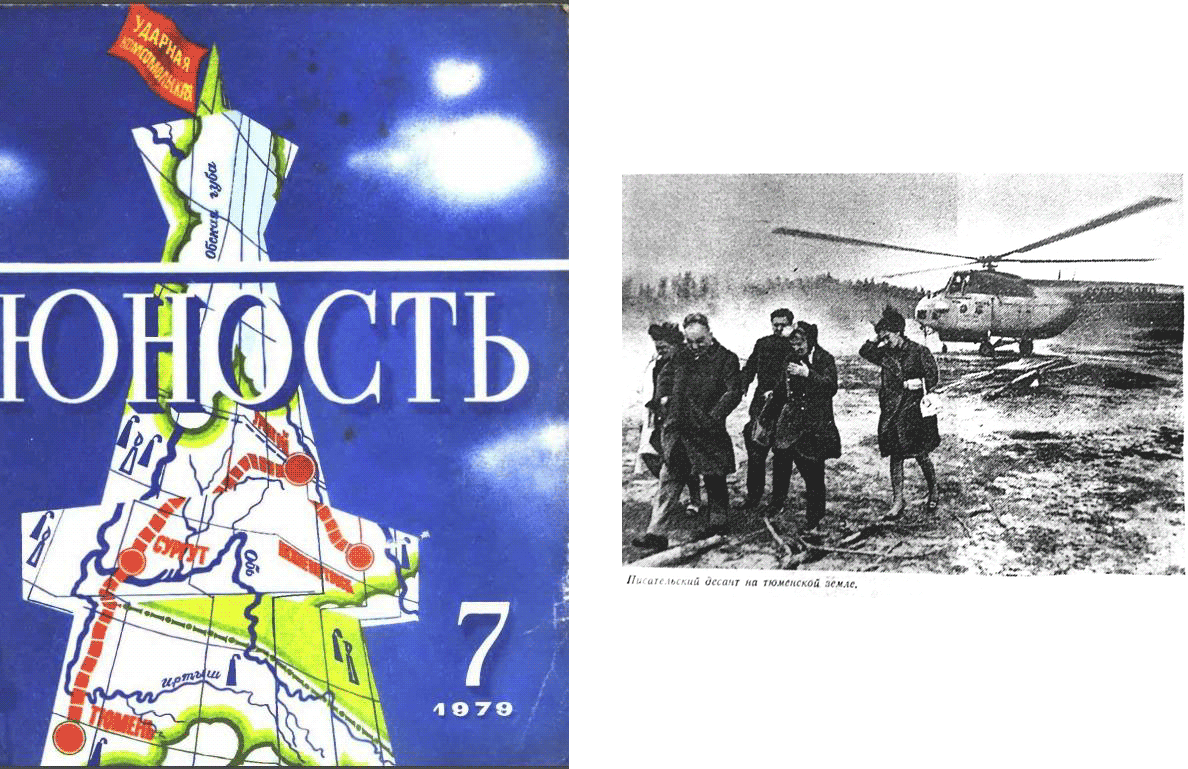 Справа: обложка журнала «Юность», 1979 год. Репрезентация Тюмени как административного центра эпохи нефтяного бума. Слева: Писательский десант на тюменской земле. Самотлорское нефтяное месторождение, 1971
Став символом «нефтяного материка», именовавшегося на брутальном соцреалистическом новоязе Тюменщиной и Тюменией, город как таковой не много приобрел в смысле литературного досье, которым можно было бы гордиться. Среди авторов десятков стихотворений позднесоветского периода, упоминавших слово «Тюмень», были такие поэты, как Андрей Вознесенский («Испытание болотохода», 1967; «Вечное мясо», 1977) и Владимир Высоцкий («Революция в Тюмени», «Тюменская нефть», 1972), но даже по названиям этих стихов видно, что они посвящены не «столице деревень» и не «сибирским воротам».
However, this is not entirely true. Нефтяной бум, может быть, не столько благодаря, сколько вопреки агитационным стараниям Союза писателей, привел в город новых людей, продолживших упомянутые традиции. Из сочетания консервативного уклада неизящного хинтерланда и редкой для нашей страны привычки к мобильности на свет в очередной раз явился феномен тюменщика, энергичного культурного героя с большими эстетическими запросами, который, увидав вокруг себя в юные годы унылую столицу деревень, не сдавался, но принимался творить свою вселенную, понимаемую прежде всего как социальную сеть, неформальное сообщество.
Слово «тюменщики» было придумано знаменитым Мирославом Немировым в самом начале эпохи массового Интернета. Его «Большая тюменская энциклопедия» (1995), описывавшая этот тип « с позиций представлений о мире советского человека из толщи безвестной жизни, каковой является именно, например, тюменская » никогда не издавалась на бумаге, сделана как сайт и вся построена на гиперссылках. Классическими тюменщиками восьмидесятых стали дети тех, кто положил жизнь на освоение богатств Западной Сибири. Фактически же тюменщики существовали всегда. Тюменщиками были двойные тюменские ромулы и ремы — сибирские ханы пятнадцатого века Ибак и Мамук, и русские воеводы шестнадцатого Сукин и Мясной. Тюменщиками были областники «фельетонной» эпохи, устраивавшие в Петербурге сибирские презентации. Явными тюменщиками были сотрудники «Нового Сатирикона», в котором печатался тюменский эмигрант Василий Князев. Тюменщиком был Евгений Кропивницкий, в 1920-х гг. живший в Тюмени, благодаря чему город попал в лексикон Лианозовской школы (Всеволод Некрасов. «Тюмень: отрывки из поэмы», 2000–2005). Владислав Крапивин, организовавший замаскированную под пионерский отряд парусную флотилию (на Урале!), тоже тюменщик. Сибирские панки из множества городов и московские осумбезы тоже тюменщики. Из тюменщиков выходят замечательные блогеры-писатели и блогеры-поэты. Доказательство тому — сетевая известность Мирослава Бакулина и Владимира Богомякова. «Забудь и очухайся по темноте. / И звездочка будет висеть в высоте. / Туда побреди, где кусты и ограда. / А как тебя звать — никому и не надо» (Владимир Богомяков. «Лишь чаи, лишь конфеты, лишь рафинады», до 2003).
Попав под обаяние «Большой тюменской энциклопедии», трудно остановиться.