Date
Author
Татьяна Лиханова

Preserved copy
Translated material
Russia. Money. Two yards
The reconstruction project of the Mikhailovsky Palace is evaluated as an unreasonably expensive, dangerous and illegal idea.
By the end of March, the World Bank must decide whether it is involved in the co -financing of the project. Information that for the previously approved option, a completely different version is issued, consistent with violation of the law, will hardly add arguments in favor of a positive decision.
Means justify the goal
As in the case of the main headquarters, the project of blocking the courtyards of the Mikhailovsky Palace was included in the program implemented as part of an agreement on a loan concluded between the Russian Federation and the World Bank in 2004.
The concept was prepared ahead of time, the work of the architect Mikhail Filippov 2002 submitted by the opening competition was the winner of the open competition. She was approved by the Experts involved in the World Bank (including architects, including the chief architect Versailles). In St. Petersburg, the attitude to the project was not so unambiguous. Thus, Alexander Margolis, appointed by the reviewer, refused to evaluate the presented option as contrary to the law at the Council of Conservation of the Heritage. But the Council as a whole approved Filippov’s work, recommending to eliminate a number of comments stated and present the adjusted option (which was never done).
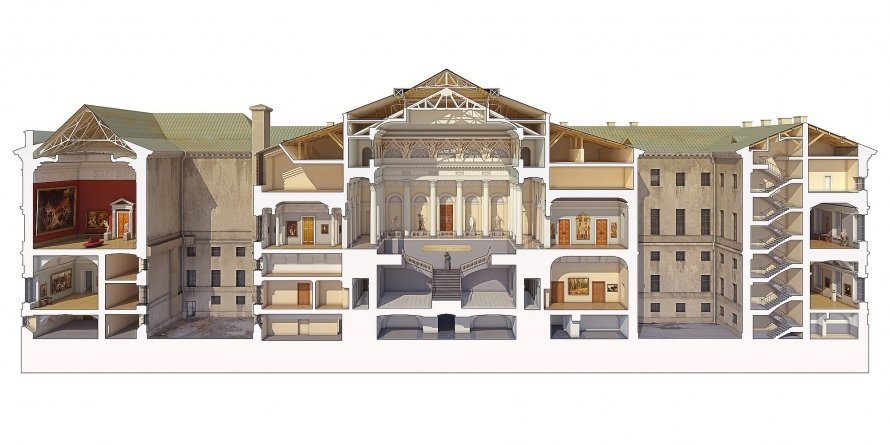 The sketch design of Mikhail Filippov. A section demonstrating an existing position with two courtyards
However, the Russian Museum was not able to realize its plans then (due to the lack of funds for the equipment of an alternative storage capable of accepting especially valuable funds during the construction), and they were frozen.
They returned to them in 2014, including the proposals for dop financing within the framework of the new agreement between the Russian Federation and the WB. The design tender was announced, which was expectedly won by Lenipoproke (it was concluded with a contract for 73.3 million). But due to economic sanctions, a pause arose again.
By the end of last year, the WB agreed to consider the possibility of its participation if the project was able to implement in three years (2016–2018). The total funding will be at least $ 30 million, the WB is ready to provide a loan only in the amount of $ 2.5 million. The rest of the amount falls on the budget of the Russian Federation. According to the director of the Investment Projects Fund (state order of Russian World Bank projects) Alexei Vasiliev, the Ministry of Economic Development has already given good, now the issue is considered by the Ministry of Finance and legal administration. After that, already this week, a package of necessary documents can be sent to Washington.
The Russian side did not lose time for nothing. The Ministry of Culture agreed on a historical and cultural examination (IKE) and the project itself, by the end of February it successfully passed the Glavgosexpertiza. The project was advancing in the situation of strict secrecy. So far, the resuscitation of reconstruction plans with the accompanying evacuation of funds and the closure of the museum for several years has not informed colleagues at the scientific council and. O. Deputy Director of the timing for scientific work Grigory Goldovsky; The general public became known about this thanks to the publication of Mikhail Zolotonosov.
Meanwhile, Mikhail Filippov told reporters that he was actually suspended from the project, and the option submitted for approval in the Glavgosexpertise has little in common with his work, which was emasculated to the level of the “shopping center” and “absolutely passing hack”.
When the scandalous news took top -end positions not only in the city, but also in the federal media, and St. Petersburg deputies turned to Prime Minister Medvedev calling for the “criminal and corruption actions of the Ministry of Culture to destroy the Russian Museum”, Vladimir Gusev decided to meet with journalists.
But he did not show the project or talk about it. Limiting the promise of “at least a hundred times to publish it” and “discuss everything at least with city -defenders, even with deputies”, when final financing decisions will be made. That is, when nothing can be changed.
Are the World Bank misleading?
At a press conference, Alexei Vasiliev announced the two conditions put forward by the World Bank: “Firstly, this should be the same project that the World Bank experts approved in 2002. Secondly, this time the Russian Museum is obliged to move funds on time. For this, the Ministry of Culture should guarantee that such a move will take place this year, deduce money for it.”
That is why, Alexei Vasiliev explained, and a letter of the Ministry of Culture appeared to the leadership of the Russian Museum with a proposal to determine how much and where to move the funds, what financing will be required to carry out this operation "as soon as possible."
The final decision of the World Bank is hoped to get before the end of March.
The correspondent of "New" had doubts about compliance with the first of the conditions put forward. After all, the project approved in 2002 changed more than once by Mikhail Filippov himself. And in the option that the Glavgosexpertiza agreed, his surname is not even mentioned - the developer of the architectural part is the workshop of Sakhnovsky.
Alexei Vasiliev, Vladimir Gusev and his deputy Vladimir Bazhenov vied with the vocation began to assure that the "project remained the same", he was simply brought into compliance with the modern requirements of fire safety, security and other. But these assurances were not linked with their recognition that many “beautiful, elegant, but not functional” decisions of Filippov refused (in terms of the appearance of light lamps, abundant use of wood and glass, the nature and volumes of the transformation of attic spaces and a number of positions in a number of positions) - because “it was not clear how to do it all,” and it turned out that this Filippov Plus Rossi.
From all of what has been said, in our opinion, it follows: the project, agreed today, is not at all the same that the WB approved, with reservations supported the Heritage Council and the Scientific and Methodological Council at the Ministry of Culture (NMS). The latter was considered on February 3, 2015. The third option adjusted by Filippov. The protocol indicates that it was he who was approved by the exposition council of the Russian Museum. The presented concept of the NMS as a whole supported, with the recommendation "reduce the areas of new glazing on the outer slopes of the roof." The customer was also recommended to adopt this concept as the basis for further design, expressing the desire to continue to work with the same copyright team.
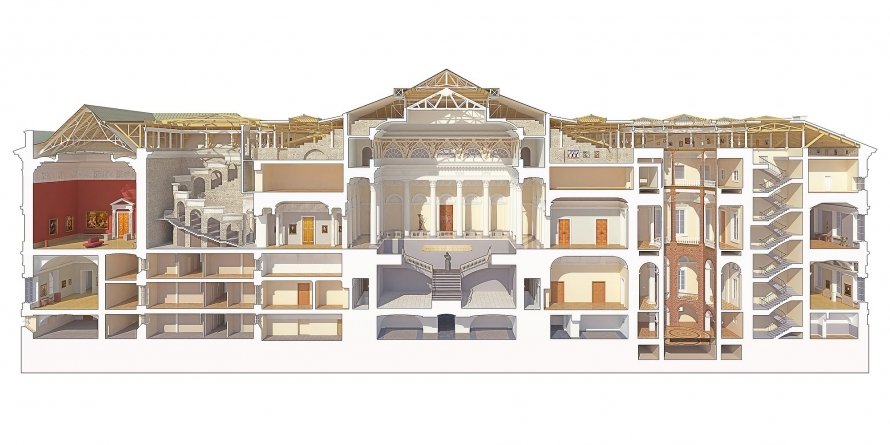 One of the options for the reconstruction of the yards of the Mikhailovsky castle developed by architect Mikhail Filippov
An indescribable examination
There is another important phrase in this protocol: "The project of the subject of protection of the monument has been completed, but not approved."
But it should underlie the design of the adaptation. According to the law, the monument cannot be approached at all until the subject of security is approved. The State IKE, designed to evaluate the compliance of the project with the requirements of the legislation, including investigating whether its implementation will lead to a change in the subject of protection.
We look at the materials of the IKE, performed by a group of experts led by Svetlana Shungina on June 17 - August 9, 2015. It indicates that "the subject of protection of the object was compiled by specialists of Renaissance LLC in 2015. Such a wording (without references to the corresponding order of the security state agency) gave rise to doubt that the subject of protection at the time of the examination was approved legally. But in this case, IKE and the conclusion made by it (that the project does not violate the subject of protection) is illegitimate. However, the Ministry of Culture of the Ministry of Culture agreed on this wording.
It does not fit in my head that for such a monument of the first magnitude, the object of security has not yet been determined. For decades, the powers to protect the Mikhailovsky Palace have been assigned to KGIOP. By order of the Government of the Russian Federation of 09.06.2010, these powers were transferred to the Ministry of Culture. And by order signed by Dmitry Medvedev dated 10/17/2015, KGIOP was returned again. After the Department of the Ministry of Culture agreed by both IKE and the project of the reconstruction of the courtyards of the Mikhailovsky Palace.
That is, having made dirty work in every sense, the Ministry of Culture outlined the responsibility for its consequences to KGIOP. The committee claims that the project has not yet been seen. And they did not even receive all the appropriate documentation on the monument, for which they are responsible since October last year.
The Ministry of Culture previously signed a similar operation with our Nikolsky market: the powers to protect the federals for a while took from KGIOP, and having coordinated a destructive project that turned out to be demolished a significant part of the monument, they returned it.
The Mikhailovsky Palace Minkalt threw off Kgiop even without the approved object of security. “Such an order was not only not at the time of the examination, but has not yet been published,” Irina Teterina, chief architect of the timing, confirmed the “new”.
According to the calendar plan as part of the technical assignment for the tender for design, the winner is obliged to draw up and approve the list of security items in the first three months from the date of conclusion of the contract - 06/20/2014 (not yet executed - and the contract has been closed, the money has been paid).
Only after that it was possible to start design, then conduct an IKE. However, the cart was placed in front of the horse.
If Svetlana Shungina were a conscientious impartial expert, would not have taken up the IKE in the absence of an approved object of security. But, judging by the fruits of its activities in recent years, such characteristics are hardly appropriate here. So, with the participation of Mrs. Shungina, an examination of the Mordvinovs was completed under the interests of the developer - which, as stated in the decision of the Kuibyshevsky district court of St. Petersburg, "cannot be recognized as legal."
Of particular interest to the supervisory authority can be a comparison of the amounts for the IKE specified in the documentation for the tender and in the contract agreements concluded by the Lenporet with experts. In estimates to the tender, it is allocated to IKE for nearly 15 million. And if you believe the contracts, each of the three members of the expert group received 20 thousand rubles each.
We are still more interested in the substantial part of the IKE. First of all, because it allows you to compile at least a general idea of the hidden project.
New building under the guise of "preservation"
From the design proposals described in the examination, it follows: this is not about creating a couple of atriums over the two domestic courtyards of the museum, but about their development - with the creation of new rooms in several floors. In the first yard, four are installed, and in the second - three monolithic reinforced concrete floors. Which will be instituted in the capital walls of the palace to a depth of 25 cm. An additional load on the capital walls will lie down the glass caps themselves. " The yards are overlapped with tent glazing, based on the parapet, built on top of the existing walls ," the examination said.
As a result of all transformations, the museum, according to Vladimir Gusev, will receive an additional 1,500 square meters. m.
The fact of the new construction is also recognized as an examination, it is written there: " This project provides for decisions on the development of courtyards ." Which did not prevent experts from concluding the conformity of project 73-ФЗ. Although article 5.1 of this law prohibits within the boundaries of the monument or ensemble of work on new construction and increase in the dimensions of existing facilities.
The inadmissibility of such work under the guise of "preserving the cultural heritage object" is confirmed by the recent decision of the Kuibyshevsky district court in the Mordvinovs.
The project provides for both the laying of several existing window and doorways, as well as punching new inputs from window openings (in the first yard, in the end, eight doorways are obtained, including the existing ones, in the second - 14). In some cases, we are talking about disassembling the walls of the walls: for example, one of the premises are now transformed under the funds of the premises, " two new doorways are arranged for this (break through in the capital walls )."
The premises of the restoration workshop " are reconstructed - with the device of the balcony at the level of the attic floor ", " for this it is supposed to disassemble part of the attic overlap in the premises ." For their lighting, windows are installed on the slopes facing the ramp.
In the courtyards there is a device of three elevators and ventilation mines.
To ensure additional evacuation routes, it is proposed to cut down the two exits from the museum to the garden: having opened the previously existing historical doorway and cutting the second in the existing window. It is recognized as an examination, included in the list of the subject of protection. But this annoying circumstance is proposed to neglect. New outputs are equipped with bastard metal stairs. Which, according to experts, is also permissible - since the stairs "do not close to facades closely, that is, they will not damage their decorative finish."
The view of the main entrance along the main facade is also changing: to the stairs with lions and two wings of granite carriage entrances will add " the material and form " Modern ramp - "Technical convenience for the stroller". Unlike historical, leading to the oak vestibule of the first floor, this one leads to the entrance in the basement. According to experts, such a change in the front entrance " will not entail the distortion of the perception of the composition of the palace."
What for?
These and other aggressive introduction into the body of the monument, a change in the volumetric and spatial characteristics are issued, of course, for work to preserve the object of cultural heritage. Although the formulations used in the examination indicate completely different purposes: one of the innovations is presented as necessary “ for the convenience of visitors ”, the other “ for the construction of technical premises ”, some openings are laid “ behind unnecessary ”, new are cut off “ for the interaction of the newly created premises ”.
Why is a unique monument proposed to expose such a serious and dangerous operation? According to Vladimir Gusev, out of 1500 square meters. m obtained as a result of reconstruction, 600 is given to the "recreational space". There will also be a conference hall for 100 people, shops, cinema, technical and office premises-well, something will remain in the exposure areas proper.
It would be nice to look at the reasonable calculation confirming their need: how many square meters and for what exactly is not enough. And compare with an assessment of the effectiveness of the use of existing areas for all the objects transferred to the Russian museum. The calculation of the subleases of the same Stroganov Palace speaks rather about the excesses, with which the timing with whom is just not ready to share. Here you have a cafe, a restaurant with five dining rooms, wine cellars and “secret rooms” (those who want to stay after a hearty dinner are offered apartments in the “smallest palace hotel”, the price of the issue - 30 thousand rubles a day), a museum of wax figures and a museum of chocolate with brisk trade, gift stores and souvenirs, a bank office with an exchanger.
Vladimir Gusev likes to remind that the collection of the Russian Museum four of the Tretyakov Gallery is four. If the scale of the deficit of the premises for its exhibiting is so large - it could be more reasonable to adapt the stable department, and not to fence reinforced concrete floors in cramped (10 to 14 m) of the Mikhailovsky Palace?
The ends are in the water
At a press conference, a clear answer to disturbing questions about what would happen to funds, to what volume, where and when they are moved, did not sound. Vladimir Gusev only said that "different options" are being worked out. And he expressed the timid hope that at least some part would be able to leave in place-"if we find compromise options with the builders; but they will turn off heating and electricity, and we cannot leave the exhibits without alarm."
Meanwhile, in terms of reference to the tender, it is spelled out:
" Creation of the conditions for the preservation of the museum collection in stock premises to ensure isolation from penetration and dust from the construction zone - the construction of bays, partitions using technical means of protection ";
" Development of a project of technological sequence of work on the reconstruction of engineering networks, taking into account the continuous functioning of the engineering systems of the building ."
It seems that the idea of the need for total evacuation of funds, streamlinedly estimated at "hundreds of millions of rubles", is someone's improvisation (hardly born in the walls of the museum). Its implementation is able to bring additional Navar to the sawmills. And responsible for the safety of funds are real terms. Vladimir Gusev is clearly not eager to share the fate of the ex-director of the Naval Museum, to whom the story of the move cost the "nine". And when Vladimir Alexandrovich calls the ideal situation in which "there will be no reconstruction, and I will live life calmly without accusations of corruption," this is the rare case when you believe him.
In the meantime, everything is lined up in such a way that there will be no one to ask for the catastrophic consequences of the crazy project of “improving” Russia. The Ministry of Culture merged, shifting the responsibility to the KGIOP for what was pumped. Глава комитета Сергей Макаров с двумя выговорами в анамнезе и малоприятными результатами проверок Минкульта – в шаге от отставки. Не факт, что будет продлен истекающий к 2017 году контракт с нынешним 71-летним директором Русского музея. Гендиректор ЗАО "ЛенПолпроект" Сергей Костерин, подписавший контракт на проектирование, сменил место работы (трудится первым замом гендиректора АО "Ленгидропроект" экс-депутата Владимира Пехтина). И вообще, к планируемому сроку окончания реконструкции, глядишь, и падишах сдохнет.
Не дожидаясь такой развязки, градозащитники намерены уже теперь обращаться в прокуратуру и в суд.