
Translated material
Album Miles Davis Bitches Brews
Miles Davis said that there are actually as many as four Miles. “The zodiac sign is twins,” he loved to repeat. There is a good Miles and bad. And inside each of these two is also good and bad, and all of them are different personalities, and even with their unconscious. Before us is a multigerler, and the only thing that connects all the Miles is together is his music. The Album "Bitches Brews" was born by its angry sub -powerfulness - this is how the visions of demons, the pharaohs from the past, burning poppy and two frying girls calling for dirty and promising carnal pleasures sound.
The name of Miles Davis indicates the path: Mille Passuum (this word is called miles, measures of distance) means "A thousand double steps of Roman soldiers in complete vestigo on the march." On the Album "Bitches Brew" you can just hear how Roman legionnaires walk from the speakers and pour into the listener of the Horde of musical instruments. The light is no longer visible on the earth: the time of the Last Judgment has come, as Michelangelo portrayed him on his fresco from the Sistine Chapel. In the center of the lower part of the composition of Michelangelo, right above Haron, a carrier of the souls of the dead, a group of people soaring on the cloud and blowing into terrible long pipes of the apocalypse is depicted. This group with pipes could be a team of Miles Davis, which announces people on Earth the arrival of a terrible trial. The music of apocalyptic pipes can be heard on the album "Bitches Brew".
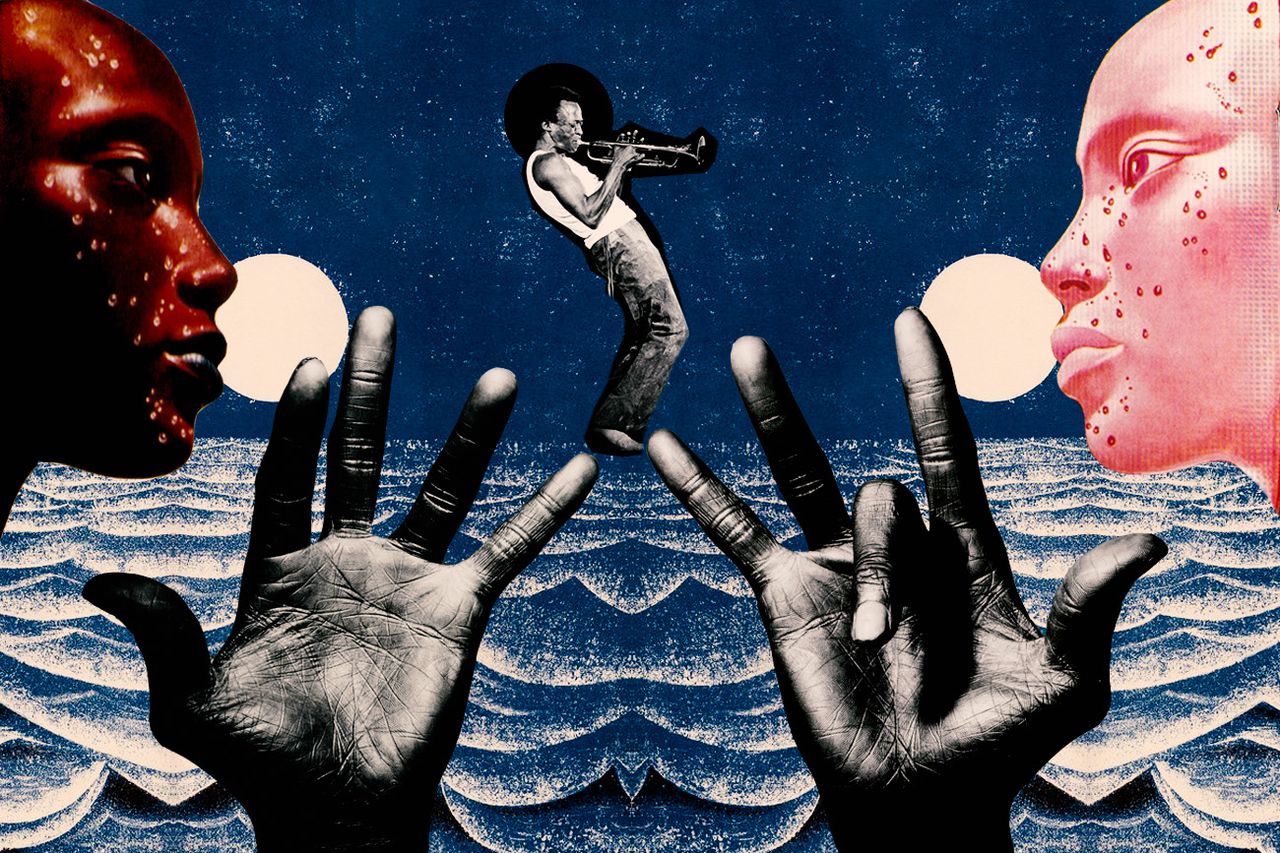
A real alchemical wedding of rock music and jazz with the participation of a pipe, saxophone, an electric piano, electri-guitars, percussions and drums. The album was recorded in 1969, in the midst of hippie culture and the movement of black panther, love for peaceful protests and hatred for the Vietnamese War, at the peak of universal passion for psychedelic drugs and human psychic capabilities. Miles Davis managed to look into the most dark corners of the collective unconscious of that time and put the quintessence of the “bitch” quintessence in the form of the plate.
As always in the case of Miles, the album was recorded in only a few approaches, during which the musicians were mostly improvised. Musical improvisations are very similar to good and stormy sex, in which lovers act harmoniously, but spontaneously, not adhering to the hard rules, not following any scenario. Miles loved to breed real musical orgies, in which he himself was limited to the role of the master of the ceremony and started everyone with his exact and laconic movements, allowing everyone else to forget and give out all his feelings in the mountain: the main thing is not to interfere with the neighbors and try to supplement them. The percussionist, who stuck with sticks on outlandish objects with Zazubins and persistently moanded a rag inside an elongated drum, and the saxophonist, who at the quietest moments of music, slightly blew into the saxophone, afraid to frighten off the peace, which was at times lowering to the team, were mostly descending into the team. And, of course, in the moments of the culmination and approach of the musical orgasm, the Miles pipe sounded louder, which powerfully betrayed the wave -shaped lumber sounds that caused a mixture of horror, enthusiasm and languor on the faces of all other musicians.
After several stages of such musical orgies, when everything was recorded and it was necessary to bring the album together, Miles and his beloved musical producer Theo Masero decided that now the music needed to mount and leave only the best and most lively moments, and even put special effects on them.
For the first time in jazz and rock music, the cut method was used: pieces from some places were cut out and superimposed in other places.
It so happened to kill two birds with one stone: on the one hand, to provide musicians with complete freedom during the recording, and on the other, to build a clear and rather thoughtful composition of the post -fact. As a result, the album "Bitches Brew" has gained a magical property. You seem to listen to the same plate, but each time it sounds in a completely new way, with some other shades and accents, as if someone rewriting music until you listen to it. After the “bitch bvic” was assembled in their canonical form, the musicians at concerts tried to adhere to the recorded structure, which, however, did not prevent them from breaking up to the fullest, retreat from the canonical sound and give out something new every time.
A year before writing his first jazz-gang “Kind of Blue,” Miles married a black dancer named Francis Taylor. Along with this marriage in the life of Miles, the second important period in his work began - from Bibop, he moved to the writing and execution of modal jazz. Relations with Francis began to deteriorate over time: Miles began to go to the side, addicted to cocaine and often arranged fights with his wife. The musician exceeded forty, and his middle -aged crisis almost began: in addition to his wife, his music managed to get bored - and longed for changes. Once, when he was asked why he no longer plays ballads, he replied that he did not play them precisely because he loves to play very much.The changes came to him in the person of the twenty-year-old Betty Mabri, a long-legged black model, which wrote the song and friends with cream gaining rock and fink touches.
Soon after meeting, Miles and Batty got married. This marriage helped Madmoiselle Maibri to launch his solo musical career and become a popular Funk-Diva, which we all know under the name Betty Davis . But for Miles, the young wife played an even more significant role. Although their marriage lasted only a year, during this time Miles completely changed externally, changed strict and elegant costumes to riveted jeans and dashiki, began to hang out with rock musicians (of course, black) and, most importantly, began to make fundamentally new music.
Betty introduced Miles to James Brown's music, brought with Slaim Stone and Jimmy Hendrix, who had a very strong influence on the music of Jazzman, which had already been legendary by that time. Despite the rumors that the cause of the sudden divorce from Miles was Betty Roman and Hendricks, the relationship between the guitarist and the trumpeter formed extremely warm. Several times they together in the studio and, according to rumors, were going to record a joint album, in which Paul McCartney supposedly also had to take part. Miles told Jimmy, who did not even know a notate letter, everything that he knew about music - young animals grabbed on the fly. Jimmy did not really need to tell Miles - it was enough just to be himself and play his music. Under the influence of his young colleagues, Miles began to depart from a conservative jazz sound, pay more attention in his compositions of rhythm sections and use electronic tools in their orchestra. Rockers and Funk musicians of that time built their compositions around the drums that Basitar echoed, and used electric Piano with might and main. Jimmy Hendrix soloed on his guitar just like Miles on his pipe. The young audience went crazy from such a sound, and Miles, who was tired of the classic jazz, rightly decided: since young and illiterate musicians collect such audiences and sell so many records, it will not be difficult for him, you only need to play in a new way.
Jazz is not a set of instruments and not a musical size. Jazz is a feeling and attitude to what you play.
When Miles was still studying in the elementary grades of the school, the Harlem Rhythm radio program was in the morning - and he did not miss a single issue of it. He could easily distinguish the sound of black musicians from the whites, because the music of the whites could not "get into his body." It was then that he decided for himself that he would play like that, black music. Despite the fact that at the origins of rock and roll and all its derivatives stood the music of blacks, blues and rhythm-n-blouse, and the first luminaries of the genre were the African Americans like Chuck Berry, Bo Didley and Little Richard, the first real pop star of this genre was a white named Elvis Presley (which for some reason is still called the king rock and roll). At the end of the sixties, Rock was already the basis of pop music and launched many genre branches, a few African Americans like Jimmy Hendricks finally sparkled on the rock panteone, but Rock still remained with the music of white for the white audience. Miles accepted the challenge of popular music for a white audience, but did it with a jazz feeling and attitude, which led to the birth of a new musical genre - Fuzhna (which in English means "alloy"). Actually, Miles already created an “alloy” in the 1960th year with composer Gil Evans on the album “Sketches of Spain”-but then they mixed jazz with classical music. And in the seventies, jazz sought to merge with Fank and psychedelic rock. A significant part of the musicians who played with Miles during the “bitch” period became the headliners of the genre Fuzhn and made their own cult groups: Joe was twisted and Wayne Shorter founded the Weather Report group, John Maclaflin founded Mahavishnu Orchestra and played in The Tony Williams Lifetime , Chick Korea headed the Return To Forever group, and Herby Hankok led to Headhunters .
When Galileo Galileo began to promote astronomical ideas, inconvenient for the religious picture of the world, the modern scientific community abruptly broke him off and offered him instead of a telescope to stare at the anus of people through Clistir, which would be in the original medical education.
The same caste division can be found in music. For most successful musicians, the transition to a new musical direction of death is similar: on the one hand, it is scary to lose laurels, with difficulty conquered in one direction, on the other, it is very highly likely that the new genre will not be on the teeth, but with the third-the public itself does not love when someone changes horses at the crossing. Miles was not afraid to lose the laurels of the jazz guru, because he perfectly understood that jazz was an attitude, so as soon as he began to play rock, his music began to be called jazz rock. The new genre, in fact, much simpler than jazz, turned out to be more than on the teeth of Miles, and he not only captured them, but also complicated and sophisticated him, so that his experiments became a new guideline for all subsequent rock musicians who could no longer play rock as if there were no “Bitches Brews”. Well, the third barrier, the rejection of the new role of the old and well -known jazz horse, Miles overcame with a contemptuous smile and stoic patience. When he played a jazz-rock, the anger of the Purist jazz critics fell upon him: one defeatous review of another appeared in the press, the journalists wrote that Miles was “ready to sell and exploit his music, as he sold and exploited women while he was a heroin drug addict.” At the concerts, the audience, accustomed to jazz Miles, boasted and threw it with rolls of toilet paper as soon as he began to play. But unlike critics, the audience surrendered under his pressure quickly enough: almost every concert was converted into a new faith, and people, whistling and raging at the beginning of the evening, stood with open mouths and eyes full of admiration by the end of the concert.
"Bitch Bvar" has an extremely dense and rich sound. Miles used that time non-standard for jazz, but electrical musical instruments extremely popular for rock: an electric guitar, electric Piano and an electric bass. Miles was so liked by the sound of the Fender-Rodes electrician that he ordered the Theo Masero from his producer at once and seated three outstanding pianists for them: Chika Korea, Joe and Larry Yang. The three of them played all the three of them only on one composition, but mainly play in two - one piano sounds from the right column, the other from the left. The rhythmic line, extremely important for rock music, is provided by outstanding drummers Jack Dedzhonet and Harvey Brooks, which is helped by the bassist Dave Holland. Several Cuban drums at once create an additional rhythm performed by Don Alias. The rhythmic line is the percussionist Hum Santo, who, with the help of many outlandish instruments, is barely noticeable, but extremely atmospheric sounds similar to a swarming and squeak of fairy -tale small animals. Throughout the album, the Miles Davis pipe does not just solo, as it was in previous albums, she tells the story of insanity and travel from the thumb of the night to the first rays of the rising sun. The Wayne Shorter saxophone is subordinate to the pipe, he complements and explains the message of the master of the pipe and the Witch Mr.. The sound of the album, his musical passages and the very image of Miles Davis resemble the devil from the classics of horror films, the silent film of 1922 under the name “Witches”. In it, the devil first appears from the darkness in front of the priest, curling over a thick and dusty opus - and terribly vigorously waves his tongue, urging the frightened Son of God to join the forces of darkness. The screen is darkened and the inscription appears:
“The devil is everywhere, he can take any form. He manifests himself in a nightmare, a raging demon, a seducer, a lover and a knight. ”
The Album "Bitches Brew" was released on March 30, 1970 - and in the shortest possible time more than half a million copies were sold. In just a few months from the moment the album was released, Miles replaced smoked tight clubs with a minimum audience to large concert halls with thousands of coasted listeners. Repeatedly Miles, despite his legendary status, had to play on the warm-up of a variety of rock collections. The young public, young and open to all the new, had never heard jazz before, with a bated breath of Miles’s magic sounds and left the concert in a firm belief that it was not a rock concert, but a jazz mystery. Nobody usually remembered the rockers playing after Miles. Having played this way for a while, Miles decided to resort to cunning and began to godlessly late for concerts. As a result, he was not on the warm -up of the rockers, and the angry rockers found themselves against the will to warm up. The managers could not do anything with Davis, he had one answer to all the complaints: people like it, get rid of.
PS
On August 29 of the same year, five months after the publication of the “bitch”, Miles and the company fell on one of the largest music festivals of all time. The festival took place on the island in England and gathered an audience of more than six hundred thousand people - one and a half times more than the Woodstock American music festival a year before. Jim Hendricks and Jethro Tull, The Doors and The Who, Leonard Cohen and Joni Mitchell performed at Isle of Wight - and all the hot musicians of that time.
In thirty -eight minutes, Miles played several abbreviated compositions from the “bitch of the brew”, and when he was asked what his set is called, he answered in his spirit: “Call as you like.” The composition of the musicians at the concert differs from the team that recorded Bitches Brews in the studio - but this is even for the better, since this version has its own energy and history. Unfortunately, we do not have the opportunity to see how the musicians looked in the studio, how they were gnawed at their instruments, how we looked at each other. But there is an opportunity to carefully see how they played this hellish music live.
The most restrained on stage is behaved by the electrician Chick Korea, who later became an avid hoinconologist. He thoughtfully gives out short passages on his instrument and, it seems, thinks about something tightly, as if something was very scary. The exact opposite of him is the second keyboard player, playing in this case on the electronic organ, Kit Jarrett (a guy with antennae, in sunglasses and a yellow jacket). With his movements and game, he brings pulsing electric chaos into the game of the septtee. A crazy spanish Grove is fried by the legendary drummer Jack Devigonett - and a blessed smile is practically not leaving his face. He exchanges glances with the bassist playing his bassist Deive Holland, who seemed to smoke too much grass before going on stage (which, however, does not interfere with him). Devignette and Holland at the end of the composition of the composition “Bitches Brew” (begins at the end of the seventh minute) extremely excitingly play with the rhythm, as far as they can, are moved away from the “right” rhythm. The saxophonist Gary Barts, on the contrary, behaves extremely restrained on the stage: since the saxophone gives out only solo, most of the time it just stands and sways slightly. But when his time comes, this modest introvert begins to work miracles - look, for example, at his solo, starting in the twelfth minute, he seemed to whisper and talks with owls, then falling into hysterical notes. Brazilian percussionist named Airto Seaira, an orcestr man deserves special attention. He visualizes the nervous nerve of all this music, frantically shaking, blowing and knocking on a whole arsenal of outlandish instruments laid out in front of him - to observe this action extremely exciting and cognitively, and to recognize his most important sounds in “Bitching Vrev,” not so simple. And of course, the main spectacle is Miles Davis himself. Все остальные музыканты играют музыку, которая пришла из глубины этого трубача. Он расставляет основные акценты и обьясняет на своём духовом инструменте, что и о чём играют музыканты. Понаблюдайте за тем, как он ведёт себя после своих партий, как частенько его что-то не устраивает в собственной игре, как он вытаскивает промасленную клавишу из трубы и облизывает её, чтоб она мягче нажималась. В общем, этот концерт и есть визуализация тех самых музыкальных оргий, о которых говорилось в начале.
PPS
Изначально альбом должен был называться «Witches brew» — то есть «ведьминское варево» — и только после развода с Бетти Дэвис альбом приобрёл свою каноническое название. Алхимики говорили «lege lege et relege», что в переводе означает «читай, читай и перечитывай», и если будешь так делать — добьёшься своего. Чтобы получить силу «Сучьего варева», его придётся слушать, слушать и переслушивать.