
Translated material
Feratrante fever
Feminism, screaming covers, series HBO: the main thing is what you need to know about Elena Ferrante
The Sinbad publishing house was published by the novel The History of the New Name, the second volume of the Neapolitan Quartet, Helen Ferrante, the most famous Italian author of the living. Since Ferrante's books cause not only mass delight, but also numerous disputes, Gorky gathered a guide to the main scandals and discussions related to the writer.Pseudonym
Everything that is officially known about the life of Helen Ferrante fit into the book “Fragments” ( La Frantumaglia ), which included letters to publishers, essays and rare interviews of the writer. Talking with journalists by e-mail, Ferrante has repeatedly explained why she chose anonymity. According to her, the preservation of the author’s incognito made it possible not to enter into burdensome contact with the media and focus only on books representing interest in themselves. Nevertheless, after the English -language publication of “my brilliant girlfriend” - the first novel from the “Neapolitan Quartet” - entailed the so -called “fever of Ferrante” (#Ferrantefver), attempts to expose her personality became more frequent.
The Italian journalist Claudio Gatti especially succeeded in the investigation into the “case” of Ferrant: in the fall of 2016, he presented the public with several significant arguments in favor of the fact that under the pseudonym, translator Anita Rayi, the wife of the Neapolitan writer Domenico Startnone, whose work went out in the same publishing house as Ferrantye. Gatti resorted to the methods that are usually used by journalists investigating corruption scandals: the evidence of the authorship was information about the income of Anita Rays and the purchase of real estate, which in time coincided with alleged copyright deductions. As Gatti claimed in an interview with The National Book Review, readers have the right to know who she is actually, and, “if Ferrante and its publishers did not play cat-mouse with a press for almost a quarter century”, he would not have sought to find out the truth: “Everyone who plays a hide and seek, must know that being caught is an inalienable part of the game.” One way or another, neither the publishing house nor Ferrante confirmed this successful theory.
Gatti provocative material caused a flurry of condemning texts: journalists and writers did not fail to speak about the writer’s right to stay in the shadow, and Salman Rushdi even proposed to launch the campaign “I am Elena Ferrante”.
The author of the N+1 magazine Dane Tortorichi writes that the anonymity and independence of Ferrante, first of all, was beneficial for her books. Ferrante repeated many times that she could be published, only protecting her author’s “I” from prying eyes. “Writers need a creative space,” Tortorichi continues. - One of his definitions is a room, the other is freedom, the third is solitude. Everyone finds this space where he can. "
In his monologue on Lithub, entitled “Leave Elena Ferrant at rest”, editor David L. Ulon is outraged by the meaninglessness of this revelation: “First of all, why? <...> Does someone care about how much Ferrante earns and where does she live? <...> I don’t care what Elena Ferrante is actually called, therefore, if Gatti is really right, I will not give her name here. I don’t give a damn how Thomas Pincon looks and whether after Jerome D. Salinger Kip unpublished manuscripts. All this has nothing to do with what these authors wrote, to what we know about them thanks to the vision of the world, stories and observations that they share. Ferrante's books are respected not because of her name or property, but because of what a person she is and how he turns his feelings into the language of narrative and plots. ”
In addition, many regarded the investigation of Gatti as a manifestation of sexism. The writer Janet Winteron draws a parallel between the explanations of the journalist, claiming that Ferrante should have expected exposure, and with common arguments like "put on a short skirt - she asked for herself." According to Winteron, "the basis of this so-called investigation is neurotic indignation at the successes of the author-woman, which decided to write, publish and promote books on its own conditions."
Feminism
In today's popular discussions about feminism, the theme of modern female literature is often raised. As a rule, a short list of relevant examples is not complete without Elena Ferrante, in whose works the heroines come to the fore. Discussing his attitude to feminism in an interview for Vanity Fair, Ferrant calls himself “a passionate reader of feminist works” and recalls how her interest in this ideology was born: “I grew up with the idea that if I could not integrate as much as possible into the world of highly gifted men, if I will not remove the lessons from their cultural Experience, I will not pass all the exams that my life will prepare brilliantly, it will be tantamount to the fact that I do not exist at all. ”
The question of what Feminism Ferrante is also asked by Margaret Drebble: “At times - and at the first reading - Ferrante's books seem surprisingly old -fashioned and inappropriate, as if we look around long -solved or irrelevant problems: basic issues of gender equality, jealousy and betrayal, age -related discrimination of women, fathers and motherhood. Nevertheless, as you read, you understand that these problems have yet to be eliminated, that they are still pressing and that maybe we resist Ferranteus’s research only because it is a very painful and awkward process. ” The literary critic of The New Yorker James Wood is reasoning on the same topic, comparing Ferrantea fiction with the practice of female writing, the author of which is Helen Six - the theoretician of feminist literature.
On the website of the Bustle, Kara Benson reveals twelve “most feminist moments” in the “Neapolitan Quartet” Ferrante, focusing on the sequential movement of Lena and Lila to freedom and independence - from reading “little women” to creating their own computer company.
Publishing from Europa Editions (@europaeditions) Jul 25 2016 at 7:59 pdt
Translations
The first book by Ferrante was released by a small Roman publishing house in 1992 - since then its texts have been translated into several dozen languages and dispersed five and a half million copies. An incredible sensation, after which the whole world learned about the works of Ferrante, was the release of the novel “My Brilliant Friend” in English. He was translated by Anne Goldstein, part -time editor of The New Yorker. It was in the linguistic adaptation of Goldstein "Neapolitan Quartet" that became a bestseller in North America, England, New Zealand and Australia.
In a sense, Anne Goldstein is an official “representative” of Ferranteus, who never appeared at public events. So, in the article on The Weekend Australian, Jennifer Maloni writes about her special status, citing the presentation of the last novel by Ferrante in New York as an example: “In September last year, more than three hundred people barely squeezed into a narrow Brooklyn store Bookcourt on the occasion of the release of the lost child. The writer, whose personality is kept secret, did not appear at the meeting. Instead, the crowd greeted the “Hadliner” party, translator Anne Goldstein with loud applause. ”
According to Mary Norris, “Ferrante's success was given by Anne Goldstein something like fame, glamor, which translators do not strive for and what they rarely achieve. <...> They are in the service of the language, try to reliably convey the intonation and plan of the author, suppressing their own personality. The largest achievement of the translator is the ability to dissolve. But, since Ferrante preferred to remain anonymous, her absence at the presentation of the book brought Goldstein's personality to the fore. ”
Nevertheless, according to Lithub, Goldstein herself claims , she never identified herself with Ferranta: “I am a language, not the creator of this world. <...> I do not feel the right to talk about books, because I did not write these books, I can speak the language. "
Covers
In addition to the mysterious personality of Ferrante and the popularity of its "Neapolitan Quartet", a special resonance in the press caused a trivial selection of covers for four bestsellers.
The cultural observer Quarz Tu-Huong Houses carries the design of novels to fluff: "The covers are confused and are not associated with anything other than a book bought for four dollars at the American carfamon." Steven Heller, a critic of graphic design, is in solidarity, claiming that Ferrante covers look like “Hallmark Postcards or bad love novels”. However, the publisher Ferrante Sandro Ferry has a different opinion: “The so -called“ vulgarity ”was our plan. We did not want to make a typical “literary” cover focused on the audience of readers-intellectuals ... Ferrante novels are a mix from popular and high-button literature. We wanted to reflect it visually. ”
The book designer V.Kh. Chong, who was responsible for the publication of Ferranta in Australia, also did not fail to speak out about the tasteless covers of the "Neapolitan Quartet" chosen by Italian editors.
The author of The Atlantic Emily Harnett, who tried to understand the nature of this deliberately “female” design, is of a different opinion. Harnett claims that, "depicting everyday life on the covers, Ferranta insists that the daily life of women is as literary as any other."
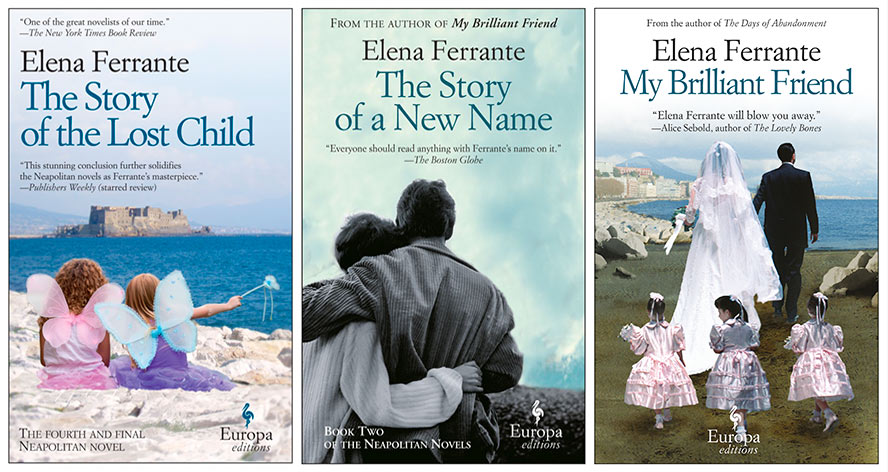
The covers of Ferrante's books annoy both Twitter users and art critics: the former brand them for vulgarity, and the latter complain that the level of vulgarity does not reach to be considered a postmodern
Courtesy Europa Editions
A film adaptation
Helena Ferrante's novels turned out to be a good film for the film adaptation: the film “obsessive love” was shown in Cannes, and “Days of Loneliness” were included in the program of the Venice Film Festival. Today, the shootings based on the “Neapolitan Quartet” are discussed with might and main - together with the HBO channel Italian director Saverio Constantine, known for the films “Personal” and “Hungry Hearts”, plans to turn the story of friends in the television series. In addition, the project involved the production company Wildside, which worked on a young dad.
In an interview with The New York Times, Constance said that he was working on the script together with Italian writers Francesco Piccolo and Laura Paolucci and hopes for cooperation with Ferrante on Email Real. According to the director, the biggest difficulty in television adaptation is “to convey the same emotions that are in the books with a cinema.” According to Hollywood Reporter, the series will consist of four seasons, eight episodes in each.
The journalist The Guardian Brian Moylene predicts the likely success of this adaptation: “Given the commercial success of the four books and recognition of critics, it will be the long -awaited and popular film project, regardless of who it is intended for.”
#FerrantEfEver
After the “my ingenious girlfriend” was translated into English and diverged around the world with millions of print runs, a hashtag #FerrantEfEver appeared on the network, symbolizing a general hobby for the Neapolitan cycle.
The Tracy reporter Mcakeda notes that, due to the incredible popularity of Ferrantea, Naples, “has long earned a reputation as a dirty and dangerous city,” is experiencing a real tourist boom. Moreover, working quarters are of no less interest than traditional attractions like ancient palaces and churches. “The fever of Ferrante is gaining momentum in the city itself,” McVe continues, “since bookstores and restaurants can boast of that are associated with the plots of four novels.”
The fact that the degree of universal love for Ferranta continues to grow, writes in The New York Times Alexander Alter: "The delight of reading the novels is so great that it is described from an epidemiological point of view, which is why this phenomenon sounds almost like an infectious disease." According to Alter, the Neapolitan Quartet has become a kind of commercial blockbuster - world sales in English exceed three million copies.
The popularity of Ferrante inspired Jakomo Durci to shoot a documentary with the speaking name “Ferrante Fever”. Filming will cover several cities, among them New York, Naples, San Francisco and Turin, according to journalist Camillo de Marco on the website of Cineuropa. “My interest in the project was born from the all -consuming passion for Ferrante's books and the desire to explore the plot in all its multi -sos. This picture affects extremely urgent problems, including the value of anonymity, which provoked unprecedented debates. I will try to give food for thought about the special reasons for her success, and I will not succumb to the temptation to make a “gossip” documentary about the secret personality of the writer, ”the director said.