
Translated material
Voinbu's voice
About Kim Jandry Kimsuk and her novel "Grass"
During the Second World War in the territories occupied by Japan, tens of thousands of girls and women were in sexual slavery. After the war, this topic was silent for a long time, and the Japanese government has not yet brought apologies to the victims, limiting itself to only monetary compensations. The fate of one of the women in a military brothel at the age of fifteen is dedicated to the documentary graphic novel by Kim-Jandry Kimsuk “Grass”. Orientalist Maria Zetrova tells about him for readers of Gorky.Kim-jandry Kimsuk. Grass. The story of "women for comfort." M.: Bumpniga, 2021. Translation from Korean Ekaterina Zholkova, Ro Ji Yong and Alexandra Krapivina. Content
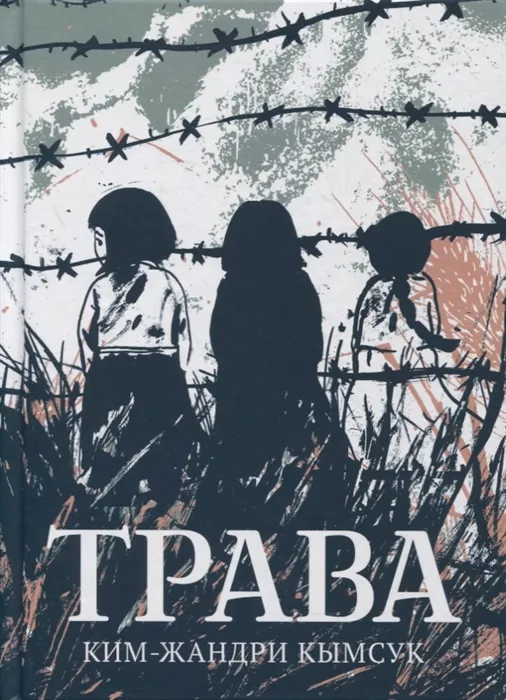 “Women for comfort”-in Korean Vianbu -crafty euphemism, applied to women, girls and even girls who worked in Japanese military brothels during World War II. Among the Vianbu were representatives of different nations and countries, but the documentary novel “Grass”, created by Korean Kim Kimsuk (after marriage, she added to her and the name of her husband-French-Zhandry), tells of her compatriot named Lee Okson.
The main character of “grass” is an unexpected character, this is a real person. Now she lives in South Korea, she is 94 years old, and she is one of the already few living witnesses and the immediate victims of the crimes that were happening in Korea when she was a Japanese colony (1910–1945). Lee Okson was at the so -called comfort station at the age of fifteen. In broad daylight, when the girl was returning to the house where she helped the household, unknown people grabbed her, threw her into a closed car, in which the other unfortunate people were already sitting, and took away from Korea to East China. So she became a “woman for consolation” - without rights, without loved ones, without medical care, unable to even escape.
Once again, Lee Okson was able to see Korea again after half a century. “It took me fifty-five years and only two hours on an airplane to return home,” the heroine says at the beginning of the book. But in the homeland, her ordeals did not end: there were no relations with the newly acquired relatives, I tormented the longing for those who remained in China to relatives. In the end, Lee Okson was in a remote suburb of Seoul, in the state boarding house, organized by the authorities for the Korean victims of Japanese sexual slavery surviving her century. To date, there are only fourteen of them.
In the Korean public field, the Wianbu problem for the first time sounded in the early 1990s, when the most daring of these women decided to openly talk about their past and demanded to restore justice. Since then, attention to the topic of “women for consolation” does not weaken at a very different level: from interstate relations and serious scientific research to works of art.
“Grass” does not just tell the tragic biography of a girl from a poor family, whose life turned out to be a brush in the fire of Korean history of the 20th century with her colonial experience, wars, poverty and backwardness, universal bitterness, gender and social inequality, xenophobia. Together with the author of the book, the reader painfully, in several stages, plunges into the theme of Wianba , trying to explain to himself how it turned out to be possible “with our grandmothers”, how to preserve the living soul after everything experienced, and most importantly, how we, living today, be with it. The novel does not allow to dismiss, to distract himself with everyday worries from Lee Okson, from these women, who still live somewhere nearby, as well as from thoughts about other victims of human cruelty and indifference. And this, perhaps, is the most important thing that gives us the reading of “grass”.
A military brothel is a place that in itself is terribly imagined, and when you find out that the girls were taken there by force or lured by deception, promising to help their families or give earn money to study, well -known mental powers are needed so as not to quit reading. The topic is so heavy and painful that it requires a special language and approach. It is the means of graphics that allow it to tell it carefully, delicately and at the same time truthfully and very sincerely. Kim drawings are gentle, they have a lot of love for his heroine, a lot of sympathy. And you return to them, even having read the story to the end. Thanks to them, reading the “grass” is not scary, although there are certainly many heavy pages in it.
In the novel, we literally hear Lee Okson's voice, because the book was built in an interview that Kim Kimsuk conducted with his heroine. True, the term “interview” is unlikely to be suitable for those conversations that Kim and Lee from time to time. The author leads himself in the novel, honestly and even with humor, telling how she was confused at the beginning of her work, how she did not know what to ask how she was afraid to once again upset the elderly interlocutor. In the afterword, the author recalls that I did not initially plan to write about Vianba , but wanted to make a book about the situation of women in Korean society as a whole. But it was precisely familiar with Lee Okson that the author realized that each story was unique and even the story of one fate could show all the inhuman horror that occurred in those years with a huge number of women in Asia and, in fact, destroying their lives.
According to various estimates, several dozen to several hundred thousand women from Korea, China, Burma and other territories occupied by the Japanese Imperial Army passed through the “consolation stations”. Having lost in the war, the Japanese hastily left their former colonies, throwing both the stations themselves and their scolded workers to the mercy of fate. But freedom did not bring relief - few of these women were able to return to their homeland: there was no means, a feeling of shame and guilt was burning, there was no one to ask for help. Many of them were illiterate, lost their health and the opportunity to have children, spoke poorly in the language of those countries where they were. Did these women have a chance to live a normal life? Did they wait for them at home, especially with such luggage? According to the bitter irony, there was no consolation for these women, even when the war was replaced by the world. Now they had to withstand the torture of public condemnation.
Since January 1992, the former Vianbu every Wednesday went to the Embassy of Japan in Seoul with the requirements of official apologies and compensation. In 2011, a monument was erected there all the victims of sexual slavery-a touching figure of a Korean teenage girl, dutifully sitting on a chair and looking in front of him. The Japanese authorities reacted painfully to all this, the problem exacerbated the already complex Korean-Japanese relations. The situation was aggravated in 2015, when the government of Park Kyn Hy (the first Korean-woman President!) Agreed to the proposal of Japanese Prime Minister Shinzo Abe to create a joint fund, from where the payments will go to injured women. After that, the parties announced that the problem was solved and there was no need to return to it. Such a turn of events outraged the former Vianba , and the activists supporting them, and the Korean society as a whole. The Japanese authorities simply bought off the problem, without even meeting face to face with victims of war crimes, without apologizing immediately before them. The replaced Pak Kyn Hye President Moon Jae in canceled the decision of his predecessor and continues the struggle. One of its participants, Kim-Zhandri Kimsuk, her contribution was the novel “Grass”, which was released in Korea in 2017, and in 2019 was published in English, attracting the attention of foreign readers to the topic of Vian .
In his homeland, Kim Kimsuk today is a recognized author. She was born and raised in South Korea, but in her youth she left to study painting and sculpture in France, where she lived for more than 17 years, but she did not lose touch with the house. Now she lives again and works in Korea, writes and illustrates both adults and children's books. By their own admission, Kim is more attracted by sad stories. The artist sees in them the beauty of overcoming, and it is she who delights Kim Kimsuk in all her heroes. It is no coincidence that the author compares his heroine and other victims with grass in the novel about Wianba , which is always reviving, even if the wind bends it or trample with his feet. So, this is a novel about hope.
The most famous work of Kim, in addition to “grass”, is the graphic novel “Waiting” dedicated to the author’s family history. When Kim was a student, her mother decided to tell her daughter her secret. It turned out that her mother had a sister with whom she had to part during the Korean War (1950–1953), she remained in the north, and since then it is not known whether they would ever meet again.
Kim Kimsuk and the novel “Alexander Kim, Korean from Siberia”, telling the story of Alexandra Kim-Stankevich-a revolutionary, one of the leaders of the Bolsheviks of Khabarovsk, who tragically died in 1918 during the Civil War. True, this novel has not yet been translated into Russian or other foreign languages.