
Translated material
"I am a fragment of old Moscow"
Artist Evgenia Lang about Remizov, Bryusova and White
The Oral History project, with the support of the Mikhail Prokhorov Foundation, digitizes and publishes archival and new conversations with representatives of science and culture of the 20th century. Viktor Duvakin, one of the pioneers of “oral history” in the USSR, on December 22, 1970, spoke to the artist Evgenia Lang, who told him about her life in pre -revolutionary Russia and emigration. Gorky publishes fragments of the conversation about how Remizov in Germany handed over to extend a passport painted by monkeys, Nina Petrovskaya shot at Bryusova, and Andrei Bely refused to play the ball with her. The material is completely available on the Oral History website.About the eccentricities of Alexei Remizov
Victor Duvakin. Remizov was incredibly weird. Everyone knows this.
Evgenia Lang. He was terribly weird. I went with him in Berlin once to change the passport. I had a shame there in the prefecture with him. With Remizov. Accidentally. And since I say well in German, I was pressed by Remizov.
V. D. And he spoke badly in German?
E. L. Yes.
V.D. Yes, what are you! He did not know languages?!
E. L. Here we come to the window. The German sits: red mustache, blue eyes open. I take Remizov’s passport, give this German out the window and say: “Here is a famous Russian writer.” The German is amiable, benevolent: “GUT, GUT, GUT, Schön, Schön, Schön. Well, we will extend it. ” Opens - suddenly changes in the face: “Donnerwetter! [Damn it! - approx. Ed.] What is it? " I say: "What?"
I didn’t open my passport, I didn’t look. There, some monkeys are drawn, on the passport.
Then the German says to me: “Er ist Verrückt? Crazy?" I say: "No, he is wearing." - "What is this? On the passport! On the official! " He turns to him and says to him: “Wer sind sie? Who are you? " And Remizov replies: “Ich Bin Affen König. I am a monkey king. " You can imagine - in the prefecture the effect! And this fool who came with him is me, you understand!
V. D. Ah, that's why you are angry! Now I understand that you ...
E. L. Fu you, Lord! Then I began to beg a Germans. In the end, I asked. He was polite by nature, he says: "Discard this passport." He even said the address where you can buy essence to withdraw ink: “Here on that street buy an essence and bring me a cleaned passport. I don’t extend like that. ” And Remizov molested everything: “What does he say? What does he say? " - “Well, leave me alone,” I say, “you are in what story ...” I will also say what he says.
V. D. Well, this is a wonderful story! What is offensive here? Not for you?
E. L. was simply disgusting.
V. D. I understand that you have experienced some unpleasant moments. But this is so characteristic of Remizov.
E. L. Now we went out with him, went to this store, bought this liquid for the brood of ink, and I say: “Remizov, I will go to you, and I will do it myself to make sure that the passport is clean.” “Of course, of course,” he agreed. Here we come. They lived from the German woman, the room is large. A large, fat wife in his white dress, behind a large blue bow.
V. D. who kept him very strictly.
E. L. Bolshoi, Tolstoy and behind a large bow. And here we come in - and I almost fall at once. It turns out that between two chairs the thread is stretched, and I stumble on it. The whole room in the threads is blocked. And some dead mice hung on the threads there, some insects-everyone, the devil knows what, the dirty tricks on these threads hung. I say: "What is this?" “And these are spells against evil spirits.” I say: "This is a stink, not a spell against evil spirits." I sat down and let him clean this passport. And at this time, for my happiness, such a musician, Nikolai, the brother of the famous writer in America ...
V. D. Nabokov?
E. L. Nabokov. Nikolay Nabokov enters.
V.D. And does Nabokov-writer have a brother-artist?
E. L. The cousin of Vladimir. Nikolai Nabokov is a composer, a musician, and Vladimir is a writer.
V.D. Here. The writer Nabokov-I heard that, who writes in Russian and in English?
E. L. yes-yes. And I clung to Nabokov, I say: “Listen, Nikolai, tomorrow you will go to the prefecture with him. I won’t go with him anymore. ” I cleaned my passport, handed it to Nabokov and untied it from Remizov, from the prefecture.
V.D. Well, so what, they extended his passport?
E. L. extended. Nabokov then came to me, says: “Well, I let it down! Lord, what was my explanation with the German! He says: "What, do you have all the writers so crazy?" I had to say that not all, no. ”
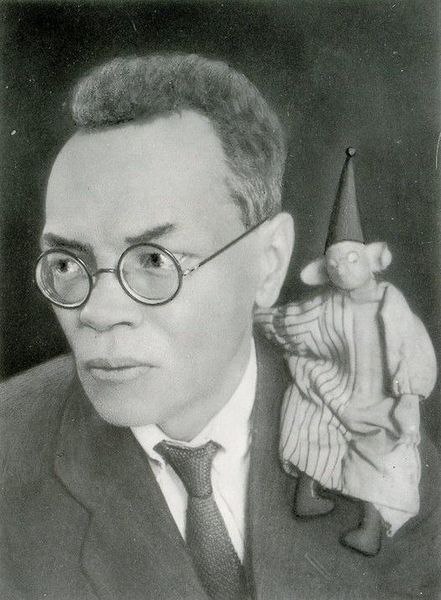
A.M. Remizov. Berlin, 1923
Photo: www.godliteratury.ru
About Alexander Miropolsky and Valeria Bryusov
E. L. And when I was a girl, it was for me ... After all, my brother was from this literary fraternity. But he was not a talented poet, my brother. He wrote under the name Alexander Miropolsky.
V. D. So this is Bryusov's ally!
E. L. Yes.
V. D. The first time this image for me ... This is a classmate of Bryusov in the gymnasium.
E. L. not <only> classmate, but a friend of his life.
V.D. Well, maybe. He, along with Bryusov, issued the first collection “Russian Symbolists” [the collection was published in 1894, most poems in it were written by Bryusov himself and published under various pseudonyms; One of the few real poets who took part in the collection was Miropololsky. - approx. Ed.].
E. L. Yes, yes. When I was born, my brother and Bryusov were eighteen years old. Both Bryusov and my brother taught me the Russian language and said: “Do not dare to ban! And then you won’t get sweet. ”
V. D. And you pronounced poorly?
E. L. I said so (imitates buckshot speech), I wanted to say that. Well, they scolded me, said: "You will not get sweets." I began to say how to say.
Who shot Bryusov?
E. L. Yes. And the whole story with Andrei Bely. All this happened in our house.
V.D. What is the story with Andrei Bely?
E. L. When the wife of Sokolov, such was Sokolov-Korchetov ...
V. D. I know, publisher.
E. L. Yes. I wrote poetry too. When she shot at Bryusov. With me it was a matter.
V. D. Who, the wife of Sokolova shot at Bryusov?
E. L. Yes, Nina Petrovskaya, writer.
V. D. Poetess.
E. L. Poetess.
V. d . She lived for a long time. She died in the Soviet years.
E. L. No, she died in Paris. She left.
V. D. Ah, excuse me, this is Nina Odoevskaya, this is different. And Nina Petrovskaya shot at Bryusova?
E. L. Yes, with me. From the revolver that my brother gave her.
V. D. Then it was possible to have a revolver.
E. L. I was delighted.
V. D. And you were a girl?
E. L. I was fifteen to sixteen years old. I said: "Sasha, how interesting it is!" And he grabbed me, says: "Let's go home!"
V. D. Sasha? Who is this?
E. L. Here is Sasha, my brother.
V.D. A, Miropolsky, yes (grins).
E. L. "Let's go home!" - “Sasha, wait, wait, it's so interesting! I never saw how they shot at someone ”(laugh).
V. D. And what did she shoot at him for?
E. L. She was in love with him.
V. D. in Bryusov?
E. L. Yes. Bryusov, obviously, looked a little, gave hopes - and that’s all, and in the end she, like a romantic woman, decided to shoot him. And Bryusov knocked out a revolver. So he knocked him out - and the revolver gave him to the ceiling. And she: "Ah!" - Fainted. And to whom did she faint? In the arms of his own husband, who stood a fool with a fool behind and grabbed her.
About Andrei White
E. L. I don't know. I knew him from the age of two: we lived nearby in the country. And Borya ... how is it? Bugaev?
V. D. Yes.
E. L. When I came up, I said: "Borya, do you want to play?" “I don’t play with the girls.” But he was older than me and despised me terribly.
V. D. Are you 89th?
E. L. No, I'm 90th.
V.D. Ten years difference! It would be necessary to be surprised if a boy of thirteen years old played with a three -year -old girl.
E. L. was terribly despised.
V.D. And what, was the summer house nearby?
E. L. nearby. And he stood like this, behind the fence. He was in a velvet suit, a pretty boy, with curls, and waited for my brother, because still Bryusov, my brother-all this was terribly impressed, instantly climbed to us when he declared. And I approached him and said: "Play the ball with me." “I don’t play with the girls.”
V. D. I see. It was boldly on your part (laugh).
E. L. And then Bely began to write poetry, and I was very envious of him: he writes poetry. And so he somehow forgot a white shoe. He had a white shoe embroidered with silver.
V. D. Wow!
E. L. He was then. And I was ten years old, I went to the gymnasium.
I took this shoe and began to wear it. Mom says: “What are you walking in someone else's shoe? This is Borya Bugaev. What are you dragging him? " I say: "Mom, maybe I will become infected - I will also write poetry."
V. D. selected?
E. L. was selected from me.
V. D. And the Blok did not see the young?
E. L. never.
V. D. is strange. Well, yes, at this time still ... wait, where are you? In Moscow?
E. L. We were Muscovites.
V. D. Well, yes, you are Muscovites, but you lived on the Kuznetsk bridge, and the Bugaevs lived at the university [Andrei Bely was born and lived with his parents for 26 years at the end of the Arbat. - approx. Ed.].
E. L. I do not remember where they lived. In any case, he came to us. And I last saw him in Berlin. When I was in Berlin, I still saw him.
V. D. How do you perceive him as a person? After all, by correspondence with white [reservation, with a block - approx. Ed.], With all his abstractness and anthroposophy, in my opinion, it has a very great sincerity?
E. L. He is sincere. Some of his feathers were airy, such his hair is airy, his enthusiasm ... He is sincere, but he lies a lot in his memoirs.
V. D. Vies, yes?
E. L. Very, a lot, just lies. Then he, of course, was a drug addict.
V.D. What are you?! This is the first time I hear
E. L. Yes.
V. D. Then this is explained.
E. L. He was a drug addict.
V. D. What is the drug addict?
E. L. I don't know. I do not understand them. In any case, when I came to him in Berlin, he was still asleep, he walked in a half -tuman so chaotic. Well, I stopped ... When I came across such painful phenomena, I always left. I don't like this.
About the fate of Nina Petrovskaya
E. L. So I only knew Nina Petrovskaya well.
V. D. She died? There?
E. L. She ended with her.
V. D. , after all, it seems, was also one of Bryusov’s mistresses, no?
E. L. She was married to Sokolov-Korchetov. He wrote near Krechetov. A rich man was. Such a dear person, but quite medium. Beautiful man was pretty. And she was madly in love with Bryusov. She probably was his mistress. I don’t know how it was, he threw her or not, but she shot at me at Bryusov.
V. D. did she shoot?
E. L. Yes. And the day after that he came to us Krechetov-Sokolov and said with my dad: “Alexander Alexandrovich, did you hear what happened yesterday?” Dad raised so gold glasses and said: "He heard, of course." “What should I do now?” Scandal for all of Moscow. Of course, all this is very bad that his wife shot at Bryusov. As I remember now, my dad said: “You know ...” How is it? Sergey? I forgot his name.
V. D. Sergey, yes.
E. L. and forgot in patronymic. Sergey Alekseevich, in my opinion.
V. D. S. A., it seems, yes.
E. L. Sergey Alekseevich, it seems. “You know, Sergey Alekseevich, now you are rich. What is worth it: take a first -class ticket and send Nina to Paris to live, and all this will be forgotten. ” So he did, by the way. My father advised him.
V. D. And then the revolution occurred?
E. L. No, after a few more years.
V. D. Sorry, when it was? You are a girl of fifteen years old, so this is about the 1905th year?
E. L. 5-6, like that, yes.
V. D. If you say, fifteen years old, then ... she stayed there, abroad?
E. L. She remained. He sent her money there before the revolution, while he had. What was next, I do not know. I once in the Russian newspaper read that Nina Petrovskaya, a Russian writer, shot himself [Petrovskaya committed suicide in Paris, poisoned by gas. - approx. Ed.].
V. D. This is after the revolution, in the 20s, when you were already ...
E. L. When I already lived in Paris, yes.
V. D. And she wrote good poems.
E. L. are good. And the stories were good. She was talented.
V. D. with a talent, yes. So this is purely Moscow ... but wait, who else was there? Sergey Makovsky, publisher ...
About the bookstore, publishing house and the environment
V. D. Sorry, I forgot a little, you talked about it. Did you have something on the Kuznetsk bridge there?
E. L. Bookstore.
V. D. Ah, bookstore.
E. L. A very large bookstore and a small modest publishing house. Dad sometimes loved to publish a book that he liked. For example, he published a “Nutcracker”, with a gold torn, with illustrations of Makovsky, that is, the father of Makovsky.
V. D. How could Konstantin Makovsky illustrate the Nutcracker?
E. L. illustrated poorly.
V. D. is completely incompatible. Hoffmann and such a householdist ...
E. L. He did not grab the Hoffmann style, no. It was a "Nutcracker" Moscow.
About Tolstoy and book publishers
E. L. I saw him once in my life, nothing more. I saw him in the store.
V. D. went to the store?
E. L. Yes.
Was he familiar with his father ?
E. L. That is, they were familiar, they knew each other.
V. D. And this is no longer historical, but my personal curiosity: as a book publisher, your father did not know another small publisher ...
E. L. He knew all the publishers, because he was the treasurer of the Society of Publishers.
V. D. Ah, even so! Well then, he would have to know ...
E. L. We were all with us.
V. D. was Alexey Alexandrovich Kartsev, Kartsev Publishing House.
E. L. Of course, of course, knew.
V. D. This is the godfather of my brother and my father's closest friend. I still have ...
E. L. We had hunger, Kartsev, Panafidin, Stupin - I remember them all.
V. D. Batyushka! It turns out that my grandparents on the same rope on the one of the one, because Kartsev was my father’s closest friend, and his son, Alexander Alekseevich, such a failed musician, later the editor of Muzgiz, died relatively recently, in the 50s ...
E. L. Kartsev was.
V. D. Then, probably, my father entered your store.
E. L. probably. And you know, with us ...
V. D. Did you publish medical books?
E. L. was also published sometimes, rarely.
V. D. Everything that you want, right?
E. L. It was a fantasy of his father: suddenly something appeared ... Here he suddenly published the “Nutcracker” with the illustrations of Makovsky.
V.D. The stores were not specialized then?
E. L. No.
V.D. In any store you could find everything you want?
E. L. Yes.
V. D. It was interesting.
E. L. And here we have about four times a year of publishers: Sytin, Stupin - they were the most ...
V. D. Ah, and Sytin was?
E. L. Yes, everyone was.
V. D. And Marx?
E. L. No.
V. D. Although Marx ... No, Marx Moskvich or Petersburger?
E. L. was such a shop Wolf.
V. D. Would!
E. L. And in Wolf there was a director who conducted the whole thing, Goraiser is like that. And with these Goraisers, with the boys, with Manya Goraiser, I was very friendly.
V. D. And Wolf published very beautiful children's books.
E. L. is about. Was opposite.
V. D. Devdariani was still a children's publisher.
E. L. I do not remember. But with these children I grew together.
V. D. You remember Moscow well. But I love Moscow so much!
E. L. and I also love Moscow. And what I regret: we had such wonderful books about old Moscow at home, what good publications, with engravings, with reproductions, which we just had no house! These are our bookcases. I recall this with pity that this all did not sink into eternity.
V. D. Yes, we have this continuity of culture very ... I don’t know how to resettle, but even within our human life ...
E. L. And our XX century was very breaking everything.
V. D. That's why I do this.
E. L. And I really are a fragment of old Moscow.
V. D. This is also another topic, terribly interesting.
E. L. Blue of the Old Moscow.
V. D. And you can tell little about the emigrant?
E. L. I did not rotate in these emigrant circles.