
Translated material
Shakespeare archipelago
EG PRATT, “Witch's Office” Margaret Etwood and the “Archipelago of dreams” of Christopher Pros
Twice a month, Gorky publishes a review of the new products of modern foreign prose. The new issue has continuous miracles and adventures: the first translation into Russian classic comics about the brave captain Corto Maltese, the modern retelling of the Shakespearean “storm” from Margaret Etwudus and a collection of strange and alarming stories from one of the best modern English science fiction writers. OGO PRATT. Coroto Maltese. The ballad of the salty sea. SPb.: Bumpniga., 2017. Translation from Italian M. Khachaturov 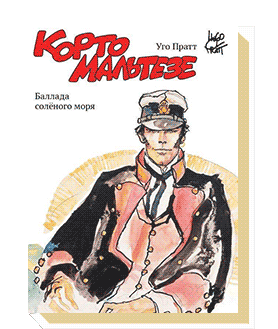 1913, on the nose of the First World War, and in the southern part of the Pacific Ocean, among the islands inhabited by the Aborigines, there are ships of pirates, adventurers and military military. And somewhere among them, Coroto Malteza swims, the most charming and the only noble of all. Humphrey Bogart in Ostap Bender’s outfits, he was born in the sixties, when the type of “a man who allows himself” was in high esteem. Over the past half a century, Fans of Corto Maltese created a whole cult around him. Now, finally, his adventures come out in Russian. “The Ballad of the Salt Sea”-the first book of OGO Pratt about Corto of Maltese-was published in 1967 and brought him a reward for the best work of a foreign author at the comic book festival in the Angulem.
Even if I have never read the original comics, Ear Pratt, sooner or later you will stumble upon the Corto itself - on a T -shirt, watch, a mug and, of course, a cigarette case, because like every romantic hero born in the sixties, Coroto rarely parted with a cigarette. Its popularity is so great that today, twenty years after the death of its creator, he returns to the comics again, already with the hands of other artists. Such a sudden resurrection is quite in the spirit of the hero himself, because the main quality of the Corto Maltez is not in a chic smile, fearless or zorkid from a cap. Its main and real superpower is not to die.
There is an episode in the “Ballad of the Salt Sea” when the Corto is consistently saved from an enemy shot, remains alive after falling from a cliff in a burning car, repelled the attack of a giant octopus, releases from a captivity of a giant shell and is saved from a giant shark. Maybe his image will not work out immediately after reading the first comic book, but definitely one thing - the Corto of Maltese is almost immortal. It is precisely such, magically indestructible heroes in abundance were born after the Second World War. And for Pratt, whose father, an Italian soldier, died in a prisoner of war camp, this magical invulnerability was perhaps the most important thing. The first comic book is the most nimble of all, although the comrade -in -arms of Corto Maltese will be a mysterious monk without a face, and the main enemy will be a shaggy and cruel captain named Rasputin; The plot is still drifting for the unprofitable seas. But already in the next series, Corto Maltese will go on a real journey through space and time. Then, OGO Pratt will finally turn the Maltese Coroto into a myth: he will wander through strange worlds, combining realistically historical signs with elements of fantasies and dreams, meet with historical personalities, will even fall into Atlantis. But in the first comic book, the hero is still completely from the flesh and blood - and this reality corresponds to another important request of time. “The Ballad of the Salt Sea” is a story not so much about adventures, voyages and small Polynesian peoples, but about the search for a good person in a motley crowd of a wide variety of heroes. And about the need to believe that sooner or later this, good, is found.
Margaret Etwood. Witch's outfit. M.: Eksmo, 2017. Translation from English T. Otidaeva
 “Witch's Office” Margaret Etwood is the first book from a series of modern retelling of Shakespearean plays invented by Random House. The second, “Winter Fairy Tale” in the retelling of Junet Winteron will be released, and the project itself promises so much interesting that I really want to survive to McBet performed by Yu Nesboe or Hamlet in the Gillian Flynn version. In the end, such projects, superstar and poppy, were invented exactly for the WAU effect to tease and entertain the reader. What could be more interior and safer than watching fights and passions, not afraid to get lost in the plot? But it is enough to know Margaret Etwood, the author of the novel “The story of the maids”, whose television screenization has just released, and masters of modern antutropios to understand that she will not portray Shakespeare for entertainment. And the play is not the most fun - for retelling, Etwudus chose the “storm”, his most difficult text.
A lot of questions are really related to the "storm". There is little action and a lot of conversations in it: the plot is almost not developing, everything is the main thing in retelling, the hero is a wizard, on stage instead of people - goddesses and perfumes, riddles and metaphors. The play can also be read as the summar of some life results (the path of Prospero from revenge to forgiveness), and as the ornate allegory of the theater-not without reason, Prospero himself says in the final that only spectator applause can truly free him from captivity. They loved the “storm” and began to put only in the twentieth century, for the modern director this production became a kind of creative manifest-about the world as a theater and the theater as a compounded illusion here more than in any other play of the world. Is it possible to transfer the “storm” entirely from theatrical stage? Etwood is not even trying, her Prospero our days become a theater director. In the same way, with a clumsy, but undeniable grace, she decides that it is impossible to do in the “storm” without interpretations of the play itself - and prisoners of an imaginary Fletchian correctional colony that put the “storm” in this novel, these interpretations provide us with excess.
In general, the tribute of respect to Shakespeare is given in full. But this does not at all make the Witch's Office a boring novel. Quite the contrary-the story of the protagonist, director of Felix, expelled from the artistic leaders of the theater festival, is almost more entertaining a fairy tale about the Shakespearean Duke-Volzhebnik Prospero. When Felix is ascended from the theater, he leaves for the wilderness, hiding under the pseudonym, lives alone, speaks with the ghost of his deceased daughter Miranda and plans revenge. Many years after the expulsion, Felix finds a job in the Fletchian correctional colony, where he disgraces and puts Shakespearean plays with prisoners. When he finds out that his offenders will come to the performance in full composition, he comes up with elegant revenge - a small theater adventure with an unpredictable ending. Isn't it like all Shakespeare's plays are taken together. We are not always ready with enthusiasm to listen to the monologues of the heroes, but in the same way as the audience of the 16th century, they are fascinated by changing clothes, tricks, the ingenuity of the heroes, and the comic ordeals of villains.
It seems that, despite the external presence of computers, YouTube, mobile phones and theatrical festivals, the outer background of Etwood is conditional, and the “storm” transferred to the present has not become a play of the 21st century. It is better: the more serious and diligent to portray Shakespearean passions in our time, the less they are believable. But magic really surrounds us everywhere: whether it be magical tricks of technology or the skill of a director who can turn Disney plastic dolls into goddesses, sew a magic mantle of gutted children's toys and force the “spirits”-to come up with a true passion to Caliban monologues in the spirit of hip-hop. Or switch to curses from Shakespearean plays - the hot you are a plague, witch's spite, a miserable jester, a toad of a tribe.
Christopher Pristress. Graz archipelago. M.: Eksmo, 2017. Translation from English by M. Klevetnko, M. Kazan, M. Pavlova
 It is pleasant when Hollywood works for us: only after the novel by Christopher Pros “Prestige” was filmed in 2006, we began to seriously translate and carefully reprint his strange and, despite the genre definition of “science fiction”, not always fantastic prose. Most of these reprinted novels are combined into the general series “Graz Archipelago” with the through image of the archipelago of various islands, beckoning from the outside, but frightening, it is only worth being on them. And the very collection “The Archipelago of the Dreams”, which in English first published in 1999, was compiled from stories written even earlier in the 70s. This is a praarchipel, the basis of the foundations of his fantastic world.
The stories are united not only by the place of action: everywhere the hero tries to break through to the true meaning of things and nowhere will be given the final answer. The dystopic world of the Proses is only initially similar to all other anti -utopias. Instead of reading a notation at this place, explaining in detail what is wrong in the world, he prefers to feed the reader with images-metaphors-whether it be a wall in three human heights, ghosts, a severed children's hand or a giant poisonous insect. These fears, which have made into reality prose prose and firmly fixed there, turn banal plots into parables and make up the main charm of its simple prose.