
Translated material
Anarchy and soil
One hundred years to Roman Knut Gamsun "Juice of the Earth"
In 1917, a hundred years ago, the novel “Joki of the Earth” Knut Gamsun was published, for which he received the Nobel Prize. At the request of Gorky, Roman Senchin recalls this outstanding work and tells how the story about the hermit cultivating the land can be useful to a modern city resident.2017 is a special year for us-the year of the century of two revolutions. All other events fade in comparison with these, or even completely forgotten. But in 1917, when, it seemed, not only Russia, but almost all of Europe, in its north, in the Norwegian Glukhomani, was written one of the greatest, in my opinion (which has not changed for the third ten years), the novels of world literature-the “juices of the earth” of Knut Gamsun.
I learned about Hamsun quite late. It was probably 1994, for me - over twenty. Okarev (I won’t pick another word) from Henry Miller’s “cancer tropic”, I decided to show him to my father ... After a couple of days, he returned the book to me with the words: “Yes, this is darker than the“ hunger ”of Knut Gamsun.”
There was no Gamsun in our home library, and I went to the city. There was only the second volume of the collected works - in such green covers it came out - the first volume with “hunger” was in his arms. I took the second and began to read. “Victoria” ... I do not remember the content of this novel at all, but the music of the language remained with me, probably forever and made me frantically read everything else written by Gamsun.
After many years, two works remained - “Hunger” and “Juice of the Earth”. At first, the “hunger” was the main one, and I returned to it many times, and then now - “juices of the earth”. However, for me it is a diptych with two polar topics. In “Hunger” - a stone city and a person in it without work, without a roof over his head, without a woman, without a penny in a pocket. In the "juices of the earth" - the soil that gives a person without a roof over his head, without money and housing, and food, and money, and a woman, and children ... Touch the ground with a shovel, and she will nourish you with his juices ...
Recently, I often meet a different name for this novel - “Fruits of the Earth”. Maybe it is more precise - I do not know; Maybe a new translation closer to the original. I read the one, old, Nina Fedorova. Rather, in a book published in the early 1990s. The book is already all destroyed, pages are greasy, but from this even more attractive, as if soaked in juice.
Gamsun with translators into Russian seems to be lucky. Largely thanks to them, who possessed an undoubted artistic gift (among the current translators, this, in my opinion, is a rarity), Hamsun was considered almost a Russian writer in the late 1890s and early 1910s. At least, many critics of that time, listing the best authors, placed Hamsun along with Leo Tolstoy, Chekhov, Gorky ... About “Hunger”, “Mysteries” (in which Tolstoy gets), “Pan”, “Victoria” at that time, hundreds and hundreds of articles, and reviews were written at that time. Some works went out in Russia earlier than in their homeland (which happened only with the most popular) ... with "land juices" more complicated.
When this novel was published in Norway and some countries of Europe, Russia was not up to great literature. In my opinion, in Russian, the "juices of the earth" first saw the light in 1923 at the publishing house "Red Nov." Today it is a bibliographic rarity, but I managed to flip out not so long ago - they didn’t give it to my hands - a book. An indication that this is not even a translation, but processing (the author of the processing Viktor Mujel) is fair. Roughly speaking, something like Robinson Crusoe Korney Chukovsky.
But this publication of processing is important. The “juices of the earth” could not exit either earlier - during the time of military communism, nor later - during the years of collectivization. In fact, this novel is absolutely anarchist.
Anarchism in a public representation is drunken guys in vests and with Mausers, it is destruction and chaos ... Anarchy is a word that has long become synonymous with chaos. Anarchy of citizens is frightened by any state power in moments of protest unrest, too much manifested freedom of speech, conscience and everything else. And the anarchy in harmony became synonymous with anarchism.
But we can recall that even Leo Tolstoy called himself an anarchist that Peter Kropotkin proved in his books that with anarchism, discipline would be stronger than if the form of state structure that arose somewhere in Mesopotamia and especially not changing over these thousands.
Yes, by the way, the amazing cover of that edition of 1923. The biblical appearance of the husband stands on a dug black earth. In the right hand of the shovel, the left lies on the side. The look is both harsh and affectionate at the same time. The view of the owner.
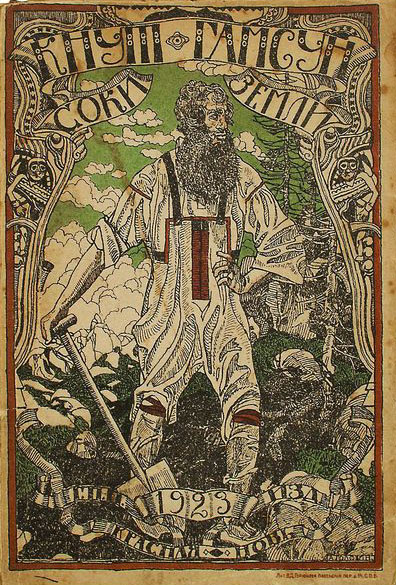
"Lights of the Earth", 1923 edition, cover
Image: auction-imperia.ru
And the plot ... The plot of the book is simple to the limit (modern writers, even subconsciously focused on action, are unlikely to see food for a whole novel, especially for an epic breath novel): somewhere in a deserted wilderness-“a whole day of the path from the nearest housing” comes-a man named Isaac comes. Small, ugly, clumsy. Obviously did not find his place in the big world, where the struggle among themselves is competition, pushing with the elbows.
He needs a woman, a “worker”, how he is trying to convince himself. But no one wants to settle in this corner, far from the rest. And yet the woman comes. Inger. She is as outcast as he, even stronger, has ugliness on her face. The hare lip ... Isaac and Inger begin to live together, expanding their plot in a meter, conquering the land from wild nature.
The first time I read the "juices of the earth" in 1994-1995. Remember those years? How many new or inaccessible before we fell on us. At least in literature. From Solzhenitsyn to Burrose ... The time was bubbled, frantic. And in Gamsun’s novel - difficult, as if the weak, who had left all his strength in his work, at a warm stove, in dark, without electricity, hut ... Day after day, day after day, he tells either his life or the life of a loved one. And this is the present, especially shocked me then:
“A person goes towards the north. He carries a bag, the first bag, in it foods and some tools. A person is strong and rude, he has a red -haired, stiff, like iron, beard and small scars on his face and hands - where he got these scars: at work or in battle? Maybe he fled from punishment and is hiding, maybe he is a philosopher, looking for peace and silence-but be that as it may, he goes and walks, no birds or animals are heard around, occasionally he mutters to himself some kind of word:-Ohhh, Lord! He says. Passing the swamps and going out to a friendly place, with an opened glade in the forest, he lowers the bag to the ground and begins to wander around the area exploring the terrain; A little later he returns, throws the bag on his back and goes on. ”
This is from the first page. But the ending:
“KLING LING! - They say bells high on the slope, closer and closer: the cattle makes his way home in the evening. Fifteen cows and forty -five pieces of small livestock, only sixty heads. There they go to the summer corral of women with many subinishes, they carry them on the rocker over their shoulder - Leopoldin, Jensin and little Rebekah. All three barefoot. Markgraphine is not with them. Inger herself is at home, preparing lunch. She paces the house, tall and stately, Vestalka, which maintains fire in the kitchen slab. Well, then, Inger swam around the stormy sea, visited the city, now she is again at home; The world is great, it is seething with many places, Inger also seethed. She was almost no one among people, an insignificant unit. The evening comes. "
There are several decades between these paragraphs. The birth of children Isaac and Inger, the transformation of their wilderness into the village. Inger lip surgery, for which they earned money for a long time, Ingger escape to the big world, years in prison and return. Instead of two goats and goats, now a whole herd. Instead of a dugout made of turf - a spacious house.
“The juices of the Earth” - “Robinson Crusoe” (according to the version of Chukovsky, and not Defoe, who has a Crusoe - a child of his greedy century), on the contrary). But for some reason, the plot of Robinson Crusoe (necessarily with a return to the so-called civilization) is much more interesting to us as stories as that of Isaac. But Isaakov is much more Robinson. Since ancient times, people left the tribes, the sailors escaped from the caravels and galleons and settled at the savages. Russia expanded and stretched out by no means because of the Cossacks-pimpers, but because of the peasants who strive to live and work freely. In fact, the Cossacks are the same peasants, but having weapons and do not have the owner (now this should already be celebrated). Perhaps the Old Believers, spirituality is rather an occasion to go away. Even to America, China ...
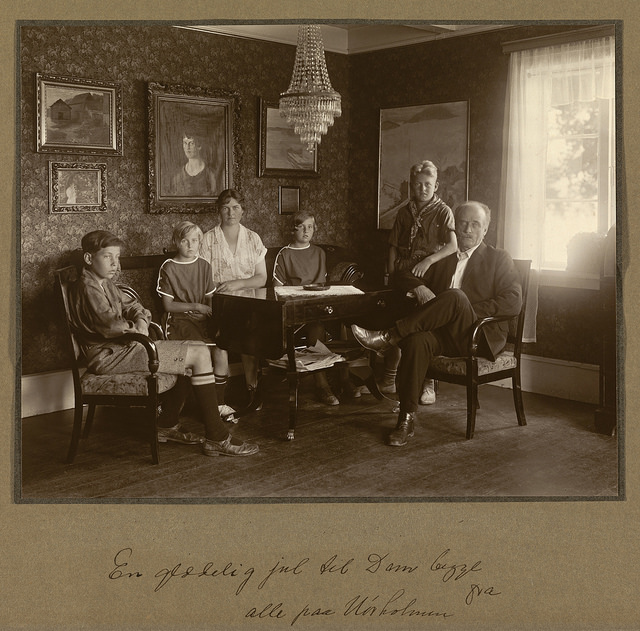
Knut Hamsun with his family, around 1926
Photo: Norway National Library
Recently, the word "self -building" sounds quite often. Self -building is considered a serious crime. Self -building must be demolished, its owner is held accountable. I don’t know how in other countries, but in Russia they always fought with self -construction. They burned since the time of Ancient Rus'. After all, everything should be taken into account, each person is attached to someone.
“Juice of the Earth”, of course, is an idealistic work. And the Nobel Prize in 1920, when Europe, having drank blood and bearing a series of revolutions and small (compared to Russia) civil wars, was more than fair to this novel. Nobel wrote in a will that the author should be awarded the prize, "creating the most significant literary work of an idealistic orientation."
But idealism is not idealization. “Quiet Don” is also an idealistic novel. And no matter how much I re -read it, I watched Gerasimov’s film, every time I hope that Gregory and Axinya will run away, hide, find their wasteland, and the “Black Sun” will not burn the earth.
I don’t know if Sholokhov read the “juices of the earth” then, in the 1920s. But in any case, nature, the highest mind was made in such a way that the brother of Gamsun’s book appeared in the Soviet Union. Native, but does not mean similar. Isaac with Inger two sons, Eleus and Sivert, but they are completely different, these are two opposite types of people. So the novels of Gamsun and Sholokhov are related, but the opposite: one from the desert to the flowering farm, the second has a blooming farm, turned into a desert ...
Sholokhov was right. He finished the “Quiet Don” when Europe again overshadowed. Gamsun had to see this fire; He tried to extinguish him, but instead he began to be listed in Hitler's allies.
In the Soviet Union, Gamsun was forgiven relatively early. In 1970, a two -volume was released. The one who made a great impression on my father. But there are no "juices of the earth" in it. In general, it is clear why. Free Isaac is not a positive example for any state. It is much more useful to him such as the hero of “hunger”. Beggars of cities that do not have families are ready for any work, for anything. The owners are dangerous.
In Russia, now it seems that a new campaign has begun to grow such owners. In the news, they talk a lot about the Far Eastern Hectar. But those who wish are not particularly observed. Minuses are heard: we have already passed-farming and everything else ... grinning, in general, are right. History shows that it is worth our Isaac to stand on his feet tightly, and he is cracking under his knees, and then pluck.
But let's, urban hostages, inhabitants of one-room, two-room chambers, open the “juices of the earth” and, if not personal, then we will recall the free Isaac. They were, and they are, but in distant, secluded, not discovered by the authorities with the police and the solers of the angles of the planet.