Date
Author
Александр Косован

Preserved copy
Translated material
Art from the landfill
Yegor Fedorichev is 29 years old, he was born in Barnaul, grew up in Omsk, studied in Moscow - first on a scenographer in GITIS, now at the School of Photography and Multimedia named after Rodchenko. Recently, he ended an exhibition at the Winery , where he set up installations made of industrial fabrics thrown into the trash of advertising banners and other garbage. Samizdat decided that Fedorichev was our man, and sent his author to the artist’s workshop.
Garbage
I knew a little about Yegor Fedorichev: he is the artist and does his work from what he finds on landfills.
He came to a meeting with me in a holey jacket, which, however, did not bother him at all. We met at the metro, shook our hands and went to his workshop, which is located on the territory of the former research institute of long-term radio communications. Entrance - according to passports and through turnstiles like in the subway.
On the way, they started talking about Pelevin’s last novel and contemporary art. I asked if he agreed with the Pelevin thought that the expert determines the value of art in our “gypsum age”, and the rest should simply accept his opinion on faith.
“It looks like the truth,” Yegor agreed. - You need to know the language of contemporary art in order to understand it.
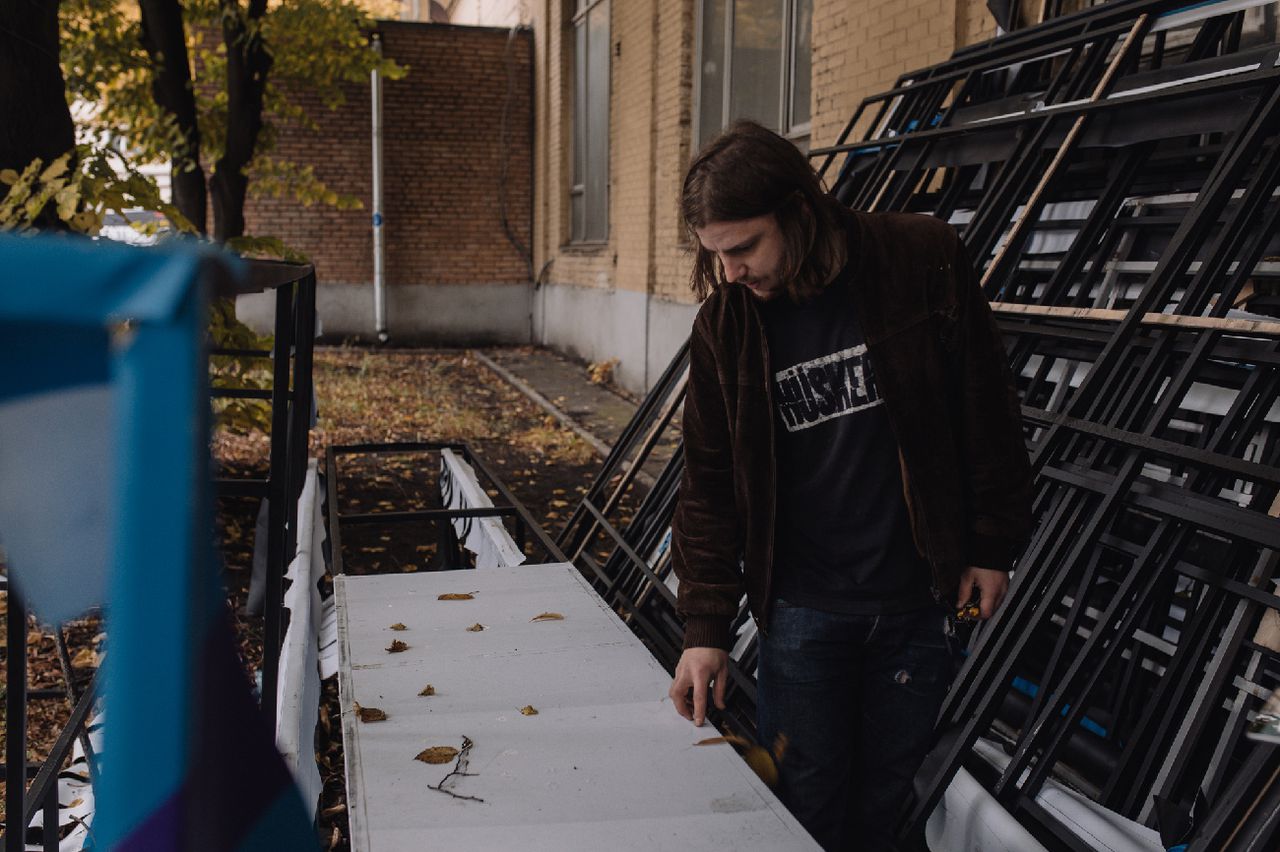
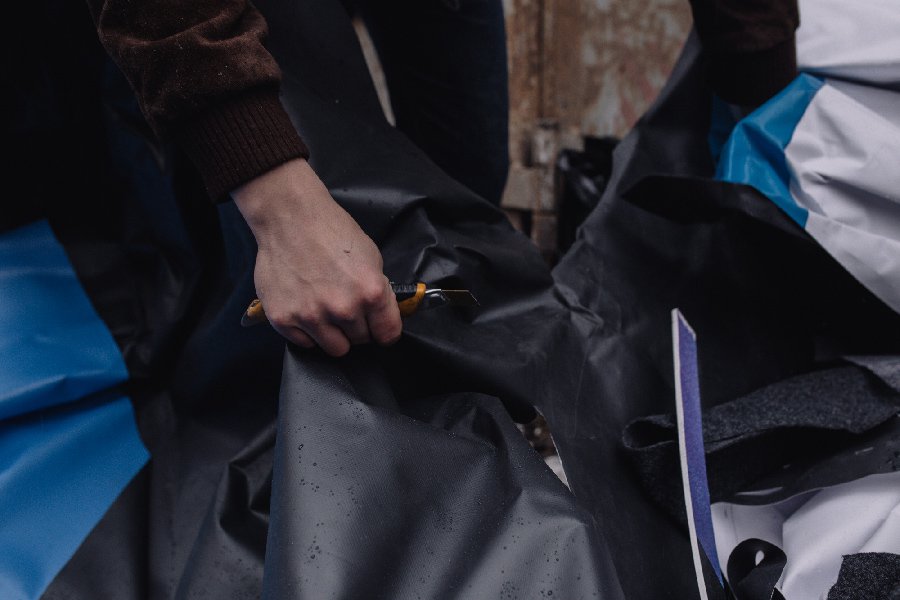
Suddenly he abruptly separated and quickly went forward - to a five -meter structure with a strained tarp, which lay next to one of the buildings. Yegor looked around several times, then took out a yellow stationery knife, pierced the tarp and cut off a large piece.
“Why are you cutting a tarp?” I asked. - For a new job?
- It may come in handy. Good tarpaulin. Look, ”Yegor showed me a trace of the fallen sheet on the fabric. - That's why I need it.
And he explained: if you put a blot on paper - it will be painting, but the man -made, and the fallen sheet, which left the mark on the fabric, is also a painting, but miraculous. “The painting of nature and time,” Yegor said. It turned out that he collects not only construction garbage, but also, for example, cuts political advertisements, which he then also uses in his works. Egor generally believes that all art is political.
“This is the only reliable document of time,” he reasoned on the way to the workshop. - History textbooks write to please the authorities, and by art we can understand what people actually felt during the creation of the work. Levitan was a Jew, we can consider his landscapes sadness as a reflection of the difficulties of the life of a Jew in the Russian Empire. After all, even from Moscow, Levitan was sent for its origin. Or “black square” - it is clear on it that people are tired of everything old. This is absolutely political work. So after thirty years they will judge what has happened in our years.
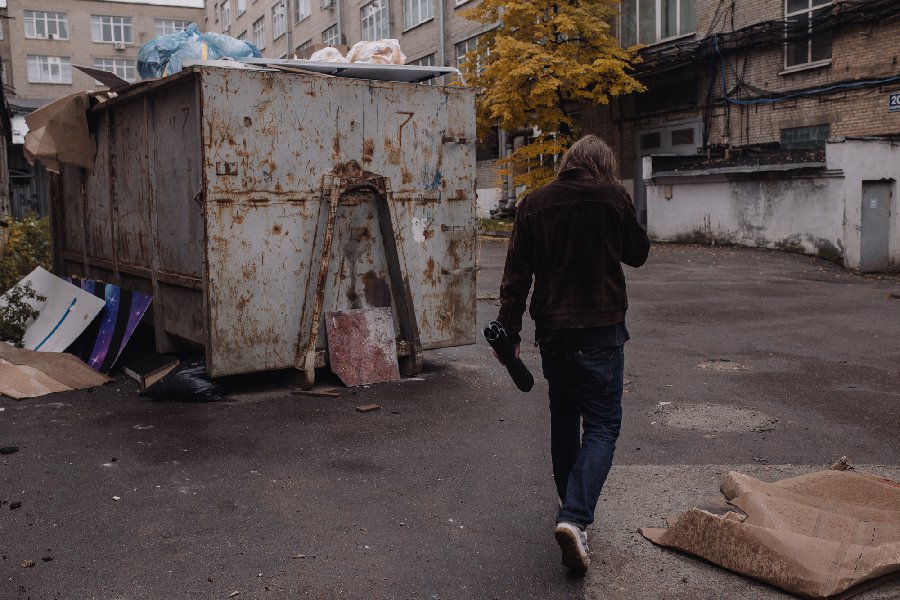
We stopped again - this time next to a large garbage container. Yegor noticed another tarp.
- Look, the flag of Ukraine! I will soon at the exhibition in Kyiv, I will do something of this.
There is no flag there. But on the tarp in the corner there are two stripes: yellow and blue.
Workshop
Very different people rent premises on the territory of the former research institute of long-term radio communications. For example, milling mills work here, who do something around the clock under the techno. Ossetian pies are also preparing here. Somewhere African music plays.
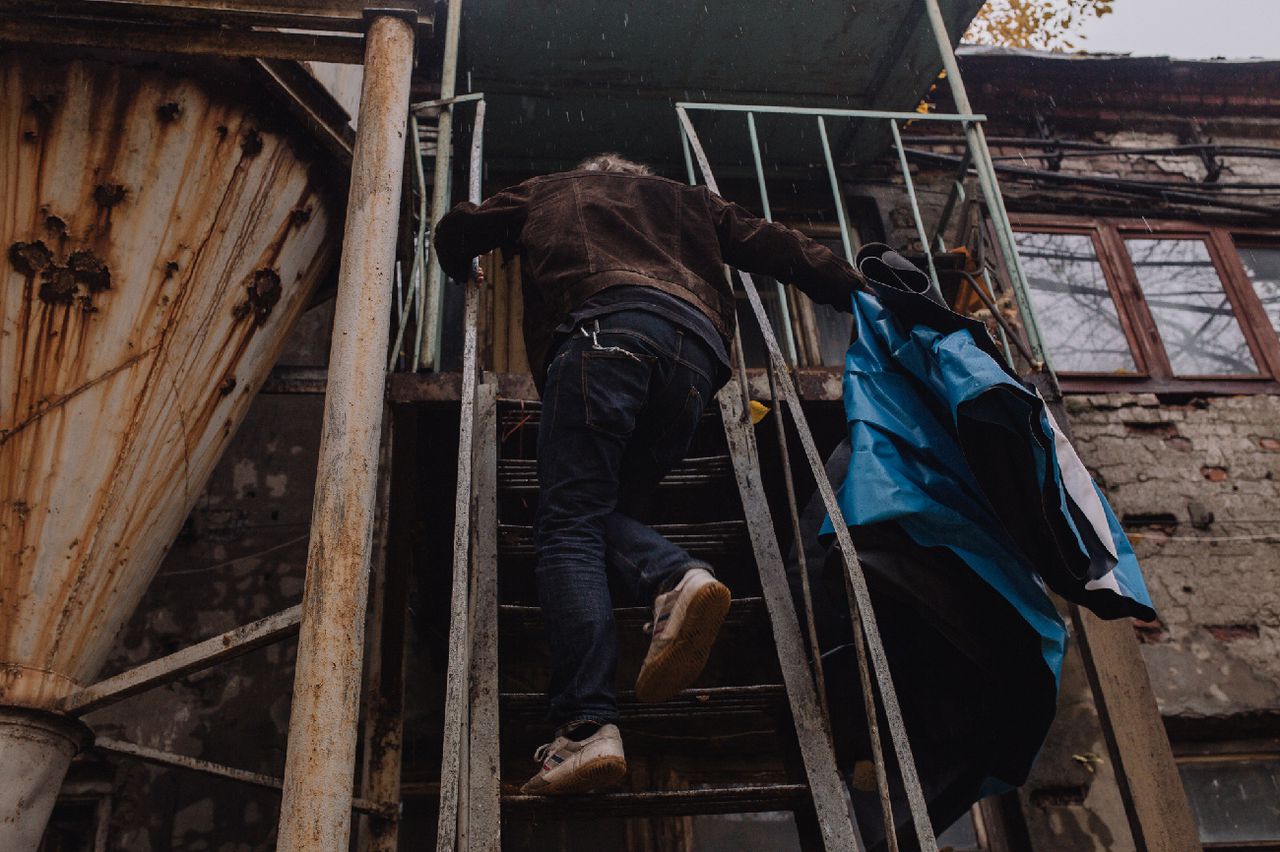
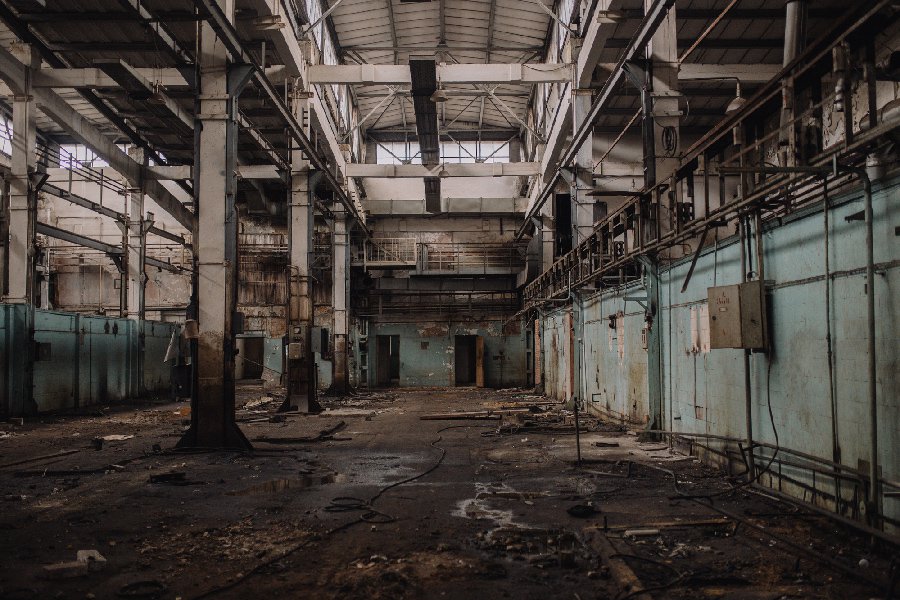
Yegor's workshop is in the building, which they were going to demolish this year. It is necessary to climb the second floor along the almost vertical staircase from thin iron rods.
“Just don’t be scared,” Yegor opens the door to the workshop. - There is a lot of rubbish, and it is also cold, except for me in this building, no one takes off. Well, I’m high, I'm a loner.
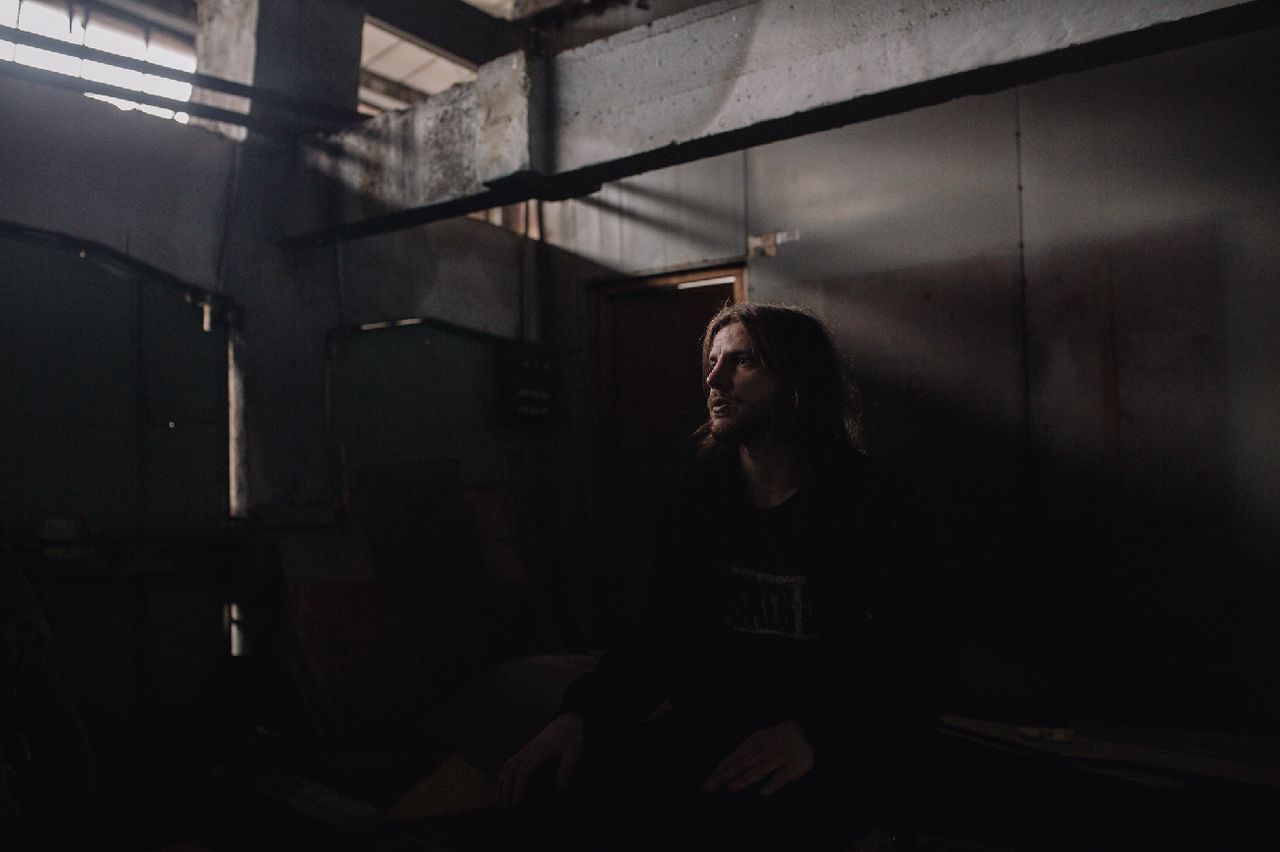
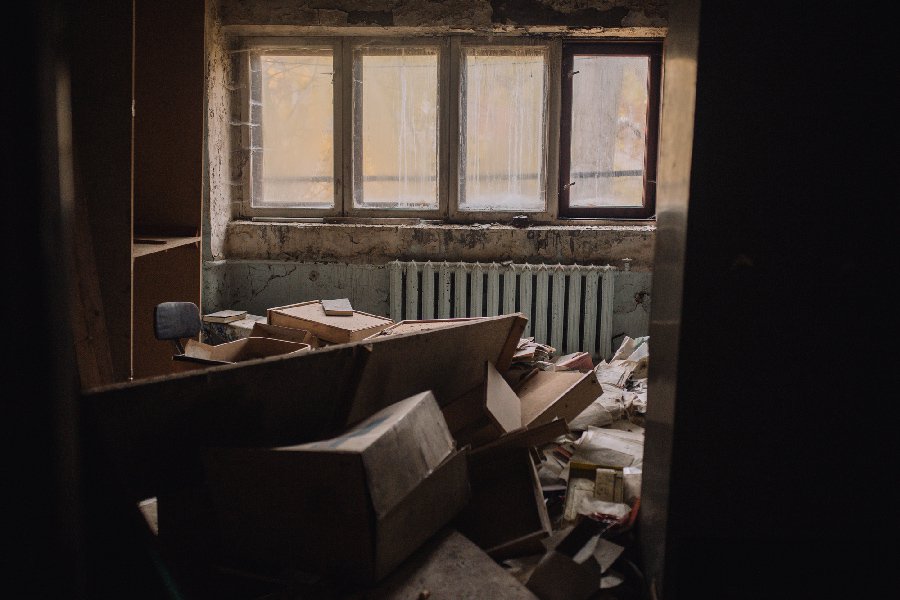
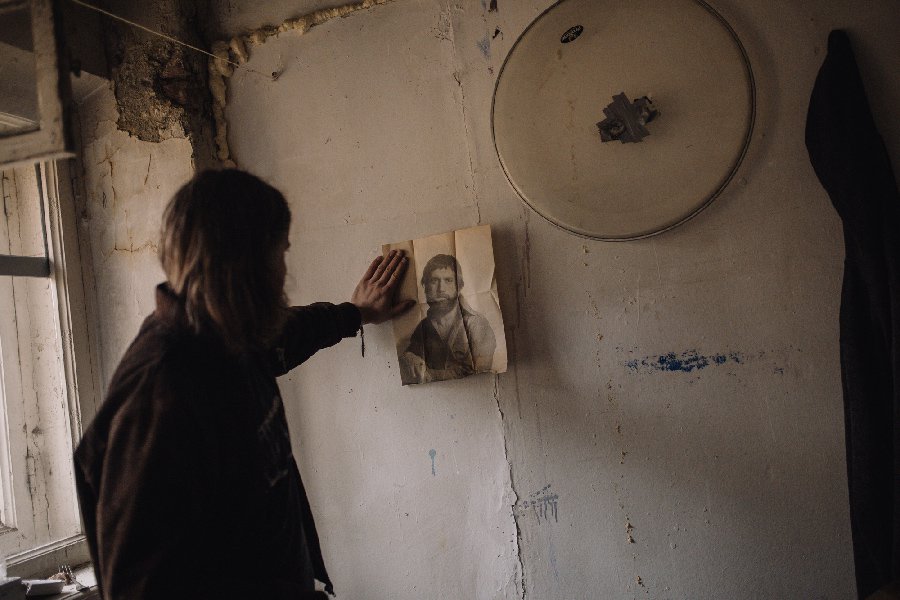
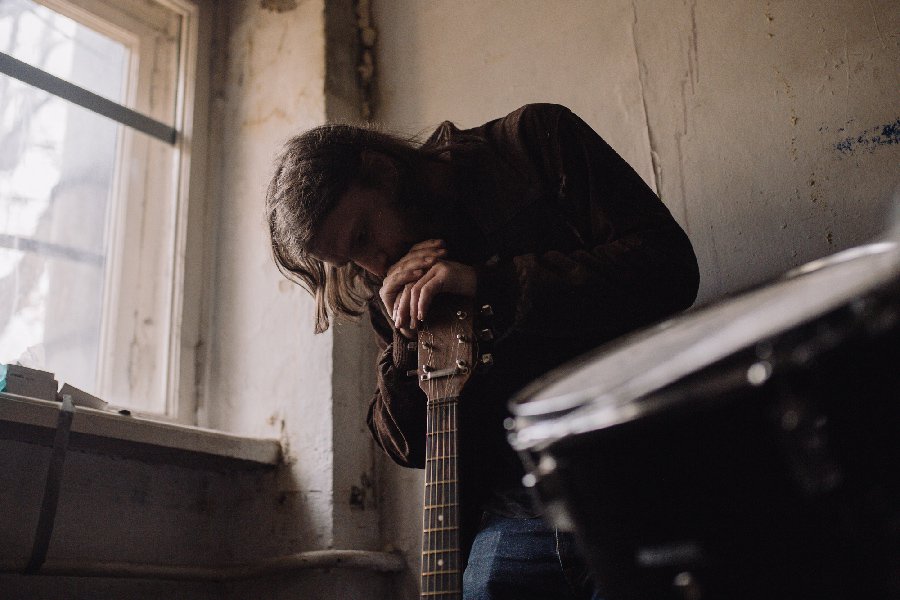
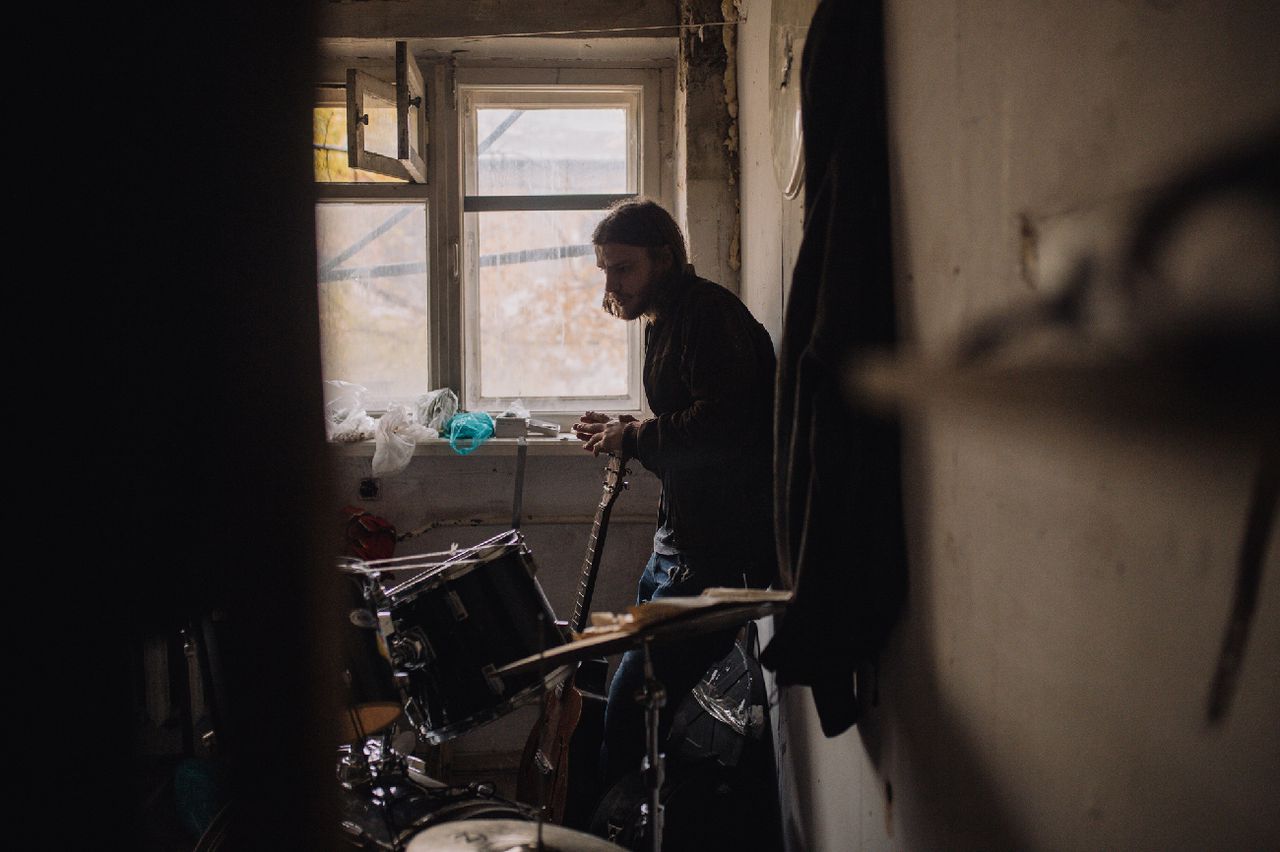
We pass into a dark room where there is no light bulb. Wooden and iron sticks stand in the corners, some trash is scattered near the walls. We go further - to the corridor. Then another room is the workshop. It is already lighter: a silver autumn light breaks through into large windows. In the middle of the room is a drum installation, by the window - a table littered with rubbish. Among other things, on the table you can see a small gas burner and walnuts. The walls are naked, without wallpaper, here and there there are many different pieces: sticks, lanterns, spotlights, bedside tables, tables.
“This is how artists are forced to live, this is where they have to create a new art,” says Yegor. - In a house intended for demolition. And our roof flows. This is because art is not supported by the state if you are not Sarik Andreasyan and not Nikita Mikhalkov. They are unlikely to create their work in such conditions. Therefore, art is politics.
Propaganda of Satanism
The rain begins. The workshop seems to be acquired by scope; Through the window, the room is filled with fresh air. Egor puts coffee in the Odessa clay Turk on a burner. He says that he recently found the old closet, dismantled it and made the second floor. The extension was just over my head - a cute iron ladder led to it.
Egor lives according to the workshops - he has several of them. True, you can’t sleep in this - the director will immediately terminate the contract. Often remains with his girlfriend.
I ask what he lives on.
“Now I help Volodya Logutov with the exhibition,” Egor replies, “I get some money.” Before that, there was a fee for my exhibition at the Winery. Even earlier, I painted a bar. One of my work was recently sold at auction. So I interrupt from case to case. There is no constant earnings and cannot be.
The artist explains that with contemporary art in Russia it is bad, and indeed with modernity-"it is very difficult to break through something new here." “Russia did not recover from the Soviet Union,” says Yegor. And again he returns to his thought that all art is political: “Politics are not people in jackets in the stands. This is a set of social and personal rules that a person follows. This is his attitude. Politics is about why it happened.
Therefore, I go to look for materials in the trash, and my works talk about today in Russia. ”


For some time he developed his argument about the collapse of the Union, said that this is the largest event in the life of a modern Russian man and reflection on the Union cannot be avoided. Then he gave the example of Serebrennikov as an example and told an entertaining story:
- In 2012–2013, I did a children's performance in the German fairy tale at the Barnaul theater. History about three brothers. One of them did not know how to be afraid, and the other two tried in every possible way to scare him. An old funny story for children. And in Barnaul, two hours after the premiere, the director and director of the theater sat in the prosecutor’s office and gave a recognizance not to leave, because the local official came to the performance with her daughter, who was about three years old, although the performance had an age of 6+, and this woman considered that the performance was too terrible for her daughter. We had an accusation: propaganda of Satanism for preschool persons. A mustachioed uncle in a jacket reported us: he said that you and your Moscow little things climb into Barnaul - the only city in which three volumes of Brezhnev were placed on the stage of the theater.
We laughed. Coffee is over. Egor put Turku again and continued:
- I do not represent myself as a person working in Moscow. You come to Samara or Omsk and think: “How nice it would be to become a city architect here. Work in time, go home in the evening. ” There, the atmosphere has stability. Moscow is a metropolis. It differs from the city. It was created for work, and a person here exists only for work. I do not feel part of this game, this is not for me. Once I worked in the theater by a butafor. He sat at the table and did not understand at all why all this was needed - this is the entertainment of people. Then I had an accident on a scooter and broke my shoulder. Then I decided that why all this was needed - not our business. I am given to me by God, the nature of the hand, and you need to do something with them. Thoughts are born in my head - they must be embodied. There are legs - you have to ride a skate.
The mythology of optimism
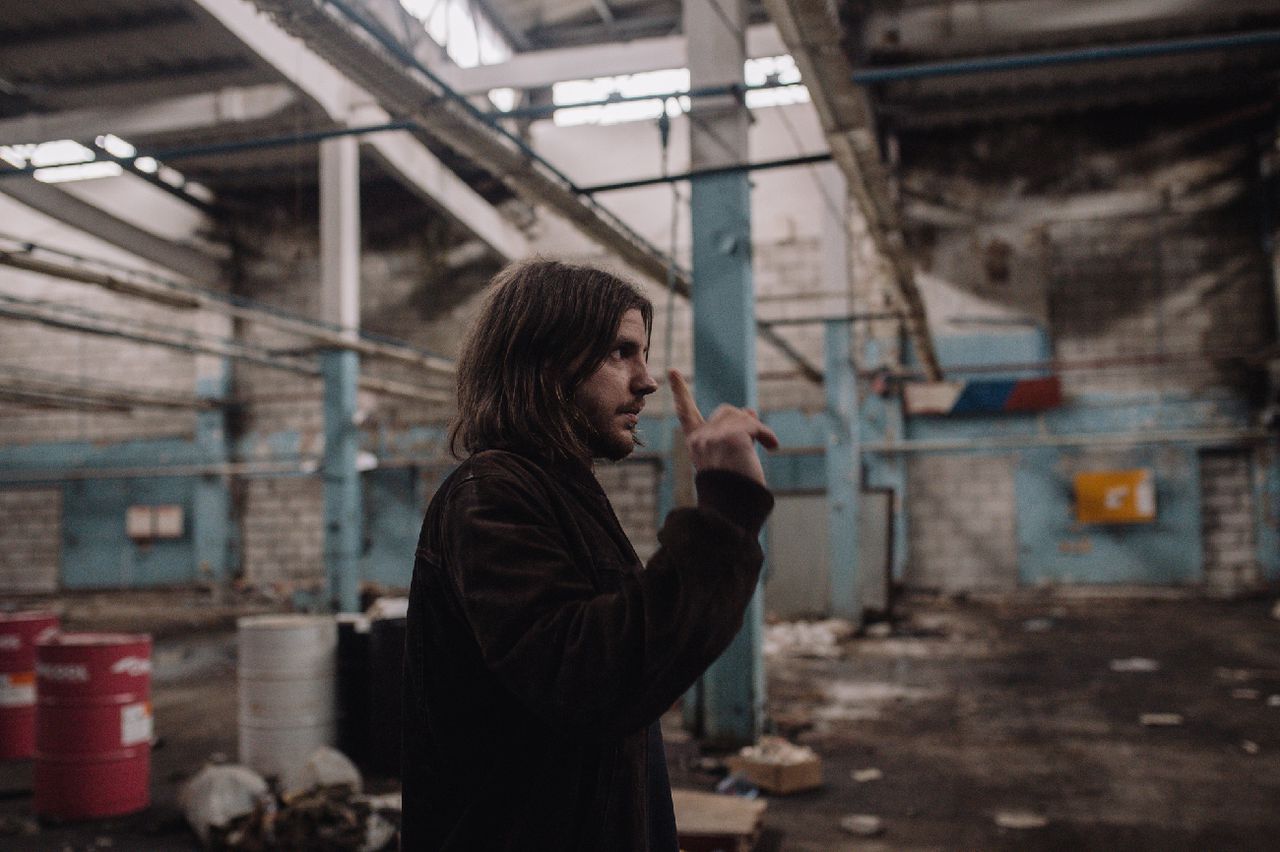
After the coffee, we went for a walk around the building of the former Institute of Radio, which was more like an abandoned plant.
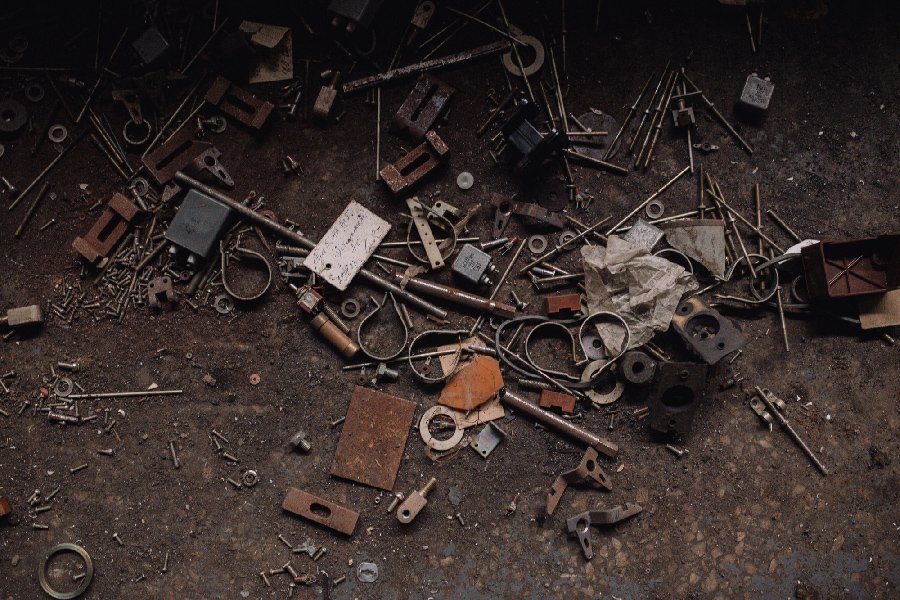
Wires are grinding under my feet, I am stammering on a large old castle - it looks like barn; around pieces of metal, metal squares and stripes; To the right of me is a helmet wrapped in white wires.
We stood under the image of the Russian flag on the wall.
“This plant is a time capsule,” Yegor said. - Here everything was sealed with the collapse of the Union. It happens that you are hanging for a long time, and then you shine with a flashlight on the ceiling, and under the ceiling a sign: "Do not enter without a suit." There is a giant number of cabinets that have been closed for almost thirty years. And so you open this closet, and there is a blouse and pants of a former worker. And a notebook with plans for what to do tomorrow. This is an amazing relationship of time. There is also an interesting place that has now been closed. There were a lot of all kinds of magazines and working calendars. All of them end in August 91st. What struck me the most: there was a room of some kind of electrician, triangular, without a window. And on the table was his Komsomol ticket. In good condition. Here is my student - in a disgusting state, and the Komsomol ticket after twenty -six years in good. This electrician for thirty years of birth, he lived all his life for the sake of the Union, and then, when he collapsed, this man simply got up and left. And left his party card. What was he thinking then?
“You have almost all stories about how you climbed and saw the Soviet Union somewhere,” I remarked.
- Well ... The last book that made an impression on me, "it was forever until it ended." On the one hand, how much you can already dance on the corpse of the USSR. But on the other, this cannot be avoided. After all, Soviet thinking has not gone anywhere. It only acquired other features-in some way even, probably, much more ugly. From the very beginning of human history, everything should have been different. We have always been sick. And the Soviet Union is also a disease. A disease that was not treated. The most colorful description of the USSR is the lines from the “Russian Field of Experiments” by Letov:
The geography of meanness,
The spelling of hatred,
Apology of ignorance,
The mythology of optimism.
During the tour of the plant, we found a table.
“You are here, like in Ikeui, you go,” I said.
- Absolutely. Only such a table in Ikea would cost five thousand thousand, ”Yegor answered. -Let's go upstairs, I have to show something else.
We climbed a very steep stairs and went into a very dark room. Before us blurred silhouettes of some wreckage.
“This room is straight from the movie Stalker,” Yegor said.
He climbed deep into it, and I turned on the flashlight on the phone. On the wall - a poster of the domestic "Lada" with a slightly rolled brown -haired woman. Something fell, I shone towards Yegor.
“I somehow made a cabinet for the miniature books of my friend’s daughter,” he answered. - I needed a piece of glass. At first I inserted the usual one, but then I thought that the girl could break it, so I decided to find a transparent plastic. I needed a small piece, but I did not want to buy one and a half meters for a million money. I was looking for - there is nothing anywhere. Found only trimming, they are all scratched. One morning, as soon as I got up, the first thought that came to my mind: you need to finish the locker today. I threw a sweatshirt and purposefully went into this room on some kind of autopilot. He turned on the flashlight, began to delve, and - one! - Almost immediately, I took out a sheet of Soviet plastic glass in a protective package of exactly the size that I need.
In the light of my flashlight, cabinets became visible. Yegor continued:
-After some time, I made repairs, and I needed to buy a lot of polyethylene. I looked in several construction stores, but I did not find exactly what I needed. And again, in the morning, on the autopilot, I went down to this room-and suddenly stepped on something soft. Three rolls of Soviet polyethylene in the package were under the foot. Here he is - "Stalker." The most interesting thing is that if you did not use all the material, then the room does not give anything new. This room should not be idle with this room.
The artist fell silent and climbed into the deeper.