
Translated material
Alexander Solzhenitsyn died
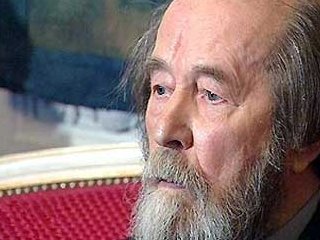
The outstanding Russian writer, the Nobel Prize winner, Alexander Solzhenitsyn, died at the 90th year of his life, on the night of Monday in Moscow.
As it became known to Interfax from sources in the literary circles of the capital, according to preliminary data, the writer struck a stroke. As ITAR-TASS specifies with reference to the son of the deceased, Stepan, Alexander Isaevich died at home. According to him, the cause of death was "acute heart failure." Death occurred at 23:45 Moscow time on Sunday.
Before that, Alexander Isaevich was sick for a long time, but continued to engage in active creative activity. Together with his wife Natalya Dmitrievna - the president of his fund - the writer worked on the preparation and publication of his most complete 30 -volume works.
“Yesterday, Alexander Isaevich worked all day, but he was gone at night,” Natalya Dmitrievna told the agency. “During the day, everything that concerns the funeral service and funeral, everything will be fulfilled in accordance with his will. He wanted to die in the summer - he died in the summer, he wanted to die at home - he died at home. In general, I must say that Alexander Isaevich lived a difficult but happy life,” said Solzhenitsyna.
Russian President Dmitry Medvedev expressed condolences to his wife and sons Alexander Isaevich Solzhenitsyn in connection with the death of the writer. This was announced by the press secretary of the head of state Natalya Timakova.
US President George Bush also grieves in connection with the death of the world -famous writer and expresses condolences to his family. This was announced by the official representative of the White House Gordon Jondro. "The president is mourned in connection with the death of such a supporter of freedom. He expresses condolences to the Solzhenitsyn family," said Jondro.
The only national newspaper USA Today celebrated on her website on Sunday that Alexander Solzhenitsyn did not live up to the first edition in English of his novel "The First". The newspaper recalled that less than a month ago, Harpercollins announced that his subsidiary Harper Perennial would publish a novel in 2009.
“The first” is one of the most important novels of the twentieth century, and we are proud that we can imagine this masterpiece in all its glory, ”said Carrie Kania, Vice -President of Harper Perennial. The abbreviated version of this book, 580 pages, was published in English in 1968.
Biography
Alexander Isaevich Solzhenitsyn was born on December 11, 1918 in Kislovodsk. His father, a lieutenant lieutenant, who returned from the front of the German war, died from an accident on a hunt six months before the birth of his son.
In 1925, his mother moved with her son to Rostov-on-Don, where Alexander Isaevich graduated from high school, and then the Physics and Mathematics Department of the University. At the same time, he studied two years before the war at the literary faculty of the correspondence department of the Moscow Institute of Philosophy, Literature and History.
Solzhenitsyn was drafted into the army. And since December 1942 he commanded a sound intelligence battery. He fought on different fronts. In August 1943 he was awarded the Order of the Patriotic War of the 2nd degree. He fought until February 1945, and, being in the rank of captain of the Soviet Army, was arrested for outright correspondence with a friend of his youth, which contained criticism of Stalin.
He received eight years of camps according to the famous 58th article and spent part of the deadline at a closed research institute, where prisoners were developing secret telephone security funds. On this material, his famous novel "In the First Circle" was written.
In 1956, Solzhenitsyn was released from exile and moved to the Vladimir region, where he taught at the village school for two years and lived in the house of the peasant Matrene Zakharova, about whom he later wrote the famous story "Matrenin Courtyard". Then he taught in Ryazan for several years and actively engaged in creativity.
A whole revolution in socio-political and literary life was made by his story “One Day of Ivan Denisovich”, which was published in the “New World” in November 1962 through the efforts of Alexander Twardowski. In subsequent years, this magazine printed four more stories, and all other works, including the story "Cancer Corps", were prohibited by the authorities, but some of them went to Samizdat.
The first publications caused a huge number of responses to writers, public figures, critics and readers. Letters of readers - former prisoners (in response to "Ivan Denisovich") laid the foundation for the "Gulag Archipelago" - an artistic and historical study on the Soviet repressive system from 1918 to 1956.
The Gulag Archipelago was written by Solzhenitsyn in the USSR secretly from 1958 to 1968 (completed on February 22, 1967), the first volume was published in Paris in December 1973.
In the USSR, the "Archipelago" was published in 1990 (the first chapter selected by the author of the chapter were published in the journal "New World", 1989, No. 7-11).
The phrase "Gulag Archipelago" has become a household name, is often used in journalism and fiction, primarily in relation to the penitentiary system of the USSR of the 1920-1950s.
It is noteworthy when last year Vladimir Putin awarded Solzhenitsyn by the Russian State Prize in the field of humanities, he noted the writer's contribution to the study of the Russian language. There was no mentioned about the “Gulag Archipelago”, notes The Times (full text - on the website inopressa.ru ).
The famous epic of Solzhenitsyn “Red Wheel” about the Russian revolution gained wide fame abroad.
In 1969, Alexander Solzhenitsyn was expelled from the Union of Writers of the USSR, and in 1970 he was awarded the Nobel Prize in literature "for moral power with which he continued the original tradition of Russian literature." Four years later, Solzhenitsyn was arrested and accused of treason, and then deprived of Soviet citizenship and expelled from the Soviet Union to the West, where he completed the memoir book “Boda Boda Oak”, wrote several plays and completed the publication of the “Red Wheel”.
Since 1989, the works of Solzhenitsyn again began to be printed in their homeland. A year later, Soviet citizenship was returned, and soon 27 million copies in the USSR published his famous article "How to equip Russia" was published in the USSR.
In May 1994, the writer returned home, having arrived from Alaska to Vladivostok and driving by train to Moscow through the whole country. Here he continued to work actively by publishing several stories, a military story, a cycle of miniatures "Baby".
In 1997, the annual literary prize of Alexander Solzhenitsyn was established, whose winners were famous scientists, writers, filmmakers.
The contribution of Alexander Solzhenitsyn to the socio-political and cultural life of our country is difficult to overestimate. His name is forever inscribed in the history of domestic and world literature, human rights activity.