
Translated material
New Russian prose: end of May
Alexey Salnikov, Sergey Khazov-Kassia and Vadim month
Twice a month, Gorky publishes a review of the new products of modern Russian literature. In this issue, Vadim’s autobiographical stories are not a very successful attempt to write an actual gay roman in Russian and Roman Alexei Salnikov, in which a Grishkovets of a healthy person walks along the Nabokovsky line between reality and delirium. Sergey Khazov-Cassia. Gospel from
M.: Kolonna Publications, 2017
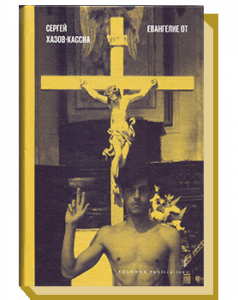 For obvious reasons, in Russia there is virtually no Gay-Roman genre-such as Michael Cunningham, beloved by the general public and does not require any special experience from the reader. Of the at least some famous Russian authors taking up homosexual plots, it is worth calling Nikolai Kononov with his modernist novel Flaner and Olga Pogodin-Kuzmin, who wrote the dilogy that Russia in every sense is our ancient Rome. Journalist of Radio Liberty Sergey Khazov-Cassia is following the path of direct social statement. His debut novel “Another Childhood” talked about how difficult it is to live in Russia to homosexual teenagers. The Gospel of the OTO is the story of an adult man who leads a double life, following the public demand not to lean out, and then it involuntarily becomes the Messiah for the LGBT community.
The main character is the name of willow, he lives in Moscow and works in the office. In his free time, the time meets men on the Internet, attends clubs and saunas, rests in Italy. IVA is satisfied with everything. He is silent when colleagues reason what gays need to be shot for, and is annoyed from activist initiatives, attracting excess attention to gays. Then he meets a young man who does not want to hide. Then with a teenager who admitted to his homosexuality at home and at school and no longer wants to appear there or there. Iva decides that he should change for the sake of those who suffer from silence like him, but go on false charges of prison. Another line of the novel is provocative and, the heart on the heart, completely superfluous apocrypha about the life of Jesus: the parallel that Khazov-Cassia wants to hold, and without this awkward game of Bulgakov, there is more understandable.
The author, obviously, studied the materiel well: the life of Moscow gays and a forensic life, and even, it seems, the gospel. The problem is that he was not able to decide for whom all this is written. The first sentence of the text and the next scene behind it with its deliberate frankness reduces the potential audience of interest by ninety. The inspirational sermon that willow pronounces in prison risks not to reach those to whom it is addressed to the homophobes of all kinds and degrees of aggression. If the main message is “silence kills”, then sermons turn out to be superfluous: those who are afraid to get out of the closet can not tell about homophobia. As a result, the social pathos of the novel disappears in vain, and the book remains an artifact for specially interested. The Russian Canningham did not work again, we are waiting further.
Alexey Salnikov. Petrov in the flu and around him
Magazine "Volga", No. 5-6, 2016
 The second novel by Yekaterinburg, Salnikov, better known for his poetry, is an unexpected pearl of the long list of the “Big Book”, which should be reduced to a short leaf at the end of this month. The text, at first, seeming a rare case of high -quality graphomania, is delayed in word, intonation, details, humor. And when the reader no longer expects anything more and simply enjoys the stream of speech, a mystical plot is cursed, for which it is not a sin to re -read all over again and collect bread crumbs, quietly scattered by the author along the road.
Petrov is a car mechanic drawing fantastic comics, his bibliocorus wife, suffering from the inability to empathy, and their phlegmatic son, carried away by mobile games. The action of the novel begins during the New Year's Epidemic of the influenza. Petrov, like everyone else, picks up the virus one by one. They are trying to go to work and school, buy products, prepare for the holiday, be treated, and in parallel - to understand how they got to such a life. But strange events are seeping into boring life that begin with a booze in a cataphalus and go rooted in the distant past. Where there is reality, and where fantasy is a question worthy of Gogol and Nabokov. Or maybe it's just about temperature delirium.
Alexei Salnikov creates a detailed world for the Petrovs, without lazy to describe the foot and transport routes of Yekaterinburg, typical dialogues with sellers, pharmacists, conductors, ambulances, shaking each corpse of a wasps from a dusty glass before pouring cognac. The degree of drawing of this world cannot but admire, even the early Grishkovets would envy the density of recognizable details per page of the text. Only Salnikov is also witty and ruthless. Especially in this sense, the head of the Flashbek about the children's campaign Petrov Sr. on the Christmas tree, written in the style of Natasha Rostova in the opera. The reader does not immediately understand the rocking alien temperature and trolleybus crossings how the understandable world becomes incomprehensible before tangibility. As in the text without pictures, the logic of the comic book is launched. How are cold -blooded killings, resurrection and meeting with an antique deity. “Petrov in the flu and around him” is a stereo, which consists of a thousand little things and the outlines of something completely different. And one of the charms of this text is that even it is almost impossible to dispose of it - the devil knows what is really happening there.
Vadim a month. Striptease on the 115th road
M.: Publishing house "E", 2017
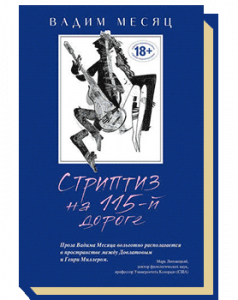 The collection of Vadim's stories of the month is another contender for the place in the short list of the Big Book. And again, the prose of a man who is more famous as a poet. The stories of the month are rightly compared with Dovlatov's prose. The point here is not only in emigrant experience (he lived in the United States for a long time), but in the fabric of the described reality, the types of heroes, intonation.
“Stripping on the 115th road”-many autobiographical stories covering the period from the seventies to the approximate today. School bikes from the Soviet Tomsk, with fights, discos and adventures, like an attempt to steal mattresses from a boarding school in order to exchange them for books at the point of receiving raw materials. American episodes, where the hero jumps from the train to the unknown, endlessly drinks with the same restless former Russians and meets in bars with foreigners who love to talk about Chekhov and Dostoevsky. Numerous stories about non -ramatic human relations, from which it is easy to leave without offending and without turning around. A joke tells the joke for a month, but they sound like an elegy about loneliness. Like scraps of sad songs in the transition of the metro, from which for some reason it becomes easy in the soul.
The heroes of the month seems to be non -therapists and losers, but at the same time - happy people whose frivolous non -ambiuliiness allows you to live with joy to live simple moments. Without trying to build fate, they float with the flow, and this current cannot stand them to the shore, but does not hit the stones. And if it beats, they are again not offended, because they believe that life cannot be treated seriously. “Fate consists of its own. Why did I get everything, as if I had been preparing for every act for years? I do nothing: I live and live. And I have fun like a moron. In any circumstances, ”writes the month in the last story“ Ha-Yarkon ”and hangs the reader on the neck of the key to his holiday of life.