
Translated material
In the pitch world, the work of hell
Fragment of the book "Lyrical Hero of Mayakovsky"
Under the Soviet regime, it was not customary to write about what artistic means Mayakovsky creates the image of Lenin, but it is not difficult to notice that his main trick is an anthropomorphic grotesque that allows the poet to criticize Soviet reality. Read about this in an excerpt from the book of Leonid Bolshukhin and Maria Alexandrova “The Lyriro Hero of Mayakovsky”.Starting from February 24, 2022, we were all in the face of the advancing barbarism, violence and lies. In this situation, it is extremely important to preserve at least the remnants of culture and support the values of humanism - including for the sake of the future of Russia. Therefore, the editorial office of Gorky will continue to talk about books, reminding our readers that the world remains in the world and fiction.
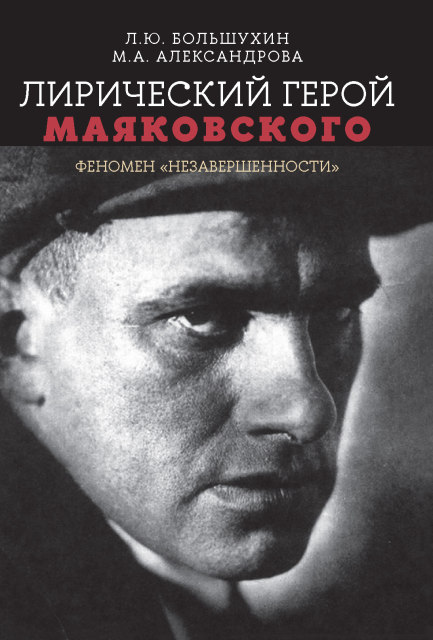
Leonid Bolshukhin, Maria Alexandrova. Lariric hero of Mayakovsky: the phenomenon of "incompleteness". M .: Ed. House of Higher School of Economics, 2022. Content
 "Conversation with Comrade Lenin": Self-report, the presentation of the lyrical hero
The image of Lenin is always created by Mayakovsky in the spirit of a tall grotesque, conflicting with the smooth scricking of Soviet Leninian (it is natural that at the time of Soviet canonization this side of his poetics will become non -absorbed). But the resistance to the false style of worship - “so that the candy / not to be / the beauty of the roller” is only one of the tasks solved by Mayakov. It is a sharp displacement of proportions, reconstructing the appearance, that serves to understand the epoch -making status of Lenin. The principle of metaphor, characteristic of the Mayakovsky, is based on the official phraseology (“Lenin is the brain of the revolutionary party”) and the common people (“Lenin - the head”), which the poet boldly connects with the real appearance of the leader, so far from the well -being: “Holy / and bald / one person”, as the poem “Vladimir Ilyich Lenin” is not yet about the hero. transformed by its historical role. The courage of Mayakovsky was that he crossed through his own experience in creating a grotesque image of the Lord of everything in the poem "Man":
There, ascending over the heads, he.
The skull shines,
at least put it on your feet
hairless,
The whole was pierced in a gloss.
The general principle of the image was re -found in the poem "Vladimir Ilyich!" (1920):
Rushed
In all directions
The world is an awkward body .
<...>
When
Over the world, it has grown
Lenin
A huge head.
In the poem “Vladimir Ilyich Lenin” (1924), this visual principle is fixed; The specific deformation of the everyday appearance builds a “one person” to the rank of lively personification of the mental force moving the story:
And from there,
For days
Looking around these
head
Lenin
You will score first.
In “Talk with Comrade Lenin”, the same expressive disproportion of appearance is motivated differently - the nature of the presence of the addressee of poetic speech in the “I” space:
Two in the room.
I
And Lenin -
photography
On the white wall.
The verbal image coincides with the real photograph of Lenin in the poet’s room on Lubyanka; Lenin is captured on the rostrum during a crowded rally, but the photograph is not panoramic, it highlights, it takes the head “into the focus”:
The mouth is open
In stressful speech,
mustache
seta
I got up upward
In the folds of the forehead
Closed
human,
In a huge forehead
Huge thought.
Must be
Under him
Thousands of ...
Here Mayakovsky manages to combine the effect of Lenin's vastness, his growing over the world, achieved thanks to the grotesque “thugs”, and a close visual plan, which allows me to enter into a dialogue with the hero of the poem.
Direct contact with the overhuman force, with the creature of the highest order-the constant lyrical situation in Mayakovsky’s work: I and the Sun (from the cycle “I!” And up to the “extraordinary adventure, who formed with Vladimir Mayakovsky summer in the country”), I and the god (“cloud in pants”, “flute-border guard”, “man”), I and Napoleon in the same name in the same name early early. poems, I and great converters of life in the Fifth International. The lyrical hero of Mayakovsky as a carrier of creative power either competes with the great, or continues their business:
I want to become
to the ranks of the Edison,
Lenin in a row,
In the ranks of Einsteins.
But in the “conversation with Comrade Lenin” there is a restructuring of the situation due to the crisis of the lyrical self -awareness, which Mayakovsky is trying in vain to survive. The poem involuntarily, even impulsively reveals this crisis.
Lenin who is speaking, the oratorical to thousands, changing the world with a word appears as an ideal embodiment of the prophet - against the backdrop of the unfulfilled verbal mastery of the world, to which the lyrical hero felt called up (“I, // Zlatiuh, // whose every word // The soul is a newborn, // I amusing the prophetic mission of Lenin, the lyrical gero is a lyrical ger In the power of the speaker and responds to his imaginary speech to “go, to welcome, report , the word from the ideological, optimistic lexicon of the era is put into a strong position; level.
I got up from the chair
The joy is highlighted ...
M.L. Gasparov and I.Yu. Podgaitskaya pointed to the Mayakovsky’s poetic journalism “turning the inside out” of the glory and solemn report (“On Dryan”, “Instead of the Oda”, “Down with the cap”, “Do not annivers”, etc.), including in this series and the corresponding fragment of “Talk to Comrade Lenin”; Reception, according to their observations, is motivated both by the didactic attitudes of the poet (early to rest on the laurels) and the poetics of the antithesis, dating back to the general culture of the avant -garde. We consider it necessary to highlight the “conversation with Comrade Lenin” as a special case: firstly, here the poet does not turn to the “educated”, but to the highest moral instance for him; Secondly, the antithesis (achievements-failures) becomes the basis of severe reflection, unusual rhetorical poetry.
The first style failure arises at the very beginning of the solemn “report”:
Comrade Lenin,
I report to you
Not in service, but to your liking.
Comrade Lenin,
Add
will
Made
And it is already being done.
The epithet to work - hell - is highlighted by inversion, with an displacement at the end of the verse, but especially expressively violation of the rules of the formation of the adjective from the word "hell", dictated by not at all the conditions of rhyme. The dactilic clause of “Aidov’s work” would have been quite satisfactorily combined with the hypersdactylic “I have” (complete hypersdactylic rhymes in Russian poetry are rare, usually experimental); A short adjective would resemble the expression “adovable flour”, which became stable as a result of fixing the portable value as the main one. Having abandoned the truncation of the verse, Mayakovsky forced to pronounce the occasional epithet "hell", chanting each syllable, including unstressed. Such a semantic pressure is explosive, since the connotative revitalization of ideas about the underworld does not allow to perceive the epithet only in its expressive function; The reduction of the primary significance of adjectives derived from the "hell" is turned to the poet back. In other words, the world from where the lyrical hero appears to Lenin is pitch.
The further list of “achievements” is not only contradictory - stylistically and meaningfully; The very nature of the deployment of a poetic statement that reveals the poet’s internal conflict is much more important. M.L. Gasparov and his co -author, following the patterns of the organization of material in Mayakovsky’s poems, written for the festive dates, come to the conclusion that it is the “conversation with Comrade Lenin” that violates the dynamic principle of “growing”, which was supposed to directly affect readers (the scheme “We remember - we learn - we will win!” In the “Paris Commune”, etc.); But what is the law of clutch and movement of images in this not quite “typical” text, the researchers are not formulated. They also need to clarify the conclusion of these authors about the function characteristic of the Mayakovsky bicenture or three -member antithesis “Past - Present”, “Present - Future”, “Past - present - Future”.
“Photography on the White Wall” gives an exit to the sphere of ideal, in the connecting past and future eternity - a lasting revolutionary holiday, a thousands of procession with flags and stretching up to the leader, hands. The present as the time of the “Lenin Testaments” (according to the official Soviet formula) is characterized first by an oath to make “hellish work”, and then an inverted reflection of the festive procession - a ribbon of modern types. In the interval, in just two verses, the results of extreme efforts to transform life are indicated:
About the glow ,
about the gol ,
Sh is the extraction of coal and ore ...
Rationally constructed assonations and alliterations, their accumulation at the beginning of the promising poetic “run” - all this enhances the meaning of the form due to the content, which is a symptom of an insoluble problem for the poet. “Povert and Elevation” is a large -scale, proportional “work of a hell” image, covering a lot of people, happy “Soviet people”. But this image does not have anthropological signs that are so important for the late Mayakovsky. Recall that the resentment of an ordinary person, deprived of “things binding in socialism”, was experienced by the poet painfully and personally; He needs to see “Communism of Nature and Flesh” not only as “steamers, lines and other long deeds” (“Comrade Netta - the steamer and man”), but also as the facts of a new life, as the everyday manifestations of human transformation - external and internal. Not confirmed clearly, the word about the achieved good is, with all the effectiveness of the form, empty. It is natural that a newspaper stamp is adjacent to it: "The extraction of coal and ore is wide ...". A pause, graphically designated by a multi -plate, allows you to feel this formula as a “hollow” word. Neither a test of the transforming power of an individual-poetic language, nor an appeal to the common places of the Soviet novel gives the renewed world desired for Mayakovsky visualization.
The reality of life, which it appears in the twelfth year of the revolution, forces the speaker to change the genre; Instead of a report, a bitter confession sounds:
And next to it,
Of course,
many,
many
different
Dryan and nonsense.
You get tired
Fighting off and bite.
Many
Without you
Fighted away.
Very
many
different bastards
Walking
On our land
And around.
The abstract collective image of the “Soviet people” contrasts a visual set of “bastards”, with each repeat of the epithet “a lot” grow in their significance “rubbish and nonsense”. The initial delight, which prompted to stand up to the force emanating from the prophet, is replaced by fatigue; This fatigue was born not by a great struggle, but by the daily resistance of the poet of the aggression that comes from contemporaries, “new people”: “You are tired of fighting off and gnawing .” This usage is very far from the energetic verbal gesture of the hero of “Poems about the Soviet passport”: “I would have gnawed at bureaucracy.” On the contrary, the neologism created according to the “snap” verb model, paired with “fighting off”, conveys bitterness, accompanying despair. For a lyrical hero, whose weapon is a word, the need to “bite” means no less than the risk of losing the status of a poet who speaks out of her voice . This tragic background reveals the self -determination characteristic of Mayakovsky in the horizontal-inventical and temporal coordinates of his art world.
Declaring for many years (up to the “entry” of a farewell poem) his readiness to be “assenced and whistal”, Mayakovsky emblem both the low -like object of influence and “sanitary” contact with it - as a gesture directed from top to bottom and / or creeping: “rubbish the rhymes with the end ”, “poet // rough language of the poster ”, etc. The vertical imagery-heavenly, aviation, construction metaphors of the “future in the present”, Mayakovsky presented the lyrical , as personified aspiration upwards and even his own high growth into the realized metaphor of the future (the image of this series-the neck-rally in the “fifth century”, which allows to look through the “thirtieth century”).
Such a setting of a lyrical hero in the artistic space, where the “horizontal” is reality, and the “vertical” is the path to the future, the special one - almost hopeless - characterized its everyday activity - character: when the poet responded to the resistance of the lower, “horizontal” world with a gesture of “Ascension”, “Rashing”, “Rashing” over reality, “over the gang / gang. poetic / rowing and burning ”, this meant the transfer of the last act of struggle to the future, where the victory is inevitable (“ in full voice ”); In the present, the fighter with the “rubbish and nonsense” is doomed to “bite”, sacrifice his superiority (“vertical feeling”), with his voice soaring over the world. It is significant that the most important for Mayakovsky images of a winning creative force are connected with the struggle of a different scale, for example, in “A letter of comrade Kostrov from Paris about the essence of love”:
... from the pharynx
To the stars
The word soaks
gold -bearing comet.
<...>
To raise
And lead and to attract
which weakened by the eye.
To enemy
heads
Sprinkle from the shoulders
tail
shining saber.
It is obvious that here the poet inspires readers / listeners to fight enemies of external enemies (which were thought of “white” in the civil war and “hires of imperialism” in the future world war-revolution). Meanwhile, in a “conversation with Comrade Lenin”, the lyrical hero has to plunge into the thickness of his, Soviet life, which is still not transformed by a chased “revolution of the spirit” (formula from “IV International”).
The pitch world imposes horizontal movement to the poet "vertical":
No
them
not a number
not nicknames
whole
type of type
stretches.
Fists
and red tosses,
sneaks,
sectarians
And drunkards.
It is now that Soviet reality (life without Lenin) is visualized for the first time, and there is a non -ranging roll -call with the early poem “Night”:
The crowd is a variegated fast cat -
Saved, bending, the doors are drawn.
In both cases, we have the same “world -headed body”, but not at all thirsty (unlike the rushing world from the poem “Vladimir Ilyich!”) To reunite with the “head” and thereby gain the anthropomorphic “completeness”. Once again, we emphasize the contrast with the initially festive procession (“It must be, / under it / pass thousands ...”), which is perceived not extended, but directed upward (“Forest of flags, hands of grass”).
If the “fists” and “sectarians” are enemies of the external (some - as a “relic of the past”, others as “hires of imperialism”), then all the rest of the creature of the revolution itself who intercepted from the lyrical hero the right to say about its “achievements”: “red tape” ( new bureaucrats), “subsidents” (prosperous from the new government), “drunkards” (from contexts) (from contexts) (from contexts) The late satire of Mayakovsky, it is clear that these are also their own - activists and bosses). Therefore, the list of types is completed by the general portrait of the hosts of the situation, which has nothing to do with the notorious “fist”:
... go
proudly
Shooting the chest,
In the handles all the time
And in badge badges.
The world, over which the leader’s lively voice does not sound, reveals a tendency to regression, degeneration.
Neither the prophet nor the liturg (according to V.V. Musatov) the poet here does not feel himself. He cannot show the creative energy that builds, overlords such a world. The lyrical hero identifies himself with the collective we , who reports to “Comrade Lenin”, but in fact throughout the poetic story (and not just in the introductory part) we are talking about the lonely I am left without “comrade Lenin”, because we cannot suffer from the resistance of reality, this feeling is individual. An attempt to speak the language of rhetorical confidence is constantly breaking away:
We are them
all
Of course, twist,
But all
Twist
It is terribly difficult .
The failed report is hit by the spell:
Comrade Lenin,
Through the factories smoky,
in the lands,
covered
and snow
And with a reinforcement,
Your
comrade,
heart
and in the name
We think
We breathe
fight
And we live! ..
Lenin is imagined by those present over all spaces (urban, factory and rural), in all times (the annual cycle will be folded into the pair image of “snow and improving”, which metonymically representing winter and summer), its name is attributed to the world power. Without its sacred impact on the world, one cannot hold the sense of goal, life meaning: the post -revolutionary life itself does not give rise to meaning.
The ring composition, which in the rhetorical verses of Mayakovsky serves, according to the observations of M.L. Gasparova, collecting poetry “blocks” and / or strengthening the imperative effect, here, firstly, structurally complicated and, secondly, performs a different function. A double ring is created: to make the oaths together the “hellish work” corresponds to the spell “think, / breathe, / fight / and live”, the whole is framed by a picture of the evening, secluded appeal to “Comrade Lenin”. The main thing is that the external and internal “frames” interact dialogically. The literal repetition of the first part in the finale is by no means the mechanical fastening of the elements of the text: it is precisely against the background of oaths on behalf that I become clear that, with all the desire to become part of the collective figure and the collective herald of the new world, inevitably returns to myself, to the initial need for personal contact with the highest instance. Soviet rhetorical discourse exposes itself: it cannot serve as a universal resolution of those conflicts that arise with self -determination in reality; He does not give rise to images “completing” a picture of being for the lyrical hero. The ring composition fixes the line on which the rhetoric is powerless. We lose our stability in the space of a night confession, I enters into the field of personal responsibility to the ideal.
In this movement of images, important for Mayakov’s attitude is realized over time. A rhetorically cheerful word does not need accurate temporary coordinates; оно звучит в пространстве условной современности, долженствующей стать будущим, то есть в «большой истории». Включенности в историческое время противопоставлено время суточное — личное, причем особое значение получает вечер и ночь, когда лирический герой исповедуется и напряженно ищет смысл происходящего.