
Translated material
Why did Satan stick his tongue
A similar story happened in the United States, where a raised hand gesture was used to greet the state flag. It was introduced after the Civil War of 1892 as part of the program to strengthen state patriotism: schoolchildren were supposed to start the first lesson, having previously raised their hands (“Salute Bellamy”) and swearing in fidelity to the American flag. Morris writes that “in the magazine The Youth's Companion of the same [1892] year, the gesture is described as follows:“ The right hand gracefully rises the palm upward, towards the flag, and remains in this gesture until the end of the oath ”. Naturally, in the 1930s, the US authorities realized what associations the Bellah Salute causes, and with horror they were forced to abandon it, replacing the salute with a hand pressed to the heart.
As the author concludes, a bright associative connection between the thrown hand and the Nazi regime led to the fact that after the Second World War this greeting came out of everyday life. Today, the gesture is almost not depicted in the works of contemporary art - unless in a satirical or obscene context.
Insult - leaned tongue
Of course, the body language can be used not only for greetings - it is also more than suitable for applying insults. And, as the surrealists would say to insult someone in the language of the body, there is nothing better than the language in the mouth. Therefore, another gesture that Desmond analyzes becomes a sticking out tongue. Talking about the origin of this gesture, he notes that the unconscious protrusion of the tongue is characteristic of the babies who refuse to eat, pushing food with his help: “ The child is too small to say“ enough! ”, So he has to expel the food with the end of the tongue. Thus, from an early age, a person correlates the clash of the tongue with rejection - this connection is intuitive to everyone. ”
The unclean power is traditionally the embodiment of everything bad in human life, so there is nothing surprising that it can adopt human gestures that are associated with something negative, negative or insulting. That is why the stuck language was often called the “Satan language”, and the devil himself in the European tradition was often depicted with a vile pointed tongue hanging from his mouth. Desmond gives an example of one of the frescoes in the village Church of the Danish town of Tingstead on the island of Falster, where a black horned devil shows a long red tongue of an innocent woman whipping oil: “This image of the XV century was pious by lime, hiding from human eyes until 1877, when the fresco was discovered and restored.”
The image of a horned demon of Krampus, one of the characters of Central European folklore, largely similar to Satan and has no analogues in Slavic mythology, is also extremely curious in this regard: “ According to belief, it appears on the eve of St. Nicholas Day; And if St. Nicholas, who comes to obedient children, gives them gifts, then Krampus, on the contrary, punishes naughty. The demon welcomes them, sticking out a red tongue of extraordinary length, and scares, demonstrating the arsenal of punishment tools. ”
However, Morris in his review is not limited to the traditions of antiquity, considering, including modernity. He probably recalls one of Albert Einstein’s most famous photographs, which is depicted with a stuck tongue. Einstein in this position managed to capture the photographer Arthur Sassu, who asked the famous physicist to smile, but received a slightly different reaction. As Morris notes, this photo has become a symbol of duality itself, since the contradiction laid down in it is obvious - the smartest scientist of the world core a stupid face. The picture has gained such popularity that now there is hardly a person who is not able to instantly resurrect this photo in his memory.
Relaxation is a dream
Our dreams form a separate reality, the veil of secrets over which in the 20th century tried to reveal psychoanalysis, and then the surrealists passionately carried away by him. Naturally, Morris, not alien to surrealism, could not ignore this topic.
What can tell the body immersed in sleep? To begin with, the author divides the poses of sleep into two groups - deliberate (a person chose a pose himself) and unintentional (a person fell asleep in a random pose that he occupied before), and then analyzes some of them in accordance with the representation of the modern psychology that sleep pose depends on the general psychological state of a person. For example, the “embryo pose” is widely known, the position of the body in which recalls the pose characteristic of the child in the mother’s womb. Some psychologists believe that attempts subconsciously return to the embryo state speak of the acute needs of a person for safety and protection. And this is only one of the examples that Morris is far from limited to: he gives such an extensive and bizarre list that Horhe Luis Borges and Umberto Eco would envy him. Here is a part of it:
“... there are other poses of sleep, including the“ royal ”pose (on the back, with hands extended along the body),“ pose of flamingo ”(on the side, one leg is bent, the other extended); “Hands behind the head” (on the back, with the hands connected behind the head); “Cyclops pose” (on the back, with a hand thrown above his head and closing one eye); "Dutch" (on the stomach or on the side, hugging a pillow); And “leaning” (on the side, putting his head on the hand). <...> In fact, sleep pose can naturally change from forty to seventy times a night. ”
Of course, all this could not but find a reflection in art, which, as you know, is a mirror of the human soul, and in this case, also the body. One of the most impressive artistic display of sleep, according to Morris, is the hundred -meter statues of the sleeping Buddha, which are found in South Asia (the largest of them is located in Burma near the city of Smoyin). The author says that “these colossal figures depict the Buddha in the last seconds of his earthly life. Knowing that he was about to die, the Buddha turned to face the west and lay on his right side, putting his right hand under his head. In Buddhism, this pose is known as “Mahaparinirvanasana”, and such statues are called “Buddhas in Nirvana”. ”
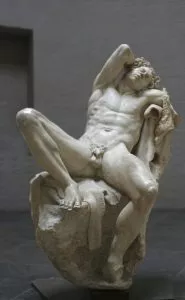 Morris also notes that when a person falls asleep unintentionally, a blind game of chance begins: his body can take a wide variety of poses depending on the position in which he dozes off-sitting, squatting or leaning against something. It is curious that in the history of world painting, artists more often choose the poses of unintentional sleep, which probably allows you to give the composition a more natural and living character. The author of the book illustrates this remark dating from the III end - the beginning of the II century BC. e. The statue of “Faun Barberini” is the work of an unknown Greek sculptor who depicts a naked man who fell asleep on a skin spread out on a stone: “His carelessly spread arms and legs form sharp corners, which give the composition acute dynamism. The left (apparently, broken) hand of the faun, apparently, was supposed to hang freely, and the right hand thrown up and bent in the forearm supports the head, pressing it to the left shoulder. "
This and many other examples in the book indicate that poses, like gestures, most often not what they seem at first glance, and almost each of them hides its historical context and a set of meanings, which can differ greatly from the usual. The culture in which these images and meanings are rooted is represented by Morris in the form of a fascinating journey through era and styles, the basis of the plot of which the human body remains.