
Translated material
Historian against fake news
About the book of Carlo Ginzburg "Judge and historian"
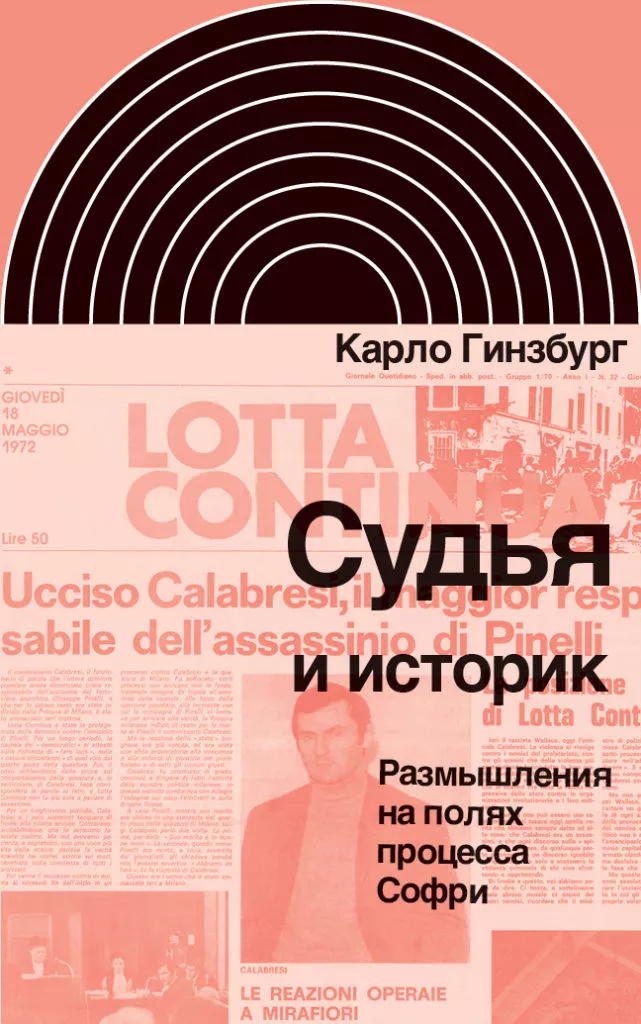
In 1990, the levoradikal Adriano Sofrey sentenced to the 22 years for incitement to kill the police commissar, and the famous historian Carlo Ginzburg, his friend, wrote a book about this process. Konstantin Mitroshenkov - about what he did.Carlo Ginzburg. Judge and historian: Reflections in the fields of the Sofri process. M.: New Literary Review, 2021. Translation from the Italian Mikhail Velizhev. Content
 1
In May 1990, the court of Milan was sentenced by Adriano Sofrey, the former leader of the Lotta Continua levoradical organization (“continuous struggle”), by 22 years in prison on charges of murder of the police commissar Luigi Calabriazi. The prosecution was built on the testimony of Leonardo Marino, a former activist Lotta Continua. Sofrey served the full term and was released in January 2012.
Luigi Calabrazy was shot dead in May 1972 next to the entrance of his house. A few years before, the police commissar was involved in the scandal due to the death of an anarchist, who allegedly accidentally fell out of the window of the police station. The murder of Calabraisi was immediately connected with political motives. The investigation was beating for many years until in July 1988 Leonardo Marino appeared in the carabiner station and said that he was a member of the “secret division” of Lotta Continua and, together with the accomplice, killed Calabraisi by order of the executive committee of the organization. Marino’s recognition was the only direct evidence against Sofrey and two other former leaders of the organization.
Carlo Ginzburg and Sofrey are binded by long -standing friendship. They met back in the early 1960s, when both studied at a higher normal school in Pisa. Upon learning of Sofrey’s sentence, Ginzburg decided to act in the most familiar way - to write a book to demonstrate the failure of the prosecution arguments.
In the “Judge and the Historian”, Ginzburg analyzes the arguments of the prosecution, separating the proven facts in them from assumptions and frank speculations. First of all, he raises questions of the words of Marino himself, who, as it turned out during the court hearing, was repeatedly talked at the carbines, before making “sincere recognition”. In addition, Marino confused in details, “remembered” and “forgot” the events and changed his testimony several times. But this is only half a bastard: “Instead of looking for an objective confirmation of the recognition left by the defendant, the investigation took advantage of his testimony as a test stone, with the help of which it could analyze (and, on occasion to reject) the stories of eyewitnesses.”
The investigation, not having enough evidence, often resorted to the so -called "logical evidence." For example, the deputy prosecutor Armando Spataro claimed that if Marino’s participation in a crime is proved, this will automatically mean the involvement of Sofri and other Lotta Continua leaders, because “it is unthinkable for Marino ... he thought up and committed the most loud political crime of the 1970s.” Ginzburg witty remarks that Spataro thinks rather not as a lawyer, but as a historian forced in the absence of sources to establish certain details based on the context. The difference is that a bona fide historian (Ginzburg gives his colleague in microhistory Natalie Zemon Davis) does not seek to “eliminate gaps in the image, applying a new drawing, but emphasizing the boundaries of the indistinguishable zone, without trying to restore it.” Spataro confuses the guesses with established facts.
In its analysis, Ginzburg also emphasizes the boundaries of indistinguishable zones. He notes that during the trial, the chairman of the court dramatically changed his position regarding the prosecution. If in the beginning he was quite critical of Marino’s testimony, then at some point, on the contrary, he began to help him leave tricky protection issues. Ginzburg also cites several remarks of the judge, on the basis of which it can be assumed that he, the carabiners and defendant Marino were in conspiracy, but this does not go further: “It is obvious that such a serious assumption cannot be formulated on the basis of the only sinister evidence.”
2
Ginzburg was not the first time working with the materials of the investigation. The book “Cheese and Worms” (1976) brought him world fame, where he analyzed the protocols of interrogations of Melnik Menokkio, accused of heresy. At the same time, the author - we must pay tribute to him - is well aware of his professional deformation. "Judge and historian" is opened by the following passage:
“A slight sensation of disorientation. It is this feeling that first is experienced by the one who, accustomed to read acts of the inquisition processes of the XVI and XVII centuries, turns to the materials of the investigation that Antonio Lombardi (Investigative Judge) and Ferdinando Pomarichi (Deputy Prosecutor) in relation to Leonardo Marino and his alleged accomplices. Disorientation, since these documents, contrary to any expectation, are similarly similar. ”
However, analogies between the court of the Inquisition and the Italian justice of the 1990s are far from the most interesting in the book. In an attempt to prove the innocence of his friend, Ginzburg addresses issues related to the methodology of historical research and the social role of knowledge about the past. The starting point for him is the thoughts of similarities and the differences between the judge and the historian.
Since ancient times, history and law have been closely connected. The similarity between the judge and the historian was usually seen in the fact that both of them should make judgments based on an impartial analysis of evidence and evidence. According to Ginzburg, the “influence of the judicial model on historians” led to the fact that for a long time they paid the main attention of “events [m] (politically [m], military [m], diplomatically [m]), which ... could be made without any difficulty to reduce one or more individuals to the actions of one or more.” The prestige of the “historiography based on the judicial model” staggered in the second quarter of the 20th century, when historians, under the influence of the French school of Annals, turned to such phenomena as the history of social groups and the history of mentality, the analysis of which did not look at the trial at all: “Coming to the dilemma“ judge or understand ”, [Mark] Blok, without hesitation, chose the second option.”
Ginzburg, in general welcoming such a turn in historiography, notes with annoyance that in the second half of the 20th century historians began to pay insufficient attention to the role of evidence in their research. In the “Judge and the Historian” and other works, Ginzburg acts as part of what he calls “Ulyakovo Paradigma” . The researcher, like a detective, concentrates on the details at first glance (like inconsistencies) and considers them as manifestations of “deep phenomena of significant importance” (in our case, we are talking about a possible conspiracy of Marino and the side of the prosecution). Another important feature is the consistent nomination of hypotheses that will either be confirmed by evidence or discarded. This approach implies the emphasis on individual and attaches great importance to the researcher’s intuition. In the article “Signs: the Uklokovka paradigm and its roots” (1979), Ginzburg insists that the story is “Ulkaya” in the nature of the discipline: “Without the fact that the historian cannot but refer ... to the ranks of comparable phenomena, his cognitive strategy, as well as the codes of the expression, remains internally individualizing (even if a group or a whole group or a whole one will act as an individual. society) ". As Irina Staph notes , Uklokovka Paradigma has largely a reaction to quantitative and sociological methods that dominated historical science in the 1960-1970s. But by the beginning of the 1990s, Ginzburg had new opponents.
3
In the afterword on the Russian translation of “Judge and the historian”, Ginzburg writes that the contents of the book were greatly influenced by his public dispute with Hideen White, the author of the famous “meta -ore”. The contents of the polemic can be judged by the collection "Probing the Limits of Representation. Nazism and the “Final Solution” ” (“ Exploring the limits of representation. Nazism and “final decision” ”), issued according to the results of the conference at which both historians spoke in 1990. White proceeded from the fact that any historical narrative was arranged like a literary text. He stated that even the views of the revisionists denying the Holocaust cannot be refuted as “false” simply because it is only representation of the events of the past . Ginzburg, in his own words, was amazed at White’s approach: “The proof became a matter that is very sensitive to the international community of historians ... I suspect that the methodological reflection present in my book is able to serve as an antidote in the current intellectual and political atmosphere, still poisoned by radical skepticism.”
True, Ginzburg agrees that not a single certificate can provide us with “direct data on historical reality” and in the article “Microistory: two or three things that I know about it” (1994) recognizes that the object of study is constructed by a historian, and is not presented to it in finished form. Nevertheless, he is firmly convinced that, based on sources, it is possible to establish the truth or falsity of certain facts - as if they, in turn, are not the design of the researcher. All this makes the position of Ginzburg internally contradictory and vulnerable to criticism .
But White questioned not only the ability of historians to establish separate facts. In the latest lifetime book of 2014 “The Practical Past” (“Practical Past”), he wrote that professional historiography, which took shape as an independent discipline by the end of the 19th century, was in a dual position. On the one hand, she claimed the production of “scientific” and “objective” knowledge about the past, and on the other hand, she served the interests of the national states, and served as a “guardian of [their] genealogy”. In the 20th century, historians, under the influence of criticism of ideology, retreated to the field of "sound empiricism", which allowed "professional historiography to proclaim their ideological neutrality." According to White, as a result of this retreat, history finally ceased to be a “practical” discipline, excluding itself from the discussion of relevant social, political and ethical issues.
It seems to me that the emphasis on the “practical” measurement of the historian, their connection with modernity is what paradoxically brings together White and Ginzburg. And if the first has always been skeptical of professional historiography, then the second looks at his discipline more optimistic. Take the microistoric project of Ginzburg, one of the goals of which was “to extract from the misery of the voice and the worldview of the victims” (a striking example - “cheese and worms”). As the historian admits, this desire “had deep personal reasons: the memories of the persecution that turned me into a“ Jewish child ”during the Second World War.” In the “Judge and the Historian”, Ginzburg draws attention to another “practical” component of its craft - the ability to expose falsification. In the afterword, he writes:
“The political potential of philology has been manifested for a very long time: at least since the time of the Italian humanist Lorenzo Valla, who in 1440 showed that the letter of the imaginary“ Constantine Gift ”, describing how the Roman emperor Konstantin left a third of the empire of the pope before his death is a fake. <...> Marino’s false accusations against Adriano Sofrey and his comrades can be considered fake news, since these accusations led to the process, which then confirmed them. <...> My attempt to expose these fake news, as I said, was unsuccessful. However, I am convinced that the art of slow reading still retains huge potential. Fake news is distributed on the Internet, therefore, using the Internet, they should be refuted. <...> Digital philology has a future. ”