Date
Author
Галина Артеменко

Preserved copy
Translated material
Penultimate shelter
In St. Petersburg hospitals, homeless people with disabilities are discharged onto the streets.
Dmitry Shcheglov is 49 years old, he has been in St. Petersburg for a long time, although he is registered in Vorkuta, he rented housing here. He worked as a plasterer and tiler. I went to visit Shlisselburg, jumped unsuccessfully, and broke both heel bones. At the local hospital they put him in a cast, kept him for a short time and discharged him. The sister transferred money so that Dmitry could get to the city. At the Finlyandsky station they called an ambulance for him. He spent a day in the Aleksandrovskaya hospital - from June 4 to 5 and was discharged, although he said that there was nowhere to go, no money, and the owner rented out the housing to others.
Doctors advised him to go to Vorkuta, took him to the address where he was discharged and left on the street. He again called an ambulance, again the Alexander Hospital, where they left him for the night, but they said: “Tomorrow, go wherever you want.” His roommate told him about the Malta shelter. According to friends, Dmitry collected money for a taxi and in a wheelchair, with both legs in plaster, he got to the nook between Kolomyazhsky Prospekt and the railway. Homeless disabled people live here who simply have nowhere else to go.
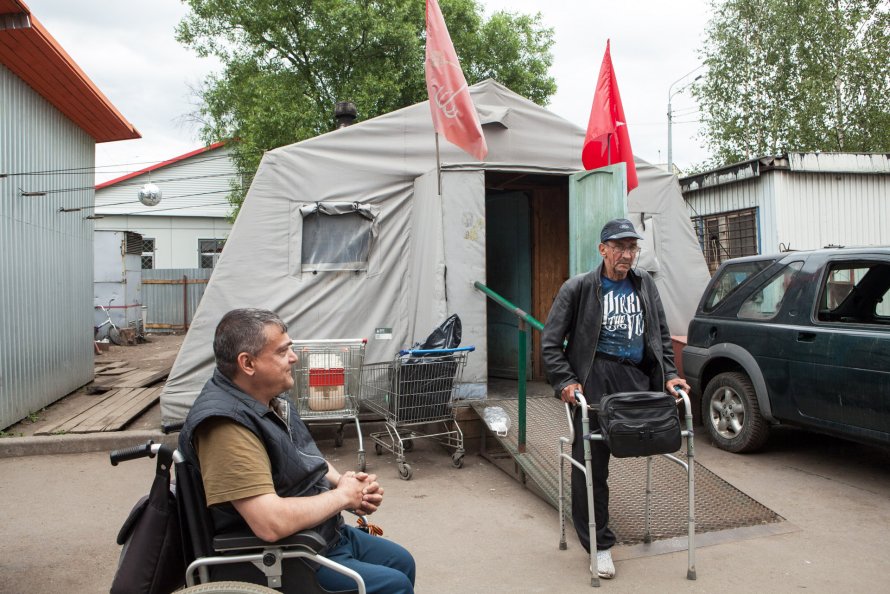 Photo: Elena Lukyanova
 Dmitry Shcheglov // Photo: Elena Lukyanova
“Those who walk are on the top tier, they leave at eight in the morning, return at eight in the evening, and those who don’t walk are always here,” says Mikhail Kalashnikov, project manager of the Maltese Help Service in St. Petersburg. One of the service’s projects is the Malta Shelter, in other words, a huge tent with bunk beds. – Either compassionate citizens bring them here, or they somehow get there themselves, or they call us from hospitals and ask us to pick them up.”
Kalashnikov himself goes to hospitals to make sure that the person is mentally adequate and not completely bedridden. After all, a shelter cannot take in a mentally ill, inadequate person or someone who cannot even get to the toilet, because there is simply no one physically available to care for such people. When a discharge date is agreed upon, Mikhail picks up the person and takes him either to Kolomyazhsky, or, if possible, to a state overnight stay home, or to the Pokrovsk community shelter. But recently, hospitals are increasingly bringing homeless people being discharged to Nochlezhka on Borovaya or simply taking them out onto the street and leaving them to their fate.
“Nochlezhka” is always overcrowded; it cannot accommodate wheelchair users and the disabled, since the shelter is on the second floor and the stairs are steep. The Maltese tent, in fact, is the only place where such a homeless person can be quickly accommodated, although the conditions there are more than Spartan, but still.
... Denis Ivanov is 32 years old, he is from St. Petersburg, an orphanage resident - his mother died, his father rented out an apartment, dragging the child along with him everywhere he knew, and then he completely sent his seven-year-old son to an orphanage. After graduating from a correctional orphanage, Denis lost his home, and for so many years he has been living wherever he can, sleeping in basements. He has polyneuropathy of the legs - he has poor feeling in his legs, so one day, falling asleep in the basement, he did not feel the burn from a hot pipe. The leg festered, the ambulance brought Denis to city hospital No. 14, which specializes in purulent wounds. Why was he kicked out of the hospital, why did the man lie on a bench near the hospital for four days? Denis has difficulty speaking, he says that he asked for a drink, and some local person gave it to him. Kalashnikov explains that this kind man informed the shelter that Denis was brought here. Now he can barely move with the help of a walker, he needs to renew his passport and then decide what to do next; most likely, he will need to register for a boarding school.

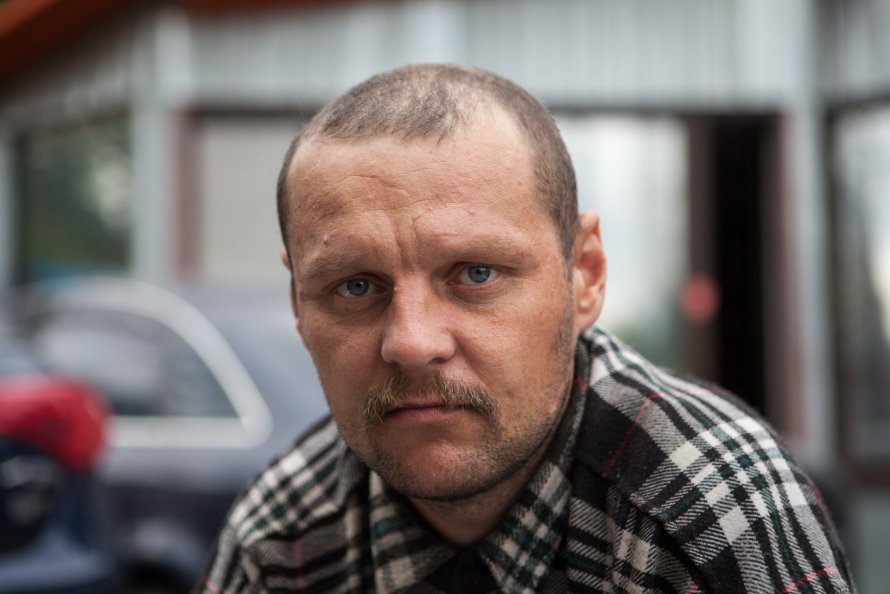 Denis Ivanov // Photo: Elena Lukyanova
Elena Sidorova is 58 years old and has no documents. At first he talks about himself calmly, then begins to cry. She says that she was from Leningrad, married a military man, the marriage broke up, and lived in Alma-Ata. In 1995, she came to St. Petersburg for her father’s funeral, she was robbed, her documents were stolen, she did not have Russian citizenship, her documents had to be restored only in Kazakhstan. She tried to live in St. Petersburg in the 90s like this: she worked wherever she had to, then she met a man, they lived with him, then he died, and Elena had nowhere to live. Three years ago I froze my toes, resulting in high amputation. Elena sits in a wheelchair and tells how she ended up in the Aleksandrovskaya hospital at the end of May, how she was discharged from there, brought to Nochlezhka and unloaded onto the street - a woman without a leg. She says that she has children in Astrakhan, but the connections have long been lost, she is ashamed, and they probably won’t want to see such a mother.
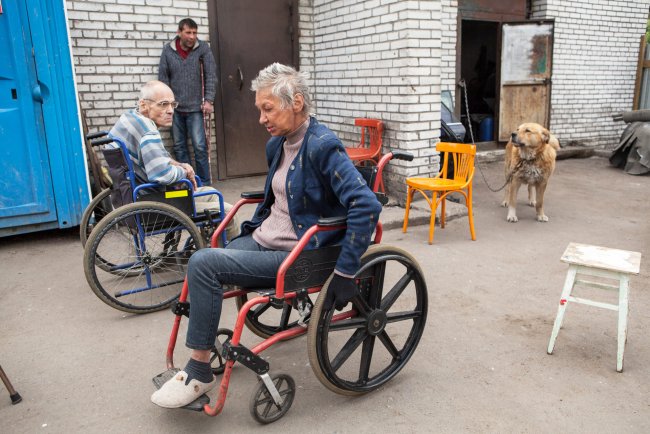
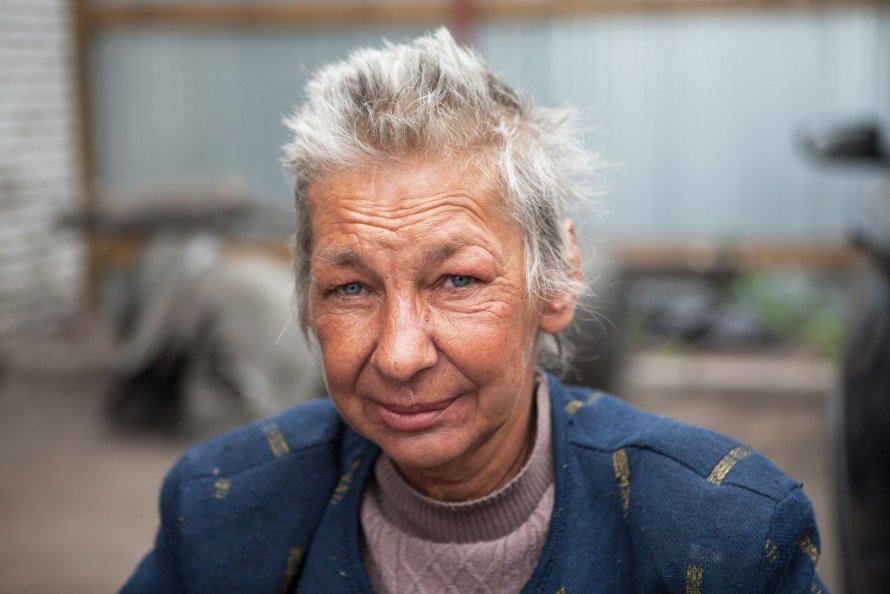 Elena Sidorova // Photo: Elena Lukyanova
Kalashnikov continues to list: Mikhail Ryabov, 50 years old, was in hospital No. 26 after a stroke, semi-paralyzed, discharged, epicrisis not given. Left on the street... Mikhail Smirnov, 52 years old, suffered two strokes, the left side of his body was paralyzed, he was brought from hospital No. 26 to Nochlezhka and left on the street. The shelter ensured that one was admitted to the nursing department, the other was taken to the Pokrovskaya community, where sisters can care for the bedridden. But this, alas, is all temporary. At best, they will be brought back to the Malta shelter. At worst...