
Translated material
Orderly
The head of the Human Rights Council Fadeev believes that the Solovetsky stone should be moved, the “Last address” signs should be removed, and the law interferes with the state
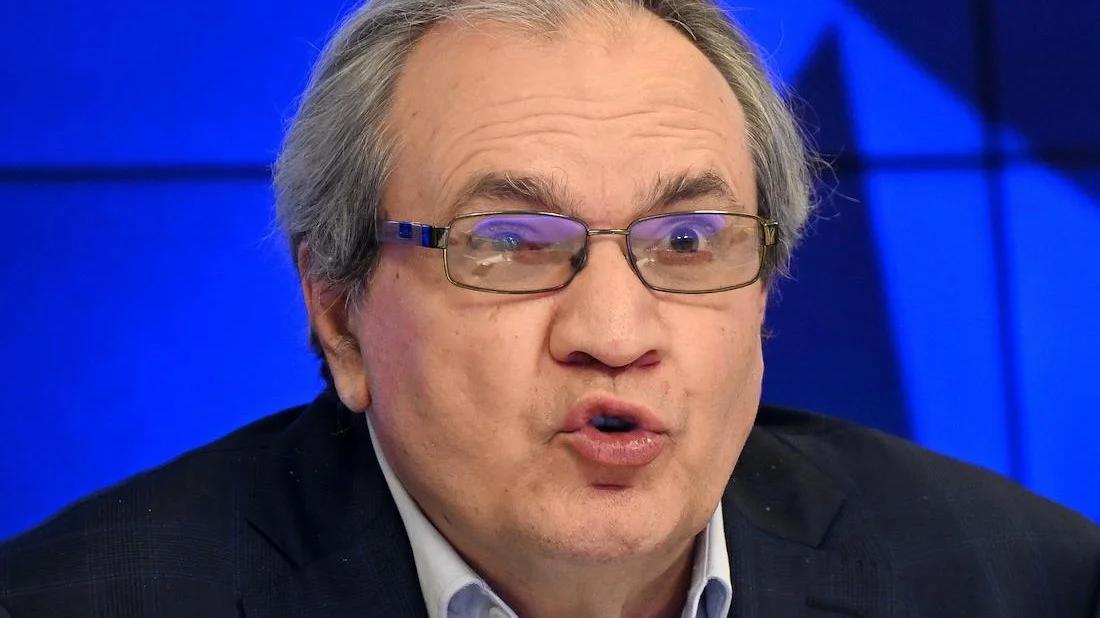
Valery Fadeev. Photo: Irina Bujor / Kommersant
18+. THIS MATERIAL (INFORMATION) IS PRODUCED, DISTRIBUTED AND (OR) SENT BY FOREIGN AGENT VISHNEVSKY BORIS LAZAREVICH OR CONCERNES THE ACTIVITIES OF FOREIGN AGENT VISHNEVSKY BORIS LAZAREVICH.
There is absolutely nothing surprising in the proposal of Advisor to the President of Russia and head of the Human Rights Council under the President Valery Fadeev to move the Solovetsky Stone from Lubyanka Square, because it is “a reproach to those people who are sitting in the building on Lubyanka.”
The only surprise is that it was not heard earlier.
The head of the Human Rights Council has previously been distinguished by pro-government statements that poorly correlate with his official position.
In 2021, he did not see any violations in detentions at protest rallies, stating that “these actions are uncoordinated” and “we need to talk about the illegality of the actions, and not about the arrests.”
At the end of 2022, he predicted Russia’s role as a world leader “in terms of preserving, protecting and developing human rights,” pointing to human rights violations in “Western countries.”
Finally, he recently stated that there are no political repressions in Russia, but only “minimal sanitary measures” for those who “actually side with the enemy.”
Now Mr. Fadeev gave a detailed interview to RBC, where the proposal to move the Solovetsky Stone is far from the only one made in the loyal vein of deliberate justification of the actions of the authorities, hatred of dissent and attitude towards “dissenters” as enemies.
Fadeev justifies the transfer of the Solovetsky Stone by saying that “in fact, they are not holding an action of memory, but an action against the employees of the building on Lubyanka - the FSB, the KGB, the NKVD,” and they say “we are here, we remember everything, and you are the same.” And that “this is not an action of memory, but a political action, as if a reproach to those people who are sitting in the building on Lubyanka.”
In order to gather and remember the victims of repression, according to Fadeev, the “Wall of Sorrow” monument on Sakharov Avenue is quite enough. Like, “they demanded this, the authorities responded, showed an anti-Stalinist character and created a monument at the request of these people.”
Let's note - “ these people”.
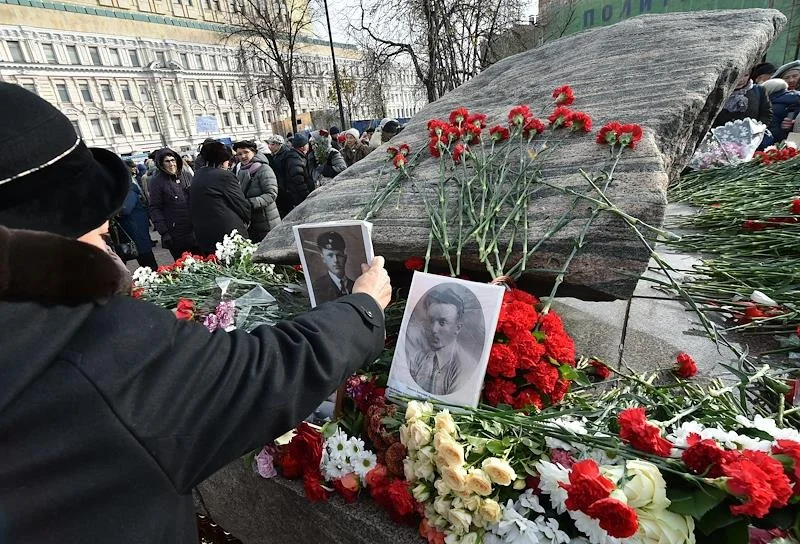
In fact, in the Constitution, where the very human rights are spelled out in the second chapter, the council for which is headed by Fadeev, the right of citizens to freely express their opinions and beliefs is written down. And if they want, having gathered at the Solovetsky Stone, to express what they think about Stalin’s repressions and about those who carry out repressions today, this is their full right, and no one has the right to tell them what they should say and what not.
But the commendable frankness of the state “human rights activist” (quotes are necessary in this case) is very noteworthy, who, without hesitation, protects from “reproaches” those who openly call themselves heirs and successors of the security officers, who keep their portraits in their offices, and consider Stalin’s repressions “state necessity” and persecutes those who, like “Memorial”*, strive to preserve the memory of both the victims of repression and the executioners.
And Mr. Fadeev really doesn’t like the “Last Address” project - installing signs on houses with the names of those victims of repression who were taken from there on their last journey.
“There are a lot of signs, in the center of Moscow there were repressed people in almost every building. Here you are walking through this beautiful city - and there are signs on every building. Here some are repressed, here others are repressed. But in this magnificent city and in these buildings, not only repressed and murdered people lived... you walk through the city of the dead, you walk - and there are dead everywhere, everywhere there are reminders of the horror that happened in 1937,” the head of the Human Rights Council confesses.
And he continues: “It’s so obsessive to poke people in the face every day, but you were killing each other here, this country has no future,” and therefore the “Last Address” project is “just on the side of untruth, and at best — half-truths, that’s why I don’t like him.”
This is not said by an official of the mayor's office or the presidential administration, not an employee of the FSB or the Ministry of Internal Affairs - this is said by the person who heads the interdepartmental working group to perpetuate the memory of victims of political repression! He categorically does not want citizens to develop “immunity” against the policies of repression - both past and present, sympathy for the victims and rejection of the executioners. At the same time, he indifferently notes that “there is no agreement in society” regarding Stalin, that “this was our tragic and heroic history at the same time” and that “some focus on heroism, while others focus on tragedy”...
As already said, the head of the HRC said many more remarkable things.
Valery Fadeev, by his admission, “doesn’t know” the books of “foreign agents”; he “didn’t read” either Akunin or Ulitskaya because “they didn’t come across them.” But he considers the new discriminatory initiatives against “foreign agents” recently adopted by the Duma in the first reading to be “fair” and “adequate.”
It should be quoted in detail here.
“If citizens begin to loudly oppose the policies that the state is pursuing today, then society and the state have the right to take measures in this tough situation. So the state is taking these measures. If this had been a few years ago, well, perhaps one would have been more irritated about it. And now I’m not irritated about it. I understand this with understanding."
In other words, the head of the Presidential Human Rights Council quite openly admits that they are registered as “foreign agents” not for non-existent “foreign funding” or “foreign assistance” invented by the Ministry of Justice, as is written in the law, but for “speaking against state policy.”
In these initiatives, which actually deprive “foreign agents” of the right to dispose of the money they earn, the head of the HRC does not see any violations of the Constitution, stating that “ if in this specific difficult situation we rely only on the law in its limited understanding , then it will be more difficult for us to act and accept solutions." Although he sees the danger that those who “simply criticize the authorities” will be subject to restrictions, and states that “we will have to intervene in each specific case.” It’s hard to believe in this intervention, to be honest, based on everything that has been coming from Fadeev lately...
He does not see any increase in the number of denunciations in Russia, and he justifies the closure of the oldest human rights organizations (including Memorial), stating that they “were expunged not for human rights activities, but for political ones” and “were engaged in politics of a very specific nature.” .
And finally
repeats his thesis about “soft sanitary measures” - stating that “those laws that were adopted against “fakes” about the army, about the SVO, about “foreign agents” are quite soft measures that are adequate to the situation in which where the country is today."
Apparently, according to Mr. Fadeev, seven to eight years of imprisonment for an opinion about the SVO that differs from the official one is “quite mild measures.” As well as the deprivation of voting rights, the right to be deputies, the right to teach and one and a half dozen other constitutional rights of those who were declared “foreign agents” by the stroke of the pen of an anonymous official.
Let us repeat: in the mouths of officials, “security officials” or state propagandists, all of the above would be quite organic. But when this position is voiced by the person heading the HRC, cognitive dissonance arises, as they say. True, this is not the first time. And the very concept of human rights in today’s Russia has already been declared a “hostile instrument for the destruction of sovereignty,” interpreted as the ability of the authorities to do whatever they want with their subjects, without regard to any legal norms or international conventions.
The chairman of the Yabloko party, Nikolai Rybakov, called for the resignation of Valery Fadeev, who “with his statements has so discredited his post that he has no right to continue to hold this position.”
And he proposed moving not the Solovetsky Stone from Lubyanka, but the secret service office from the building on the square to another building that does not carry a dark history, and moving the Gulag Museum to the building on the square.
However, both proposals have little chance.