Date
Author
Нина Петлянова, Алексей Душутин
Source

Preserved copy
Translated material
Student line
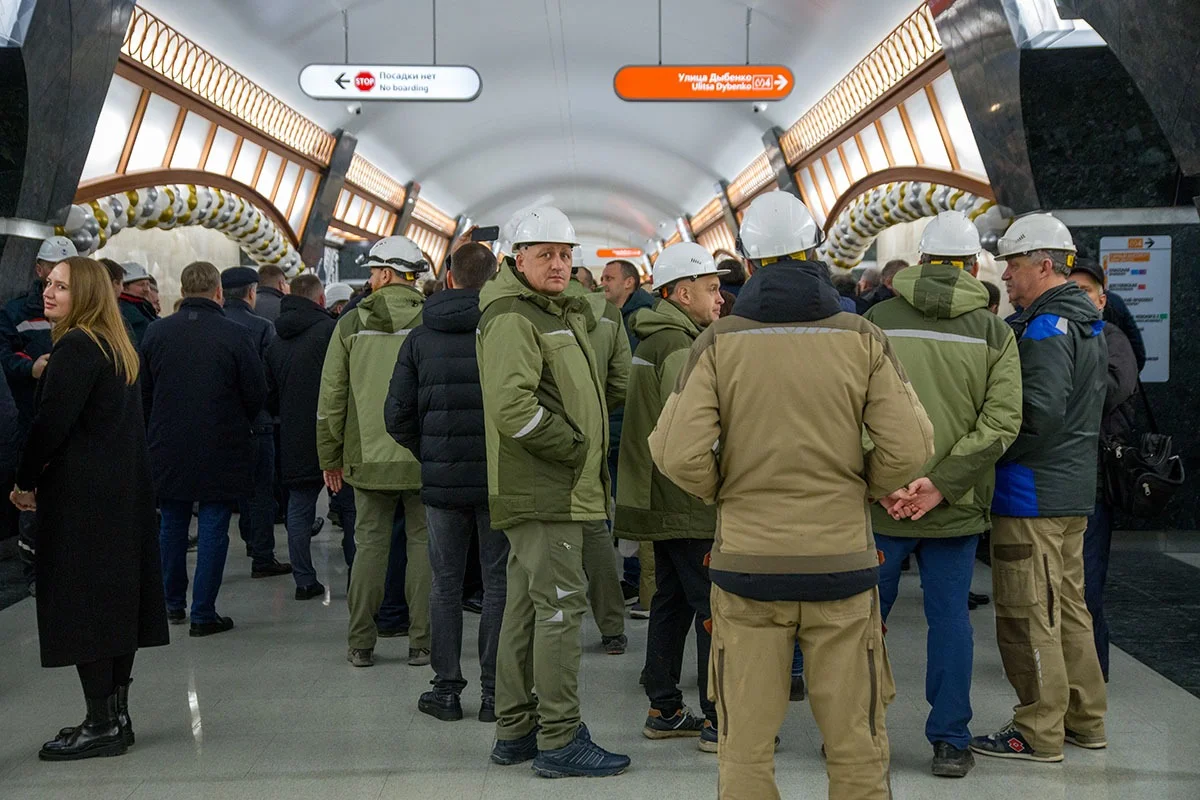
Today, for the first time in five years, a new metro station, “Mining Institute,” was opened in St. Petersburg. Three previous new stations went into operation in October 2019

Opening of a new metro station in St. Petersburg. Photo: Alexey Dushutin / Novaya Gazeta
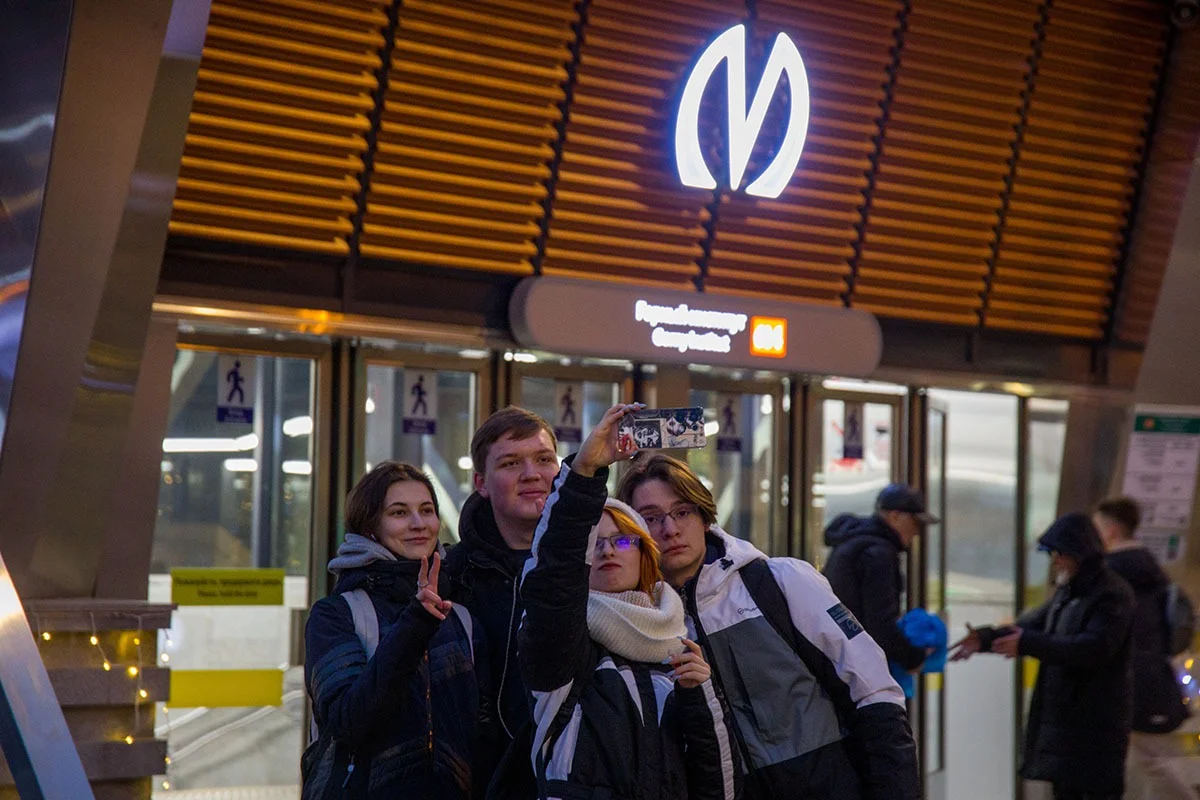
At 8 o'clock in the morning, the city governor Alexander Beglov, the speaker of the St. Petersburg parliament Alexander Belsky, the head of the St. Petersburg metro Evgeny Kozin, the director of the construction company "Metrostroy of the Northern Capital" Dmitry Vasiliev and the rector of the Mining University arrived at the New Year's decorated area in front of the entrance to the "Mining Institute" station. Vladimir Litvinenko. The latter did not appear alone, but together with hundreds of the best students of the university. On December 27, they were to become the first passengers of the new station, and then permanent ones.
The young people explained to Novaya that until now they had experienced great inconvenience when getting to their place of study from Vasileostrovskaya or Admiralteyskaya (the metro stations closest to the university) on passing buses and trams. It takes longer and is more expensive.
The “Mining Institute” will help not only students, but also employees of the Baltic Plant, as well as residents of the alluvial areas of Vasilyevsky Island to get to the desired point faster, remove the long-term overload from Vasileostrovskaya, and relieve congestion on bridges in the city center.

Early on Friday morning, the metro builders themselves came to look at the creation of their hands. The workers took pictures at the entrance, in the lobby, on the escalators, and shot videos as souvenirs... Such childish joy could have surprised or amused if new metro stations in St. Petersburg were not presented so rarely. It is not for nothing that Beglov, before cutting the ribbon at the Mining Institute station, thanked St. Petersburg residents for their “waiting” and “patience” and justified the long construction time by saying that on the banks of the Neva “it is more difficult to build a metro than in Moscow and in any other city in Russia.”
The construction of this St. Petersburg metro facility lasted a decade (to prepare the territory, Metrostroy entered the construction site in 2014), which, however, is no longer a record. The Teatralnaya station, located on the same orange line, directly in front of the Mining Institute, has not been completed for 14 years (it was originally promised to be launched in 2014).
The question of where the exit from the station located next to the Mariinsky Theater will be located has not yet been resolved. According to metro builders' forecasts, for another two to three years trains will travel from Spasskaya to the Mining Institute past Teatralnaya without stopping.
The Mining Institute, which was planned to open in 2018 when it was designed, also has problems with exits. Initially, there were two planned: on the Oblique Line of Vasilyevsky Island and on the Maslyany Canal. However, now there is only a way out on the Oblique Line, and an underground pedestrian crossing has not even been built under Bolshoy Prospekt of Vasilievsky Island due to the large number of utility networks.
Over 10 years, the cost of building the station has more than doubled: from the design 21 billion to 46 billion rubles.

A year ago, Beglov promised that the “Mining Institute” would be introduced not just before the end of 2024, but by September. After this, the race began: the first working train reached the station, photos from the lobby appeared, landscaping began at the corner of the Kosaya Line and Bolshoy Prospekt of Vasilievsky Island, Spasskaya was closed to connect a new section of the line to it, etc.
However, even despite such efforts, the Mining Institute did not manage to open by the beginning of the school year. Rumors that were terribly inconvenient for city authorities appeared that the opening would only take place in 2025. Smolny, however, has already demonstrated that in such situations he knows how to jump over his head. All the latest metro stations in St. Petersburg (Begovaya, Zenit, Prospekt Slavy, Dunayskaya, Shushary) were launched with significant deficiencies, which were eliminated during operation.

The Mining Institute will have to undergo testing in the last week of December and the January holidays. But the station encountered its first problem today at about 9:30 a.m., after it received its first passengers. Some of the escalators working up and down suddenly stopped. Over the loudspeaker in the subway they immediately announced: “We apologize. Anything can happen, the escalators are new.” But the delay turned out to be long. As a result, people on the escalators were forced to go up and down on foot. Despite the fact that “Mining Institute” is one of the deepest stations of the St. Petersburg metro, it is located 70 meters underground. And so far this is the only point of the city subway where there is no mobile connection.
Saint Petersburg