
Translated material
Popopartorgi
If we are to assign priests to pro-government media, then only exorcists

18+. THIS MATERIAL (INFORMATION) IS PRODUCED, DISTRIBUTED AND (OR) SENT BY FOREIGN AGENT VISHNEVSKY BORIS LAZAREVICH OR CONCERNES THE ACTIVITIES OF FOREIGN AGENT VISHNEVSKY BORIS LAZAREVICH.
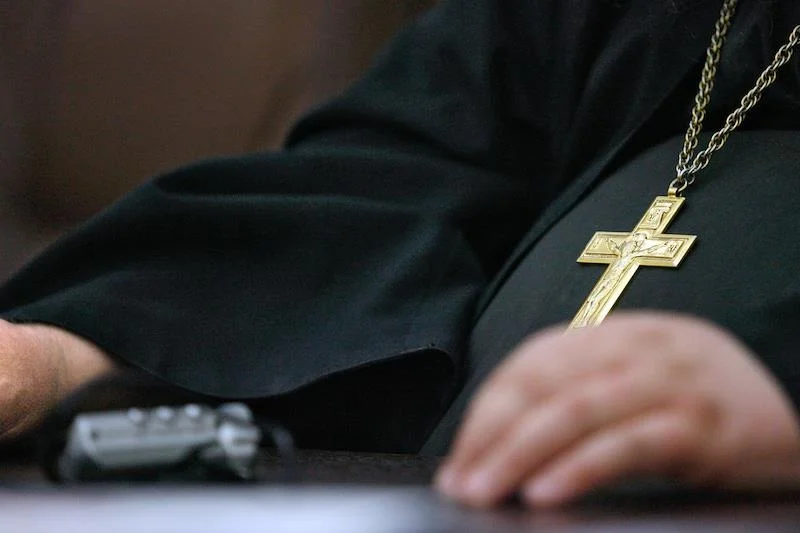
In the Sverdlovsk region, a priest will be assigned to each media outlet , Metropolitan of Yekaterinburg and Verkhoturye Evgeniy (Kulberg) announced this at a meeting with media leaders of the region.
Those who were invited supported the idea unanimously. Now specific “attached” priests will be approved by the end of February. They, according to the press service of the diocese, will have to meet with editors, hold conversations and together come up with “new formats of interaction.”
Nothing new - it all happened before. Including in literature, which seemed like fantasy, but now increasingly resembles realism.
At the meeting, where the heads of OTV, Channel 4, E1, EAN, State Television and Radio Broadcasting Company, TASS and some others were invited (the editors of the independent publications Vechernie Vedomosti and It's My City were not invited), the Metropolitan said that “a similar scheme is already in effect in universities,” that “priests who were graduates of the same universities were attached to the institutions”, that “they very harmoniously merged into the life of each of the universities” and that he hears "very positive feedback."
After that, according to him, “we asked ourselves whether we should project this practice onto our media,” “so that the priest would talk about his life, about the life of his parish, about the life of the diocese, so that the editorial staff would get to know and become friends with this person.” . The Metropolitan hopes that “there will be a reflection of this friendship on the pages of print or media, and the church will become closer to our society with the participation of the media.”
As they say, there are questions. Both from Soviet times and from literature.
In Soviet times, such “attached” people, including those in civilian clothes, were known to be in every media outlet. Only they were called not priests, but censors, and, to put it mildly, they were not loved by journalists. Can we repeat it? By sending “curators” in robes?
Next, I would like to understand: now in the editorial offices of the mentioned media there will be a morning prayer service for good news? I can vividly imagine this scene.
Well, what if someone in the editorial office (Ekaterinburg is a city with a very diverse ethnic composition) is not of the Orthodox faith or is not a believer at all, which is still allowed under the Constitution? And he won’t want to be friends with the priest, much less demonstrate “a glimpse of this friendship” on the pages of his publication?
How is the Metropolitan going to evaluate the effectiveness of “friendship”? By the number of publications, that is, by the degree of “reflection”? So our administrations at all levels evaluate work with the media in approximately the same way, only they call it not “friendship,” but somewhat differently. True, subsidies are also allocated - and the Metropolitan, apparently, hopes for a disinterested response...
In the comments to this news, they evilly ironize that if we are to “attach” priests to pro-government media, then we must start with exorcism rituals. Let’s add: and if you attach it to the federal media, you will simply need unique specialists in this field who will be at odds, and their efforts may not be enough...
Finally, literary examples immediately come to mind.
For starters, the science fiction writer Evgeniy Lukin and his “Scarlet Aura of a Proto-Part Organizer” - where one of the heroes, African, is awarded the title of “proto-part organizer” by “Partiarch Lytsky Porfiry” (the prefix “proto” means “senior”).
And then, of course, the wonderful and unique Vladimir Voinovich, his “Moscow 2042” and “first deputy of the Main Committee for Spiritual Nurturing, Major General of Religious Service Father Zvezdony.”
Remember?
“In the new system, the church turned out to be in demand, which received all the benefits in exchange for only one “trifle” - to abandon God and replace him with the Genialissimo. At the same time, the state-religious system is based on the Five Unity of nationality, party affiliation, religiosity, vigilance and state security.”
“The Holy Scripture turns out to be the creation of the Genialissimo, in the new communist church actually headed by Father Zvezdonius, there are also military ranks, and Marx, Engels and Lenin are canonized, and together with the “first communist” Christ and the Genialissimo, they are universally glorified and portrayed.”
“The Church always instills in its flock that a true righteous person is one who fulfills production tasks, observes production discipline, obeys his superiors and shows constant vigilance and intransigence to all manifestations of alien ideology.”
“The newspaper was called, as before, Pravda.” Under the name of the newspaper it was written that it was an organ of the Communist Party for state security. <…>
From the newspaper I learned that, being in some three rings of hostility, the country is experiencing temporary difficulties, and a limited contingent of Soviet troops is located on the territory of the Afghan-Pakistan People's Democratic Republic "...
Re-reading this (“Moscow 2042” with a dedicatory inscription from Vladimir Nikolaevich Voinovich is on my shelf) is both funny and creepy.
Voinovich and Lukin had no idea that they were not writing dystopias, but instructions.
By the way, it was Metropolitan Evgeniy (Kulberg) who recently worked as an assistant for the notorious Daniil Sidorov, who was accused of harassing a student and then went to the SVO to avoid trial.
After which the Metropolitan said that he “will bring the fruits of repentance on the battlefield through dedication and military labor.” And he criticized the media for covering the scandal, comparing priests to airplanes: they say, while they are flying, no one is interested in them, but as soon as one falls and crashes, all the world’s media immediately write about it.”