
Translated material
No alternative
Activists from all over Germany came to the German Riese to prevent the far right from nominating a candidate for chancellor and being elected to the Bundestag. Report "New Europe"
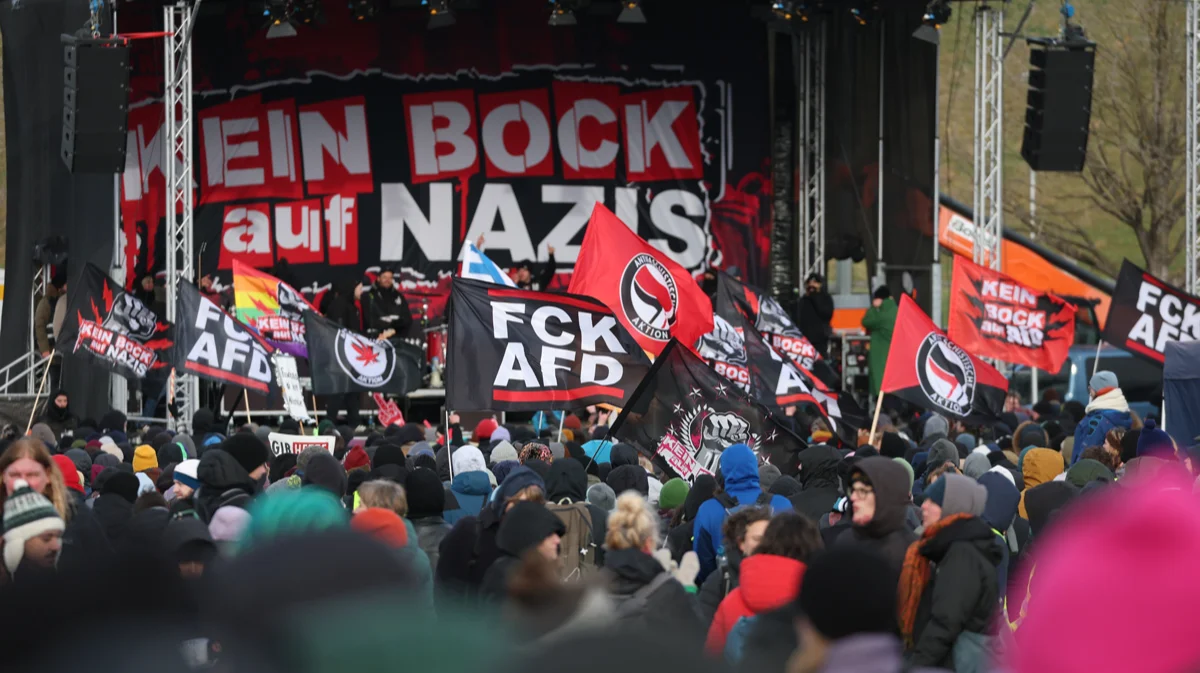
Protest against the Alternative for Germany (AfD) party congress in Riesa, January 11, 2025. Photo: Jan Woitas / dpa / picture-alliance / Scanpix / LETA
Alternative for Germany chose the small town of Riesa in Saxony to hold its party congress on the eve of the upcoming parliamentary elections in February. The ultra-right hoped to quietly approve their program and candidates here, but this was not destined to come true.
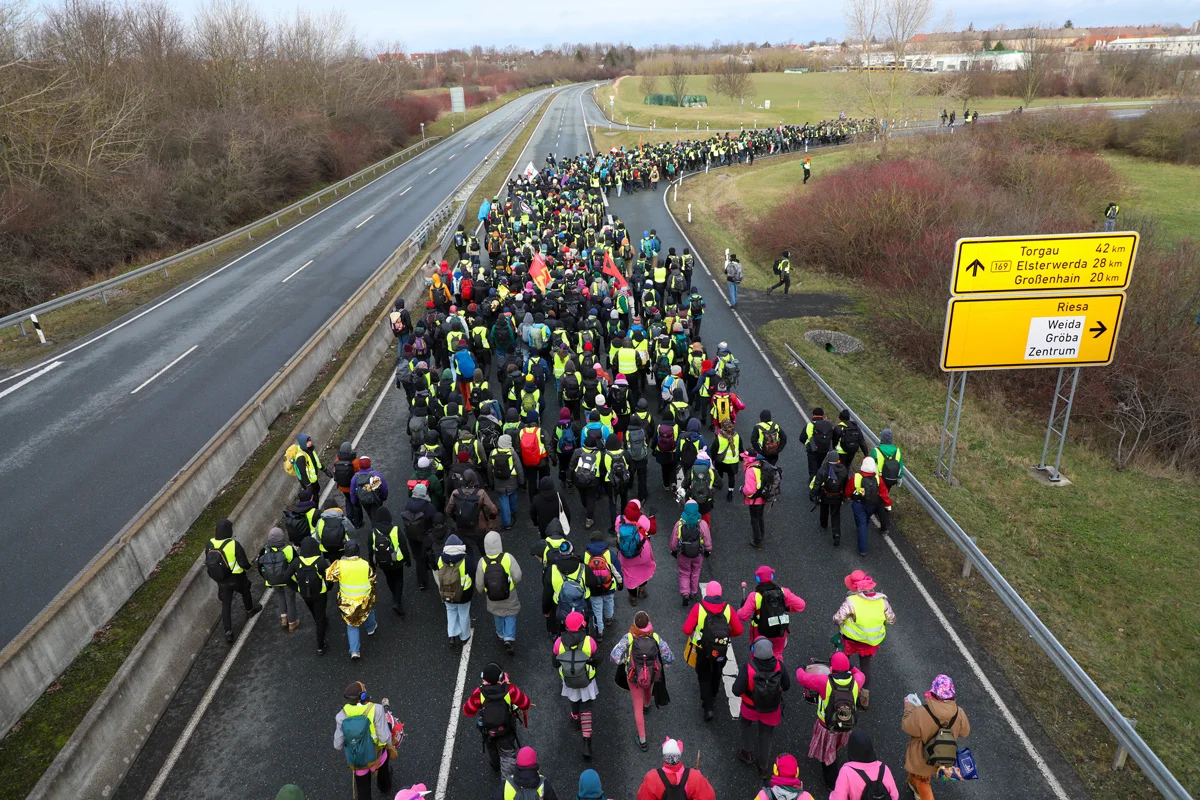
On the day of the congress, left-wing activists, trade union members and other ardent opponents of the party flocked to Riesa from all over Germany, demanding its ban. A crowd of protesters tried to prevent Alternative members from participating in the meeting, but were stopped by German police and continued to rally near the congress. How the unusually noisy and politicized weekend for Riza went and why the organized rally demonstrates the high polarization of German society on the eve of the elections - in a report by Novaya Gazeta Europe.
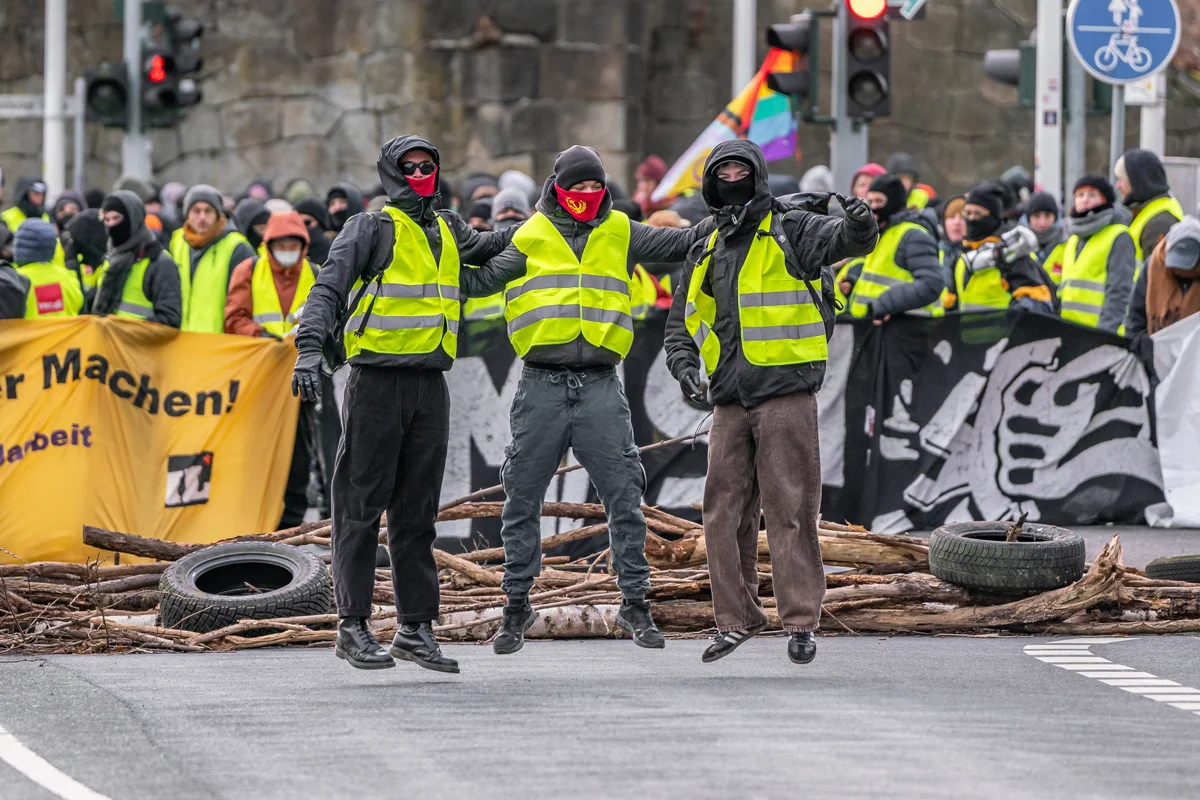
Early morning, cold. “Group number two blocked Rostoker Strasse, group number three blocked the bridge, group number seven is already on the B169 federal highway, two more groups are holding the road from neighboring Oschatz,” a man in a green signal vest, one of the volunteers, tells me.
Vests are their uniform, leaflets and speeches are weapons, and the entire city is today’s battlefield. Each group of protesters has its own task and location. The entire city is divided into squares so that participants can quickly navigate and, if necessary, strengthen another point.
On the morning of January 11, a congress of the far-right party Alternative for Germany (AfD) is due to take place at the local exhibition complex WT Energiesysteme Arena in Ries, a small town between Leipzig and Dresden, but the German left and antifa intend to prevent this.
In the parking lot of the WT Energiesysteme Arena complex, protesters set up a large stage for musicians to perform and set up tents with food and hot tea. Music and sirens sound. Activists are preparing for the appearance of 600 delegates to the congress. A noisy demonstration with banners and drums is moving here, towards the exhibition complex, from the Rize station.
Those wishing to attend the event continue to arrive, the railways are operating normally, but they are still unable to cope: at the Leipzig station, sixty kilometers from the center of events, one of the platforms is packed to capacity with people waiting for the next train. From five in the morning, groups of activists set off from here to Riza. The next train is supposed to leave at eight in the morning, but not everyone gets on it either - the cars are packed. Another one will arrive in an hour, and will be greeted with applause - for those participating in the protests this is the only chance to get to the place, because the roads are blocked.
The Alternatives for Germany party congress, which is taking place in the city, is rather formal in nature: the electoral program for the upcoming elections in February is known, lists of candidates have been compiled, and key persons have been appointed. But for AfD opponents, this event is a sufficient reason for protest. “Let’s stop this right-wing propaganda show,” the organizers of the action call . According to them, the AfD intends to “destroy democratic structures” in Germany, as it did in the 1930s, when the Nazis actually won elections and then dismantled the Weimar Republic.
The fears of the party's opponents are not unfounded, as the latest polls promise the AfD that after the February elections it will become the second party in the country, receiving about 20% of the vote, or twice its previous result.
The leftists and anti-fascists who gathered for the rally are also concerned about the fact that some representatives of the establishment also sympathize with the ultra-right: security forces , large businessmen , underground workers .
As Germany's voting date approaches, tensions are rising. Political confrontation is moving to social networks and to the streets. What is happening today in Rize demonstrates this best. It was here, in the outback in the east of the country, that the AfD hoped to hold its congress without prying eyes. But that is precisely why protesters from all over Germany flocked here.
Thwart plans
Most of the activists gathered in Riesa belong to an organization called Widersetzen, which means “Resist.” This cross-platform alliance of opponents of the Alternative for Germany appeared in March 2024. The initiative was put forward by 170 people from trade unions, green movements, anti-fascist and feminist communities. Their only goal is to prevent the AfD from coming to power.
As representatives of the alliance told New Europe, it is financed exclusively by donations and is not associated with any political force. “We bring together people who often take opposing positions but agree that the AfD is not a democratic party,” they say.
Widersetzen's first target was the AfD's summer meeting in Essen last year. To disrupt it, activists organized mass actions of civil disobedience: they made noise and blocked roads. And although the congress took place anyway, the speech of anti-fascists became a notable event. In addition, it turned out that it is possible to resist effectively and legally.
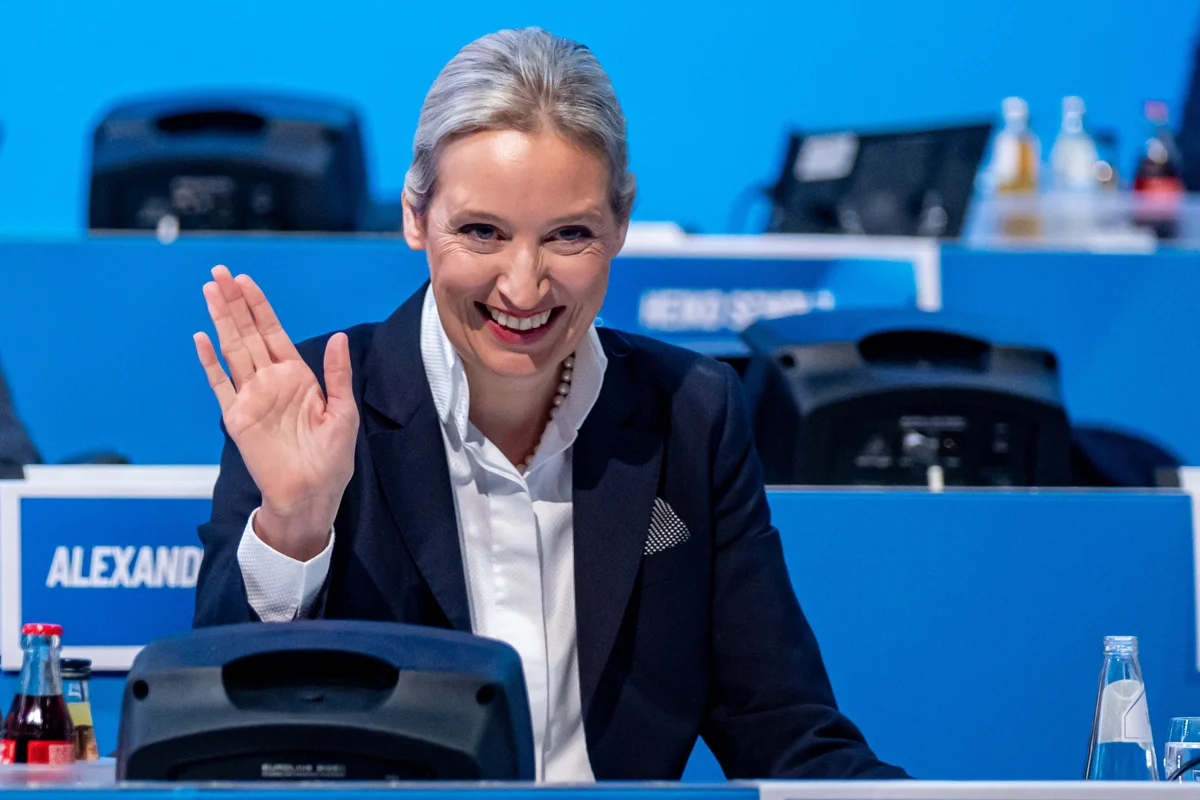
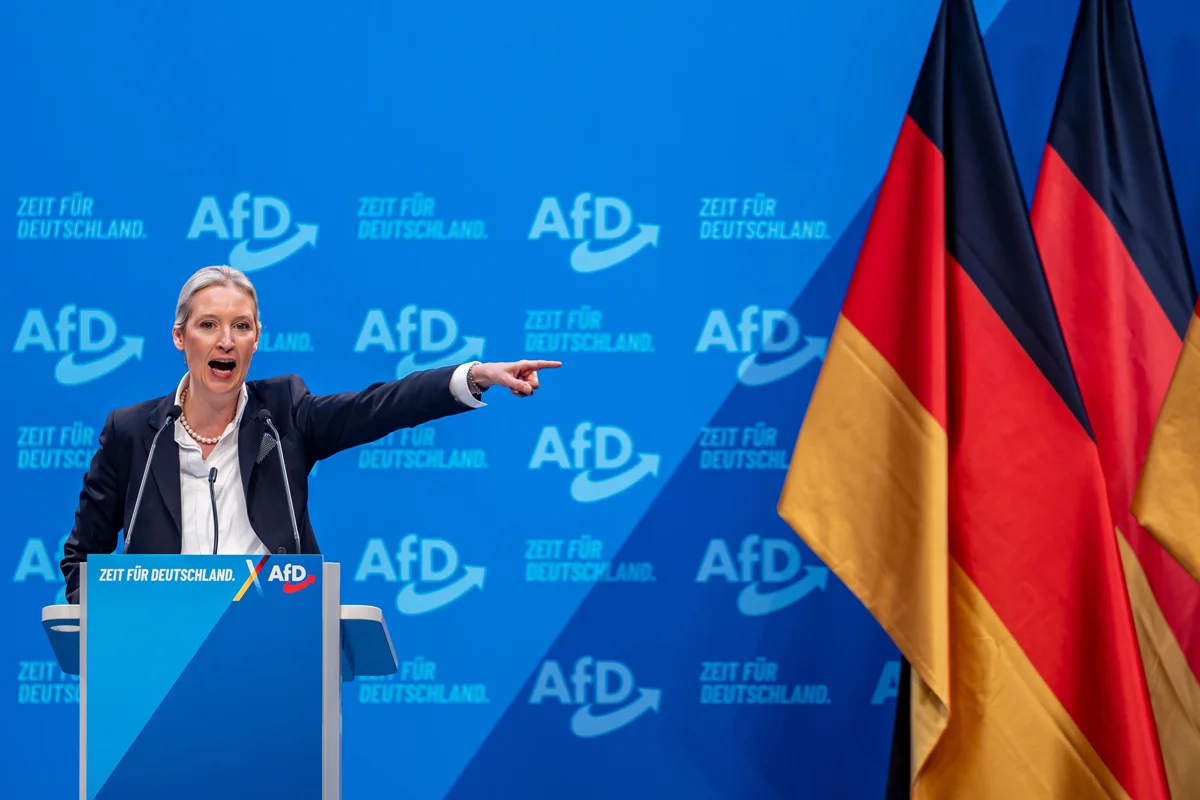
Now activists have decided to interfere with the congress in Rize, at which the far right intends to nominate their candidate for chancellor. This was the co-chair of the AfD parliamentary faction, Alice Weidel, a blonde with large, calm eyes and an impressive biography.
“The pride of populists, a mystery for everyone else,” DW wrote about Weidel back in 2017.
Weidel was born and raised in Gütersloh, North Rhine-Westphalia, the son of a sales agent. She received her higher education at the University of Bayreuth, where she studied economics. In 2005, 26-year-old Alice began working as an analyst at the American Goldman Sachs Group, which in popular culture has become a kind of symbol of modern capitalism and the financial elite. Then, as Spiegel writes , she lived, studied and worked in China, although Weidel’s biography on her website says nothing about this.
In 2013, Weidel joined the Alternative, a newly assembled group of Eurosceptics and disillusioned conservatives. The young party quickly ruled, and Alice climbed the career ladder. In 2015, Weidel joined the federal executive committee, in 2017 she became a member of the Bundestag and immediately headed the faction, becoming a co-chairman.
At the time, German media described her as level-headed and savvy. It was noted that she deftly avoids accusations of racism and demonstrates “ideological flexibility.” Alice now lives in Switzerland with her girlfriend Sarah Bossard, who was born in Sri Lanka. The couple has two adopted children. Even though Weidel is successful and rich, she excels at playing the role of “victim of establishment politics.”
Neighboring Weidel in Switzerland is the German dairy magnate, CSU veteran (aka CSU - Christian Social Union, Bavarian relative of the CDU) Theo Müller. In February last year, the businessman confirmed to reporters that Alice “lives nearby and often comes to visit,” and they enjoy talking about politics.
However, Mueller is not the only billionaire who enjoys talking politics with Weidel. A few weeks before the congress, Tesla owner Elon Musk supported the AfD. First with a short tweet : “Only the AfD can save Germany,” and then with a whole column in the Welt am Sonntag newspaper, owned by Axel Springer. Musk's actions caused a storm in the media, but this did not stop the businessman, and he soon announced a live broadcast with Weidel on his social network X (formerly Twitter). The meeting took place on January 9, the speakers exchanged opinions and came to very unusual conclusions, in particular, Weidel stated that Hitler was a communist.
Conversations between Musk and Weidel, of course, added political points to the AfD, but also invigorated their opponents. “We are going to prevent the delegates of the congress from building their fascist plans,” the organizers of the rally in Rize wrote in their address.
"Grandmothers" lead by example
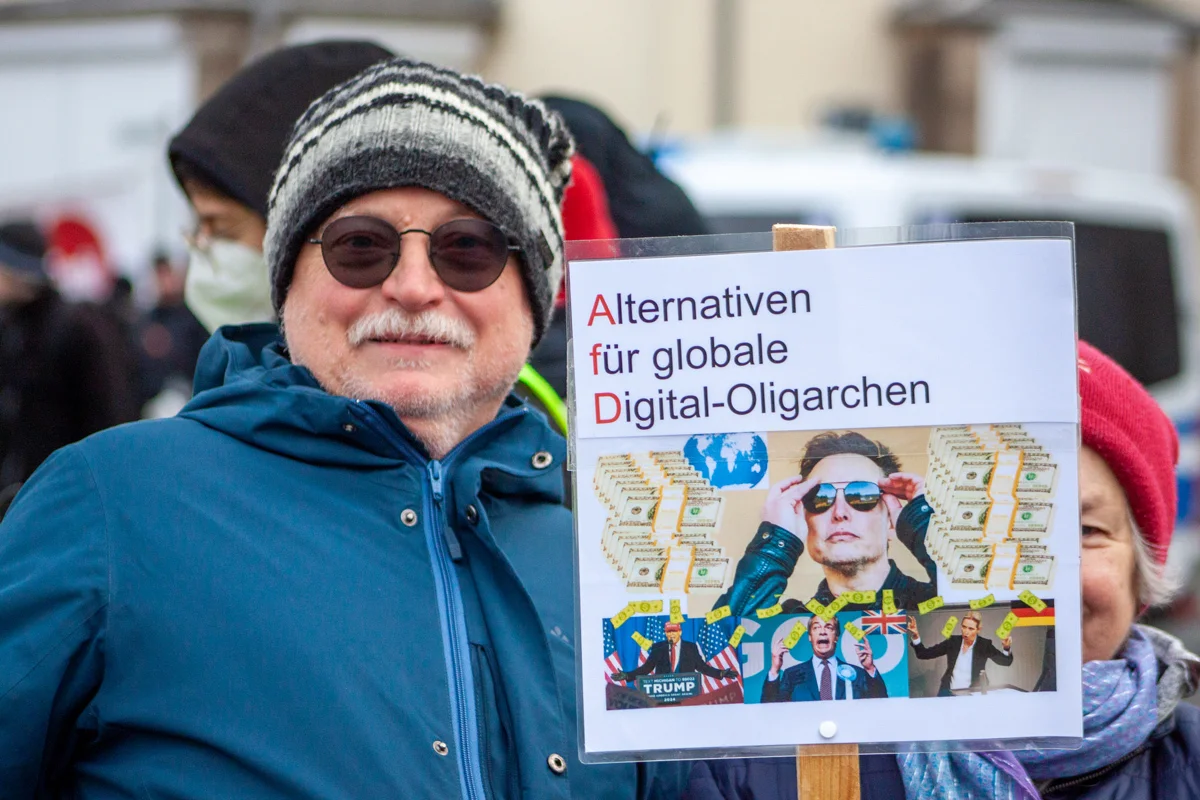
A couple of pensioners walk past me, in the hands of a mustachioed man a poster with a recognizable image of a billionaire and the inscription: “An alternative for digital oligarchs.” Many in Germany are unhappy that Elon Musk has recently been too actively interested in European politics: he is either seeking the resignation of the British Prime Minister or insulting Bundes President Frank-Walter Steinmeier. The protesters in Rize are not shouting about it: one of the agitators shows me the new issue of the Red Flag newspaper, on the cover of which Trump, Weidel and Musk made faces.
To the right, a hundred meters from the stage, I notice another group of pensioners. They drink tea and chat lively.
These are the legendary “Omas gegen rechts” (OGR), that is, “Grandmothers against the Right,” a movement that first appeared in Austria, which calls itself opponents of the far-right forces.
There are at least three or four groups of “grandmothers” at the demonstration in Rize. Those I met near the stage came here from Saxon Halle, west of Leipzig.
While the others finish their tea, Gerda and Rosemary - both sixty-five years old - agree to give a short interview. Rosemary was born and raised in western Berlin and says her parents lived through World War II and the rise of the National Socialists. “We oppose far-right ideologies and want to convey to young people that this is very dangerous,” she says. According to my interlocutors, they are concerned about the growth of right-wing radical parties, and not only in Germany. “It has already started in Austria, it is happening in France, Italy and other European countries,” adds Gerda, a native of Ludwigshafen.
“We came here to make a statement. The AfD wants to penetrate the institutions of our democracy in order to destroy it, they [AfD] even write about this in their party program. They don't respect our rules. They don’t respect our history,” says Rosemary.
Gerda and Rosemary are very well informed about what is going on. As an example, they cite recent events in Austria , where conservatives (ÖVP), who previously flatly refused to cooperate with the far-right Freedom Party (FPÖ), are now forced to negotiate with it. This incredibly outrages the “grandmothers.” “Politicians are afraid to defend their point of view, so we will show how to do it,” they say.
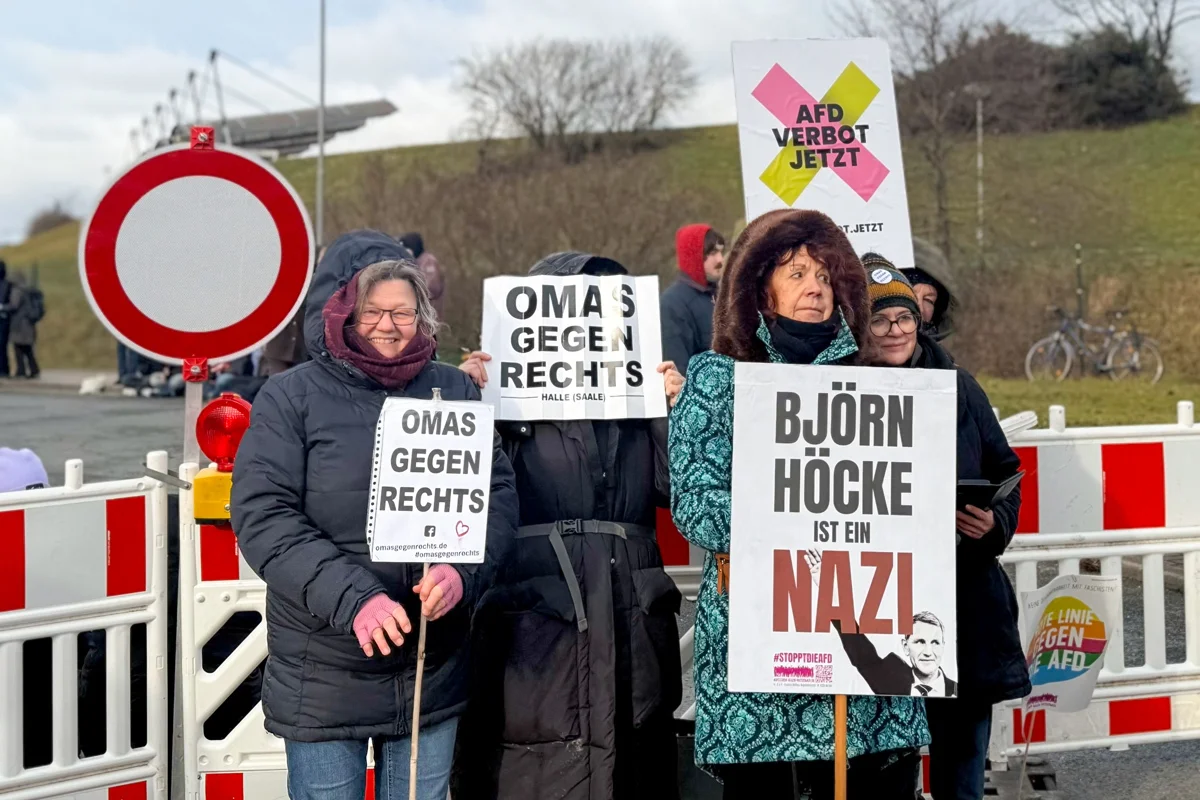
Women believe AfD should be banned. Moreover, its youth wing, the Young Alternative (Junge Alternative für Deutschland, or JA), was already recognized as an extremist organization in 2023. “Why repeat mistakes?” — asks Rosemary rhetorically.
A ban won't solve the problem
As we speak, the first AfD delegates are finally entering the building. Almost all of them have to take a roundabout route to get there with police support, so the start of the convention is delayed by several hours. Well-armed “cosmonauts” walk around the city in columns; a special squad is on duty right on the roof of the arena. Judging by the chevrons and numbers, security forces from Thuringia and other lands had to be mobilized to help their colleagues.
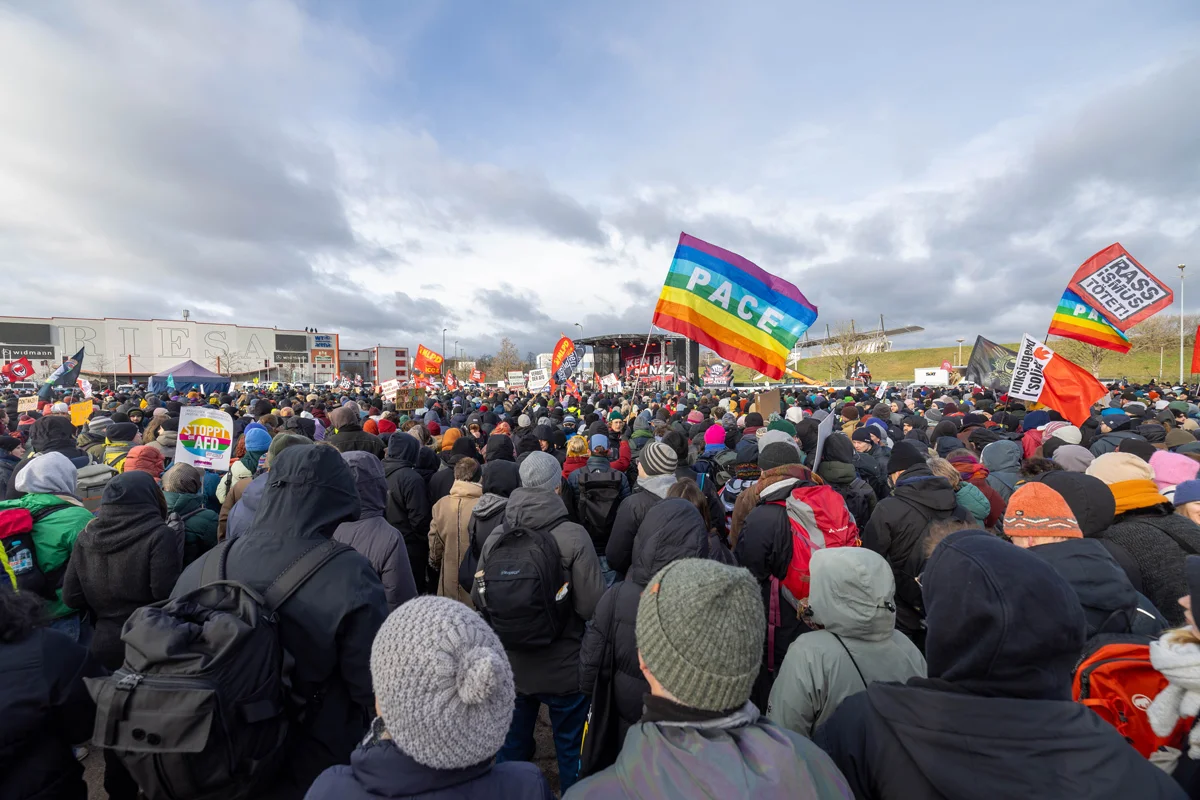
According to the organizers, more than 12 thousand protesters came to the rally, who dispersed throughout the surrounding area and climbed far beyond the city. There is one policeman for every four activists. In some cases, the police use physical force to unblock a particular area. The further from the center of events, the fiercer the confrontation. They fire tear gas on the highways and unleash dogs on the protesters in order to quickly clear the roads. Within the city limits, people are also grabbed and knocked down; water cannons are kept at the ready.
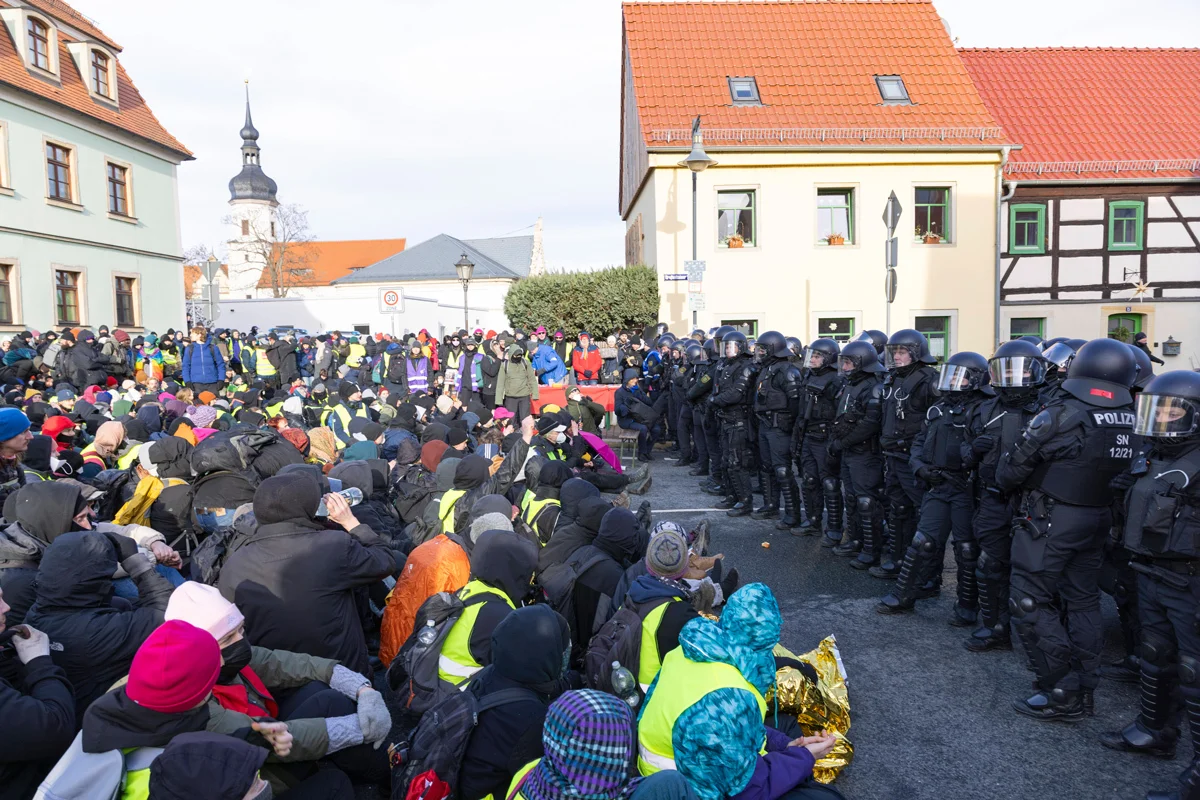
One of the volunteers reports that the nearest point of tension is on the corner of the main street. There was a sit-in there. Hundreds of people are sitting right on the asphalt, surrounded by police. Among them are not only guys in signal vests, but also those who are usually called the “black bloc”. Often people in black clothes are the striking force of street protests. They are organized in columns and, if necessary, can repel the police. But for now this is not required.
The drums are thundering. A small group of activists dressed in black stands slightly away from the sit-in. One of them - the one with the rolled-up cigarette - does not want to give his name, but says that he came from North Rhine-Westphalia, where he is studying to become a fashion designer. As an anti-fascist, he is convinced that the AfD offers inhumane methods and is dangerous because it uses populist slogans and deceives the most vulnerable sections of society.
“Fascism cannot exist without capitalism,” says my interlocutor. “I think that if we preserve the capitalist system, history will repeat itself.” New military conflicts, the young man is sure, are also inevitable in this case.
“We need a revolution. International. We need to address the problem at the root, otherwise we won't be able to change anything. I think this is the only way, but for now it is a utopia. All we can do is protest."
- he reports.
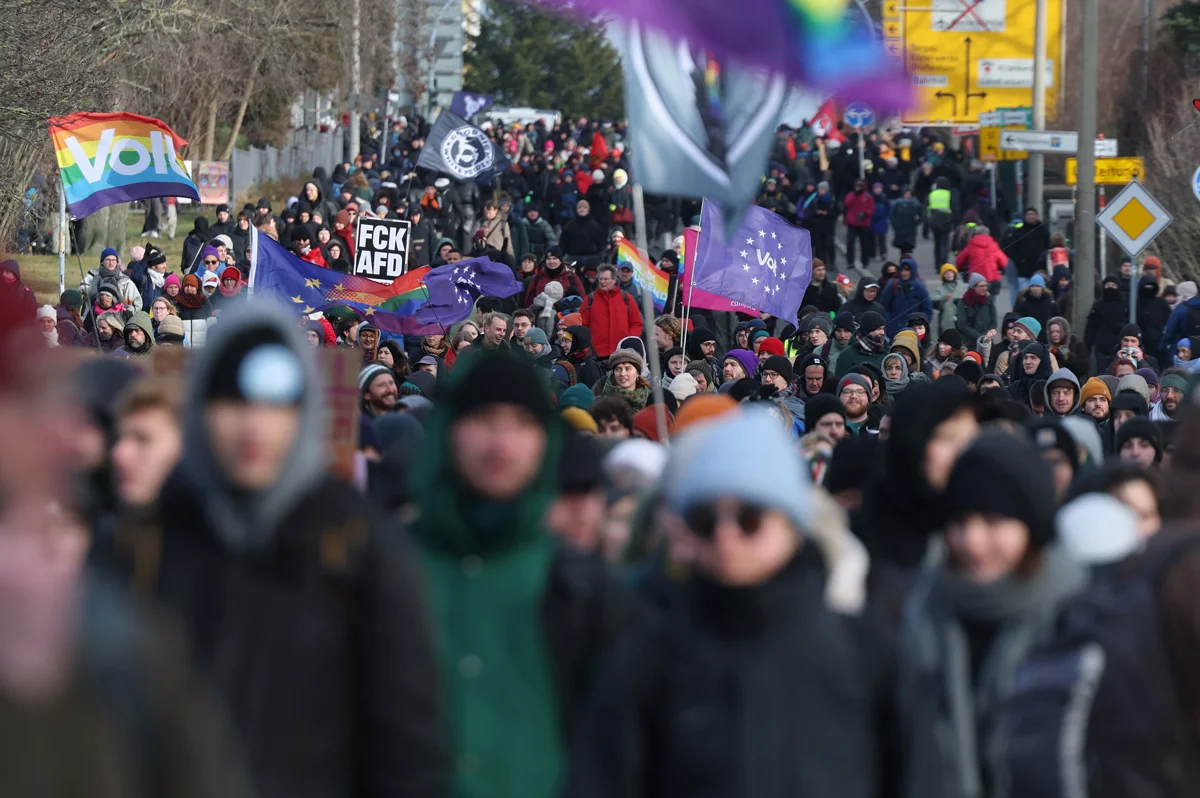
It's getting dark. Under pressure from the police, all demonstrators gradually move towards the stage. Almost all the blockades have been lifted, and after two o'clock in the afternoon the rally turns into a rave. Electronic music plays and sirens sound. While some are dancing energetically, others, who came from checkpoints, dream of eating and warming up. There are huge queues at the tea and vegan food stalls.
A group of activists in red balaclavas and with a “Linksjugend solid” flag departs from one of the tents - they represent something like the youth wing of the Left party (Die Linke). The man with the flag introduces himself as Hummus and says that he works as a nurse in a hospital, but today he went out to protest because he considers it his duty. “We are protesting against a fascist, anti-democratic party that, in my opinion, should not exist, that lies to the people who vote for it,” he explains.
The activist is outraged by what the AfD says about migrants and climate change. He is sure that the country does not have enough workers and really needs migrants, otherwise who will pay taxes and provide for pensioners? In his opinion, the main problem in Germany is not migrants, but an unfair social structure and the pursuit of profits by corporations.
However, unlike many, Hummus is confident that a simple ban on the AfD is not the answer.
“This is not a solution to the problem. Another party will appear immediately. The solution to the problem is to tell people what is really going on. The AfD creates the illusion that the establishment and the media are against them, but the funny thing is that they, the AfD, are themselves part of this elite. Many of them,” the young man replies.
New round
At the end of the day, it becomes clear that, despite the action of many thousands and the virtually complete control of the Saxon town by Widersetzen forces, the Alternative for Germany still managed to hold the congress. As a result, a program was adopted with which the party will go to parliamentary elections, and a candidate for chancellor was elected - as expected, Alice Weidel became. In addition, the AfD officially disbanded the party's youth wing, which was considered extremist, but promised to replace it with something new.
Immediately after being elected as a candidate for the post of Chancellor, Weidel made an uncompromising speech to her colleagues, declaring that
If the party comes to power, then in the very first hundred days the borders of Germany will be “sealed” and “large-scale repatriation” will be organized - in other words, the expulsion of everyone whom its fellow party members consider unnecessary.
On this occasion, the publication Der Postillon even released a comic test with which you can determine whether you are in danger of being expelled from Germany if the AfD comes to power. Weidel also promised to "tear down all the wind turbines" and bring back into operation the nuclear power plants that Germany had trouble abandoning under Merkel. And although Weidel was previously considered a relative moderate, N-TV has now described her as “more radical than ever.”
On the day of the rally in Rize, Weidel's black Audi was met by demonstrators on one of the bypass roads to the party congress site. The driver braked right in front of the activists sitting in his path. Only with the help of police force and bodyguards were they able to clear the way for the car to move on.
How many demonstrators on this day were ultimately injured from the actions of the police, it was not reported, but, according to TAZ, at least 15 people asked for help, including the Saxon deputy to us Dui Nguen from Die Linke, who served as a parliamentary observer and had to follow to ensure that The police behaved reasonably. Six police officers also received mild injuries.
In turn, the co -chairman of the party Tino Khopall accused the protests of Riza of "behaving like antidemocrats and terrorists." He stated that activists threatened the delegates and the police. Weidel called the demonstrators “red Nazis” and said that the “crowd of left -wing, prone to violence” blocked her path.
On that day, Riza really took out mainly representatives of the left -wing forces, but among AFD opponents there are many people and other political views. The Central Parliamentary parties of Germany, which promise to maintain the “firewall”, that is, do not include AFD in the government coalition with any election result next month, secretly support the “resistance” and the centrist parliamentary parties.
The very next day, Sunday, the city will be empty. Riza will return to the usual life again, and the next round of civil and political confrontation in anticipation of elections to the Bundestag will begin somewhere else.