
Translated material
Kit your stone uphill
What mechanisms exist to help yourself cope with the surrounding absurdity. Psychotherapist about the riot and internal emigration
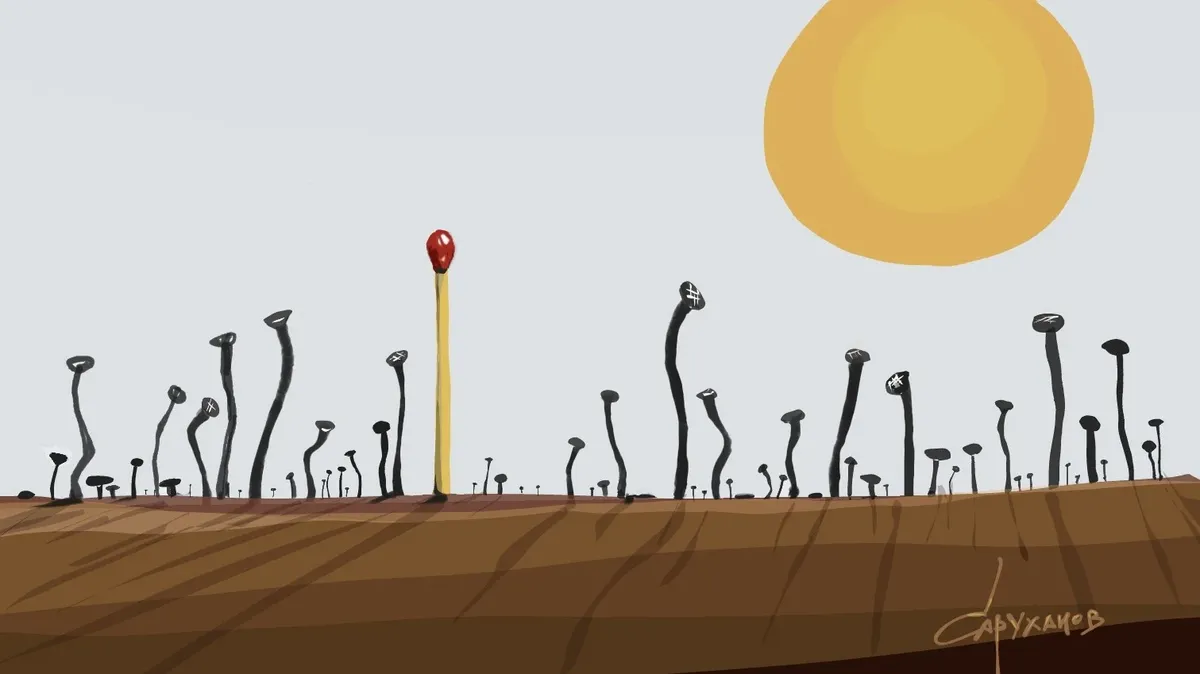
Figure: Peter Sarukhanov / "New Gazeta"
I am sure that in recent years, many people have repeatedly visited a sense of absurdity, the feeling that what is happening should not happen because this should not be, because it contradicts the prevailing ideas about life, morality and just common sense. Of course, what will be perceived as absurd depends on the individual worldview and human expectations. I will give two personal examples. I remember the sense of absurdity that arose with me when the city was filled with Z-hungeries and Z-banners on one day. But an even greater sense of absurdity was caused by the fact that the vast majority of people around them did not cause any emotions at all. There is much less-by virtue of addiction-but still the sense of absurdity was caused by the results of the January survey of the Levada Center*, which showed that problems such as the cruelty of the police, the disbelief in the justice of the judicial system, and the restriction of civil rights and freedoms is concerned about only 3-4% of Russians. And, of course, I understand that these are only my individual reactions, with other people, these examples can be perceived in a completely different way. It all depends on the basic conscious and unconscious expectations of a person from the surrounding reality.
But one way or another, the absurdity constantly chokes us and becomes clear when we are faced with a break between what should have been from our point of view, and what really is. Everyone knows that the world is not particularly a bit of our desires. And that would be nothing. But in it there are regular things that overturn our human ideas about rationality, expediency, good and justice. Evil triumphs and remains unpunished.
This text is devoted to what can help us cope with the state of loss of hope and disappointment, for which there are now many. I will again turn to existential philosophy, and then I will try to connect her ideas with the experience of everyday life.
Absurdity, nausea and riot
Existential thinking, understood in the broad sense, and not only as a specific activity of individual philosophers, begins in crisis situations. When the usual life guidelines stop working. Karl Yaspers introduced the term “borderline situations”: “Death, case, fault and unreliability of the world are found for me as a situation of failure ” (italics mine). He asks the question: "What to do in the face of this absolute failure , the awareness of which I can not avoid when honestly examined?"
Do the existentialists have an answer to this question? Existential philosophy breaks into two branches - religious and atheistic. Different solutions were proposed depending on belonging to the first or second existential thinkers.
From the point of view of religious existentialists, the solution is to support the transcendental, which is realized through faith in God. The same Karl Yaspers wrote that
Even being in the face of death, in obscure and deprived of any meaning of circumstances, a person may experience disinterested gratitude, calmness that are found in faith in the existence of God.
But, as we know, in the modern world, not all people for one reason or another adhere to a religious worldview or adhere to it quite sequentially, to the extent in which it can provide their effective assistance. But, fortunately, the atheistic existentialists also proposed their options for what a person, being an atheist or agnostic, can rely in the opposition of the pressure of the world.
Let's mentally return to the middle of the 20th century and turn to the work of the author of the philosophy of the absurdity of the French writer and playwright Albert Camu. He presented his philosophical views in the essay “The Myth of Sisyphus”, and their artistic illustrations are his novels and plays, drawing worlds permeated by the atmosphere of irrationality, hopelessness, a sense of a certain derealization. And, probably, this, at least, is partly explainable by what personal and historical background these works were written - childhood and youth spent in extreme poverty, the fight against little treatment at that time with tuberculosis, the Second World War and the occupation of France.
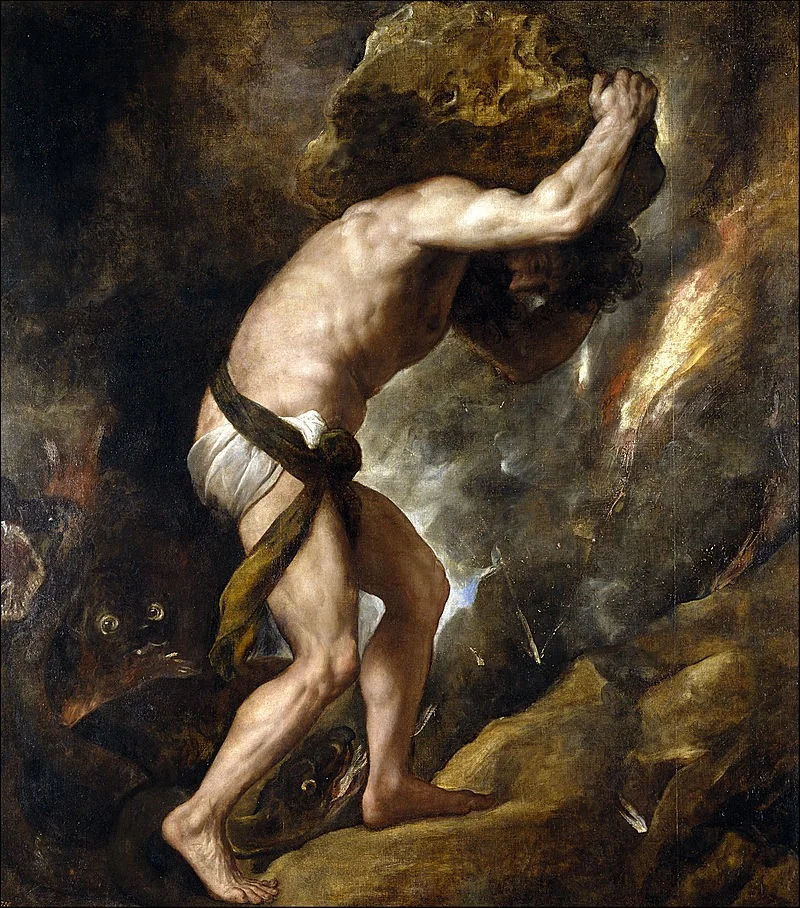
The absurdity is the central concept of the philosophy of Camus. He adopts the baton from Seren Kierkegaard, who raised the problem of meaninglessness and the accompanying her despair and continued his thoughts on this subject Lev Shestov. But, unlike his predecessors, he tries to comprehend these issues, not addressing faith in God.
From his point of view, absurdity is "a split between full desire and a deceptive world." This is a specific connection between them.
Its character stems from the contradiction between a person’s desire for clarity, rationality, understanding of meaning, on the one hand, and the irrationality of the world, his unpredictability, complete indifference to man and his aspirations - on the other.
She appears in front of a person in the form of a feeling of discord between him and his life - between the "actor and the scenery." Camus correlates the sense of absurdity with the Sartre experience of existential nausea, the experience of a world, devoid of meanings familiar to humans. A sense of absurdity at times can be dull, but the givenness of the absurd does not disappear anywhere.
What does Alber Camus offer? How to live a person in an irrational and indifferent universe?
He was clearly not satisfied with the hope of retribution in the afterlife. However, he also treated life for the sake of any great idea (for the sake of a happy life of descendants or life in their memory, etc.). He called such methods of handling the current sense of absurdity.
The antithesis of the original meaninglessness of life Camus believed the metaphysical rebellion of man. This is the second fundamental concept of his philosophy, which is dialectically connected with the first.
"The absurdity makes sense when they disagree with him." A. Camus
The riot does not count on achieving a certain result and does not mean that the restrictions will be overcome, but, on the contrary, implies a complete lack of hope and conscious dissatisfaction. The symbol of the rebellion without the hope of victory for Camus is Sisyphus.
In his interpretation of the myth, although the Sisif cannot turn the situation in which he ended up, he remains inconsistent - "the riot is confidence in the overwhelming power of fate, but without humility."
For Camus, experiencing your riot, your freedom as fully as possible means living in full range. In his works, he leads a galaxy of “absurd heroes”, alone opposing the hostile world.
The absurdity of the USSR and modern existential failure
Now let's see what is for us in these not very cheerful reasoning.
Let's take a look at the current existential situation of people in Russia, who associate themselves with liberal-democratic values. They had to go from hopes of 2011-2013. On the triumph of justice, the “awakening of the people” for the series of more and more hopeless “failures” (using the expression of Karl Yaspers). In 2014, in 2020, in 2022 ... And now there is no longer a mention of the “beautiful Russia of the future” even from the most stubborn optimists.
What should we do when there is no hope left? In this regard, I want to turn to the life of people in the late Soviet Union, with which modern living conditions in Russia have much in common. In addition to censorship of information-an obscured mouth, coercion to express only the point of view that is authorized by the state, the inability to influence state decisions (through participation in the elections or in any other ways)-the similarity is aggravated by the fact that the Soviet man lived in a hermetically closed space, from which it was impossible to get out, although it was not yet fully. He did not believe that he could somehow affect the policy of the state, and even more so to change the political system (the latter was not even implied by participants in the human rights movement)-the Soviet Union was perceived as something eternal and unshakable.
Of course, most people in the USSR - as, indeed, in all other societies - chose a conformist way of adaptation. In other words, they allowed themselves to passively dissolve in the absurdity.
The apotheosis of the absurd in the USSR was perhaps massive processions, to which the employees of the enterprises were sent forcedly (or, as it was customary to say then, “voluntarily condo”, which sounds absurd) and which allegedly showed solidarity with all the working people of the world and was famous for the Communist Party of the Soviet Union. As well as voting in elections with one candidate, which is also absurd. The vague dissatisfaction and disagreement with the fact that everything is as good as he is told, the average Soviet man merged in conversations in the kitchen and through the story of political jokes in the smoking room, for which in the later Soviet times they no longer punished.
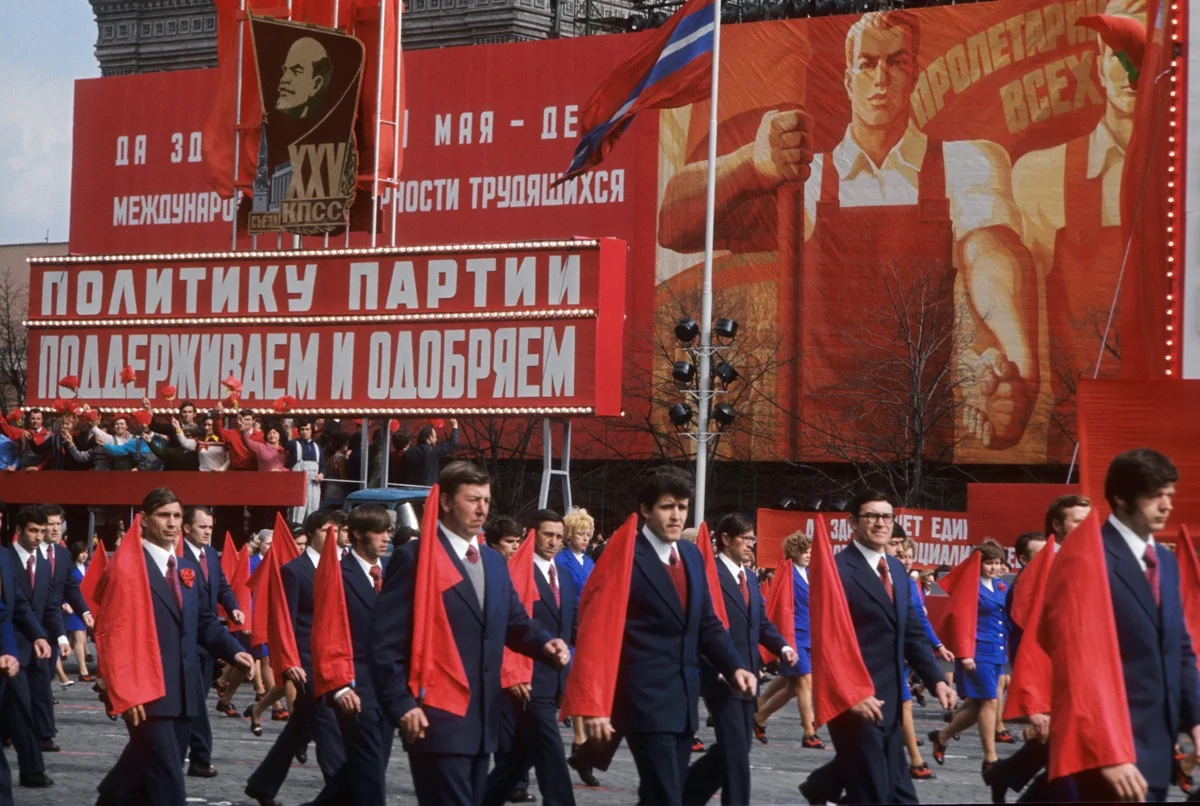
Despite the external suppleness of the most ridiculous requirements of state power, in Soviet society there was a vague dissatisfaction with the way of life that was imposed on top, and manifested in the forms of a “riot”, which sometimes took a political, and often not a political form at all.
The political part was represented by a dissident and human rights movement. But since such an activity was dangerous to health and life, a very small number of people participated in it in a country's scale.
As for open dissent, the willingness to conclude in a prison or psychiatric hospital or even just lose work from an external point of view also looks absurd against the backdrop of the fact that this victim has not changed anything. But she could have a personal meaning for a person. The main character of the novel by Milan Kundery “The Unbearable Lightness of Being” Tomash in response to the proposal to make a small dishonest act, to sign a certain statement in which he will renounce the views expressed by him earlier, in exchange for maintaining social status, answers: “I will be ashamed.”
Internal emigration
The unexplored part of the existential rebellion of an individual against him and everywhere penetrating the “system” - sometimes partially intersecting with dissidentity, although far from always, it seems to me that it is covered with the phenomenon of internal emigration. This term does not have a generally accepted definition and clearly defined boundaries.
But in relation to the Soviet reality, this phenomenon, I think, can be attributed to a wide range of situations: and situations where some people deliberately refused the social elevators offered in Soviet society and the preferences they proposed and went to work as “janitors and watchmen”, and situations when a person continued to go to official, even prestigious work, but his real circle of interests and creativity was not related to what the government expected from him. This is the creation of informal communities in the type of associations of non-conformists or rock musicians.
In general, all these examples are united by the fact that people tried to create a certain environment for their spiritual life, autonomous from state control, to lead the existence parallel to it.
The question of whether it can be considered internal emigration to the departure of alcoholism or garages (a common hobby of Soviet men), I will leave it without discussion so far.
The very desire to acquire internal autonomy from life in the format prescribed on top, as a rule, did not at all pursue political goals, i.e. goals to change the political regime in the country. But sometimes it happened that the self -creative process of the authors touched the topics that the KGB and party leadership did not like. This happened with the work of Alexander Galich, Sergey Dovlatov, Vasily Aksenov, Vladimir Voinovich.
Of course, all these forms of autonomous life could not lead to a complete getting rid of the influence and control of state bodies, which, however, is impossible under any political regime. And even from the totalitarian one can’t hide even in a monastic cell. Although, nevertheless, it is possible to a certain extent to vary the distance with the authorities. As we recall, in the novel by George Orwell with the Partyers and the “races”, the demand was different.
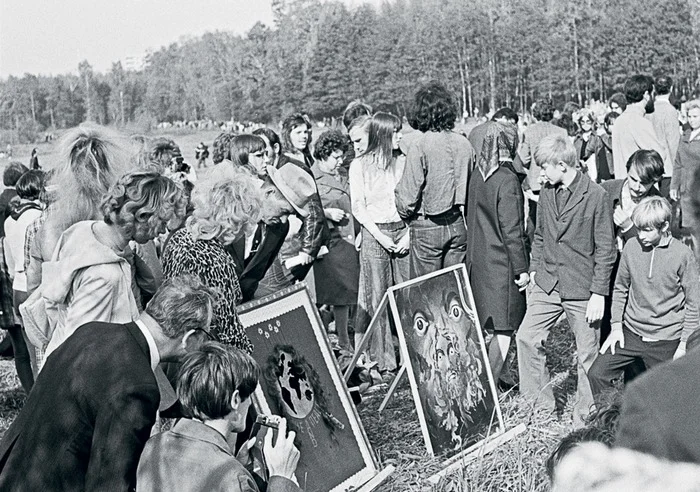
People in the USSR created individual or collective spaces, where they felt that they could breathe freely, where no one climbs into their heads to force them to think, feel and behave in a certain way. Although most often they did not have any conscious politicized subtext, it was often attributed to the authorities itself. Just as in our time, the State Duma deputies are concerned about quadrobors, Soviet functionaries have caused anxiety and irritation any activity that was carried out not at the direction of higher party organs - too long hair or shaved whiskey, listening to unrealized music, yoga, jazz, rock or playing ancient musical instruments, etc.
Suspicion caused any work that did not fit into the officially recognized canon of socialist realism. Especially if it began to arouse public interest.
In this regard, one can recall the sadistic persecution of Joseph Brodsky by the Soviet authorities, whose only fault was that his poetry was outside of any political agenda - that, paradoxically, in the USSR was also interpreted as a political position - and that his poems became too popular. Exhibitions of Soviet avant-garde artists were destroyed, and artists were arrested.
And it should be noted that Soviet propagandists, if they needed to discredit some kind of sphere of hobbies of people, differed in ingenuity, not inferior to their modern colleagues. In the Soviet press, focused on youth, it was written that the musical groups KISS and AC/DC support Nazism, on the basis that the former in the title used stylized letters S, and in the latter on the covers of albums appeared an electricity sign in the form of lightning.
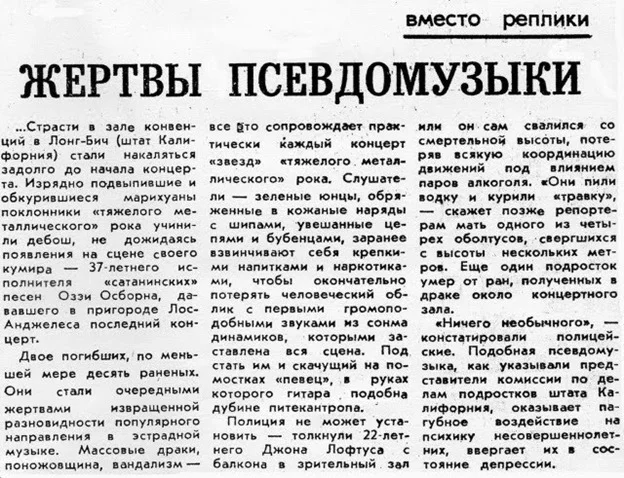
To date, the opuses of Soviet propagandists, their naive lie can be perceived with humor. But in a person who was in a closed information space, this undertaken confidence in his perception and caused confusion. Life in the absurd reality prompts either to dissolve in it in order to avoid continuously arising cognitive dissonance, or to pull away from it. And everyone made their choice. In the above examples, I think you can see a lot similar to what is happening now.
In a state that we generally called internal emigration, a person could get almost involuntarily, carried away by his autonomous life and starting to slowly forget that the state has its own claims for his life. But it was also possible to get into it through a conscious refusal to do what the state demanded, neglecting the promised preferences and opportunities for promoting the official social ladder. The second is closer to a conscious rebellion against the system, although it does not have hope, guaranteeing losses and self -restraint, but returns a sense of dignity and personal, and not imposed from the outside.