
Translated material
"Shoot Irakts"
As cult American artists of the 20th century protested against the wars of their country in Vietnam and Iraq
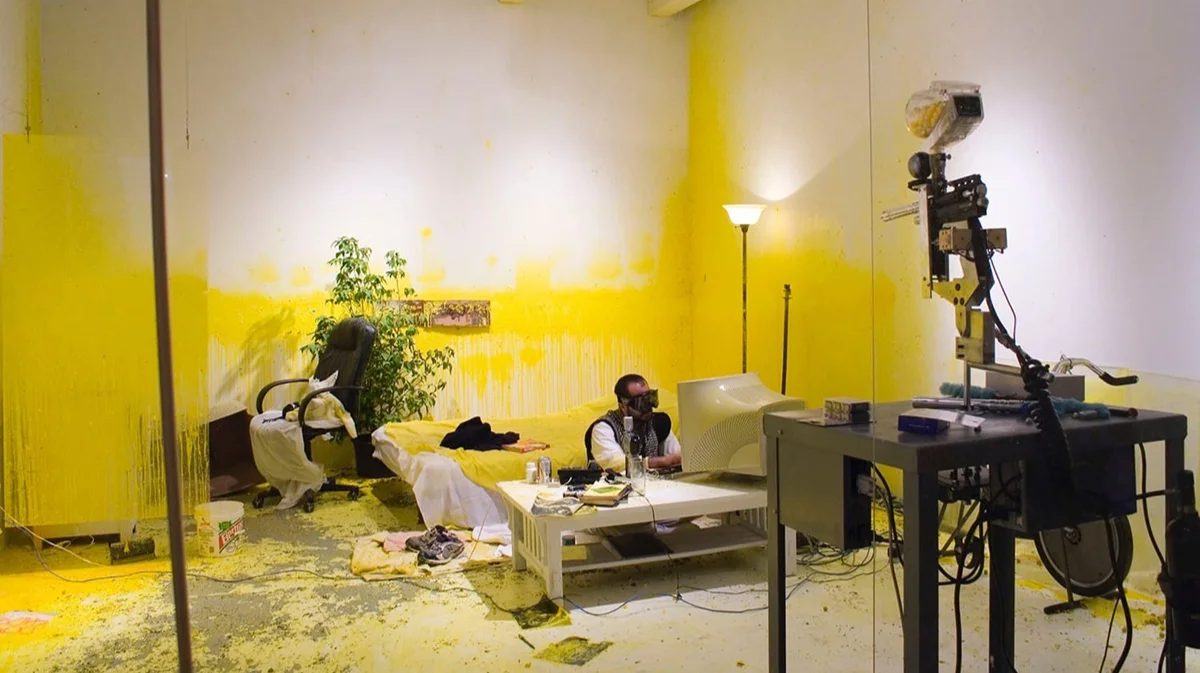
Vafaa Bilal, the “Internal Stress” project. Photo: artguide.com m
Culture figures in the United States often found themselves in opposition to power. The most acute conflict with the government became during the war, when many artists retreated from the usual to express their pacifist beliefs. Some authors, who themselves visited the role of soldiers or refugees, tried to comprehend and convey personal experience.
Iraq, Afghanistan, Vietnam, the first and second world - all this was reflected in American culture. Sorin Brude talks about the five most interesting anti -war artists of the United States, whose works are responding today.
Leon Golub
By the beginning of the war in Vietnam, he was passionate about medieval and ancient art and categorically not fashionable pigeon (1922–2004) managed to visit both “very promising” and “written off from accounts”. Since 1959, he and his wife, gifted by the artist Nancy Specro, lived in Europe, and returning to their homeland in 1964, soon became one of the leaders of the anti-war organization Artist and Writers Protest.
AWP held a lot of high -profile promotions. The artists wrote a petition with a request to live legend Pablo Picasso in protest to remove Gertinik from Mom (New York). The answer, alas, was not received. They collected many ironic "gifts" for military officials and a crowd brought them to the post office. Golub presented the Pentagon “Napalm” toilet rim. The postal employees honestly accepted the parcels, but their further fate is unknown. When the mayor of Chicago Richard J. Daily authorized the strict suppression of the demonstration (1968), the artists personally devoted a whole critical exhibition to him.
The most striking AWP project was the “Week of angry arts” in New York (1967)-an anti-war festival with music, performances and a grand “collage of indignation”-installation from wall panels (about 3 by 36 meters), where hundreds of artists expressed their disagreement with the policy of the Lyndon Johnson administration. Meanwhile, a truck traveled around the city, from the platform of which the Pacifist artists performed and distributed leaflets until the police stopped them.
Golub was one of the organizers of these actions, but comprehended the war in his own work. The artist wrote several episodes in a manner close to expressionism.
He applied sharp strokes of contrasting flowers in several layers and scraped with a knife, creating an emotional texture. And he left large pieces of canvas naked, enhancing brutality.
Golub himself reproached himself for the fact that in Giantomachia (1965–1968) he wrote a mythical war of the gods and giants, and not specific. The series "Napalm" (since 1969) and "Vietnam" (since 1972) corrected the situation. But experts often identify the first project.
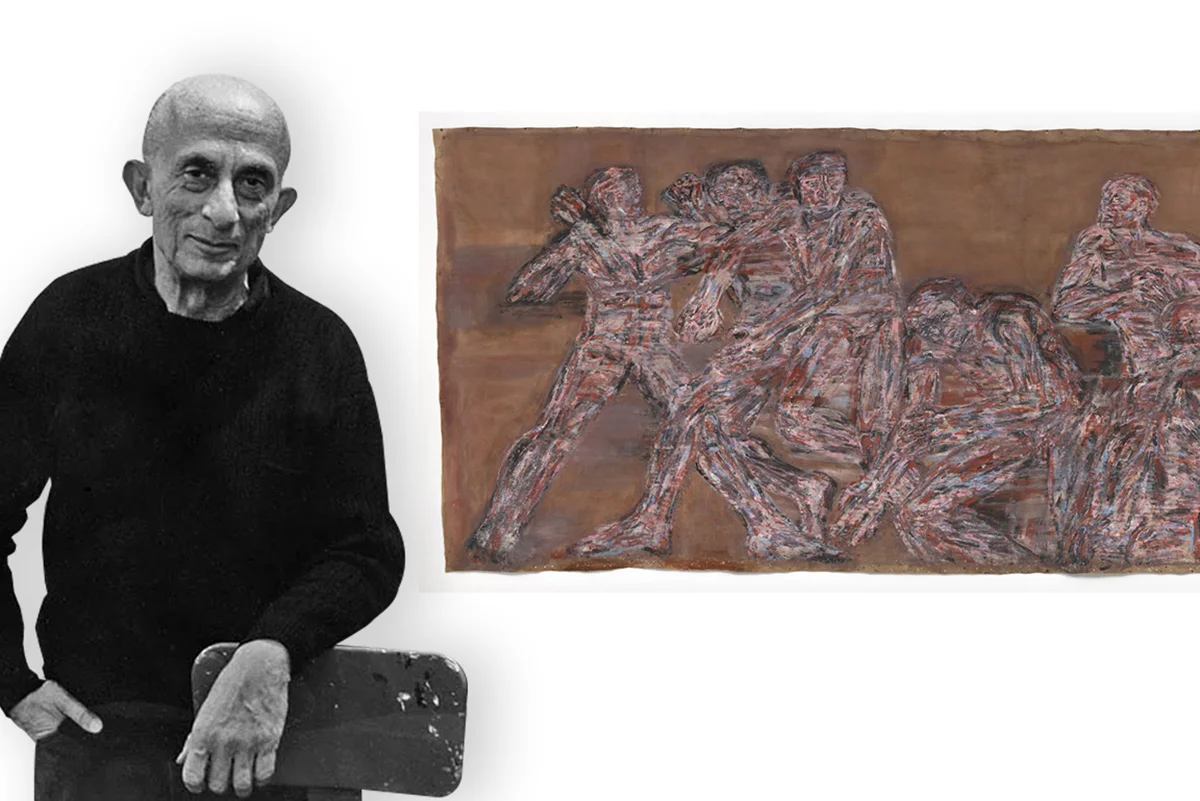
Giantomachia I and II depict fighters as an impersonal crowd - the result of the divided and legitimation of the murder. The heroes of Golub are aggressive piles of meat with sodar skin, reminiscent of the characters of the "attacks of the titans." And the battle was turned into a meaningless and cruel bunch of mala. It is not clear who is against whom and what is fighting for. The war, begun by the subjects, gradually becomes the subject itself and objectifies the participants, subordinating them to their own logic of hatred and violence. The scope of paintings (both - about 3 meters in height and about 7.5 meters in length) refers to classical battal painting and ancient Greek sculptural scenes. But in the paintings of Golub there is no place for heroism and feat - only a bare archaic and a masculine cult of power. A feat in the opposite is to turn off the mechanism of war and allow its recent participants to gradually regain an individual appearance.
When the war in Vietnam ended, the artist fell into a creative crisis. But then he devoted his art to the struggle against police violence and totalitarian regimes. It was during the years of protest that he gained a topic and artistic handwriting. In 1995, Golub and Specially were awarded Hiroshima Art Prize-a prize for authors who contributed to coverage of war and violence. When the Iraqi campaign began, a number of museums, protesting, put up iconic antimilitarian works. The New York Gallery of Ronald Feldman showed precisely the painting of Golub.
Roy Liechtenstein
In 1943, a 19-year-old student of an art university was drafted into the army. There, Liechtenstein (1923–1997) studied at the pilot and took part in the hostilities against the troops of the Third Reich in France, Belgium and Germany. Only in 1946 he was able to return home. The war made him a pacifist, although illegible critics and spectators sometimes reproached him for militarism. Partly confusion is explained by the fact that Liechtenstein is an analytical warehouse that avoids direct statements. Ready -made answers in his works cannot be found.
At the same time, the painter was very seriously related to the threat of arms race and Cold War. And when the campaign began in Vietnam, without hesitation opposed.
A year before the “collage of indignation” in Los Angeles, a large-scale installation of the “Tower of the World” (1966) appeared. Around the 20-meter tower from steel rods, an impromptu exhibition space was created-418 anti-war works. In this exposition, Liechtenstein presented a job with the eloquent name “Atomic landscape”. The artist did not play a vivid role in the pacifist movement, but sometimes critically analyzed militarism in the paintings (for example, “readiness”, 1968). Liechtenstein wrote his main works about the war in the corporate style “Comic + image applied by dots (raster)” even before Vietnam. The most famous is Whaam diptych! (1963, it is usually translated into Russian as “Bu-uh!”))
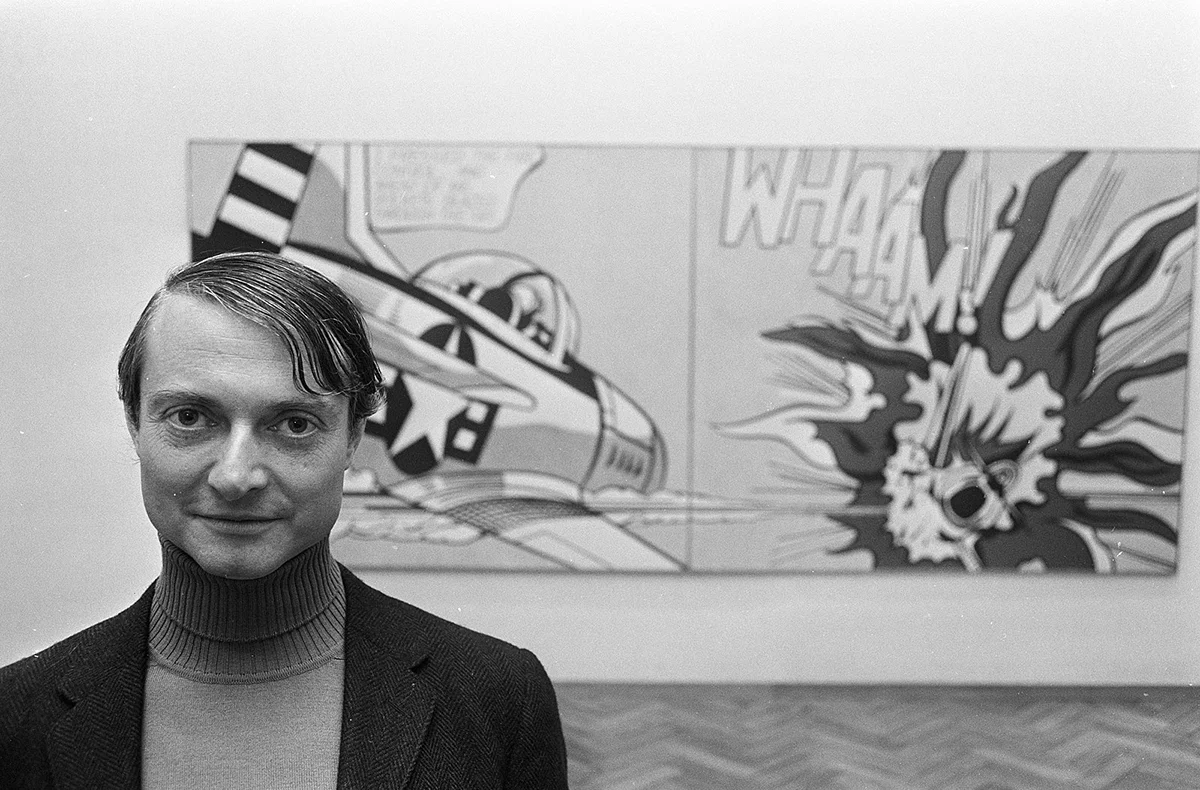
“I pressed the fire button. And missiles rushed past me through the air, ” the inscription says in the cloud of text. It is as if about the battle, but about the festival of fireworks. Whaam! More corresponds to the headed engine of the racing bike. Bombers look like children's models. Explosions and shelling are also a ponaroshka. Liechtenstein creates a pop-cultural militaristic image-a sort of exciting adventure “for real men”.
One of the key tasks of the propaganda of the aggressor country is to create a parallel toy war with successes in the battlefields, exploits for the glory of the Motherland and a combat partnership, but without death. In Liechtenstein, a bright spectacular picture in the comic book style is pounced on the viewer, and he does not immediately notice the catch - the “pixels” of Rust, from which the “new reality” is blocked. The gaps of the white background emphasize the illusory nature of the picture. But at the same time they remind of the air of lost reality.
Lichtenstein’s proprietary manner, which initially criticizing the consumer society, was also suitable for reflecting the dangerous mechanism. For directly not involved people, the media image of war gradually replaces it itself: for some, it makes it quite attractive, for others - not particularly terrible, familiar and tolerant. Canceling the empathy of invisible victims, the derealization of hostilities creates the conditions for their continuation.
Marta Rosler
In the protests, Marta Rosler (b. 1943) participated from the school, including fought for equal rights for African Americans, although it did not belong to their number. Later, the artist explained the active desire for social justice by Jewish religious education. When the war in Vietnam began, Marta was only 22 years old, and she was just starting a creative path. Moreover, she worked in the spirit of the then popular abstract expressionism, and with photo collages on acute topics she was just starting to experiment.
“We watched this war on TV at dinner every evening, so it is called “ War in the living room , ”Rosler recalled . - I remember how I sat at the table in my mother’s living room and looked at the newspaper with a photo of a Vietnamese woman floating with a child in her arms. Her face expressed absolute horror. I was just amazed. Suddenly it occurred to me that <...> I can use [photo collages] as a form of protest against war. "
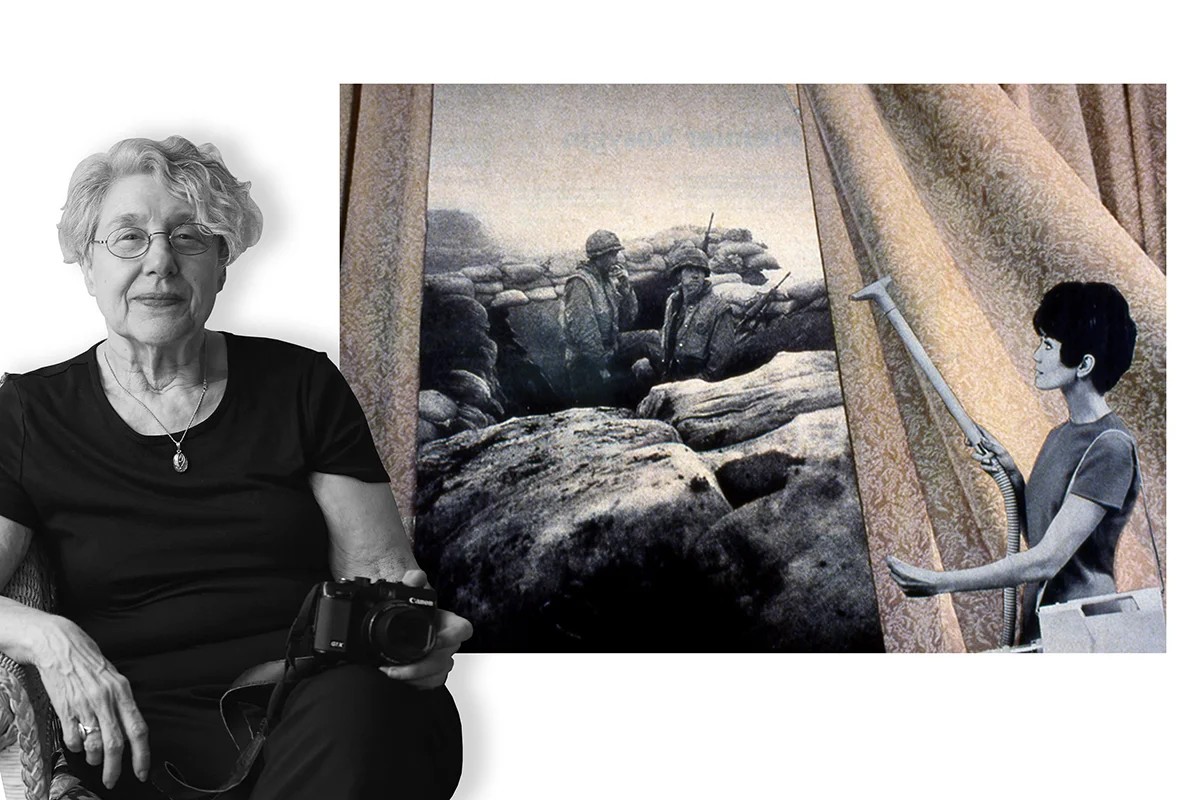
In the series "House Beautiful. We return the war home ” (1967–1972) Rosler combined military photos with images from glossy magazines about interiors and home comfort. The artist was outraged that many Americans easily turned a blind eye to the actions of their army in a distant unknown country. House Beautiful, Life and others ignored the fighting and social problems, helping readers to close in private life. They formed the myth of the family and the house as a fortress in a hostile world, and the opposition of “their” and “alien” spaces implies different norms for them, and contributes to indifference.
In the cozy kitchen of the American mansion, armed men in uniform are paced. A girl who vacuuming curtains discoves a trench outside the window. A Vietnamese girl who has lost her leg falls into the stylish living room.
Bringing the fighting to the peaceful houses of fellow citizens, the artist destroys the propaganda irree of the “distant” war, provoking empathy and turning someone else's grief into the personal cause of every American.
Initially, Rosler herself perceived these collages precisely as a form of protest, and not as artistic works. She published them on the pages of the lower pacifist samizdat and distributed them at rallies like leaflets. Society reacted differently to them. At the exams and while studying at the University of California (San Diego), Rosler showed only abstract paintings, since some of the teachers were hostile to her pacifism. “ In the afternoon, I was engaged in painting in a university studio, and I made photo collages at night at night ,” the artist recalled .
Closer to the end of the war, which had long become unpopular, several museums offered Rosler to set the anti -war series, but always received a refusal. She was averted by the very thought to extract career benefits from the suffering of victims of militarism. Later, the artist nevertheless made a museum project in order to remind the audience about the horrors of war, and in 2004, already being very famous, unexpectedly resumed it on the material of the war in Iraq. “ Yes, I already did it. But what is the difference between what we are doing now? " - Rosler said in an interview.
Vafaa Bilal
Bilal was born in Iraq in 1966. In his youth, he was arrested for an art object criticizing the regime of Saddam Hussein, and subjected to torture. But the artist failed to intimidate. He entered the opposition group that sought to bring the overthrow of the dictator, counting on the support of the United States. Bilala was declassified and had to arrest again, but he managed to cross the border with Kuwait, where he was almost shot, suspected of espionage. For two years he lived in a refugee camp, and in 1992 he was able to get to the United States and get an art education. In the early 2000s, Bilal had already begun an art side, taught at the Chicago Institute of Arts and made lectures on Iraq's problems.
Soon after the outbreak of war, the artist’s younger brother died at the hands of American soldiers, a few weeks later his father died, and the relatives turned out to be refugees. In 2007, the tragic experience of Bilal and his family was embodied in a pacifist statement - the “internal tension” project (the draft name - “shot Iraqs”). For a month he lived indoors (gallery in Chicago), from where the round-the-clock online broadcast was carried out. On the project’s website, visitors talked with the artist in chat or controlled the paintball gun installed in the room. Anyone could shell Bilal around the clock without leaving home. The artist constantly had to be ready to dodge the balls with yellow paint (ribbons of this color symbolized the support of the American army).
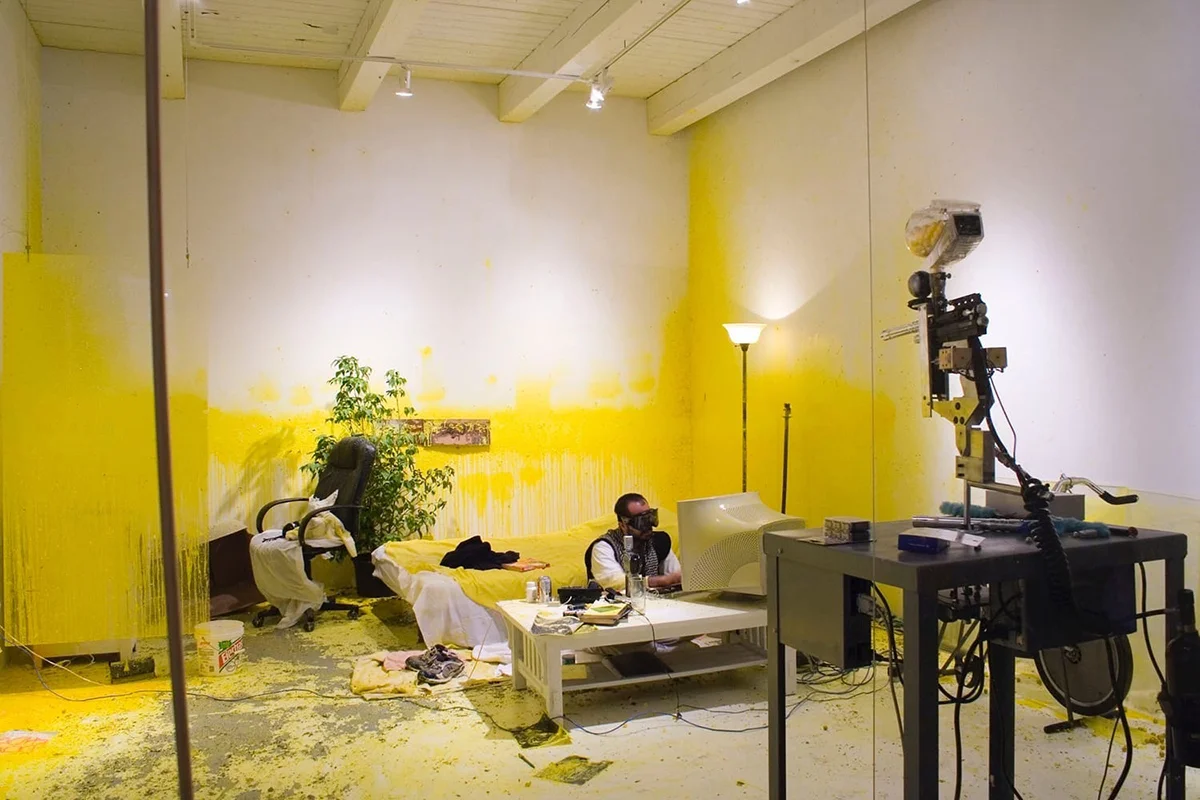
There were places outside the gun’s reach, as well as a panel from a plexiglass (it was broken several times with shots - indoor plants, a lamp and an artist’s computer were shot). However, Bilal could not protect himself from the noise and smell of paint. Having placed himself in the conditions of constant psychological stress, Vafaa reflected the pressure that a person in the combat zone experiences.
A characteristic feature of the modern war is distance damage. Pressing a button in one peaceful place - destruction in another. Specific physical aggression is perceived by a strike as virtual. For him, this “cleanses” the war of pain and death, makes them almost invisible. Modern militarism borrowed a lot from the online game. Bilal displayed this, allowing him to shoot at him from afar.
The artistic social experiment showed conflicting results. For a month, more than 60 thousand shots sounded in the room, and residents of 128 countries were “killers” (in total the site visited about 80 million times-there are huge numbers for the art project). The room was covered with layers of paint, despite regular cleaning. During the project, the performer suffered from a rash, chest and abdomen, and breathing problems. He had a relapse earned in Iraq PTSR, which led to paranoia and insomnia. Several nervous breakdowns happened. Closer to the middle of the experiment, real “hunters” appeared who tried to shoot almost continuous (hackers who hack weapons driving, and ordinary users who opened the site in several windows).
At the same time, visitors to the gallery (among them were the former military) brought the artist food and necessary things in return spoiled. And a group of “defenders” gradually formed around the site. They conquered the gun from fanatical shooters and aimed at the zones safe for Bilal.
Jesse Trevinho
One of the most famous painters of Chikano (art movement of Mexican-American artists) Jesse Trevigno (1946–2023) was born in Mexico, but he moved early to the United States. When the Vietnamese War began, a promising student-artist could return to his homeland, but did not use this opportunity and in 1966 he hit the front. Participation in hostilities gave American citizenship. At the beginning of 1967, Trevinho received severe injuries-a fragmented thigh, rupture of the arteria, ten fragmentation wounds. He was miraculously saved, but several years of rehabilitation could not restore the paralyzed and causing constant pain with his right hand. Trevinho learned to work with his left, at first not even dreaming of resuming creativity and hoping to become a drawing teacher. At the end of 1970, the crippled hand was amputated, but for some time he was pursued by phantom pains.
The fresco Mi Vida Trevigno wrote on the wall of his room during the period of depression after amputation. The image was removed from the wall and represented by the public only in 2009, when it has already become a famous author. Prior to this, many rumors went about the fresco, the artist called it one of his main works, but almost no one saw her live.
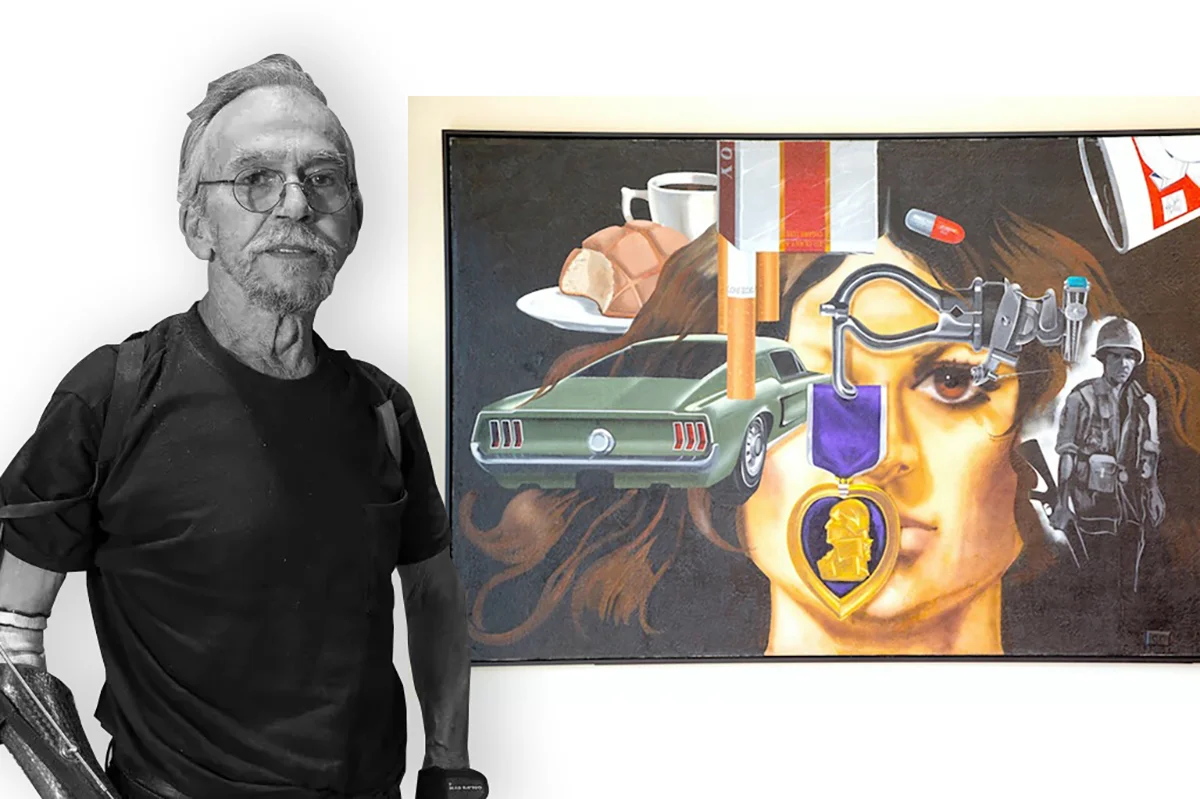
According to art critic Ruben S. Cordoba, Mi Vida depicts all lost and acquired in Vietnam. From the prosthesis, the Order of the Purple Heart grows, which was awarded to the wounded soldier. George Washington's profile for medals is the conquered right to be an American. The Ford Mustang is also metaphorical (“ The central component of a teenage American dream related to travel and dates ”), acquired for disability benefits. Cigarettes, beer and analgesic Darvon helped the painter calm the pain in his hand.
The artist attached a blue bracelet to the prosthesis and in life - it was presented by a certain Joanna, also depicted on the canvas. Little is known about her fate: she died in an accident before the artist finished work. It can be assumed that the bracelet symbolizes the normalization of life, and the image of Joanna is a dream of a happy future. But a self -portrait from the past is especially important: a ghostly soldier squeezing a rifle. The war ceased, but did not end. Once untied, it lasts much longer than battles, continuing to influence the life of a person encountered with her and, through habits, passing on to the next generation. Mi Vida seems to be shown a peaceful life, but in reality - a life -old life. And it is precisely this precisely and emotionally pronounced idea that makes the fresco a strong pacifist statement.