
Translated material
Epidemics

Maybe survive the current attack with coronavirus to all of us a little easier if we recall the experience of previous generations. They got worse.
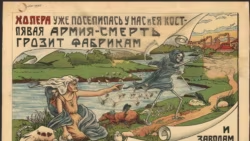
One of the earliest epidemics known to us in the territory of the future of Novosibirsk occurred at the beginning of the 19th century. Presumably, it was an epidemic of smallpox. According to metric books, a sharp increase in children's mortality occurred in the spring and autumn of 1806. Among the deceased, famous old -aged surnames: Shevelevs, Oshchepov, Bykov, Shmakov.
But the most terrible misfortune for many years became cholera. In the minds of the peasants, she presented in the image of a terrible old woman. There are cases of how the men tried to scare away the infection: at night they went around the village and fell into it from the rifles. This did not help, but Siberian frosts occurred and the epidemic left itself.
Large flashes of cholera were observed in Western Siberia every 20-15 years, and with the influx of large parties of immigrants, they began to arise much more often. In the summer of 1892, the "Putch" - an epidemic of cholera in Western Siberia (including Krivoshchekovo volost). The treeless, swampy left bank with low -perch rivers forced the peasants to use standing water. 794 patients were recorded in the volost. More than half of them died. It was especially difficult for recent immigrants.
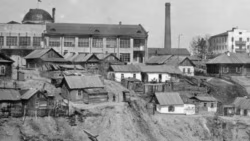
The always mud, the absence in the city of at least some sewer drains led a young city to the outbreak of a new epidemic, which erupted in 1904. Then, on the corner of the streets of Yadrintsevskaya and Logovskaya (now Shamshin), a cholera hut for 20 beds, which became the forerunner of the now famous hospital No. 1, opened. Treatment of patients was carried out under the supervision of the famous Dr. Vostokov.
The wooden Novo-Nicolaevsk, of course, could not boast of toilets. The restrooms were in the far corners of the estates, and in those buildings that sheltered on the edge of the ravines, feces automatically fell directly down and after washing with spring streams. Sanitary services clearly did not have time.
In 1907, at the resettlement point of the railway station, a new outbreak of cholera, in 1909, in addition to the hill of the epidemic of the typhoid. In that year, 67 people died from the epidemic in the city, in the next-98, in 1911-164.
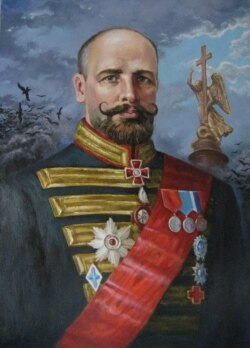
In general, the "contagious" hut was not empty. In 1910, he was not even afraid to be specially visited by the Prime Minister of the Russian Empire Peter Stolypin, who was in Novo-Nicolaevsk just in the affairs of immigrants. After which it was decided to build a new corps of the "contagious" hospital. By 1912, the new two -story stone building according to the project of the city architect Fedor Ramman was built. It has been preserved until today - the Shamshin family, 40, building 1.
To top it off in 1913, natural smallpox also fell upon the city.
And then the Great War began. The city was filled with military, thousands of refugees. It was crowded, and there was no water supply and sewage. The eternal epidemiological threat has become even more aggravated. And she was not long in coming. The epicenter became the prisoner of war camp. In the spring of 1915, the Kurds brought rash typhoid. The blockages of impurity on the outskirts of the streets and the disorder of the townspeople added a flash of cholera in August.
Despite all the efforts of doctors and authorities, the terrible epidemic was no longer stopped. In 1915, 1249 people died from typhus in the city, 400 from cholera and dysentery. But these were still flowers ...
In the fall of 1918, Tif returned. By the beginning of December, they had already hurt about 1000 people. In the summer of 1919, refugees filled the city. Its population has long exceeded 100,000 people, and living space did not increase. Plus tens of thousands of military.
The terrible winter of 1919-1920 Novo-Nicolaevsk became the capital of the Siberian typhoid. Both armies, retreating white and advancing red, carried a typhus with them. The railway is clogged with standing, frozen echelons with dying. In the city, they reigned with a drunk, abdominal and return typhoid. It was a terrible story.
Almost without a fight, the Red Army entered in Novo-Nicolaevsk saw thousands of corpses that filled the streets and ditches of the city.
A specially created Extraordinary Committee for Tif (Chekatif) mobilized for general cleaning of the city of white prisoners of war, Red Army soldiers, and civilian population. The frozen mountains of corpses were blown up, buried in deep trenches, burned in the furnaces of brick factories. The cruel methods of the new authorities managed to eliminate the epidemiological threat to the melting of snow, and to relieve the issue only by the summer of next year.
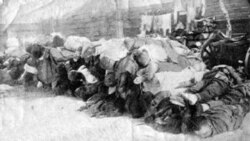
There is no exact statist, but according to researchers, the number of deaths from typhoid in the city in 1919-1920 was up to 60,000 people.
And although the situation with the construction of the sewage system and the water supply was dragged on for many years, the authorities took out the lesson from that epidemic. During the Great Patriotic War in Novosibirsk, crowded with evacuated, a special emergency anti -epidemic commission worked clearly, which ensured the prevention of mass diseases in constrained conditions and improving the sanitary condition of the city.
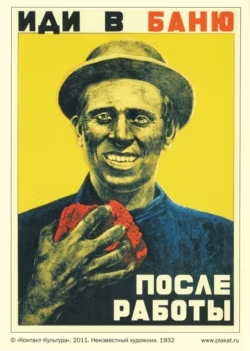
But even after the war, the situation with sewage cleaning was terrifying. Every year, the volume of waste only grew, and there was nowhere to clean them, and the drains of residential quarters and industrial enterprises (about 800 thousand cubic meters per day) flowed straight to the Ob, and in the spring the city literally swam in its own waste.
So far, finally, only in the early 1980s, the construction of the main sewer manifold with a diameter of 1840 millimeters was completed and treatment facilities were launched.
So feel free to wash your hands. And don't panic.
Konstantin Golodyaev - employee of the Museum of Novosibirsk
The "Opinion" expressed in the heading of the point of view may not coincide with the position of the editorial office