
Translated material
Dead zone
Director Michael Hunt went to the Urals to put the opera in the Gulag zone.
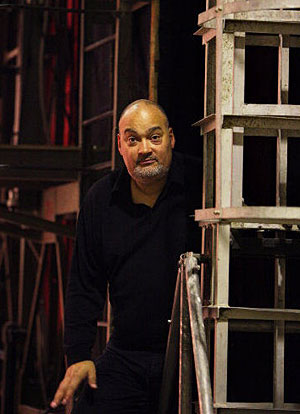
Michael Hunt is sure that the severity of the past can only be compensated by the joy of the future.
Photo: Anton Zavyalov / Perm Academic Opera and Ballet Theater named after P.I. Tchaikovsky
In early summer, the Perm-36 Political Repression Museum will be held by Fidelio opera. The English director Michael Hunt told how the idea came to transfer the performance, the action of which is developing in prison, to a real camp. And, most importantly, he explained what such sophistication is generally for.
- Have you been to many memorial museums?
-I was in Struthof, Aushwitz-Birkenau, in Dachau. They differ from Perm - 36. These are not the Gulag camp, where the task of prisoners is to work to exhaustion. In [German] concentration camps with people came differently: they were brought into a gas chamber.
-But, they say, it is in Dachau that you plan to put the opera Fidelio after the premiere in Perm-36?
- I received such an offer from the German side, but I have not accepted it yet. I do not think that it is worth transferring this performance there. The atmosphere of Dahau is different, it differs from the one that has fed my plan. The story of Fidelio, it seems to me, is not about what could be in the concentration camp.
-And what is she about, in your opinion?
- “Fidelio” is a story about a woman who is dressed in a man to rescue her lover from prison. He was arrested, but where it was taken away, Leonora does not know. To find a loved one, she gets a guard in prison. Time passes, but she does not manage to find out at least something about him. It is only known that this prison contains one mysterious prisoner who sits separately from everyone and whom no one has ever seen. According to rumors, this is a personal enemy of the head of the prison. Once a minister comes to prison. So that he does not find out about the prisoner, the head of the prison decides to shoot the prisoner. Leonora in the image of a guard Fidelio goes to execute the order. This is her only chance to find out, finally, who is hiding under the mysterious pseudonym.
- Perhaps such a story could happen in Perm - 36. There were two zones - a strict and special regime. The prisoners of one zone could not know about the prisoners of another.
- Beethoven, by the way, has written that this mysterious prisoner is contained in a special zone for political prisoners. In the Perm-36 camp, prisoners from a strict regime zone could really not know about those who were sitting in a special regime zone. We came up with that in our production the audience follow after Leonora -Fidelio, go to the last hut - and find themselves in complete darkness. The denouement will be unexpected.
- Will the costumes in the play coincide with the real form of the guards? What is Leonora dressed in?
- Dressing Leonora is symbolic. First, she appears before the audience in a historical dress of the XVIII century, then dresses in a men's costume of the same era. And further, in the course of the performance, she changes clothes several times, which is becoming more modern.
- How are you going to use the territory of the museum in your production, because everything is the same as in the camp for political prisoners?
- I immediately realized that it is impossible to use the museum only as a decoration, you can not install an opera scene and the ground there. It is much better if the action will develop on the territory of the entire museum, and the audience will become accomplices in what is happening: they will go from the hut to the hut with artists and musicians. In total, 600 people participate in the production, some of which volunteers. The optimal number of spectators of one performance is 250 people. Moreover, according to the documents, exactly so many prisoners were kept at a time in one hut.
- What symbolizes the orange color in the scenography of Fidelio?
-Initially, this is an orientation color indicating the audience where to go. We put a performance in the open air, so it is useless to try to highlight something theatrical light. Together with the scenographer, Charlotte Skin Ketling, we decided that an orange color that was not characteristic of a gray-white camp of the camp would immediately attract attention. However, its meaning is not only in this. Our prisoners of a special regime go in orange robes, like in Guantanamo prison. I did not come to Perm in order to show the Russian Soviet history to the Russians and remind you that the Gulag is its terrible pages. I want to show that camps for political prisoners may arise anywhere: in the USSR, in China, in Argentina ...
- ... And therefore, in conclusion, anyone can be. Are you personally not afraid to get to the bars?
- I - no. I live in a country that always allowed me to feel free. Unless in my youth, when I studied at the university, the police sometimes stopped me, because I did not look like everyone else. For example, once I walked with the player, and I was suspected of stole it. But it was a long time ago, now I no longer look suspicious. I’m used to thinking and acting as I think it is necessary, and go where I want.
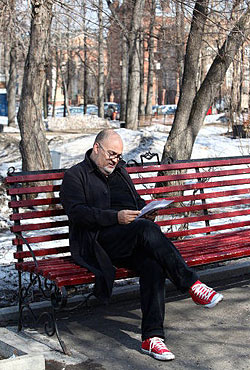
Photo: Anton Zavyalov
- To the proposal of George Isaacan, the artistic director of the Perm Opera and Ballet Theater, who came up with the opera in the Museum of Political Repression, did you agree immediately?
- Yes. George showed me photos of Perm - 36, and I immediately realized: this is the very place where Beethoven's music should sound! Then, already being there and seeing everything with my own eyes, I was convinced that intuition did not fail me: this place is for Fidelio.
- George Isaacan seriously took up the opera. Before it, in world culture, only the concept of “Perm ballet” was stable.
- Yes, I heard about the Perm ballet before my arrival in Perm. Although, it seems to me that abroad everything that is called the Russian ballet, in principle, attracts the audience. Because the Russian ballet is a great tradition that people keep, passing from generation to generation. I myself am not a ballet will, and never worked with this art. Although 1.5 years ago I received a very strange offer: I was invited to the post of executive director of the royal ballet in London. I was very surprised and politely refused.
As for the Perm opera, it today begins to leave the shadows. All thanks to the efforts of George Isaacan, who regularly travels to European opera conferences and talks about the Perm Theater. Gradually, people begin to be interested in what is happening in Perm. The projects that Isaacan organize - “Opera Pushkinian”, or the two -day production of “War and Peace”, or “Fidelio” - help the Perm opera to declare themselves louder.
- What reaction to Fidelio do you expect from the theater community?
- I am sure that on July 3, 2010 (the prime minister is appointed for this day) will be a turning point in the history of the Perm opera. I do not remember the incident in world practice, so that the opera is moved beyond the classical theater scene in the format that we offer. There were cases when the artists performed in the open air: for this, they installed a scene on the open area, and for the audience they placed chairs. But in terms of theater language there was no innovation in this. We include our spectators in what is happening. Already now the attention of the largest Western publications and television channels, such as New York Times and BBC, has been riveted to Fidelio. If you can organize everything well, the reaction to the event will be powerful.
- There will be only seven performances. Spectators, as you already said, are only 250 people at a time. Do you think people who are not savvy in opera art will have enough space there?
- I am sure that Fidelio, first of all, will attract the attention of those who usually do not go to the theater. Already now in my blog and on Facebook page, many are interested in details. These people do not consider themselves hot fans of the opera, but the news from our rehearsals fuel their curiosity. People are always interested in new, informal. Of course, I want this performance to attract as many non-food spectators as possible. It would be strange and useless to do something and not count on a new audience, right?
-And yet the opera is a rather “formal” event for the Museum of Memory. But is it ethical to carry out the deaths of people, say, festivals and rock concerts?
- I am not surprised at your question. I know that many consider this disrespect - to hold a festival in the Memorial Museum, which a large number of different public gather. From her, they say, you can expect anything. But personally, I believe that to close the place where something bad was happening, and surround this place with a halo of “sacredness” is not the best solution. The severity of the past must be compensated by the joy of the future. A deaf silence reigns in Dachau and Aushwitz-Birkenu. Such terrible crimes were committed on the territory of these camps that even birds do not sing there. How do people live with such a weight? Only bring your joy to such places and, thereby, atone the bad thing that was there.