
Translated material
"This is called - wildness"
The art critic and curator Andrei Erofeev spoke about how the cultural context of the zero changed, and also explained why officials, police and nationalists do not like contemporary art and what is the main misconception of the Kremlin, as well as Vladislav Surkov personally.
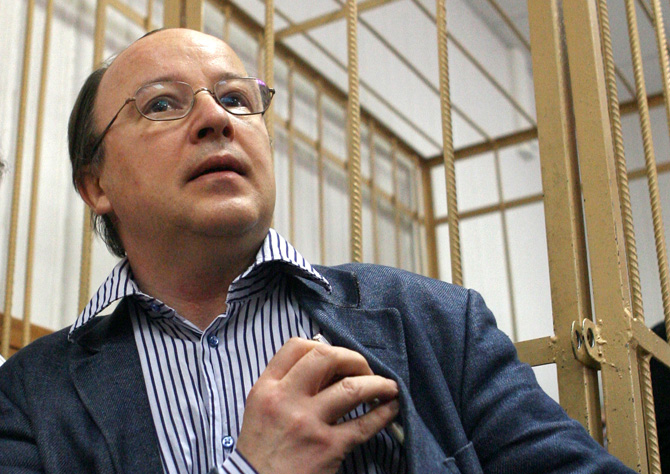
“Interest in modern art ceased to be motivated by considerations:“ Why? ”,“ Why? ”,“ What? ” Now we need to motivate the opposite - indirectness to modern art. ”
Photo: Grigory Sobchenko / Kommersant
- What fundamental changes have occurred with modern Russian art over the past ten years?
- Except for the almost complete disappearance of the Soviet theme, which for many years was the main reference and polemic basis of modern Russian art, then nothing fundamentally new happened. Everything is the same as in the early 2000s, our art develops in the channels of three directions: consumerist, existential and political. But the context changed significantly. In the late 1990s and early 2000s, from the part of society and the authorities, an indifferent attitude towards art prevailed-no one simply saw him. The artists tried to shout something, went beyond generally accepted forms, made radical performances. And they did not receive any answer, the art gesture went into the void. Society was on another, the far shore, from which it was impossible to hear something, and something was impossible to see.
Even the defiant shares of Oleg Kulik were perceived very sluggishly. As soon as they deserved hits in a scandalous chronicle. But over the past five years, the context has unexpectedly warmed up to incredibility. From the emotions of love and hatred, it is difficult to breathe. On the one hand, we have a new interested view of the viewer. The audience terribly wished to plunge into contemporary art: to acquire, regularly watch, own, understand. And this is not only in the capital, and this is not only young people, not only the oligarchs, and not only museums, not only galleries. All this created a powerful wave of fashion. This also picked up and suffered all those personalities and institutions that had not previously thought about contemporary art.
- That is, only the fashion forced society, institutions for immersion in the Council. And what process is behind “fashion trends” - regression or the progress of art?
- Fashion does not contribute to the development as expansion of art, an increase in the number of artists, works, exhibitions, and publications. At some point, the point of no return was passed, and interest in modern art ceased to be motivated by some logical considerations. “Why?”, “Why?”, “What?” And the like questions today disappeared by themselves. A new cultural coercion arose. Now you need to motivate the opposite - indirectness to modern art. Even if you are completely incomprehensible and uninteresting in contemporary art, you must know it at least a little bit. Otherwise, the girl will refuse you. Or an employer. Or they will not be invited to a high meeting. But this, of course, does not mean that everyone will certainly adore contemporary art. You can know and not love. A significant part of our population does not tolerate it to the spirit, and Avdeya Ter-Ogagany considers it a demon.
- Contemporary art was not loved before and did not know.
- Previously, dislike of modern art smoldered. You know, this was such a form of optional knowledge: I don’t know that, because I know that this is bad, which means I should not delve into it. Now everything looks different: I know this, I am following this, because it is not just bad, stupid, false, etc., but very bad, it is dangerous and it is necessary to fight it! Obscerely did not know a single name of the artist before. Now the names of artists and curators hang on their sites, they go to exhibitions, to public discussions. Analyze works. That is, from the obscurants they became programmatic opponents of contemporary art.
- That is, the reason for rejection most of the society of contemporary art is only that some love, but others not?
- Almost any of the opponents you will find a pure, “disinterested” feeling. For love for art is the desire for integration with the civilized world, the desire to see Russia part of Europe, and so on. Behind hostility is also not so much a judgment of taste as escapism, complexes, injuries, programmatic conservatism. The obscurantists are actually negligible, but these people are monstrously active. And they do not meet opposition, like liberals who always put sticks in the wheels. And obscurants use the administrative resource, support of the authorities. They are allowed to openly smash the works, attack artists, false evidence, slander. Opponents of contemporary art have received special rights today. So they are engaged in hateing. Their focus group-sick, injured, not fit into the new society marginals-old people, adolescents, visitors to parish schools, military-patriotic circles, nationalist and fan clubs and sites.
- You say that at the beginning of the zero to contemporary art there was no business. Why does art become distinguishable today and why does it love it, while others do not?
- Because the competition between public groups left the political horizon and ceased to be carried out in the competition of party leaders, programs and actions. Politics again, as in Soviet times, is carried out by the reflected light through the third -party and indirect areas of science, ecology, culture. Since the fashion grabbed the art with a powerful spotlight, it turned into a clash epicenter, into a brightly lit arena with a large number of public and with the constant influence of the press. Gradually, fights acquired an increasingly professional character. Coaches, sponsors, qualified fighters and, of course, speculators appeared on both sides. It is clear that the supreme power is interested in this battle, for this is thereby neutralizing part of the energy of the right and left opposition. But it is interesting that, inciting these fights, the supreme power did not agree to play the role of an honest referee, she openly plays along with obscurants.
- Who made such a decision, who is the author of repression?
- Personally, probably no one. It is unlikely that there is a written document where it is said to be “not allowed to exhibitions of the“ blue noses ”, the“ War ”group and Avdeya Ter-Oganan”. But the general opinion of the leadership inexorably bowed to the fact that art should be opposed in its extreme, “provocative”, as they are expressed, forms. One piece was cut off, then an extremist appeared in the second row, then in the third. So we went to cut off and prohibit. However, in all this there is neither programs nor offensive energy.
The power is culturally and aesthetically absolutely indifferent and blind. But there is a personal fear of the official, fear that certain specific works will be incorrectly understood and can, this official, be badly harmful to him. That is, he will not be able to get off, find the necessary words before the formidable eyes of the minister or head of the headquarters, or director, will not be able to joke, receive reprimand, recovery, dismissal. And although everyone laughs at it, showing their fingers, poisoned in the liberal press, this humiliated and embittered official goes to self -censorship. The repressions that we today are observing by the Ministry of Culture, Roosculture, as well as the leadership of museums and other government agencies, this is the form of the shy protection of the official, who cannot cope with the functions of the cultural player. In a situation of prohibition of censorship, the country's constitution, it is easiest to cover censorship with other people's actions. Therefore, when the obsolete mugs-mracobes appeared, it seemed to many in the state apparatus, this is an ideal way out of the situation.
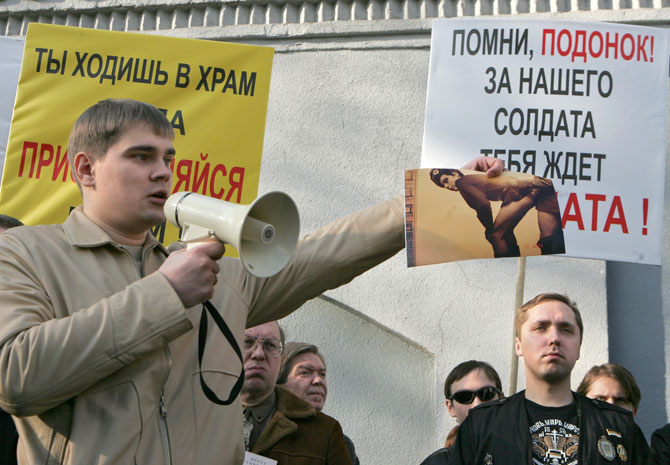
"Censorship is not a bandit with a brand, but a formal anonymous practice."
A picket against the exhibition “Forbidden Art -2006” near the building of the museum and the Sakharov Public Center.
Photo: Dmitry Lekai / Kommersant
- And how do officials understand what exactly needs to be prohibited?
- There is no general measure of state censorship. The prohibitions are regulated, firstly, by household dialogue morality, always referring to the argument "How to show children?" Secondly, by political conformism, about Putin-not a word, about the party-no-no, etc. Thirdly, the complexes of losers, excluding the taste for laughter and self-irony. Fourth, inaccuracy, inability to distinguish the artistic text from a social act. The bosses, as a rule, do not understand the art message, but “read” the work on the surface level of signs. It is as if, instead of a word and sentence, a person would understand and react only to letters. He sees the sign - Swastika. It is forbidden! Cross - you can't! A naked man is impossible! Fallos - you can't!
For example, the story of the work “kissing police officers”. Former Minister of Culture, Alexander Sokolov - middle -aged, by the way, a person who managed to live in the Soviet era - forgot, probably that a male kiss was a political sign of universal love and brotherhood during Brezhnev. For the Minister, the type of kissing men means one thing - homosexuality. And pederasts are a shame on the nation. So he screamed, as scalded, and forbade the picture. This is called - wildness. A savage that does not understand the language of his culture allows himself to lead it! But in general, this audience is quite sluggish and therefore random, episodic, not focused, not systemic repressions on their part.
- Will they intensify in the near future?
- Probably, yes, since the set of signs to be removed from public circulation is steadily expanding. As a result, they will ban half the letters in the alphabet and normal cultural texts will cease to completely arrange them. In order to somehow fill the void of museums and exhibition halls, they will surely stimulate Erzatskulture on the likeness of how they have already come up with Erzazet Politics. And the audience will vote with your feet and communicate with real art via the Internet or directly on the street at the time of artistic interventions. As for the growth of censorship, I repeat, its state form is passive and inert. Censorship, which is undertaken by the ultra -right nationalist and near -church organizations, is much more dangerous. Unlike state structures, these organizations openly declare themselves supporters of censorship and require official recovery at rallies and congresses. Their breeding of culture is not eclectic and alescript, but an ideological character. The fact that the official is simply a sign is for them a “shrine”, a sacred object, a non -canonical touch to which they declare a sacrilege, that is, a crime. Consequently, the case does not end at the seizures of work from exhibitions. They demand a court or personally make reprisals. They beat people, burn books, tear works. Their repressions are aggressive, offensive and motivated by programmatic exception of the entire avant -garde culture from the project of the future “Orthodox civilization”. I ideologists are some church -based radicals, such as the father of Vsevolod Chaplin, father of Tikhon Shevkunov, father of Dmitry Smirnov, art critic, and the performers are organized by organizations such as “People’s Cathedral” or “the Union of Guinelessos”.
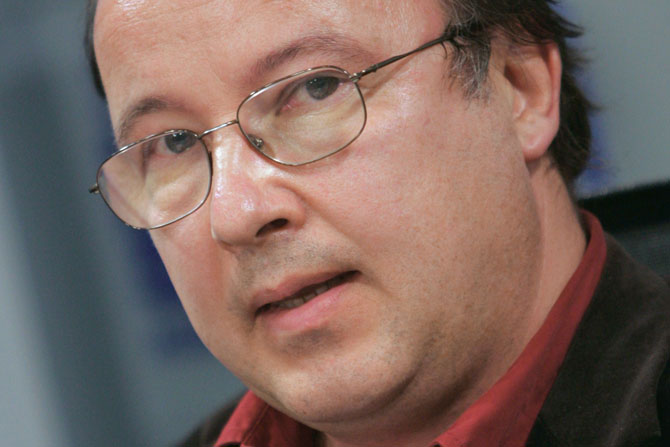
“We can be extremely undesirable in a situation when we are forced to unite with the authorities and defend us together in order to prevent the arrival of“ Orthodox civilization ”.
Photo: Vasily Shaposhnikov / Kommersant
- It turns out that they act in the interests of the authorities?
- Today, these people are no longer in the interests of power. Our political elite believes that these organizations are in her pocket, that this is their personal obedient tool, which is convenient in the conditions of censorship cancellation. This is a very dangerous delusion. Recently, we have been observing everywhere how far -right ones are eager for public policy. The fight against contemporary art is only a stage in the promotion of their cultural and political concepts. A very important stage, because they work in artists and curators techniques, forms and ideological arguments of subsequent political battles. First of all, techniques of diffamation and intimidation are mastered. Courts over art showed that these people are actively using slander and permiting. They negotiate opponents, subjected a deliberately unfair interpretation of their statements and actions. In a word, under the flag of Orthodoxy, they are ready to create the most immoral things. It is clear that not the entire Orthodox Church is such; On the contrary, these radicals are most likely in it with a reactionary minority, but they allow themselves to speak on behalf of the Russian Orthodox Church, and no one is in a hurry to refute their statements. I would qualify the actions of the ultra -right not as censorship, but as a terror.
Censorship is an administrative ban. Disrupted - get an administrative penalty. As it was in Soviet times: violated - received a reprimand, a second reprimand, a strict reprimand. But no one beats you in the entrance, does not publicly burn your paintings and books. Censorship is not a bandit with a brand, but a formal anonymous practice. And here we have just an action movie who openly declares at the hearing: if you do not condemn these criminals, we ourselves will figure out our people's court. And no one interrupts them. And these threats, common in society by journalistic reports, perform their effect.
Look at the frightened persons of directors of museums, galleries, cultural institutions. They do not know what to exhibit, they are afraid of everything. Here, for example, the Tretyakovka on the Crimean Val, that is, the part of the museum where contemporary art should be shown. It all ended, no avant -garde. Today there is an exhibition of Levitan, and tomorrow is planned “Holy Rus'”. And priests were introduced into the museum’s exhibition council. How to condemn if people are afraid of physical reprisals and pogroms? Yes, there were still few such cases - they defeated the heels of the exhibitions, beat Marat Helman. I agree, this is still a prelude, the first tactes of Bolero. But always begins with something. Fascist censorship began with the fact that cinemas were smashed, where they showed films on the remark. And who will guarantee that everything will not go on growing, like a snowball? And the power of this danger does not want to see or discuss. As a result, we can be extremely undesirable in a situation when we are forced to unite with the authorities and defend us together in order to prevent the arrival of this very “Orthodox civilization”. Maybe this is partly the plan of the [Deputy Head of the Presidential Administration of Vladislav] Surkov?
There is also a third form of repression against art emanating from the police. The police react to the fact that artists arrange unlawed street interventions with anyone. In the best case, she acts with artists in the same way as with political manifestants. And at worst - like with hooligans. The arrested members of the War group were taken from Moscow to St. Petersburg on a truck, in handcuffs, laying on a metal, white from the frozen floor. This many hours of torture is the amateur performances of police officers. Nobody on top, probably, did not order them to mock the artists. This, by the way, happened before. For example, a bulldozer exhibition. The order to crush the artists with bulldozers and water the paintings with liquid mud, tucked into irrigation machines, did not go from the Kremlin - this is the district police station overdate. But what to blame the police, when, according to Leo Rubinstein, "our society has forgotten how to distinguish the actor playing the role of a bully from a real bully."
- How are all these repressions on the part of the state, ultra -right nationalist organizations, the police affect contemporary art in Russia?
- The warmed context of love/hatred began to deform the nature of modern creativity. The emotional degree of art has sharply increased. It suffers today with an excess of feelings and a disadvantage of reflection. On the one hand, the art of aggressive resistance arose, street sabotage shares, which are carried out by various art groups (“war”. “Bombils”, “prosthesis”, etc.). Actions, actions that are in the field of ethics and politicians squeezed, and sometimes suppressed aesthetic meanings in these shares. This is no longer a game with ideological languages and styles, as was the case in the “social art”, not the mocking of the 1990s, but political statements. On the other hand, art is increasingly loaded by depressive experiences. For example, Anna Acorn with her empty frames. This emptiness is an aesthetic manifestation of existential despair. Destruction, decay, loneliness, loss - all these states fill the works of Peter Bely, Ilya Trushevsky, Vitaly Pushnitsky and many others. The light, game, parody of acting disappeared. The detached analytics and sophisticated reflection of the famous conceptual tradition disappeared. And today we may even need even more than ten years ago.