
Translated material
Tandem fell
The popularity of the ruling tandem is falling. The country's leading sociological services-the Public Opinion Foundation (FOM), VTsIOM and the Levada Center-recorded a decrease in confidence ratings for President Dmitry Medvedev and Prime Minister Vladimir Putin since the beginning of the year, quotes the newspaper Vedomosti. The fall is record, and it does not take into account changes in moods in connection with fires. But the rating of the head of the Ministry of Emergencies of Sergei Shoigu, sociologists have already appreciated the natural disaster. It turned out that the head of the rescue department is still perceived by the Russians as the main Batman of the country, and forest fires only add points to him.
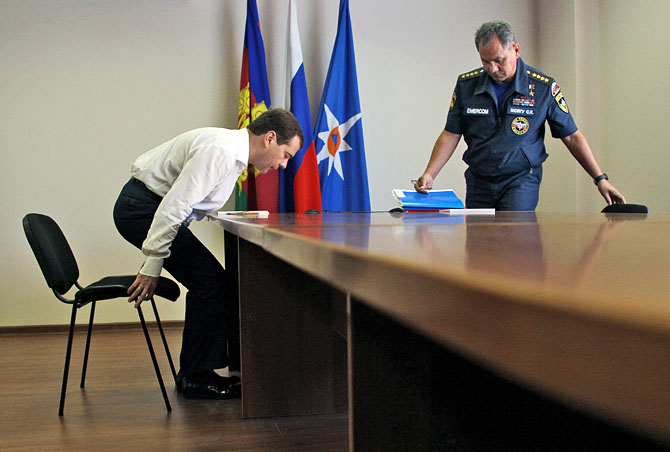
The president’s rating sank, but the head of the Ministry of Emergencies remains in the halo of the superhero.
Photo: Alexander Miridonov / Kommersant
According to the FOM, compared with January, when Medvedev trusted 62 percent of citizens, by August 1, supporters of the head of state remained 52 percent. Such a low support of the president was only in 2008, when the crisis began.
Vladimir Putin also broke his own records: he was trusted by 61 percent of the respondents, as in 2006. In January 2010, 69 percent of the respondents trusted the prime minister.
VTsIOM data is said about the same. The trust of Russians to Putin fell from 53 percent to 47, Medvedev - from 44 to 39 percent.
Levada-Center assures that the president has lost only one point: he was believed by 38 percent of the respondents (at the beginning of 2010 there were 39 percent), and the Prime Minister-four (44 percent instead of 48 at the beginning of the year).
Nevertheless, the trend is obvious: the first persons of the state become less authoritative. And fires have nothing to do with it: surveys were conducted before the start of a natural disaster.
Fires have already been reflected in the popularity of the Russian government. VTsIOM established that the share of positive assessments of the Cabinet of Ministers decreased by 3 percent. Not critical, but nevertheless. Polls were held in July, and the peak of fires came to August. The light haze, which began to cover the country in July, did not affect the popularity of the head of the Ministry of Emergencies Sergey Shoigu. 75 percent of Russians approve of his activities, cites Kommersant data. The August collapse, most likely, will not affect public opinion, says VTsIOM. Sociologists have no doubt that the rating of Shoigu will only grow. It is perceived as a “Russian Batman”, but they do not require feats. Sufficiently high -quality performance of the duties assigned to him. And his duty is the elimination of emergency situations.
Another leader in public opinion remains Minister of Foreign Affairs Sergey Lavrov, about whom 54 percent of the respondents are approvingly responded. The rest of the ministers and deputy prime ministers are not only able to arrange half the society to themselves-some of them are simply not aware of some of them. For example, three quarters of Russians do not know who the deputy prime miners Sergey Sobyanin and Igor Shuvalov, the head of the Ministry of Regional Development, Viktor Basargin and the head of the Ministry of Natural Resources, Yuri Trutnev.
The Minister of Education Andrei Fursenko was an anti -slieter of public opinion. The number of Russians who do not have confidence in him in July 2010 amounted to 40 percent (in March - 33 percent). The result is predictable, since it is in the summer that graduates and their parents suffer from his main initiative - the exam.
Sociologists are waiting with interest in the end of August to measure the popularity of Russian leaders and officials in the most critical month of the year. If Sergei Shoigu is really nothing to be afraid of, and Yuri Trutnev and other unknown ministers-technocracrates are not very needed, then the ruling tandem is concerned about the decline in popularity. Everything is used: bikers, spies, and police. Vladimir Putin and Dmitry Medvedev best in Russia understand that the country enters the pre -election period.