
Translated material
Man is "software"
Treatise on modernization. Part is the third. 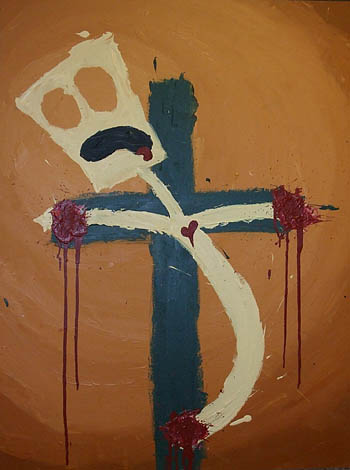
Illustration: Jumpymatt.com
I perceive the 19th century as high modernity. The butterfly came out of the doll. She takes off. Behind the completed formation. The present is concerned. Goethe and Hegel notes the onset of a new world emerging from the bowels of the old order. Somewhat later, in the 30-40s, the modernity in the person of the entire thinking community is increasingly aware of its unprecedented novelty and revolutionary. Revolution is her corporate sign. With their help, the modernity first tears consistently with the past (Dutch, English, French - Great - Revolutions), and then more and more accelerates its own movement, revolutionizing itself. As a result, the revolution becomes a form of the existence of modernity, and the novelty - its only excuse and, probably, salvation. Modernity is alive only on the run. This is her cross.
The XIX century is a centenary of progress, the time of a stunningly successful embodiment of an educational, modern project. Railways, telegraph and telephone produce the first communication breakthrough or, again, a revolution. The space, and then the time ceases to be what Newton was still at Newton: the absolute and neutral conditions of physical existence. They first begin to respond to the impulses of human consciousness.
Since the middle of the century, after a series of so -called democratic revolutions, changes cover traditional, estate society and old political structures. The social space of modernity arises: it has less aristocracy and more and more bourgeois. The bourgeois taste becomes dominant: operetta, colonial novels, Sunday by the city with breakfast on the grass, and closer to the end of the century - Pinkerton, the Yellow Press and Cankan.
Modern is overgrown with flesh, is materialized, goes outside, acquires solidity. Nevertheless, a human heart beats under his steel shell. Man is software, the rest is “iron”. Probably, the XIX century would object to this with the mouth of the father of our Marx: a person is a set of social relations. If the rulers of the XVIII century Duma were still confused in two pines (Wednesday or a person?), The next century, I think, nevertheless gave preference to the environment: the formative influence of science, industry and new social institutions on people of the progressive age was too obvious. Time itself then spoke in the language of physical and social material and, therefore, materialism.
However, this did not interfere with the European personality in the 19th century to achieve anthropological completion. Already in the middle of the century, words written seven to eight decades later later on the Russian poet Osip Mandelstam: "Do not compare, living incomparable." By this, high modernity owes, first of all, to romantics - its dissidents. Unlike the “natural” and rational person of the XVII - XVIII centuries, a romantic person reveals in himself an abnormal, irrational and even night, demonic. Romance is the first “Goths”, it is they who culturally rehabilitate the Middle Ages, by that time already covered with a noble patina of the past and causing nostalgia.
A romantic person does not want to be right. He wants to be natural, like a sea or like a forest along which the wind is coming. Of course, this is a different, non-Lock naturalness. And somewhat different, risky freedom. Romantics are trying to break out of the disciplinary matrix of the early and mature Art Nouveau. And many of them succeed. As a result, they create their own version of modernity - peripheral, protest and at the same time additional in relation to the main - rationalist - European channel. They balance, complete, complicate and complicate modernity. In particular, they create truly author’s literature that arises in a way, naturally unnaturally, and not with the help of worried rhetorical moves, as it was before, for example, in the age of education.
Only after a romantic rebellion, for which Europe was ready (having passed a rationalist vaccination) and which she unconsciously wanted, a rebellion committed in cultural, and not in social forms, that is, within the framework of decency, a modern person was completely rooted in himself. The formation of the European personality, which began with ancient tragic individualism and Christian personalism, ends. Nietzsche puts the point here, the first to speak of the age of majority of modern man. He is adult in the sense that he no longer needs anyone's metaphysical leadership, there is no overpower authoritative instances over him. He himself makes his decisions constituting him. All this is summarized by two words: "God died."
This statement is anthropologically summarizes the ascending motion movement: it is finally freed from the custody of tradition and from any custody in general. As Yu. Habermas writes, Modern “must draw his normativeness from himself” - like his subject, a modern person, ”I will add. At the same time, these two words undermine the seriousness of the modernity, his faith in the mind, in the objectivity of natural laws and scientific theories. For some time, Art Nouveau was able to increase the speed of life, without losing metaphysical and even religious guarantees that he himself betrayed. But at some point, the combination of both became impossible: the movement of modernity naturally blows, breaks its metaphysical shell, becoming self-sufficient. First, this happens in the soul of a modern person and specifically - in the soul of Nietzsche, a person of a professional warehouse. Later, already in the 20th century, this affects everything else, including a society that becomes a “risk society”.
“God died”-these words introduce the West into the late modernity, in the broad sense of the word overlapping the 20th century and, possibly, exciting some part of the 21st century. The late modernity is devoid of the balance of mature modern, his happy combination of beliefs and criticality, his implicit connection with tradition. She is also deprived of the optimism of the 19th century - the happiest, most successful in the history of Europe. The entire first half of the 20th century was under the sign of a crisis, marked by the disasters of the two world wars. The transition to the late modernity was caused by the liberated energy of the permanent revolution (not in the Trotskyist, of course, sense), devouring and digesting the project initiated it. Further, the revolution continues on its own - on the autopilot, spontaneously, like an overflow train, which can be stopped only at the cost of disaster. Does this train have a driver?! In his own way, Arnold Gelen conveyed this at the beginning of the 20th century: Modern was crystallized-in the sense that the principles laid down in it were developed and, thus, we entered the Workistory.
The late modernity began to disinfect modern - first as pictures of the world. Einstein, Bor and Heisenberg dismantle the reliable physical universe of Newton, and from that moment we do not know how the cosmos is arranged in which our little planet rotates (so far physicists cannot create the theory of “great association”). Freud draws a new image of a man whose Ratio is just a thin film over the ocean of the unconscious. Weber states the onset of the era of purposefulness, which replaced the value rationality - his older sister - into the dusty storerooms of Western history. The pathetic, quasi -religious mind of the classical modernity, guaranteeing the inevitable progress of progress, is replaced by the instrumental, demifologized mind, which refused to be a judge in disputes about values.
There is something Buddhist in this: only a void is real, which is more fully, nothing. Grind off the respectable rag of the 19th, bourgeois century, its “yes” and “no”, stop composing reality, putting her assessments, cling to her-and then she will reciprocate. This mood appears in Malevich’s Black Square, which flooded the former art of the world, dating back to the Renaissance, to his strategy of the optical imitation of reality. The latter curled up in the “zero of forms”, as Malevich defined his work in order to freely and unpredictably turn around by the bundle of new art and new reality, over which there are no more rules.
I fully admit that the late modernity has his own modest wisdom that helps a person survive in its high -speed mode. But it is difficult for me to assume that this wisdom has learned the majority, that an ideologically engaged person of high modernity was replaced by an adult man.
The Protestant theologian Dietrich Bonheffer, who died in the fascist concentration camp in April 1945, created the concept of “irrevocable Christianity”, stringing on the idea of “adult humanity”, I admit, in his own way beautiful and exciting: a person should take on full responsibility for what he is. He should not shift this responsibility either to God or to anyone else.
I am afraid, however, that the tragic experience of the twentieth century does not speak in Bonheffer’s favor: humanity has not matured, learning about the “death of God”, rather, on the contrary, it fully took advantage of the fact that he from now on there were no very permissible instances. As soon as God “die”, as soon as the teacher to leave the classroom, the students arranged a uniform soda there. Let not all, but it is no longer important. The “death of God” was immediately followed by two world wars and an unprecedented brutality of humanistic Europe. I do not think that this ligament is accidental.