Translated material
Suicide squad
The state was afraid that the games were made of maniac people - but now they support them. What turned out the "first game" about "
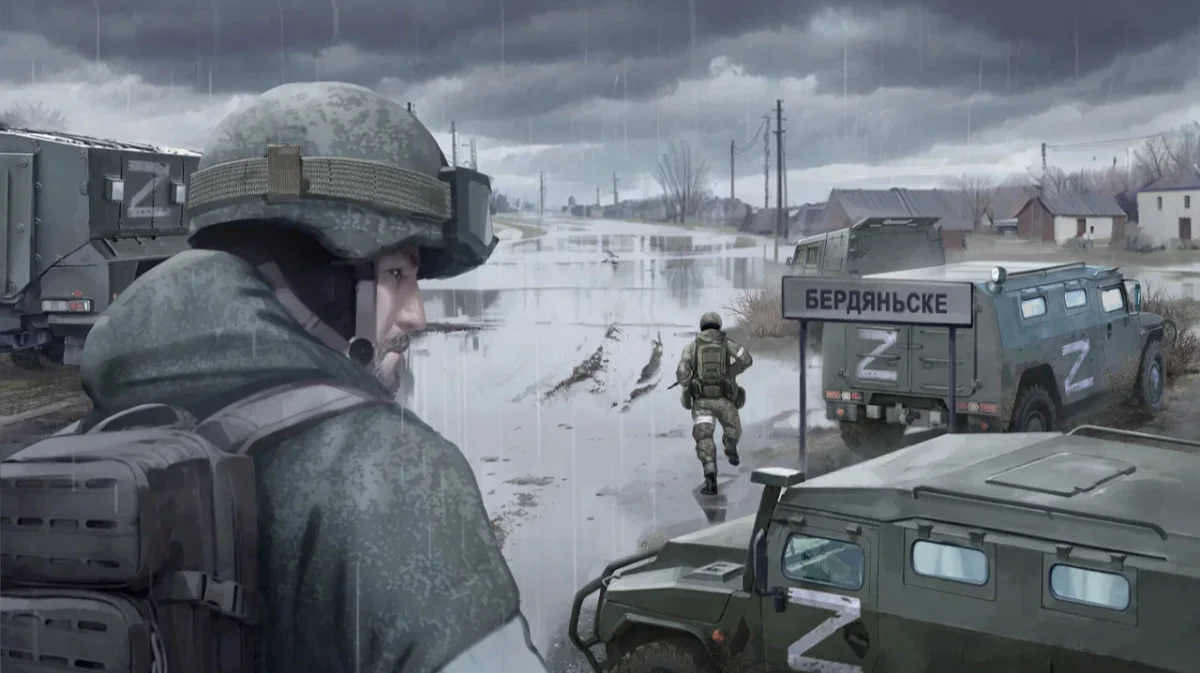
The screensaver of one of the missions of the game “Squad 22: Zov”. Photo: Studio SPN
In February 2025, the first computer game about “Svo” called “detachment 22: zov”, created with the support of the Ministry of Defense, was published on VK Play. The creators promised a patriotic and historically reliable product. At the request of Novaya Gazeta Europe, the candidate of political sciences and Z-culture researcher Konstantin Pakhalyuk got acquainted with the game and found in it not only military propaganda (like drug addiction among the Armed Forces and Soviet pensioners in Mariupol), but also a logical continuation of the logic of government officials who always searched in the games a source of violence and deviant behavior.
State games
For Russian officials and politicians, the attitude to computer games has always been twofold - and I want and pricks. On the one hand, this is a profitable market, I want to adapt it in an ideological manner, on the other hand, a potentially dangerous sphere, which can somehow “not like” the minds of youth.
Discussions about the cruelty of the video game in Russia have been going on since the 1990s, but the 2009 was a turning point when a scandal with Call of Duty: Modern Warfare 2. Then, from the Russian release, a mission where it was possible to kill civilians at the Russian airport, deleted. Further in Russia they blocked the game Manhunt - after a loud scandal that the massly killer Dmitry Vinogradov, who shot 6 people in the Moscow pharmacy, was supposedly fond of her.
And in 2013, a historical and patriotic scandal occurred. The Company of Heroes 2 strategy was accused of a negative-stereotypical reflection of the Red Army-but the gamers themselves raised this scandal (under their pressure, the 1C distributor stopped the sale).
Politicians performed only at the end of the discussion, saying the need to create “patriotic” computer games. Then the Russian Military Historical Society of the Minister of Culture Vladimir Medinsky financed the creation of the Ilya Muromets Simulator, dedicated to the first Russian heavy bomber of the First World War. The manufacturer was the same “1C”, in the future she incorporated “Ilya Muromets” into the game “War in the sky - 1917”. In 2021, the RVIO reported that more than 500 thousand times were downloaded by their joint development, and 27% had 27% on American users and only 7% for Russians.
But with historical computer games that attract the attention of users to Russian/Soviet history, everything was good without the state.
Back in 2001, 1C released the IL-2 simulator, which became quite popular in the West and even got into the ratings of the best games of this type. And at the turn of the 2000-10s, the game space was blown up by the Wargaming World of Tanks with the head office in Belarus. The company acquired copies of tens of thousands of archival documents in the Central Archive of the Ministry of Defense and tried to achieve maximum reliability from the point of view of each model of the tank, and then other equipment. The company also invested in educational historical projects ( we wrote about what happened to the game after 2022. - Approx. Ed. )
Throughout the 2010s, scandals have still replaced the patriotic product: the Russian Orthodox Church did not like that Pokemon Go chooses the Church of one of the locations, the FSB arrested teenagers in Kansk for building a building in Minecraft.
As the sociologist Dmitry Rudenkin explains: “The authorities perceived games as an absolutely rubber problem, the influence of which could be blamed for any pathologies in the youth environment. “Video games”, judging by the speeches of various kinds of deputies and officials, were all the time “to blame for the bursts of violence, then in the absence of patriotism, then in low birth rate.”
But if the media activity of the deputies, the state did not take the media activity of the deputies, the state did not take steps on the total ideological attack on the game industry.
“Russia is a striking case of a technologically developed country in which there is no full -fledged system of age -related video games, ” says sociologist Dmitry Rudenkin. - This system usually sets the publishers with clear criteria, what is possible and what cannot be launched on the market, and determines what can be sold to everyone, and what is only adults. It is in the USA, in the EU countries, in Japan, in Australia, but not in Russia. In my opinion, this clearly says that by and large a serious approach to the content of games in Russia is not and is not expected. ”
Since the spring of 2022, many foreign companies themselves stopped selling their products in Russia. In the new conditions, public criticism of the games continued-in 2024, for example, the St. Petersburg prosecutor's office attracted attention to the online game Last Train Home, looking at the “Russophobia” in history about the uprising of the Czechoslovak corps in 1918 (without any consequences).
The decree on the “basics of historical education”, signed by Putin in May 2024, also involves the creation of a system for the spread of “wrong” games: but the real tool has not appeared since then. On the contrary, in addition to the whip, the Kremlin launched the gingerbread - the production of “correct” games.
The most loud history was the “Troubles”, in which the Institute for the Development of the Internet (Iri) invested about 490 million rubles.
“She turned out to be a morally outdated project with an empty plot component, which absolutely failed in sales and did not interest the mass audience,” explains Dmitry Rudenkin. But ideologically verified: “It is based on the opposition of“ Russia ”and“ West ”as two full, but monolithic and fundamentally different from each other. In fact, they are not even “people” in the usual understanding of the main “Russian” heroes of the game, but alien creatures, ” said historian Sergey Chernoshov, who was engaged in the academic analysis of“ Troubles ”.
Other projects were recently announced or launched. The creative agency "Closer" launched in 2025 in the Minecraft universe thematic locations dedicated to the events of the Second World War. In March, the Minister of Industry Anton Alikhanov made the initiative to create a game about drones in the current war. But there were still no games as such about “Switch”.
Analogy "
“Squad 22: ZOV” has so far the only implemented game project about the war in Ukraine has become the only game project. The creator was Studio 22 in partnership with the Ministry of Defense: the Russian media emphasizes that assistance is limited to consultations, without financing. On the VK Play, the game appeared at the end of January 2025, and two months later, the developers announced the output of the mobile version.
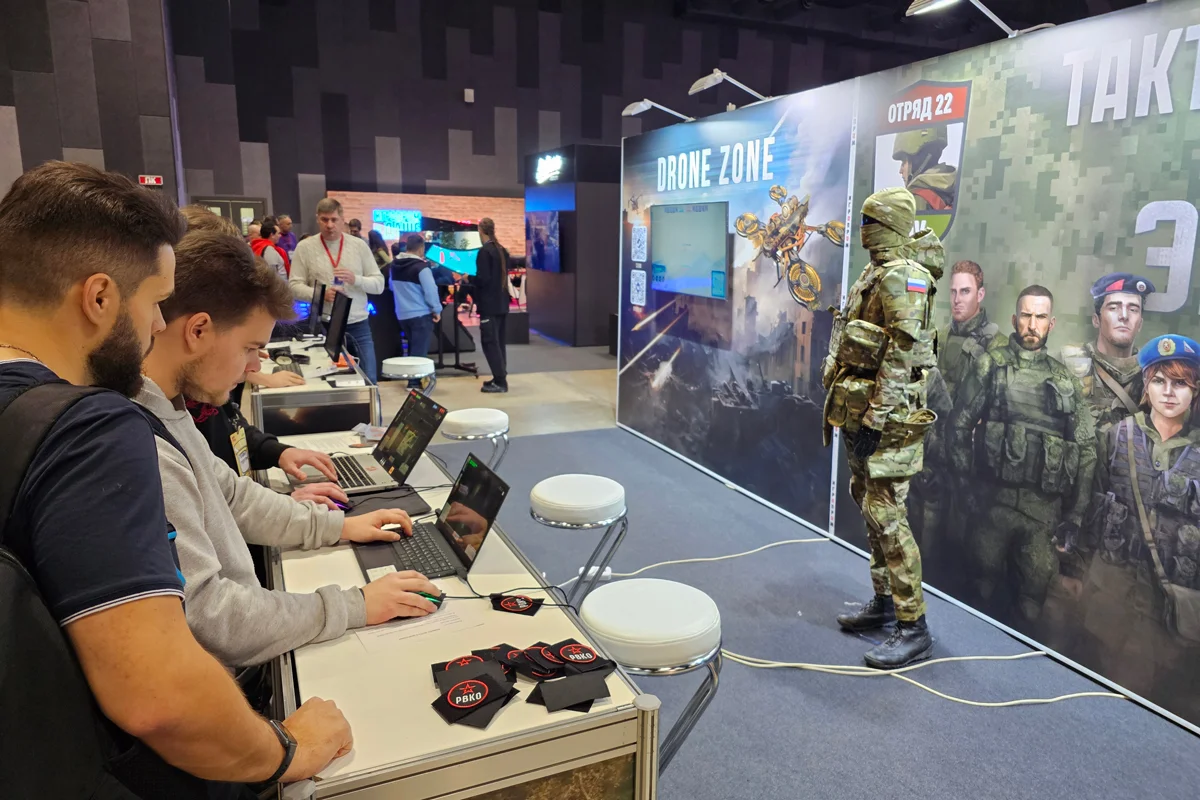
In the fall, representatives of Studio 22 stated that the Door Kikers 2, released by the Romanian company Killhouse Games and is a simulator of the police operations of a special purpose detachment, were inspired. The Russian analogue, approved, was created with the participation of “veterans of the Svo”. His presentation was held in the Central House of the Russian Army, and the leisure center of Atlant, with the support of the prefecture of the South-Western District of Moscow, announced in April 2025 a tournament for all aged 16 years.
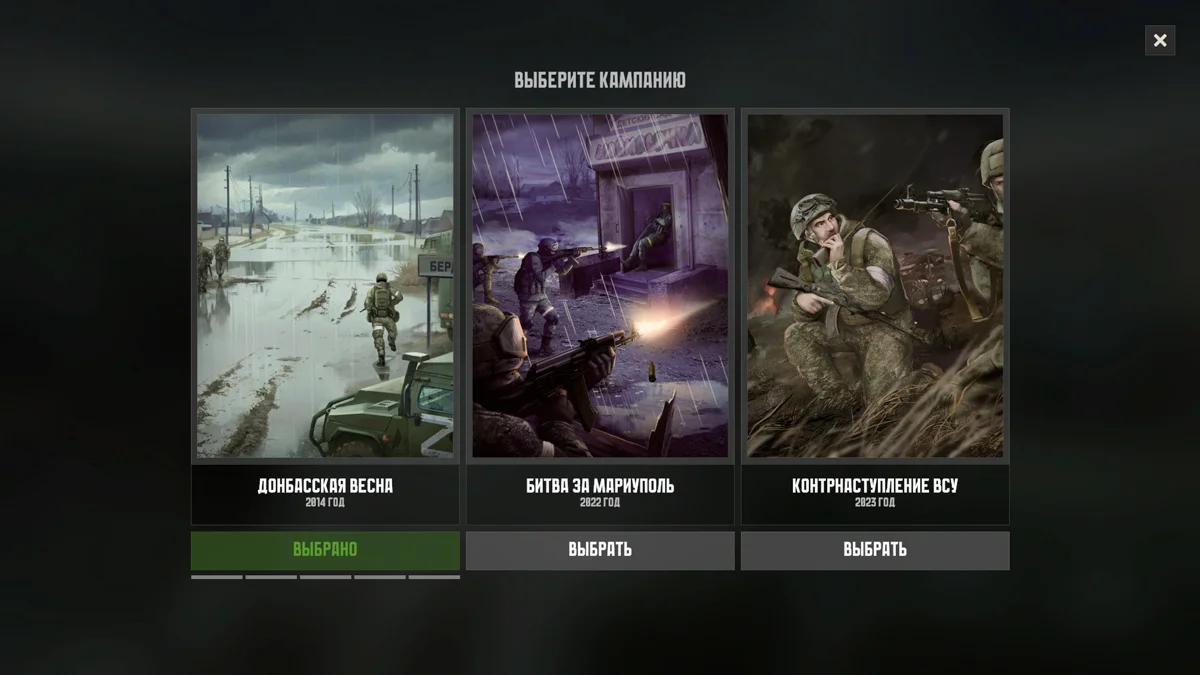
Now in the public domain there are two modules of the game - “Donbass Spring” (according to the events of 2014) and “Battle for Mariupol” (2022). For the "counterattack of the Armed Forces" you need to pay - from 460 to 2999 rubles. “The Battle of Avdeevka” (2024) is still closed for participants. Wagner events - Popasnaya or Bakhmut, did not fall into the list.
Except for the same type of materials in the press, “detachment 22: zov” did not become a noticeable event in Russia. Even public support for the All -Russian Cossack Society did not help . For Z-Militarists, a patriotic toy about “Switch” is clearly not what helps the front.
The game community met the development of restrained. Even in positive reviews that rest on the abstract “potential of the game”, there were many bugs, unusual-unauthorized gameplay and the complexity of passage. As Dmitry Rudenkin notes: “This is a purely niche product that is interesting except for the audience of the Zeetniks. Because the quality is controversial (I judge as a player as well): in the genre of military tactics there are projects much more developed and complex. ”
Cleanse Ukraine from Ukrainians
“Squad 22: Zov” is positioned as a tactical action that “teaches” the tactics of fighting in urban development (at least in free missions). The introductory video takes the tone of the story about real heroes, almost samurai. It is alleged that any war is the failure of diplomacy, and it has to be overcome by the efforts of warriors, clothed with the art of "valor, skill and death."
“Strategists are drawn with colored arrows, and we walk through the ground through lead, fire and human pain,” says the announcer with a youthful voice. But the player will not see human pain.
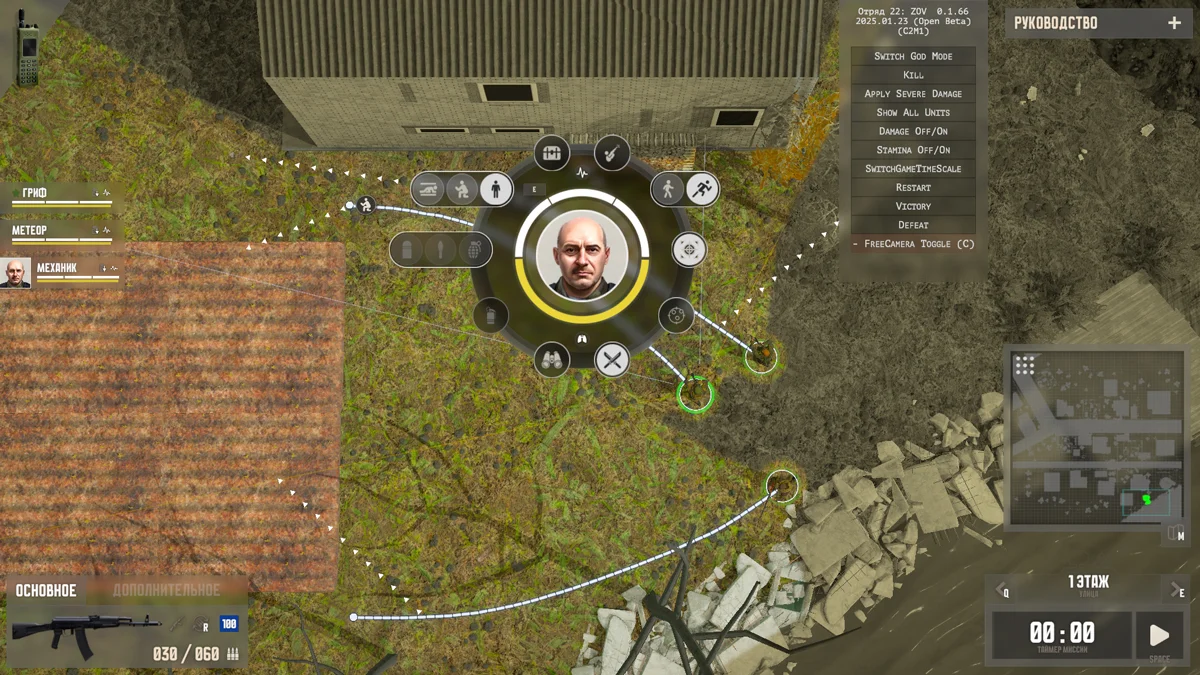
The user is invited to work out the tactics of stripping to the music, which clearly reproduces the motives of Star Wars and the Game of Thrones. The essence of the gameplay: to direct the movement of a detachment of 3-4 people, paying attention to the peculiarities of the terrain and delaying the interaction between units: where and where to go, to bend in time or hide behind the fence, attack with the right weapon, one by one or together.
The Donbass Spring module especially loves that the militias burst into the premises from different sides through the windows and doors. In a word, nothing goes beyond ordinary representations of any sofa warrior.
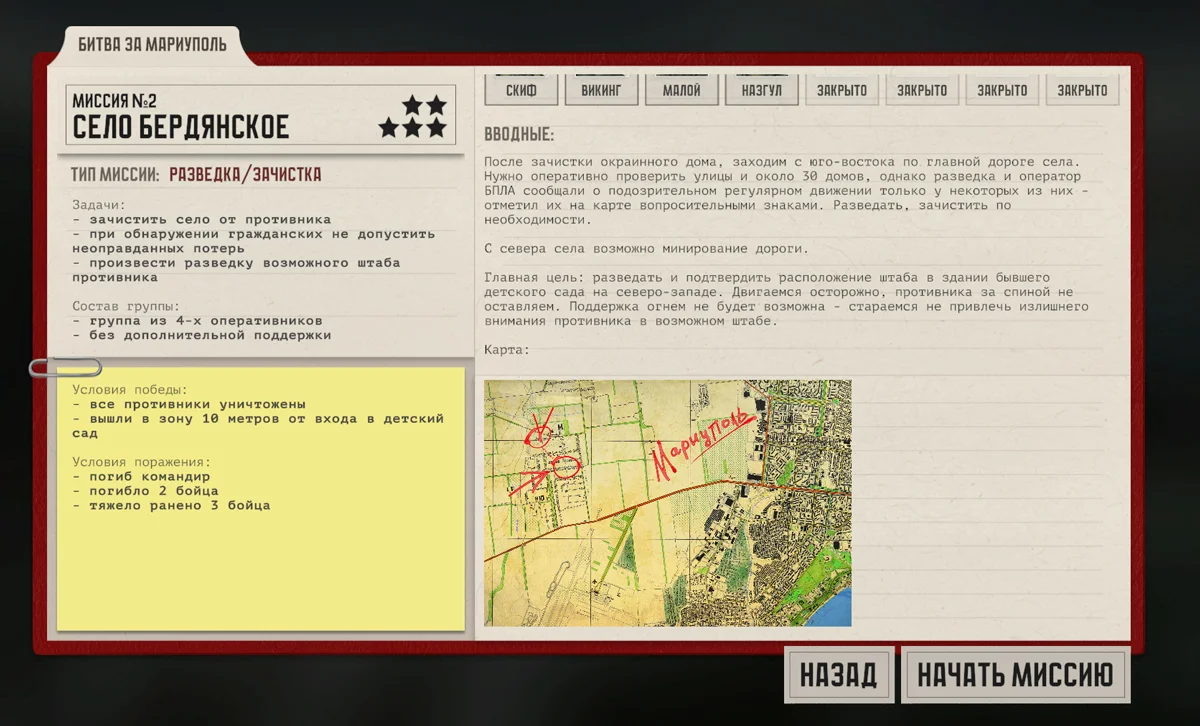
Ukrainians keep the defense in civil development. Perhaps so the authors wanted to emphasize that they are hiding behind civil infrastructure. In the Mariupol mission, the theme of defense in kindergarten pops up. True, another interpretation is possible: they defend their homes where the Russians came.
In the Donbass Spring, five units are offered to choose from: four from the Donbass, and one previously served in Berkut, and another, Armenian, symbolizes the multinational militia.
The commander of the Griff has a long military biography, but its origin is not explained - perhaps a Russian. But the plot about Russian tourists is lowered, and the Donbass uprising is represented as a "popular".
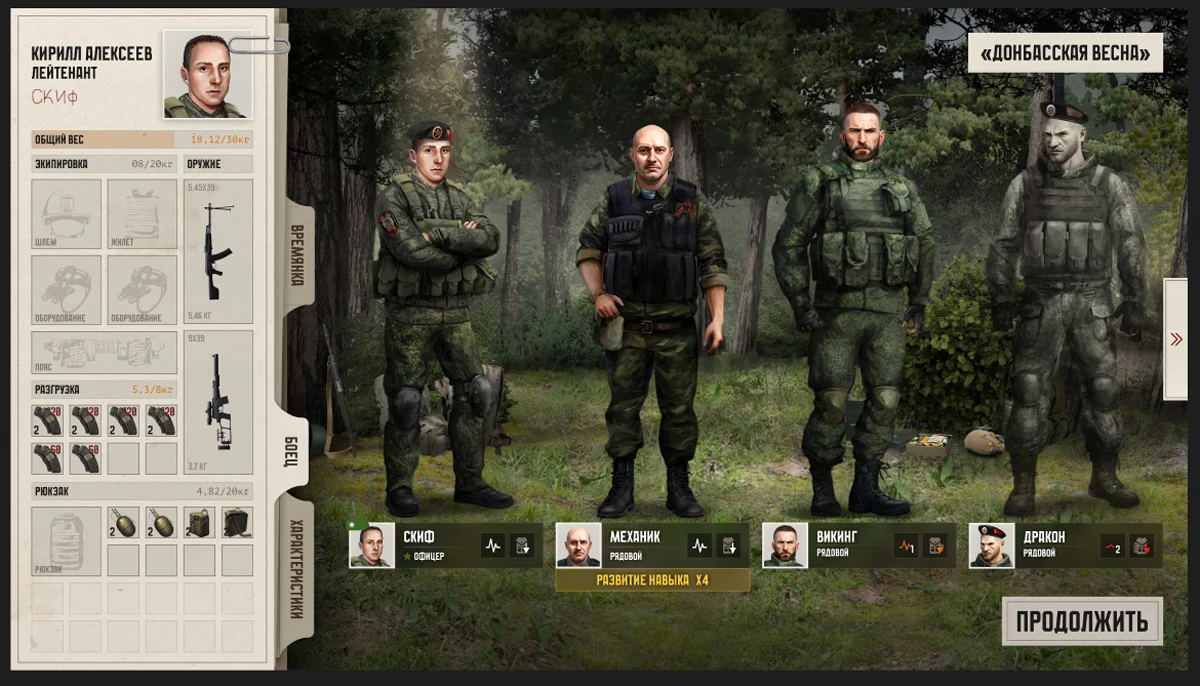
In the Mariupol campaign, there are 6 characters with the call sign “Scythian”, “Viking”, “Dragon”, “Wolf”, “Dobrynya” and “Irish”. Two with military experience, one is a former policeman (who survived in the taiga and restless city streets before the transition to the service) and two, apparently, former civilians. For example, about Viking states that such a call sign is a tribute to his ancestors, since he has a family from old Ladoga, "and there the Vikings lived for a century." He himself walks with a volume of "Elder Edda" and knows how to throw an ax. The theme of the rolevic-nua-speakers is disclosed, but the creators decided not to include the “bore”-Orthodox heroes.
Old people and drugs
The propaganda nature of the game is laid primarily in the basic setting. In the “Donbass Mission” exclusively “militia” fights with obsolete weapons (even hunting), but in 2022 the Russian army was already well armed. Russian soldiers move faster and more clearly.
Although the characters are collective images, in some prototypes are easily guessed. The game clearly helps to memorize well -known callsigns, and this contributes to the effect of recognition in a collision with them in the real world. For example, in Mariupol, the Skif officer commands the detachment: visually he looks like the famous Donbass “field commander” by Alexander Khodakovsky with the same call sign.
On the training module, it is necessary to execute the commands of the commander of “Goodwin” - this is also a common call sign, which, say, had the former deputy minister of propaganda of the DPR Daniil Bessonov. In Mariupol, the commander is the Strina, he is the hero of the Russian Federation Vladislav Golovin, who was one of the main consultants of the game.
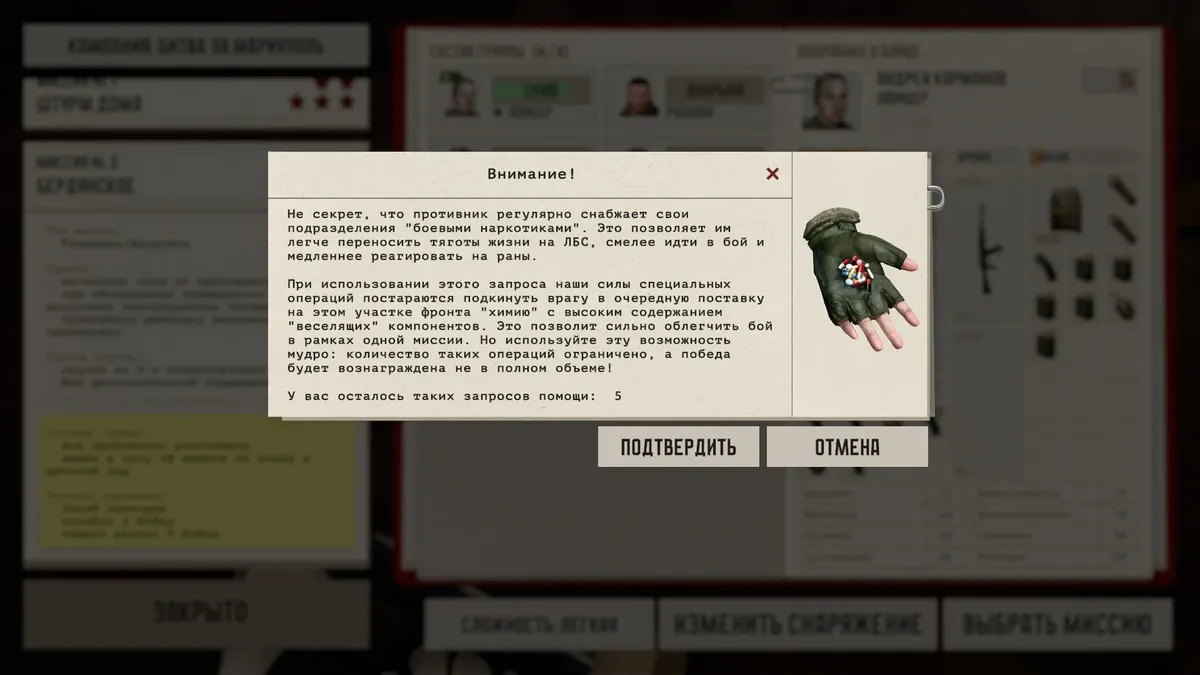
The player can pass Mariupol in a lightweight version. According to the game legend, Ukrainian Armed Forces of Ukraine are sitting on drugs, which allows them to easily “transfer the hardships of life to LBS [line of combat contact], boldly go into battle and react more slowly to wounds.” However, the Russian detachment from the forces of special operations will throw them “chemistry” with a high content of “funny” components. This will greatly facilitate the fight within the framework of one mission. ”
At the second level of the Mariupol Mission, propaganda is even more clumsy and is already directly flirting with the motives of “Liberation”. There it is necessary to clean the suburb of Mariupol Berdyanskoye from the Ukrainians. At one of the moments, the game reports the execution of civilians, and then grandfather with a Ushanka and a Red Star runs out to the fighters. He thanks for the liberation and nostalgic for the USSR: he tells how he worked at the military factory during the Second World War, calls the Ukrainians Nazis who burned people in Odessa. The “old man’s wife” (grandmother in a fur coat and a fur cap) also appears, which declares: “Guys ... we are Soviet people. We were born in the same country and lived in it ... We do not want them to Europe. ” The commander of the Skif shares with them Sukhpaik, and in response, the grandfather reveals that the defense of the Armed Forces of Ukraine is in kindergarten. Such is the Soviet-patriotic betrayal for army bite.
Replicas of Russian soldiers during and between battles make up a mixture from the descriptions of the situation and dreams of the world: “Two deaths do not come, but not to be able to pass”, “There may be a sniper”, “Silence is suspicious, you never know what awaits around the angle”, “Clushed”, “Completed”, “Would just after the war with the dog,“ They say good mushrooms in these places ”. Heat! How much you can glow! Care carefully! "
The game allows you to walk along the corpses of Ukrainians. In many games, there is an opportunity for a murdered “enemy” to pick up a weapon, but there is no such option here - so that players are not accused of looting.
Hunting and PTSR
The chopped Ukrainians, pro-Soviet old people, an ambush in a kindergarten-these propaganda passages from 2022 look strange three years later. The emphasis on tactics is fully consistent with the direction of the Z-Literature that sees the war through the prism of his heroism. “Our guys are fighting” - this is the main ideology for which pronouncing the highest meanings is not so important.
True, this heroism is closer not to everyday overcoming trials or “war war” , but a tone-bluler action movie. By the way, it was in this genre in the fall of 2022 that the first book was published, written by a direct witness of events. We are talking about the novel “The Battle of Mariupol” by the Donetsk writer-fantast Georgy Savitsky, who himself was in the “militia” in 2014, and in 2022 he worked in Mariupol “Warm-up”. Today, his testimony is except for the abundance of propaganda cliches, which have left the Z-pound.
"Squad 22: Zov" went on. Yes, the essence is to find and kill the soldiers of the Armed Forces of Ukraine, who sowed in poorly furnished Ukrainian houses or on street checkpoints. Since the enemy rarely comes out of shelters, this is more like a hunt than a real battle.
However, there is no lightness in the passage, which was noted by all critics. The player is faced with two difficulties.
The first is an unexpected fire that, apparently, should create an idea: the enemy is hiding everywhere. Sometimes Ukrainians show dexterity, sometimes make mistakes, and in the “Donbass mission” in one of the cases can be missed with a grenade and instead of a window to get into the wall, killing themselves. Everything seems to be like on the real front, however, in gameplay these sharp jumps between stupidity and professionalism are especially noticeable.
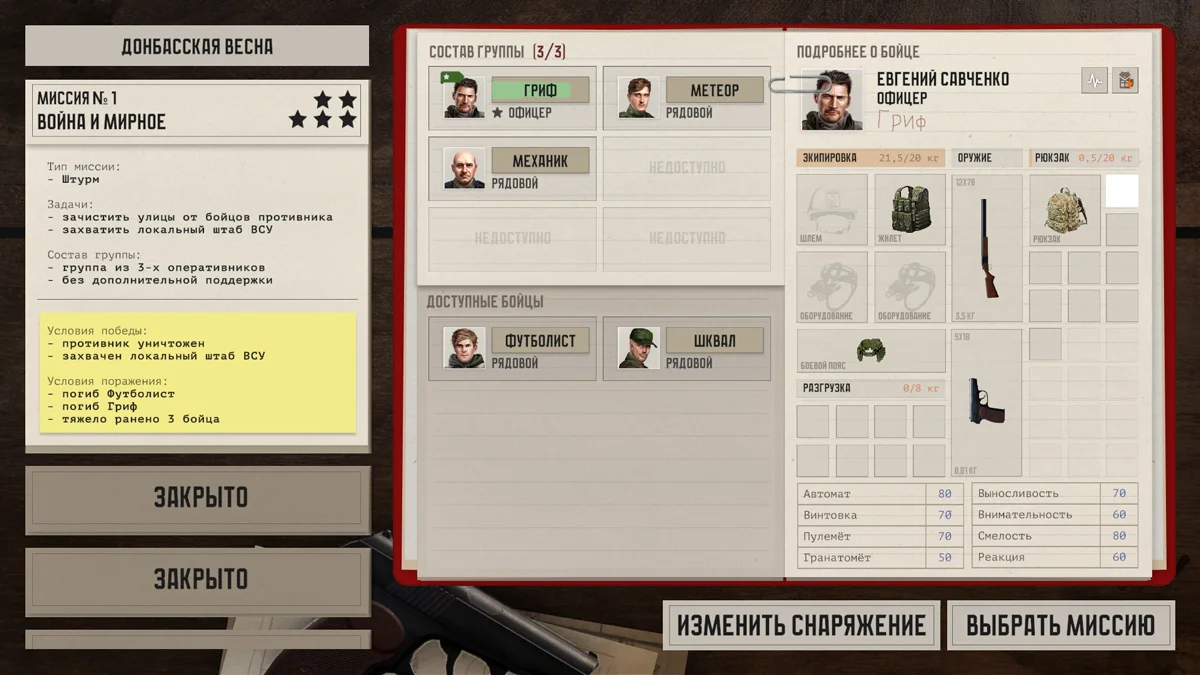
The second - the player does not control the shooting of units, and therefore even if you know that the enemy is located in this room, then there is still an element of accident, whether it will be able to hit him this time. Insecency was noted by other critics of the game. These simple techniques, logic, should fuel excitement, forcing to master new tactical techniques provided by the game.
However, it is a bug or a feature - it is not very easy to manage Russian invaders. So, when stripping one of the areas of Mariupol, Russian soldiers constantly stumble about door jambs, then about birch. Without a verified mouse movement, they are helpless, and therefore, instead of going into the house, they easily hide behind the door open. And when they put them on the attack line, you need to monitor whether they turned to face the enemy.
In one of the locations there is a point, when it gets into which the fighters begin to sharply “five hundredth”, that is, to desert - to run backlessly back. A lot of problems was caused by the unit "Dobrynya". Either he could not go along with the rest between the house and the fence, then in one place he stopped reacting to commands and froze at the barbed wire, where the “corpse” of the Ukrainian lay. Apparently, the character was an attack of PTSR.
Perhaps the intentional complexity is the idea of the creators, aimed at ensuring that the player is reconciled with the fact that there are no quick successes on the real front. Sometimes a unit cries: "Damn, the trunk jammed!" — а значит, несовершенство русской армии в какой-то степени заложено в игру. Пока игрок осваивает ее далеко не интуитивную логику, он положит больше виртуальных жизней русских солдат, нежели украинцев. Впрочем, именно так настоящие российские генералы учились воевать на полях Украины offline.
На протяжении многих лет российские чиновники — во многом ошибочно — боялись, что компьютерные игры стимулируют девиантное поведение. Однако сегодня насилие стало новой нормой, а потому появился интерес превратить игры в инструмент пропаганды. В этом смысле российские чиновники действуют вполне последовательно.