
Translated material
Another Victor Louis

Historian Igor Petrov reconstructs the biography of a mysterious lawyer and businessman

How to bypass the blocking?
read >Igor Petrov: At the end of August 1938, the German Embassy in Paris received two anonymous letters. The first was written in German and read:

Historian Igor Petrov reconstructs the biography of a mysterious lawyer and businessman
The “dossier” on Viktor Gugovich Louis has just arrived here from the Russian trade mission in Berlin. Soon he himself will come here because of a large contract with the Klyagin company (Paris - Liege) for the supply of weapons to Barcelona and will meet in Saint-Tropez with director Klyagin, who owns the 43rd Latitude hotel there. The previous deal was concluded in Paris at the Napoleon Hotel (also owned by Klyagin), and the goods were supposedly supposed to be sent to Baghdad according to the certificates that Mr. Friedenstern obtained in Berlin. In January, the shipment was sent by sea from Marseilles under a contract concluded in Paris in November. Louis had previously worked for our department at the Berlin trade mission (for legalization, he received a position in a Swedish separator company - with the help of an appeal from the Stockholm trade mission to the director of the company, Hirsch, a Jew). If you want to know more about Louis, ask Madame Kolesnikova or Mr. Werman in Berlin - both of our former colleagues at the trade mission.
The letter stated that Mr. Victor Louis was a Soviet spy.
The second, slightly more extensive letter in broken French reported that Mr. Victor Louis, living in Berlin at Bayrischer Platz 2, was a Soviet spy.
His wife in Russia served in the Cheka, and then as secretary of the Russian trade mission in Berlin. She claims that she is Russian and her name is Maria Mikhailovna, but in fact the documents about Aryan origin are forged, and her name is Miriam Moiseevna Koretskaya, originally from Ekaterinoslav in Crimea (as in the text). The Bayrischer Platz boarding house in Berlin was actually funded by the Soviets as a meeting place for spies and international merchants.
Then the names of Louis' accomplices were named - Karumidze, Friedland, Kahn, Jacobi, Winter, Roman Bundschuh, Zalmanov.
In particular, Winter, a Polish Jew naturalized in Denmark, is in charge of Louis's office in Copenhagen, but this office is fictitious, since Louis spends most of his time in Berlin, where his son lives.
In conclusion, it was reported that the letter was written by an employee of the Soviet trade mission in Paris, who was not averse to sharing information in the future.
Of course, the name Victor Louis is familiar to most listeners of this program. A Soviet journalist who lived in Moscow, worked for Western newspapers and at the same time for the KGB, carrying out both diplomatic and propaganda assignments for the Lubyanka. About his life since the late 50s. Quite a lot has been written; on the contrary, relatively little is known about what happened before. Several years ago, I translated and published on Colt a chapter from the memoirs of the German diplomat Erich Franz Sommer, who sat with Louis in the camp, and then, after returning to Germany, corresponded with him for some time. But even for Sommer, the reasons for the rise of Louis, who in a few years had gone from a disenfranchised prisoner to the king of Moscow bohemia, were a mystery. It is also common knowledge that his real name was Louis Vitaly, but since childhood he had become accustomed to the name Victor and signed his articles that way.
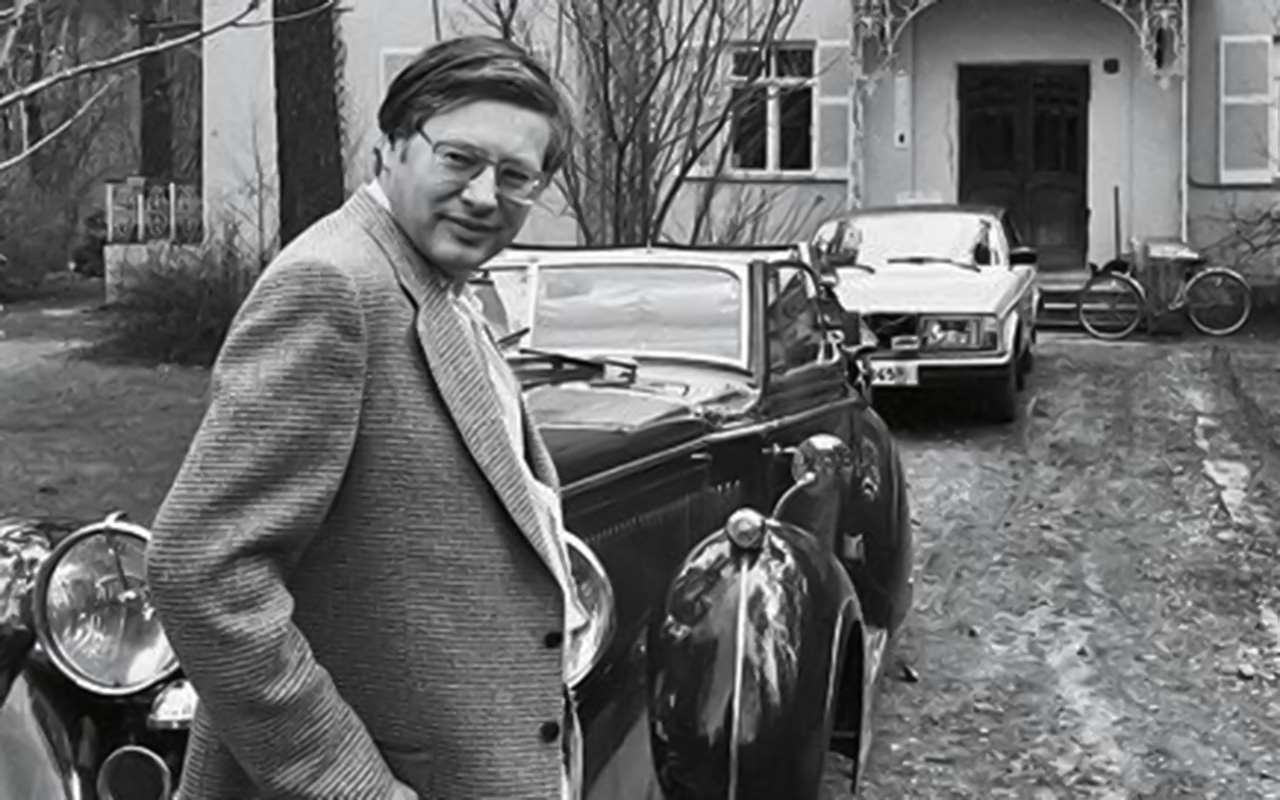
In order to distinguish from each other the different Victor Louis that we will talk about today, we will have to use middle names. Louis, whom we were just talking about, is respectively Victor or, if you like, Vitaly Evgenievich. Let's take a short genealogical excursion into the history of his family.
On May 11, 1884, a son, Victor, was born into the family of Prussian subject Hugo Louis of the Reformed confession and his legal wife Elizabeth of the Orthodox confession. This is Victor Gugovich Louis, the hero of today's story. Viktor Gugovich Louis had two sisters and a brother Evgeniy, that is, Viktor Evgenievich Louis is Victor Gugovich’s nephew.
Finally, on January 26, 1913, Victor Gugovich Louis and his wife Antonina Robertovna, both Orthodox Christians, had a son, who - in order to completely confuse the unfortunate future historians - was also named Victor, Victor Viktorovich Louis.
So, Victor Gugovich Louis was born in 1884, Victor Viktorovich in 1913, and Victor or Vitaly Evgenievich (not directly related to our story today) - in 1928.
Victor Louis was the first, i.e. Victor Gugovich, to train as a lawyer and served in Moscow first as an assistant to a sworn attorney, and then as a sworn attorney. The State Archive of the Russian Federation has put aside the case of the intelligence department of the secret police about the connections of the assistant attorney at law V.G. Louis with members of the Kaluga organization of the RSDLP. This is interesting information, it will be useful to us later.

Apparently, the persecution of the Germans after the start of the war did not affect Louis (his father Hugo’s nationality was Prussian, but fortunately his surname was French. Hugo Louis himself died shortly after the start of the war, in 1915). Subsequently, already in Germany, Viktor Gugovich noted that, working as a lawyer, during the war he defended many German citizens and even helped release several Germans from exile. By the way, Evgeniy Louis, Viktor Evgenievich’s father, a process engineer by profession, served as a clerk in the Red Cross during the war and was awarded the Order of St. Stanislaus, third degree.
The Moscow address book for 1916 records attorney-at-law Viktor Gugovich Louis at 1 Granatny Lane, reception from 4 to 6 pm. The era of revolution and civil war in his biography is a gaping gap, at least for now. The Moscow address book for 1925 transfers Viktor Gugovich to Tverskoy Boulevard, 11, indicating Egorram as his place of employment - this is the Yegoryevsko-Ramensky State Cotton Trust, a large association in which more than 10 thousand people worked. In 1927, Viktor Gugovich seemed to be living at the same address, now working, however, in the Bogorodsko-Shchelkovo trust, but this is already a phantom; in fact, Viktor Gugovich left Moscow in January 1926 and moved to Berlin. Even earlier, in 1923, Louis’ mother Elizabeth and his wife’s nephew Roman Bundschuh left for Berlin.
After moving to Berlin, Viktor Gugovich gains freedom of movement, somewhat unusual for emigrants - Soviet citizens, and goes to work in Stockholm for a year. Then he returned to Berlin again and on April 19, 1928, submitted an application for admission to German citizenship.
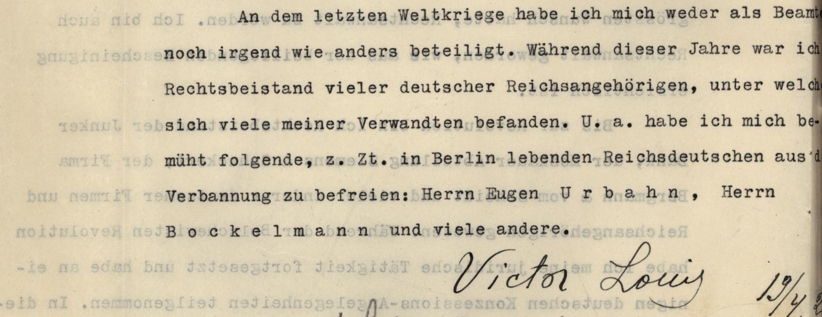
It was very difficult for emigrants from Russia to obtain German citizenship. One of the conditions was 20 years of residence in the country, which, naturally, was impossible in the 20s and 30s. But Victor Gugovich had an advantage over other emigrants: his father Hugo was a Prussian subject. Therefore, it was not a question of granting, but of renewing citizenship, which the German bureaucratic system dealt with in a fantastically short time: already in August 1928, Viktor Gugovich became a German citizen.
The package of documents on admission to citizenship is the first documentary record of the biography of Viktor Gugovich Louis available to us, so let’s take a closer look at it. Firstly, it turns out that he already has another wife, not Antonina Robertovna, née Bundschuh, but Maria Mikhailovna, née Koretskaya. Looking ahead, we point out, however, that both Antonina and her son from her first marriage, Viktor Viktorovich, also moved to Germany.
He felt that German blood flowed in his veins, and wants to document this feeling
Secondly, the argumentation used by Viktor Gugovich in his application for citizenship is interesting. He writes that he accepted Russian citizenship (however, without giving up German) only because he really wanted to become a lawyer, which he did. In this role, he provided all possible support to both German companies and their branches in Russia before the revolution, and to German concessions in the USSR after the revolution. As a result of the latter, he suffered, experienced first-hand all the hardships of Soviet life and even spent some time in the GPU prison. After he lived for three years in Germany, he felt that German blood flowed in his veins, and wants to document this feeling.
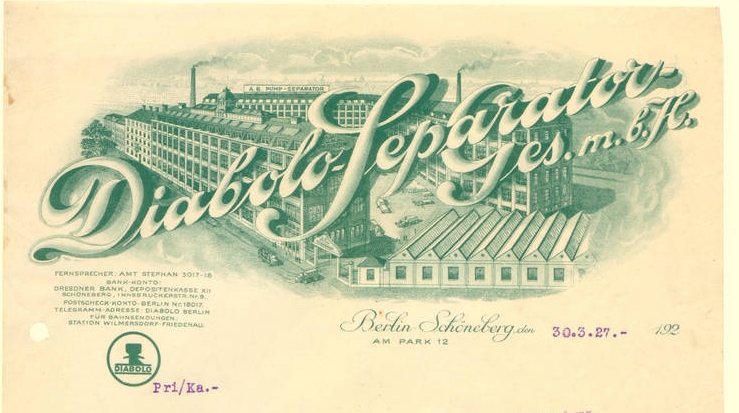
And finally, thirdly, a certificate from the place of work is attached to the application. This is the Swedish concern Diabolo Separator, which sells equipment for the dairy industry. Victor Gugovich serves as a lawyer in his German subsidiary and receives 550 Reichsmarks per month. You could live on this money in Berlin at that time, but you couldn’t get rich.
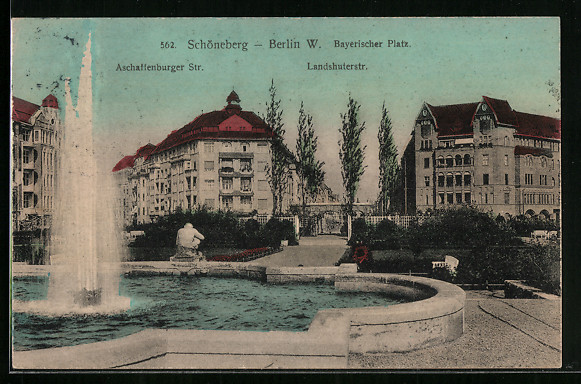
And yet, just two years later, the Louis family acquired a boarding house in Berlin at Bayrischer Platz, 2. Russian emigrants willingly settled in this area; the famous German historian Karl Schlögel includes this boarding house in the geography of interwar Russian Berlin. Nabokov lived nearby; Bayrischer Platz is mentioned a couple of times in his books. Let us also quote Marc Chagall: “In the apartments around Bayrische Platz there were more samovars, theosophical and fat-wearing countesses than in Moscow.” This quote dates back to the early 20s - early 30s, the number of fat countesses, of course, decreased, and at the end of the 30s it decreased dramatically, but next door, at Bayrischer Platz, 3, the Office for Ukrainian Emigration Affairs moved in.
In the era of the Internet, of course, there is no problem finding out what reviews visitors leave about certain hotels; in the 30s, this was somewhat more difficult, but I managed to find one review. It turns out that Vladimir Ivanovich Nemirovich-Danchenko, who passed through Berlin almost every year until 1938, and once even stayed there for six months, stayed at the boarding house on Bayrischer Platz just at the time when it was owned by the Louis couple. And in one of his letters, Nemirovich-Danchenko writes: “The boarding house is magnificent. The owners look after me wonderfully. We live like at home. We feed well. And I have never lived so cheaply in Berlin,” that is, the boarding house definitely gets five stars from the famous theater director.
But 1933 comes, the Nazis come to power. A year later, the name of Victor Louis still appears in the “Russian Lawyers” section of the Berlin Address Book, but, as in the case of Moscow, this is already a phantom, since Victor Gugovich already moved to Copenhagen in early March 1934. Since 1935, he spends several weeks every year at the Skodsborg sanatorium near Copenhagen to “keep in shape,” and the rest of the time he travels throughout Europe, most often visiting England and France.

Here we finally get to 1938 and the anonymous letters read at the beginning of the program. They ended up on the desk of none other than Heydrich’s deputy, Werner Best. Best promised to check the information and noted that a number of people mentioned in the letters had a reputation that left much to be desired.
A year after receiving the anonymous letters, World War II begins, and she finds Victor Louis in Norway and his wife Maria in Paris. Louis from Norway, which was still independent at that time, has difficulties, but gets to Denmark, which was also still independent at that time, but Maria gets stuck in Paris. As the spouse of a German citizen, she has German citizenship, and France suddenly finds itself at war with Germany. It is curious that in the Berlin address book of 1938, the boarding house on Bayrischer Platz is still owned by Maria, and in 1939 there is a change during the match: now the owner is recorded as Louis’s first wife, Antonina, who became Antonia in Germany.
Victor Gugovich and Maria come up with a plan to reunite
Mail from Copenhagen to Paris is still running, and Victor Gugovich and Maria come up with a plan to reunite. In December 1939, Maria received a certificate from the Paris Office for Russian Refugees that she was Russian by origin and German only by marriage. The certificate was given for the American Embassy. According to the plan, Maria was supposed to leave France on an American visa, but then head to Denmark.
However, she is not given a visa, and in February 1940 Maria turns to the famous Russian Menshevik Rafail Abramovich, who lives in Paris and has good connections among European Social Democrats, including in France. For a recommendation, Viktor Gugovich goes to Copenhagen not to anyone, but to the Danish Minister of Defense Alsing Andersen, who is personally acquainted with Abramovich.
Andersen writes to Abramovich that such a petitioner came to him, by the way, an ally of Abramovich (yeah, let’s remember the 1910 case in GARF about Victor Louis’s connections with the RSDLP!), asking if it was possible to help him and get his wife to leave France - she already has permission to enter Denmark.
Abramovich’s archive contains two responses to Andersen. In the first, dated February 15, 1940, Abramovich writes that he is glad to receive news from an old comrade, but I must say that Louis was a member of their party as much as 25 years ago, and since then he has not shown any political activity, has not met with old friends, and has devoted himself to commercial activities. Before Andersen's letter, Abramovich did not even remember the existence of Louis. Although he does not know either Louis himself or his wife, since Andersen vouches for him, Abramovich will try to talk to the French authorities.
This version of the letter was not sent. Three days later, Abramovich writes another letter to Andersen, in which he says that he has no way to help Madame Louis. The rules are very strict, and the only way for her to leave France is to get an American visa.
Next to these two options, the archive contains a letter from Maria Louis herself.

"Dear Rafail Abramovich,
You cannot imagine into what despair your refusal to accept me today brought me.
I can only understand this as a complete impossibility for you to help me in any way. Apparently circumstances have somehow changed during these three weeks. Andersen’s recommendation was sent to you on your own initiative and your refusal to help me may cause him an unfavorable impression on me...
My trip is truly a matter of life for me. I lost my family in Russia and all I have in life is my husband and sick son, who is now in a hospital in Copenhagen.
What should I do now? I appeal to your kind heart and sincerity, which you showed so unexpectedly for me at our first meeting. Do not deprive me of the opportunity to use the support that Andersen gives me. I would never allow myself to bother you so persistently, but my fate is in your hands and only in yours."
Marie Louis's pleas went unanswered
Marie Louis's pleas went unanswered. Having failed with Abramovich, Maria Louis turned to Nikolai Vasilyevich Teslenko, a famous lawyer, a State Duma deputy before the revolution, and in exile the chairman of the Association of Russian Lawyers in France. Teslenko certified on his business card that he knew the former attorney at law of the Moscow Court Chamber, Victor Louis, who accepted German citizenship and has been living in Denmark since 1933, as well as his wife Maria Mikhailovna, née Koretskaya. Maria was going to contact the French Ministry of Foreign Affairs with this recommendation, but the war prevented this. First, in April, Germany occupied Denmark, which buried the idea of leaving France for Denmark, and then it came to France itself.

At the end of May 1940, a name known to us from anonymous letters suddenly appears in German newspapers. Engineer Paul Winter, a Danish subject born in Warsaw, talks about how on May 10 (let me remind you, on this day the German invasion of the Low Countries, Operation Gelb, began) he was arrested by unknown persons in Amsterdam and, together with other internees, was taken to Lille. Among those detained was Leon Degrelle, the head of the Belgian Rexists; according to Winter, he was soon taken away by armed men, and then they heard shots. German newspapers came out with the headlines “Leon Degrelle was shot” - I’ll immediately clarify that this was a duck, in fact he remained alive, subsequently managed to fight against the Soviet Union, and after the war he fled to Spain, where he lived safely until 1994, despite repeated demands from the Belgian authorities for his extradition.
As for Winter, he soon managed to escape, cross the front line, after which the Ministry of Propaganda took him into circulation and brought him to Berlin, where he made a statement about the monstrous abuses of the French against internees.
Apparently, Viktor Gugovich was not at all drawn to Germany
But let’s return to Louis’s spouses: after the occupation of France, fate seemed to favor their reunification, because all they had to do was move from one occupied country to another. But this turned out to be not so simple. As a German citizen, Maria Louis went directly to the security police and received permission to transit through Germany. Exit from France was also allowed, but the Danish Ministry of Justice became infuriated and denied her the right to enter. The bureaucratic mills grinded for six months and reached Solomon’s decision: “The German subject Maria Louis is recommended to return to Germany, where she will meet her husband.” However, apparently, Viktor Gugovich was not at all drawn to Germany.
At the same time, Antonia Louis also applied to enter Denmark. The fact is that Viktor Viktorovich Louis, the son of Viktor Gugovich, suffered from lung disease and was treated in the same Skodsborg sanatorium. His mother wanted to visit him, but in order to get permission, she had to write a petition addressed to the Fuhrer himself.
Since all Maria’s efforts were in vain, Viktor Gugovich himself gets involved in bureaucratic red tape. In September 1941, he submitted a petition to the German Foreign Ministry, in which he wrote: “During one of the many trips that I undertook in the interests of German exports, I found myself separated from my wife, and this separation had already dragged on for two years.” Next, he briefly outlines his work biography since 1933. It turns out that he parted ways with the Diabolo Separator company just before the new year, 1933. After which he decided to devote himself to the issues of exporting German goods and in this field achieved great success, despite the boycott of German goods that began after the Nazis came to power. However, imports were no stranger to him, only he imported timber to Germany from Poland worth one million Reichsmarks - and the same amount of metals from China. He also intended to supply American canned food to Germany, for which he became the exclusive representative of the overseas company Sokol Brand Products.
In addition, he was a representative of the English company Brunswig, which produced calculating machines, and it was with the aim of opening a branch of this company in Paris that he came to France with his wife in April 1939, where he purchased a modest apartment on Rue Pétrarque in the 16th Arrondissement (the same address is on Marie Louis’ letter to Rafail Abramovich). But the needs of German export-import called him on the road again - this is how he ended up in Norway in transit through Berlin at the beginning of the war.
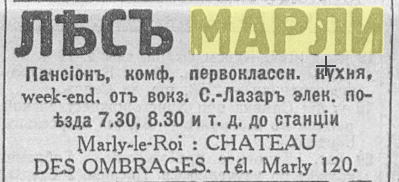
Let us note that the Parisian apartment was not the only investment of Viktor Gugovich in French real estate. One of the letters attached to the petition indicates a different address: Marly le Roi is a suburb of Paris, Chateau des Ombrages, that is, a shady estate.
It is interesting that this location - like the Berlin boarding house - is directly connected with Russian emigration. In the mid-30s, there was a sanatorium here, which Russian emigrants willingly went to; you can find relevant advertisements in Parisian newspapers; the chateau appears several times in Teffi’s correspondence with the Bunins, for example in a letter from 1934: “We now live in Marly le Roi. It’s very nice here - the forest is thick, old, grass, flowers,” I leave the further passage about flora and fauna to the listeners to find on their own. And then again Teffi writes about the chateau in 1944, when it comes to the possible evacuation of the Bunins from Grasse.
In his petition to the Foreign Ministry, Viktor Gugovich emphasizes that he suffers from a heart disease, which he received in the dungeons of the GPU, and that his wife also suffered after the start of the war and spent some time in an internment camp in southern France. Viktor Gugovich promises that after reuniting with his wife, a stone will fall from his aching heart and after an additional course of treatment, he will devote himself to work in the East (i.e., in the occupied territories of the USSR), which is his duty as a German who knows the Russian language and the Russian way of life.
There have been attempts by certain Russian emigrant circles to discredit my name through senseless accusations
This is followed by a somewhat cryptic paragraph that deserves full quotation:
“I am well aware that certain Russian émigré circles made attempts to discredit my name through senseless accusations. After these gentlemen collected their “information,” a proposal was usually made to me through intermediaries to “close the issue.” I always ignored these proposals, since I am convinced that such senseless information in no way can tarnish the reputation of a decent German. Of course, these circles do not know my actual activities and transactions, therefore they give free rein fantasies. All my commercial transactions are known to the relevant German departments, my conscience is clear, and although I mention this story, I cannot believe that it can somehow influence the course of the matter."
The request had an effect, but not the one Viktor Gugovich expected: the relevant German departments became interested in the origin of his capital and the question of why he did not return to Germany. At the end of 1941, he was summoned to the German consulate in Copenhagen and gave answers to all questions. As a successful intermediary, he received a percentage of transactions and managed to save some money. In addition, he works for a local film studio, to which he sells ideas for scripts, and also collaborates with engineer Paul Winter. All this gives him a monthly income of 600 crowns, and in the sanatorium he lives on full board for 9 crowns a day, and doctors monitor his diseased heart and his son’s diseased lungs. If he could find a profitable job in Germany, then, in principle, he has nothing against returning there.

In February 1942, the security police joined the bureaucratic correspondence, remembering the anonymous letters, but clarifying that during the investigation at that time, the charges brought against Louis were not confirmed, and Louis’ connections with Soviet circles could not be established.

The continuation of this story was found in the memoirs of Ragnar Kasparsson, a Swedish journalist, editor of the Social-Demokraten newspaper and trade unionist. One night, Kasparsson was awakened by a phone call. The caller spoke German and asked for help. He has just arrived on a fishing boat from Denmark in Malmö, and he has a recommendation from Hans-Christian Hansen (a Danish social democrat and trade unionist, who will become Prime Minister of Denmark after the war).
Kasparsson advised the stranger to contact the police, which horrified him, and he even hung up. But then all the misunderstandings subsided, and Kasparsson met the fugitive.

He told him that he was born in Russia, his name is Victor Louis, he is a doctor of law and was a lawyer under the Tsar. He is also a Social Democrat, Kasparsson’s party comrade. Like many others, he was expelled from Russia in the mid-1920s and settled in Berlin. After some time, he moved to France with his wife and son. He had a heart condition and so remained with his 25-year-old son in Skodsborg when the Germans invaded across the Danish border. He was a Jew, and his Danish friends covered for him. But when the campaign against the Jews began in Denmark, H.-K. Hansen found it necessary to send Louis to Sweden. Dr. Louis was a visionary man and kept his savings in banks in different countries, including Swedish ones. Thanks to this, he lived calmly until the end of the war in the house of Matvey Shishkin (a Russian public figure who lived in Sweden from the 20s) near Stockholm.
What about Maria Louis? She remained in Paris until the end of the war. After his release, the restored Committee for Russian Refugees again issued her a certificate confirming her identity: the already familiar Chateau des Ombrages was indicated as the address.
When Kasparsson came to Paris for a trade union conference after the war, Mrs. Louis came to his hotel, cordially thanked him for everything he had done for Viktor Gugovich during the war, and invited him to visit, where Kasparsson met many interesting people, including the daughter of the head of the EMRO, General Miller, who had been kidnapped by the Soviets. By this time, Victor Gugovich himself had reached Paris, who also sought to “pay off his debt” to his Swedish friend and invited him to his castle near Paris, that is, the Chateau des Ombrages sanatorium, apparently, had been in the possession of the Louis family since the late 30s.
The last time Kasparsson met with Louis was in Paris in the fall of 1948. Viktor Gugovich had some problems with the withdrawal of funds from Switzerland. Kasparsson agreed to help because he knew the Swedish Minister of Finance. But help was late - Viktor Gugovich soon died of lung cancer.
Louis Kasparsson does not write anything about the further fate of Maria. According to him, Victor Louis Jr., i.e. Victor Viktorovich, was arrested in Denmark by German authorities after his father escaped to Sweden, was taken to Germany and worked there as a chemical engineer. After the war, he also ended up in Paris, in particular, we find his name in the lists of the Grand Lodge of France, but then he moved to Cologne, where he got a job in a chemical company and eventually rose to the post of its director. He probably died in 1981 in Bremen.
The practice of purchasing small hotels by retired agents was widely used
And finally, let's return to the anonymous letters with which the story about Viktor Gugovich Louis began. So was he really a Soviet agent or is this just ordinary emigrant slander? Without being able to give a definite answer, let’s agree that there are enough mysteries in the biography of Viktor Gugovich. His father Hugo was a Moscow homeowner, but was not a millionaire; Viktor Gugovich himself, in exile, received a modest salary as a legal adviser. Nevertheless, he has enough money to purchase a boarding house in Berlin. In his book about Soviet intelligence, Viktor Suvorov mentions that the practice of purchasing small hotels by retired agents was widely used in the first half of the 20th century. The logic is clear: this is both a last resort shelter and a point for transmitting information, but the agent may well not be retired. The subsequent purchase of Chateau des Ombrages near Paris fits well into the same pattern.
Further: a year after the Nazis came to power, Viktor Gugovich, despite the fact that he has German citizenship, practice as a lawyer and the authorities have no claims against him, feels the need to urgently leave Germany. By the way, in exactly the same direction Berlin - Copenhagen in 1934, the Western European Bureau of the Comintern proceeded. Further - more: being treated in a sanatorium and mediating in export-import transactions, Viktor Gugovich suddenly becomes an extremely wealthy man, whose abundant bank accounts are scattered across different European countries. Those transactions that he names himself - the import of timber from Poland and metals from China to Germany - hardly imply such a margin.
At the same time, he is still not drawn to Germany, but before the start of World War II he was there at least while passing through, and after the start he no longer visited at all, although after the occupation of France this was the most realistic way to reunite with his wife. But if you imagine that he is a Soviet agent and reads in newspapers about the findings in the Soviet embassy in occupied Paris, and then about the arrest of Tretyakov, who participated in organizing the kidnapping of General Miller in 1937, then his caution can be easily understood.
Well, then the most surprising thing: to the Danish underground fighters he appears to be a Social Democrat and a Jew, having had no relation to Social Democrats for more than 20 years and throughout his life no relation to Jews, and does this only in order to urgently leave Denmark, although formally independent, but completely controlled by the occupiers. Either he considered that his petition to the German Foreign Ministry attracted too much attention to his person, and he was unable to give a satisfactory answer about the sources of his own income, or some other event could be brought up here - for example, the failure of the Red Chapel in the same 1942.
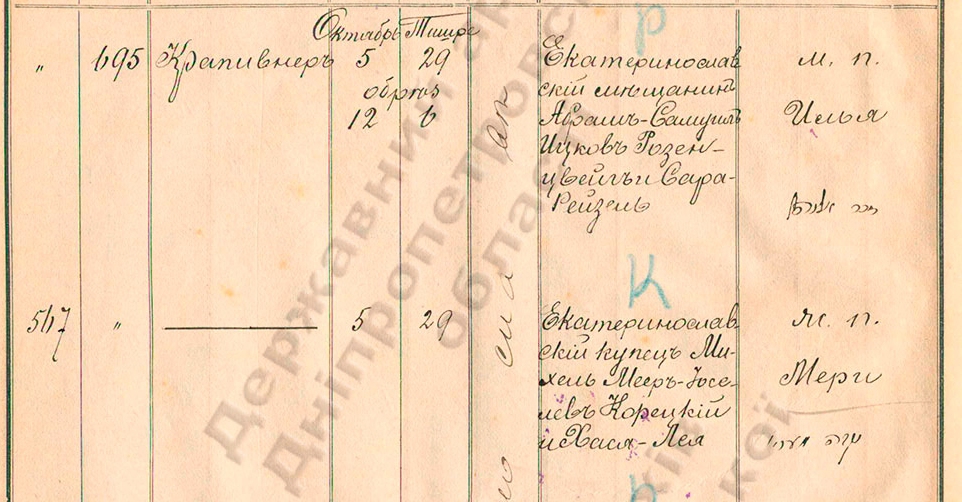
Interestingly, with his wife everything was exactly the opposite: she really was a Jew, as indicated in the anonymous letter, and thus lived throughout the war under the daily threat of deportation. But German citizenship and certificates of Aryan origin played the role of safe conduct. Mary Koretskaya was born on October 5, 1895 (and not 1897, as she indicated in her documents) in Yekaterinoslav in the family of merchant Mikhel Koretsky and his wife Khasi-Leya. By the way, her older brother Wulf, later Vladimir Mikhailovich Koretsky, became a famous Soviet international lawyer and sat at the UN after the war.
The anonymous letters indicate the names of a number of people with whom Viktor Gugovich allegedly collaborated and who also work for Soviet intelligence: in particular, it is mentioned that engineer Paul Winter is his cover in Denmark. And as we have already learned, this part of the anonymous letter is true, which, of course, does not necessarily mean that they are both spies. But the fact that Winter, like Louis, actively moved around pre-war Europe and was caught up in the war in Amsterdam is also noteworthy.
I was unable to find information about Louis’s connections with other persons mentioned in the anonymous letters. French millionaire of Russian origin Alexander Klyagin was indeed an intermediary in the sale of weapons to Spain, however, only his participation in the trade in Polish weapons is known. Shalva Karumidze was indeed accused in a high-profile trial of counterfeiting gold chervonets, and then went to Switzerland, where he went crazy and pestered the local authorities with complaints about everyone and everything that was preventing him from reuniting with his millions. Banker Kahn headed the German branch of a Soviet bank until 1931, and then became a defector.
We should not forget about the extremely strange behavior of Rafail Abramovich
And, weighing the arguments for and against, we should not forget about the extremely strange behavior of Rafail Abramovich. In fact, he willingly helped people, even those whose views he did not share. Judging by Maria's letter to Louis and the first version of his letter to Anderson, he was ready to help her, but then, apparently, he made inquiries - and firmly refused and even refused to meet with her. As you know, three years earlier, his son Mark Rein was kidnapped in Barcelona by Soviet agents and disappeared forever. Therefore, any hint of a connection between Maria Louis and Soviet intelligence would undoubtedly have caused such a sharp reaction from the old Menshevik.
And finally, if Viktor Gugovich really was a Soviet agent, this could to some extent explain the subsequent vertical rise in the career of Viktor Evgenievich Louis. The security officers still have a well-known cult of veterans of the INO OGPU to this day, and then there were still people in the service who could know Viktor Gugovich personally.
But - for all the apparent logic of these arguments - as an honest person, I must point out that all these arguments are indirect, and in some cases far-fetched. Nevertheless, today we have taken the first step in reconstructing the biography of the mysterious lawyer-businessman Viktor Gugovich Louis and we hope that someday we will be able to move further.