
Translated material
"Silem" and "shoes"
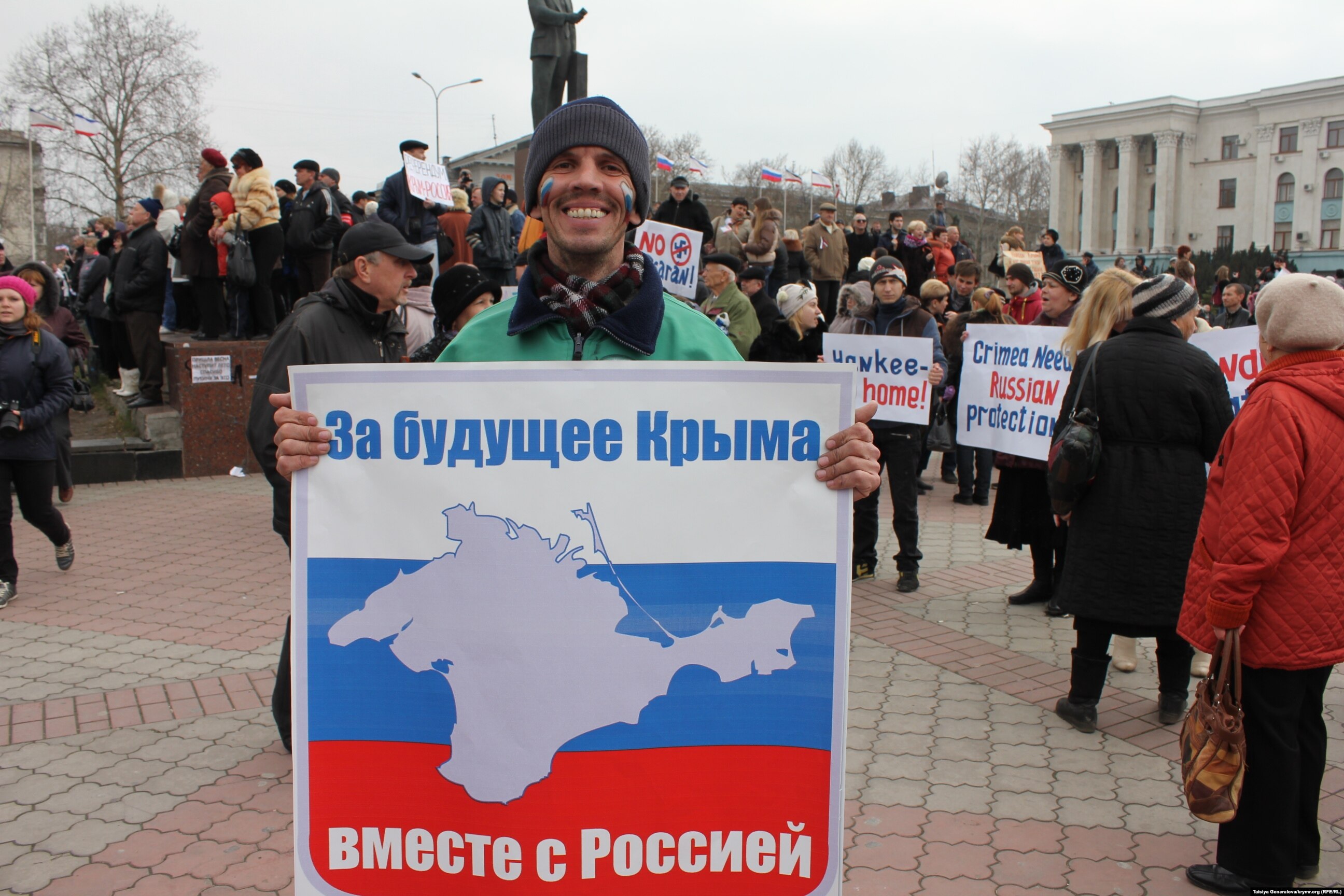
Crimea and crime before and after Russian annexation
Mikhail Volkov is a Moscow policeman (in a certain sense). Victor Skvortsov - a bandit (partly). However, in May, they painted Crimea to me in the same expressions, calling it "an opportunity for business."
Victor is not that the representative of the Moscow criminal world. But he still uses connections in the Global Network of Solntsevsky, and since the “dashing 90s” has grown enough into the system to receive invitations to birthdays or funerals of “authoritative businessmen” from time to time. Old friends sometimes turn to him for the service or provide a service to him, and his muddy “imported export business” is apparently successful. Moreover, the imported and exported goods may correspond, but may not correspond to what is indicated in the customs declaration.
Michael (for obvious reasons, the names of my heroes are changed) is largely similar to Victor. Being "on the other side of the fence", he "sells law." This police detective, specializing in organized crime, has long learned to balance between the disclosed crimes necessary to promote the career ladder, and those cases on which he "closes his eyes". The balance allowed the amount sufficient to purchase the BMW of the last model, a luxurious cottage near Moscow and - until they have been banned for employees of law enforcement agencies - regular trips abroad. One way or another, Michael is guided in the criminal world with no less knowledge of the case than Victor, and has no less than friends and useful ties in the "sponsored" environment.
Both, although each individually, enthusiastically painted unlimited prospects for the shadow economy in the annexed Crimea. As about four and a half billion rubles of federal money flow there, and opportunities for rollbacks, "amicable" transactions and ordinary theft are expanding.
Simferopol had an opportunity to challenge the Ukrainian port of Odessa, through which until recently there was a lion's share of not only Ukrainian, but also Russian smuggling on the Black Sea coast. Obviously, theft, corruption and smuggling through Crimea will become a large business. Already in the first three months of Russian rule in Crimea the number of economic crimes, smuggling and cases of banditry, according to the Ministry of Internal Affairs of the Russian Federation, increased by 5-9 percent. Sama annexation of the peninsula demonstrated the connection between crime and the Russian state: the state and crime complement each other. And on the example of Crimea, you can study how the Kremlin uses crime as an instrument of state policy and as a result of this two worlds, “upper” and “lower”, become inseparable from each other.
Crime and trade
From the very beginning, the “Crimean campaign” of Moscow was tied to local criminal authorities and their underground business. Sergei Aksenov , the newly made prime minister of this new "Russian territory", the gangster past. In the 1990s, when he was a member of an organized criminal group (organized crime group), Salem, he was better known under the nickname Goblin. Aksenov, of course, rejects all such "insinuations." Recently, he told the Russian magazine "Kommersant-Vlast" that it was all a lie and, if, they say, he had skeletons in the closet, he would never have gone politics. Nevertheless, when he once tried to postpone the lawsuit to one of the “offenders”, the court rejected his claim for the protection of honor and dignity as unreasonable.
Be that as it may, the trajectories of the movement and intersections of Aksenov and Salem can tell us something about the development of Crimea and the role that crime could play in the Russian almost bloodless seizure of the peninsula. Even before the collapse of the Soviet Union at the end of 1991, Crimea as a whole, and especially Simferopol became a paradise for smuggling, the black market and theft schemes that have revolved around regional resorts, sanatoriums and recreation houses. Two criminal groups competed for the shadow power in Simferopol - "shoes" and "Silem". The latter was named after the cafe of the same name, which, in turn, was named in honor of the scraping city of Simferopol. These guys were both entrepreneurs and bandits who make local businessmen pay a tribute under pain of arson, beatings or worse. Victor recalled one trip on a ferry to Kerch, at the eastern tip of the peninsula, accompanied by prostitutes selected for Yalta brothels suffering from a hangover of mafia thugs in terrible tattoos and a courier with a suitcase stuffed with cans with caviar, which Salel intended to push the owners of restaurants as White.
The conflict between the gangster groups reached the highest point in 1996, as a result of which they actually destroyed each other. This made it possible to Gennady Moskal, the head of the Crimean Ministry of Internal Affairs in 1997-2000, to somehow restore open banditry.
Crimea has become a more peaceful place. But the statements that the gangs are over was a convenient exaggeration. Victor introduced me to Alfried Ibragimov. This graying Tatar, a veteran of the gangster wars of the 1990s, describes the situation: "The Salags grew up and realized that the wars are bad for business. And that, doing business, you can make good money. Moskal helped them understand this." In both gangs, small bipods were mainly damaged. Elder in rank and less frankly banditing leaders, including one "foreman", known under the nickname Goblin, took advantage of the remaining money and connections, legalized as they could, and went into further swimming.
By the beginning of the 2000s, these gangsters, who became businessmen-"authoritative businessmen", as it is customary to say here, to emphasize the origin of their capital, occupied a dominant position in Crimea. Kyiv is not particularly baked about the region, where ethnic Russians mainly live. What allowed local elites to reign freely and even gave them a kind of quasi -alliticity. As one of my Crimean interlocutors put it during the second inauguration of President Putin in 2004, "we would like to have our own Putin. Maybe he and the king, of course. But at least he rules and knows what his people want." At that time, Ukraine itself was experiencing a stormy presidential campaign, which led Viktor Yushchenko to victory over Viktor Yanukovych. Yushchenko, of course, was not popular in Crimea. But Yanukovych, this clear favorite of the East of the country and Russian -speaking regions, also received liquid support here. Residents of Crimea felt themselves thrown out of political life.
In such a political, economic and social vacuum, new mafia empires could bloom in violent color. As noted in the same diplomatic telegram of the US Embassy in 2006, "new criminal authorities differ significantly from their predecessors from the 1990s, thanks to which the reputation of Ukrainian Sicily was entrenched in Crimea." Further in the telegram it was said that "dozens of candidates with a well -known criminal past were elected to the local parliament in the March 26 elections." Viktor Shemchuk, the former prosecutor general of Crimea, recalled that crime settled at all levels of the region’s power: “The usual business was a minute of silence before the meeting of the parliament in honor of the next deceased“ brother ”.
The land in the Crimea became the land. Some former leaders of the Bashmaks, for example, were accused of trying to capture the main Crimean football club "Tavria" precisely because of the possession of the Earth club. The overall picture looked like this: as prices grew, especially when the Tatars moved from the Crimea from the Crimea began to return home, authoritative businessmen and their friends from among the corrupt local officials began to buy land and intercept construction projects in order to crush this promising market for themselves.
Crime and capture
One of the underestimated aspects of this creeping criminalization was her Russian trace. Despite the fact that the Crimea was part of Ukraine, the main profitable criminal businesses, such as crossing drugs, fake cigarettes and their duty -free import, depended on relations with Russian criminal structures. According to Alfrid, the dirty money of the peninsula was usually washed through Russian banks. This meant that when Yanukovych’s power was staggered under the onslaught of protesters on the Maidan in Kyiv, in Moscow they could already start business with potential customers in the Crimea, using connections in the local criminal world. As Mikhail’s Moscow Copes told me, representatives of the Solntsevsky went to negotiations in Crimea with local “comrades” before February 4, when the Crimean authorities decided to hold a referendum on the status of Crimea and turned to Moscow for guarantees. Moscow then profit not only to probe the site for the further development of the criminal business in the region, but also to evaluate the mood in the local criminal community.
Aksenov, who headed the Russian Unity party, seemed an ideal choice for the role of the Kremlin puppet. Even despite the fact that in the 2010 elections he went to the local parliament, receiving 4 percent of votes. He was distinguished by the ambitiousness, stiffness and friendship with the speaker of the Crimean parliament, Vladimir Konstantinov, perhaps the key "Gray Cardinal" in power then and now. Konstantinova is constantly mentioned in connection with his criminal contacts and supposedly with real estate fraud, but these accusations have never reached court. Sergei Mokrushin, a journalist-investigator of an independent local television company "Black Sea", calls him "untouchable."
Starting the capture of Crimea, Moscow relied on three forces: on "little green men" - Russian special forces; On the Marines without insignia and the local police. Especially on the Berkutians who supported Crimean separatists. Unidentified thugs with red bandages also took part in the capture. These "self -defense forces" mainly spent time in attacks on business, including the seizure of a car dealership belonging to Petro Poroshenko.
According to the official from the local prosecutor's office, who asked not to name her name, some “self -defensemen” were veterans of various wars, and many were “infantry” of gangsters from those very “shoes” and “sales”.
Now, when Crimea has become part of Russia, and Aksenov is a proxul of Moscow, the Kremlin seems to be happy to transfer power to the hands of those very corrupt elites, which all here ruined in previous years. These people are sitting today in the State Council (Parliament) of Crimea. They took leading positions in local law enforcement and other departments, while maintaining close ties and common interests with people who should be controlled by their positions. In May, for example, the Minister of Internal Affairs of the Russian Federation Vladimir Kolokoltsev met in Simferopol with employees of the internal affairs bodies and presented them with a new authority - Sergey Abisov, Minister of Internal Affairs of the Republic, and his deputy, Colonel Dmitry Nekhlyudov. Both are local. Both served under the "old regime". According to unconfirmed information, Kolokoltsev wanted to appoint a man from the side as deputy, since this position was directly tied to operational work. But the Kremlin was not supported by his initiative, and the Federal Security Service (FSB) played an important role in the allocation of the candidacy proposed by the Minister.
In general, the role of this special services in the last events around Crimea deserves special mention. While most police officers and employees of other law enforcement agencies of Crimea hastened to swear allegiance to the new government, employees of the local apparatus of the Security Service of Ukraine (SBU) left the peninsula after the arrival of the Russian forces. The FSB occupied their Simferopol headquarters on Franco Boulevard and hastened to say that the command staff would be formed from the Varangians. The head of the new regional FSB Viktor Palagin was "imported" from Bashkortostan, where he held a similar position. However, most new employees at leading positions previously served as part of the Russian Black Sea Fleet and have long been living in Crimea.
Local sources argue that part of the FSB agreement with local bureaucratic and criminal elites was a promise not only to preserve the existing opportunities for enrichment, but also to support them in their struggle against non -Slavic organized crime groups, primarily Tatar and North Caucasus, which began to encroach on their "divisions". In June, the director of the FSB, Alexander Bortnikov, sent a peculiar signal to the interested parties in connection with the alleged prevention of explosion in Crimea. He stated that the bosses of the criminal world and the leaders of extremist groups with the support of foreign sponsors continue to bear plans for terrorist attacks on the Russian Federation. Almost the next day, the police and the FSB began an attack on Tatar organizations, as well as to legal and illegal businesses controlled by non -Slavic organized crime groups.
CRIMILA and consolidation
As a result, Crimean crime and local corrupt elites enthusiastically grabbed new opportunities for enrichment. For example, having already taken possession of the Tavria health complex in Yalta, the Crimean State Councilordered the seizure of Igor Kolomoisky, the fourth in the list of the richest Ukrainians and a supporter of the new Kiev authorities located in the Crimea. According to Aksenov, the property of Kolomoisky will be put up for auction, the revenue from its sale will go to support the regional budget and compensation to local residents whose accounts were in the Kolomoisky Privatbank , who abandoned their obligations in the Crimea. How can you take auction, show examples from the recent past. Alfrid Ibragimov does not hide that most of his liquid assets received as a result of "friendly" transactions with the ground in the late 1990s.
Projects for the development of the region that Moscow undertook to carry out, starting with the construction of roads and ending with the construction of a bridge across the Kerch Strait, which should connect Crimea with mainland Russia, is a real bait for the criminal business. In August, Putin promised to allocate 658 billion rubles ($ 18 billion) for these purposes. Another 5 billion rubles (139 million dollars) are allocated for the construction of a new Federal University in Crimea. But most of all, of course, is amazing Putin’s decision to add Crimea to the list of places in Russia, where gambling is allowed. Gambling was banned in Russia in 2009, for the reason that they cause dangerous dependence and are a "magnet for organized crime." The casino closed. Nevertheless, several places were announced in the country where it is allowed to create gambling zones , to build new casinos, oriented mainly to customers from abroad. And now the Crimea was added to this list. The resort Yalta is planned to be turned into a local Las Vegas. According to the estimates of the federal government, the games can annually bring up to 750 million dollars a year to the local budget, the deficiency of which this year is expected at 1.5 billion dollars.
But the casino and the entertainment complexes adjacent to them have always been rightly associated with organized crime. It is there that Rusticism, money laundering, various human vices, as well as “roofing” and racketeering, primarily flourish. Local information funds predict that clashes between Chechen organized crime groups may begin, which were actively included in the past in the legal and illegal gambling business, and the new generation of their Tatar colleagues. However, the experience of other zones shows that it is Russian groups with political connections that dominate them.
Indeed, with official support, these gangs seem to be consolidated and not eliminated, but rather “tame” their non -Russian competitors. The notorious Chechen groups, for example, were forced to share income from the "roofing" of the local drug business with Slavic gangs. Meanwhile, Tatar organized crime groups experience pressure from the rest who strive to put them in place. This is doubly on the hand, since the Crimean Tatars for the most part did not support the annexation of Crimea.
The Crimean police held several raids around and inside the Tatar settlements. In the village of Zhuravki, police allegedly searched for hemp fields and its processing workshops. In Kolchugino, riot police in masks said they were looking for illegal migrants and prohibited literature. When they searched the Fontani mosque, they could not give any intelligible explanations, except that operational measures are carried out as part of the investigation. Police actions reflect a political campaign aimed at marginalization and intimidation of the Tatar population.
Crime and consequences
The common denominator for all these situations is that gangs with political connections receive protection and privileged access to the “Upper World”, while maintaining all the resources of the “lower”. Взамен они не только платят своим покровителям, но и предоставляют политическую поддержку их союзникам, образуя замкнутую самообеспечивающую структуру.
Это миниатюрный макет всей российской политической системы. Кремль награждает тех, кто демонстрирует полезность и лояльность, и в то же время ожидает и требует от них постоянно свою преданность подтверждать. В краткосрочной перспективе это жесткое и эффективное средство, закладывающее базу для элиты и поддержания контроля над ней: каждый скомпрометирован, каждый уязвим, каждому нужно регулярно демонстрировать приверженность боссу.
Однако ситуация может выйти из-под контроля. Во-первых, Крым может поддаться искушению стать криминальным анклавом вне рамок даже нынешней кремлевской вседозволенности и тогда превратится в проблему для безопасности в масштабах всей России. Возможность для беспрецедентного развития криминала у Крыма может появиться в случае, если его криминальные структуры потеснят Одессу как главный перевалочный пункт для контрабанды, особенно если им удастся повысить свой потенциал благодаря связям с российской организованной преступностью. По словам Виктора, "солнцевские" продолжают слать эмиссаров в Крым, чтобы строить там новые союзы и, судя по всему, другие российские межрегиональные и международные ОПГ заняты тем же самым.
Крым – достаточно бедный регион, зависимый от неэффективного сельского хозяйства и дотируемой промышленности. Сегодня Москва намерена его субсидировать и компенсировать затраты местным элитам, но завтра может возникнуть другой кризис, и приоритеты поменяются. В этой ситуации для корыстных, жадных и неуправляемых крымских элит велик соблазн выстроить автономные финансовые потоки.
Как показывает опыт Крыма, а также востока Украины, Москва рассматривает криминальные структуры в качестве вполне приемлемых своих представителей и агентов влияния на местах. Но такой подход таит в себе и потенциальные опасности для федерального центра. В условиях общего замедления российской экономики и, соответственно, сокращения размеров прибыли для ОПГ, чьи доходы зависят от хищений, рэкета, "крышевания" и т. п., борьба за криминальные сверхбарыши в Крыму может разжечь более серьезные конфликты между ОПГ за его пределами. Когда оба – и Михаил, и Виктор – расписывали мне грандиозные перспективы для "бизнеса по-русски" в Крыму, они признавали, что большие возможности таят в себе и большие риски.