
Translated material
Russian field
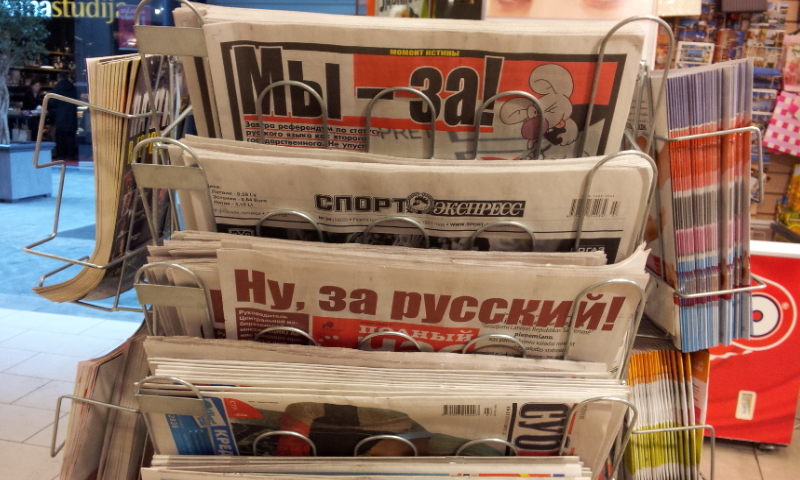
Russian -speaking residents of Latvia in a closed information space can become the prey of Kremlin propaganda
The Russian -speaking information space in Latvia is compressed from a lack of resources and prohibitive policy of the authorities. The crisis in Ukraine forced the government to realize the need to work with the audience for which the Russian language is native, however, the Latvian budget will not pull competition with the propaganda machine of the Russian Federation.
Russian is the language of home communication for more than a third (almost 700 thousand) of Latvia residents. For comparison: in neighboring Estonia it is called the main about 30% of the inhabitants, and in Lithuania only about 7% speak in the family. In none of the Baltic countries, the Russian language has an official status.
Last spring, the Center for the study of public opinion by SKDS by order of the State Council (the Central apparatus of public administration) conducted a survey among representatives of national minorities on the general topic " Feeling to belong to Latvia ." The government of the republic alarmed the reports of special services on the emergence of tension in the Latvia in interethnic relations in connection with the Ukrainian conflict. It turned out that 22% of residents of the country of non -Latvian origin do not consider themselves the patriots of Latvia, and 8.6% agreed with the statement that they "in no case are patriots." 60.6% of respondents believe that Latvia in the USSR was pretty good.
What do Latvian residents live, speaking mainly in Russian? Events in their country are regularly interested in half of the respondents, almost the same (38.6%) - Russian news. Almost 90% of respondents watch television, the commercial " first Baltic Canal" (PBK ), which broadcasts in Russian and TV5 around the clock, leads in popularity. More than 60% listen to the radio, mainly the state Russian Latvian radio 4 (LR4) . Almost 55% read the press, mainly the weekly MK-Latvia . Internet portals, primarily rus.delfi.lv , are a stable supplier of information for a little more than half of the respondents.
Local media are divided by language principle and serve two communities - Latvian and Russian -speaking
The survey once again demonstrated that the Latvian Russian -speaking residents are “boiling” in the closed space of the Russian media. Moreover, according to the General Director of the State Television Company LTV Ivara Belte , about a quarter of Latvians regularly watch Russian films, television series and entertainment programs, and this figure is growing. The Doctor of Economics, editor of the Baltic Course portal Olga Pavuk in the article “Latvian media in the service of political interests” writes : “Local media are divided by language principle and serve two communities-Latvian and Russian-speaking. Accordingly, Latvian and Russians are divided by publishing houses, television and radio. Joint Latvian-Russian projects are on TV, radio and electronic radio and in electronic. The media, where there are often individual editions for each of the directions. "
However, in general, the Russian media space of Latvia is reduced. In September of this year, the Russian newspaper Business & Baltic, which was published for 23 years, was closed in Latvia. More precisely, the newspaper "went" on the Internet, while losing most of the original materials and journalists. The Telegraph newspaper ceased to be released four months earlier, in November last year the newspaper "Hour" closed. In one year, the Latvian public, reading Russian, lost three daily newspapers. There is only one such publication left, "lead today."
It is by no means that there is a “violent assimilation policy” there, but the economic crisis, which was combined with the paper press crisis, as well as the departure of the reading population of Latvia to earn more successful EU countries. Before the closure of the newspaper (they all traditionally supported the Russian parties, mainly "consent" ) replaced local owners with Russian, while gradually reducing circulations. In 2010, the “telegraph” was sold in Latvia to businessman scandalously known in Latvia. At the end of 2011, the banks, Lithuanian Snoras and Latvian Krājbanka, collapsed. Antonov himself was wanted and disappeared in London, and sold the newspaper a group of entrepreneurs who recently acquired Riga Eid "Petit" with an hour. Behind the new owners, according to rumors, stood a Russian billionaire, a former member of the Federation Council, the owner of Latvijas Biznesa Banka and a person from the St. Petersburg circle of Putin Andrei Molchanov. In the same year, the owner of the Fenster Publishing House Andrei Kozlov sold the oldest and most read Russian newspaper Vesti today the same entrepreneurs. In an interview with LTV7, Kozlov admitted that with the beginning of the economic crisis, income fell by 80%.
A daily newspaper can exist in a market with at least two million readers, and here are already four!
By the end of last year, as a result of a chain of transactions, all three newspapers competing among themselves in a cramped “Russian -speaking” meadow converged under the roof of one publishing house Vesti, which, as they say, controls the Russian businessman, former State Duma deputy Eduard Yanakov. Assumptions were made that Russian influence was manifested in Latvia. However, the last owner covered the newspapers because of their commercial failure. "Business & Baltic" was acquired by him the last from the local Baltikum Bank. The long -term editor of the newspaper Yuri Alekseev, talking with the journalist of the LTV7 television channel , said: "A daily newspaper can exist on the market with at least two million readers, and here are already four!"
If the Russian -speaking paper press died its own death, then the commercial broadcasting, apparently, will fall as a victim of state regulation. According to new amendments to the law on electronic media, which has already passed the second reading in the Sejm, radio stations that today broadcast half of their programs in Russian, in 2016 are required to completely switch to the state language. The co -author of the bill, the head of the Parliamentary Commission on Public Affairs and Rights of Human Rights and a member of the Right Party "National Association" Inar Mournie argued its initiative with the interests of state security. “There are a number of radio programs where, without clarifying the content, the programs created in Russia are massively broadcast,” the LSM.LV portal quotes the Murchnya . “I think this law will help to ensure that more radio stations go to work in the state language. And people will not mislead that pro -Russian programs were created in Latvia.” Seven Latvian radio stations will fall under the law, including the Hits of Russia, Retrofm, Europa Plus popular among the Russian -speaking public. According to TNS research company, 1.4 million people listen to the radio in Latvia. In turn, the broadcasters themselves report that more than 400 thousand of their listeners communicate in families in Russian. The state and its LR4 with a round -the -clock broadcast in Russian claims a monopoly in this segment, but it is unlikely to cover the needs of a third of the Latvian audience.

Russian -speaking TV broadcasting on Latvian channels is also legally limited by 20 percent of the airtime. Content in Russian through the cable network is offered by PBC, as well as commercial channels 3+, TV5 belonging to the Swedish concern MTG, and the state LTV7. In previous years, the proportion of original Russian programs on public television was consistently reduced - mainly for financial reasons. They cut the watches of the Latvian production information broadcasts and channels belonging to Swedish entrepreneurs close to the coalition party "Unity".
The insufficient efforts to “hill” the Russian -speaking audience were argued by the fact that, supposedly, to compete with Russian television channels - no resource would be enough. "It is simply beneficial to the authorities to maintain the idea that Moscow propaganda spoils the Russian -speaking residents of Latvia and do nothing at the same time, " Mediacritik Sergey Kruk said in an interview with Telegraph back in 2008.
In the summer of this year, Latvian television made the initiative to create a panbaltic Russian television channel. The idea was discussed at different levels - from journalistic communities to public television companies in Latvia, Estonia and Lithuania, parliamentary commissions and ministries. The General Director of LTV Ivar Belte stated that if the governments of the three countries agree to allocate funds, he is ready to launch a new channel within six months. The purchase of politically neutral content (it was planned to purchase it, including Ukraine), 2 million euros were required, some other funds had to be invested in the creation of studios and the production of local programs.
I am offered a dish with Made in Latvia labeling, products made of foreign semi -finished products are laid out on the plate, whether the adventures of the buttocks Kim Kardashian or disputes about when it rises or, on the contrary, when Russia collapses
However, nothing came of these plans. The Estonians fell the first of the “clips”, saying that they plan to create their own “Russian” channel by September 1 (which, however, as a result, they also did not allocate money). "Because of the Estonians" Lithuanians also left the project. The Deputy General Director of Lithuanian Radio and Television (LRT) Rimvidas Palekis told the BNS information agency that in the Baltic countries, it turns out, "completely different situations with Russian -speaking." As a result, Lithuania was satisfied with the half -hour information television program “Present” , which since mid -October is broadcast on LRT from Prague (produced this program in the Voice of America partnership and Radio Liberty/Radio Free Europe). In the end, the Minister of Culture of Latvia, Datz Melbard, noted on the air of LTV that there was no money for a single Baltic channel in Russian in the budget.
However, the Latvian government, realizing the strategic importance of the moment, nevertheless allocated almost 700 thousand euros to expand Russian broadcasting on LTV7 (four times against the previous 2.5 hours). New information and analytical programs appeared on the channel, mainly devoted to the events of the country's internal political and economic life.
“The appearance of the line of Russian programs LTV7 (three evening copyright programs, discussion, interview, review, morning program and evening news releases) are indicative in itself,” says political scientist and journalist Danut Dembovsk . “The decision on financing is undoubtedly political. The state finally remembered the Russian media field, which was not indignant for a very long time, which was incredible to incredible stupidity ".
However, it is hardly a few programs that will close all the Russian field gaps in Latvia, the political scientist believes. Particularly acute shortage of local news is felt in online publications. “Information-practical, useful, interesting-I don’t have enough about what is happening in Latvia,” writes Dembovsk on his blog on Facebook . “I am offering a lot of content produced by large players of the global media market. First of all, by Russian, which is explainable-both portals and newspapers can easily carry out the operation of the copy-and-sneakers. Politicians, and "entertainment": I am offered a dish with Made in Latvia labeling, products made from foreign semi-finished products are laid out on the plate, whether the adventures of the buttocks of Kim Kardashian or disputes about when it rises or, on the contrary, when Russia, but I, as a provincial. But this content can only be made on the spot. " As a result, the reader consumes that products, the creator of which is ready to spend on its promotion, explains Dembovsk in a conversation with Radio Liberty. Moreover, this is not about Russian content, but about Russian, who is the manufacturer of the information product is the second business. There are more and more portals, and there are fewer journalists creating high -quality local news. “In the tape of the Russian portal of Latvia, what is easy to put with minimal editors,” the political scientist explains, “this is a technology, but it can be put in the service of ideology if you wish.”
The American Councilist and expert in the field of interethnic conflicts and national security Ariel Cohen, who took part in the Forum on International Relations of the Riga Conference in September, said in an interview with BB.LV portal : today it is no longer possible to build national states, squeezing out of the political and information space of the minority, as in the 1990s of the last century. They need to be integrated "with young nails, from the kindergarten", both in Estonian Narva and in the Latvian Daugavpils, since the "mono -speaking community in combination with a large strong neighbor is a delay bomb."
However, in the Russian -speaking information space of the post -Soviet countries, state and "encouragement" means of information of the Russian Federation, primarily television channels, which are used as tools for the formation of public opinion, indicates, indicates a political scientist. And the West, as Latvian experts unanimously believe, while in this field loses: "He has not mobilized, does not spend money, does not find people who are able to write and speak on his behalf and show what is needed." It is vital to engage in counter -propaganda in the native language for minorities, Cohen points out in a conversation with a radio correspondent Freedom and clarifies: “It is clear that, in addition, it is necessary to understand the strategy of the opposite side, sympathize with the local Russian -speaking community and its real problems, be on its side and not slide down to gross propaganda, otherwise the efforts of counteraction will be counter -productive.”
Russian propaganda divorced the "different sides of the trench" of the Russian -speaking inhabitants of Latvia in relation to the Ukrainian conflict. At the end of September, in Latvian Elgava , two high school students brutally beat a girl from a family of Ukrainian refugees . The reason was only an unusual accent of a new one. And although the police do not see nationalist motives in the conflict, the manifestation of such xenophobia in the city, in which many say in Russian with an accent, does not seem accidental. By the way, two women who became known after the protest against the concert Joseph Kobzon and Valeria in London also called the residents of Latvia - a small skirmish with them caused the police detention of the Russian political emigrant Yevgeny Chichvarkin :