
Translated material
Transquilizer in the hotel

Two American civil servants with diplomatic passports that arrived in Russia at the conference last year were poisoned, and one of them required hospitalization. According to officials, this incident was part of a wide campaign of Russian authorities against American diplomats.
The incident that occurred at the hotel during the UN Conference on Combating Corruption caused concern in the State Department. The American side expressed Moscow protest on diplomatic channels, a source in the US government circles, directly familiar with the situation.
Officials in Washington revised their attitude to this occasion in June, after the accredited American diplomat was hidden to the ground by a guard in front of the US Embassy in Moscow. November poisoning is now considered as part of a single campaign.
The State Department recognized that the persecution of diplomats has become the subject of special concern in the last two years.
According to one existing and one former American civil servants who are familiar with the essence of the case, the poisoned diplomats were members of the American delegation at the conference of the States of the United Nations Corruption Convention, held in St. Petersburg on November 2–6 last year.
This was the first official conference in Russia, which representatives of the American government were allowed to visit after the United States, the European Union and its allies imposed sanctions on Russia for the annexation of Crimea in 2014.
In the list of conference participants are dozens of representatives of different countries, including 21 people from different departments of the State Department and the US Department of Justice. In addition to them, other American citizens, including scientists and representatives of public organizations, took part in the conference.
When the victim was in the clinic, the electricity unexpectedly turned off there and the medical staff could not take tissue samples, a source in the government said
Radio Liberty contacted several participants in the conference from among representatives of public organizations. They all said that they did not know about poisoning.
The US government officer declared Radio Liberty that, according to the conclusion of American investigators, a man and a woman, a tranquilizer (known as a “rape drug”) poured, most likely in the hotel bar where they stopped.
One of the victims was taken to the Western Medical Clinic in St. Petersburg to take blood and tissue samples to determine the cause of sudden ailment. However, when the victim was in the clinic, the electricity unexpectedly turned off there and the medical staff could not take tissue samples, a source in the government said.
When the victim was taken abroad for further treatment, it was too late to take tests to make an unambiguous diagnosis.
Since the poisoned participants in the conference are not high -ranking employees of the State Department or the Ministry of Justice, it was decided to respond to this incident without unnecessary noise. According to the government employee, the American side protested, but the Russian authorities asked to provide evidence of poisoning, and the American side did not have appropriate test results.
When the investigators requested the work schedule of the hotel employees, in which the American civil servants stopped, the managers said that there were no data for the specified period, which only intensified suspicions.
According to an employee of the US government, the Russian authorities told investigators that without additional certificates they could not help.
The Russian embassy did not respond to a request for a comment sent to Radio Liberty.
The circumstances of the incident with the American civil servants are not like a typical robbery scenario
Cases of poisoning of foreigners in Russian bars are not uncommon. Often they are associated with attempts to rob. The website of the State Department posts a special warning about the need to monitor your drink in Russian bars.
However, the circumstances of the incident with the American civil servants are not like a typical scenario of robbery, since they usually occur in crowded bars and nightclubs. Two victims were poisoned separately, most likely, in the bar of the high -class St. Petersburg hotel, the government employee said. In this case, nothing indicated an attempt to rob.
The persecution of American diplomats and journalists by Soviet and Russian special services has a long history, including both less and more serious incidents. American civil servants reported unpleasant, albeit small, cases - in particular, that their apartments in Moscow and other cities hacked, scattered things, turned on a gas stove, and left a smoldering cigarette.
However, in recent years, such messages have become noticeably more frequent, and the surge began even before the aggravation of Russian-American relations due to the conflict in Ukraine.
The report of the General Inspector of the State Department of the United States, published in 2016, says that "employees are experiencing more and more pressure from the Russian special services. Nothing of the kind has been observed since the Cold War."
To Michael Makfol, the US ASSISE in Russia from 2012 to February 2014, the filming groups of Russian state channels were bored several times. Reporters without any preliminary agreements met the ambassador at the buildings where he held private meetings, in connection with which Washington sent an official complaint to Moscow, in which he expressed fears about the security of his diplomat. Makfol himself believes that his conversations were listened to, after which their contents were handed over to reporters.
Earlier this year, the representative of the US Embassy in Moscow talked about cases when diplomats were discovered upon returning home that water was flowing from the taps. At least two cases were officially confirmed when diplomats found human excrement on the floor of their apartments.
Nevertheless, almost all complaints of the American diplomatic corps in Russia are related to bullying; They did not cause physical damage to anyone.
In response to an official request for an attempt to poison the State Department notes that the problem has been aggravated since 2014.
“Without calling specific incidents, we are concerned about how in the last two years they treat our employees,” the State Department employee on the basis of anonymity said in an interview with Radio Freedom. “We discussed and discuss at the highest level any cases of violation of the rights guaranteed by international law.”
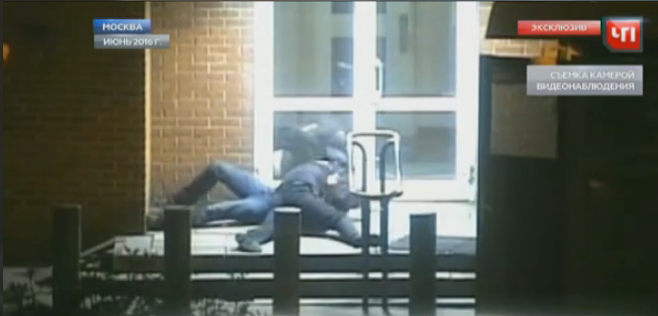
In June , another high -profile incident occurred: an American citizen was laid down on Earth by a Russian guard at the entrance to the US Embassy in Moscow. The State Department said that we are talking about an accredited diplomat who showed the guard a certificate in accordance with the established procedure.
However, representatives of the Ministry of Foreign Affairs of the Russian Federation said that the FSB officer who guarded the embassy was just fulfilling his duty, because he tried to prevent the embassy of a suspicious person who, according to them, hid the person.
Subsequently, the Russian side said that it was an employee of the CIA, working under a diplomatic cover. Such practice is common in many countries, including in Russia and the USA.
The video recording of this incident from outdoor surveillance cameras was shown on Russian television .
As a result, Moscow and Washington sent two accredited diplomats on each side. Such mutual exiles were characteristic of the Cold War.
American officials stated that for several weeks after the incident at the embassy, the traffic police officers repeatedly stopped American diplomats, although in Moscow, as a rule, they look through minor violations of cars with diplomatic numbers through their fingers.
In June, against the backdrop of the US protest regarding the unacceptable handling of American diplomats in Russia, Moscow complained about the pressure that Russian diplomats experience in the United States. The representative of the Russian Foreign Ministry, Maria Zakharova, said that Russia was simply taking response - and warned that the situation could be complicated.
"Our diplomats regularly encounter provocations by the FBI and the CIA, which do not disdain to apply unacceptable measures to them, including psychological pressure even in the presence of their families," Zakharova said on June 28 at a briefing in Moscow.
"The principle of reciprocity is in abuse. A worsening relationship with the Russian Federation, Washington himself complicates the life of his diplomats abroad," she added.