
Translated material
Ideal people
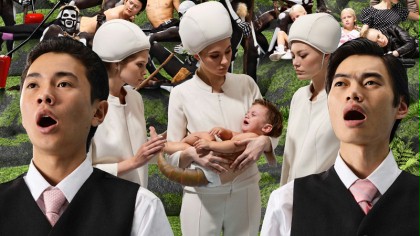
AES+F shoots somnambulic films, bright and painful, like severe clinical euphoria. For the first time I saw these video works in the Russian pavilion at the Venetian Biennale, then in the collection of the famous Munich museum, Ingvwill Getz. Video art is located between home videos, artistic action documentation and art house. The works of aes are a bewitching spectacle, but their video installations are much smarter than cinema. Here we are talking about the stream of modernity and the future, which was washing our spiritual existence: about money and about luxury, about slaves and gentlemen, about violence and consumerism, about the thirst for happiness, about the wandering and changing identities, about the peoples and their role -playing inclusion in the world of global policy. As at one time, the director of Godfri Reginio, who made the film “Coyaniskatsi”, aesy tells us about the global, from which, however, lively fetid nature and everyday problems are completely excluded. Their characters live in a sterile plastic world in which the glass sea flows. And they themselves are mostly forever young, beautiful and sterile, and as in the next world - completely immortal, that is, ideal people, as if hatching from a plastic egg.
About the Berlin exhibition and about the video trilogy AES+F, Lev Evzovich says.
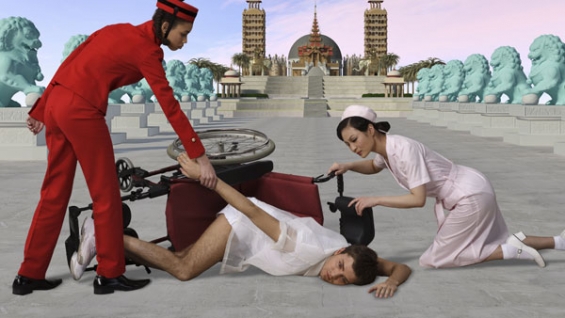
- Why are these transition states? Transitional from what where?
- This is an obscure state in which we are now personally and there is a situation in the world.
- The state of society is unclear, no one knows where to go, where to go, what ideologies ...
- Everything that has been listed, plus such psychological ambiguity that we all want to go into a new state, but we do not know and cannot formulate what it is and what are the methods of transition.
- That is, we are on the verge of a new world, where we are not letting us yet?
- Or we already live in the new world, but we do not understand that we live in it, but continue the old rituals.
- We live in a certain future that has come, but as in The Others, where dead people do not understand that ...
- ... that they died. That's absolutely - yes. Surely we live in the new world ...
-... But we still count on the old one. Another important point: what is the novelty of the work itself? Maybe because it is connected with the medial?
-Firstly, we absolutely never claimed novelty, and the fact that this is connected with the medial is unconditionally. It is not very important for us how what we do is determined. This is free from the definitions inside the art system, that is, there may be media, although it is in art instance, maybe this is modern art. It seems to me that this is not so important. The transfer of the state that is currently existing is important.
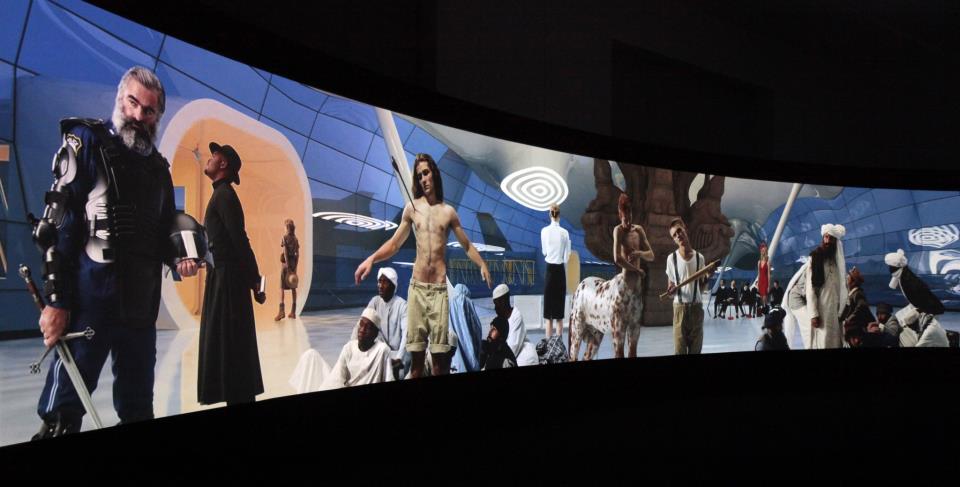
- When I watched your projects, I had the feeling that there was some connection with the texts of Sorokin, in any case, with the novel “Small”.
- I don’t see this at all, although I love Sorokin, but this is a parallel world for us. On the other hand, why not? We meet a variety of associations. It seems to me that it is more important to start the associations of the associations, and if Sorokin is remembered, then why not.
- You are loved and known in the West. How can you explain this what happened, what a miracle?
- I can’t explain this, this should explain critics.
-Many amazing works go unnoticed, and then something is completely incredible. Did it surprise you?
Russia is now different from the cultural context of the whole world. The whole world is now neurotically addressed to the future, and this is the only culture that is neurotically facing the past.
- When a moment of success happens - this is always a special atmosphere, it is really amazing. As it was, for example, on the Venetian or on the Sydney Biennale, when something more suddenly begins than just an institutional exhibition. As for the problem of Russian and Western, it seems to me that this is just not our problem. Russia is now an amazing territory, it differs from the cultural context of the whole world. This is the only culture that is neurotically facing the past. The whole world is now neurotically converted exclusively to the future. The idea of the future, not postmodernism, but neo -motor, the thirst for the future is present in the West, in China, and in India, all this is painfully worried. Russian culture-and politics, by the way, still discusses Ivan the Terrible, Stalin, this endless problem of Russian and Western, which is solved at the household level, at the level of open boundaries.
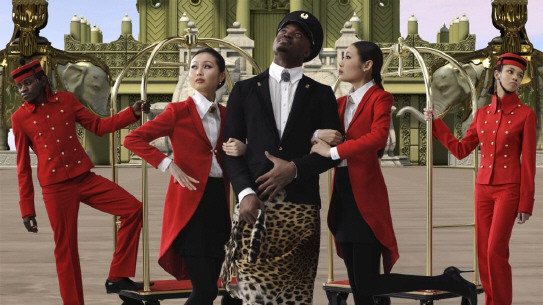
- You had work related to Islam, and for your time quite radical.
- We are not trying to be deliberately radical. Islamic work, since they were done before September 11, were censored, by the way, not in Russia, but in England. And there were a number of scandals. But now this is a story. Work with an Islamized German Reichstag even entered the German textbook for higher education.
- New ideas will be carried out in Moscow, in the West, or borders simply do not exist?
- The boundaries of production clearly does not exist. For example, we are doing sculptural projects in Spain, just there is such a plant, and the video and post -production shootings were made traditionally in Moscow. But it is possible that we will now shoot in Berlin.