
Translated material
Schedule for April
Schedule of events involving the "memorial" for April
April 8 19:00
Showing the film "Secret Path " of Dr. Zhivago - on the export of the manuscript of Roman Boris Pasternak from the USSR and the first publication (1957) by the Italian publisher Dzhanjakomo Feltrinelli.
The master of documentary Gerold Hofmann reproduces the dramatic story of the export from the USSR by the manuscript of the novel "Dr. Zhivago" by Italian journalist Sergio d'angelo and the publication of the first edition by the Italian publisher Dzhanjakomo Feltrinelli.
The film show will be held as part of the exhibition “Forty photos from the collection of Yevgeny Borisovich Pasternak”: the best pictures from the family archive, different years and various authorship. The exhibition works in the light of the anniversary year, the 125th anniversary of Boris Pasternak.
You can see the exposition until June 15, 2015 inclusive on the ground floor of the “Memorial” office (Moscow, Karetny Ryad, 5/10) from Tuesday to Saturday from 11 to 19 hours.
April 9 19:00
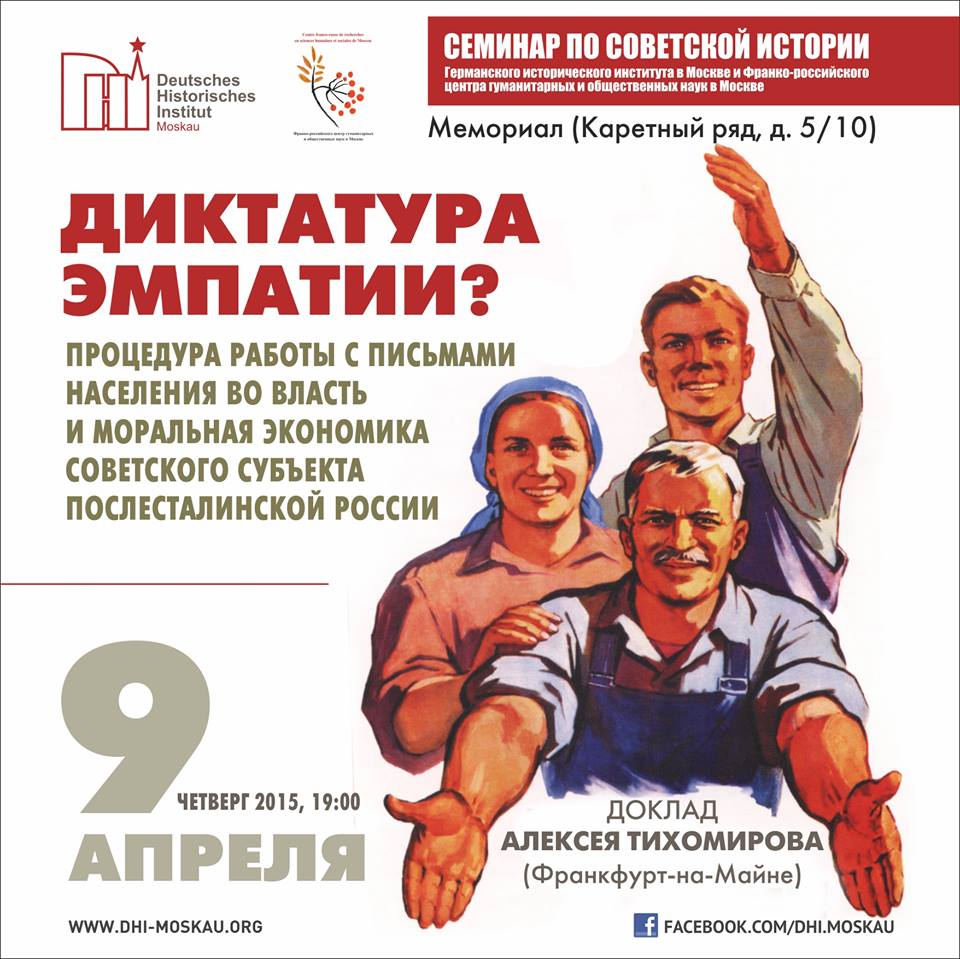
Report of historian Alexei Tikhomirov “The dictatorship of empathy? The procedure for working with letters of the population into the power and moral economy of the Soviet subject in post -war, post -Stalin Russia. ”
About five percent of the population applied to party and state authorities with complaints, proposals and statements. However, thanks to the media, the effect of written appeals to power touched the life of millions of Soviet citizens and determined the work of the entire party-state apparatus. In the report, attention will be focused on the role of letters in the power and the procedure for consideration in the corridors of the authorities as a central key to analyze the formation of the post -Stalin identity of the Soviet subject and strengthening the legitimacy of Soviet statehood in the era of Khrushchev and Brezhnev.
In this case, it is proposed to understand the form of a social contract with the authorities and the emotional regime, in which, on the one hand, the state announced its readiness and duties to react to the needs, problems and emotions of Soviet citizens, and, on the other hand, the population, more and more confidently appealed to the right to demand concern from the state and the party.
Report "Empathy dictatorship? The procedure for working with letters of the population to the power and moral economy of the Soviet subject in the post-war, post-stalinsky Russia ”as part of the seminar in Soviet history of the German Historical Institute in Moscow and the Franco-Russian Center for Humanitarian and Public Sciences.
Society Memorial , Karetny Ryad street, 5/10 Moscow
April 10 15:00
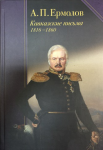
Presentation of the book "Caucasian I letter 1816-1860" Alexei Petrovich Ermolov (St. Petersburg: LLC "Magazine" Zvezda ", 2014).
"Caucasian letters" by Alexei Petrovich Ermolov (830 pp. Comment, signs) - a unique monument of Russian epistolary culture. 500 letters sent from the Caucasus and to the Caucasus from 1816 to 1860. They represent a bright and saturated picture of life not only by the Caucasus of the period of dominion there Yermolov, but also of the St. Petersburg military and state elite. Both the uniqueness of the personality of Ermolov, and his aspirations are clearly reflected in the letters proposed to the reader. Many of the letters are published for the first time, and those. What were published in the X1x century with censorship passes and errors are checked by originals and presented in their original form. "Caucasian letters" is a precious contribution to the database of sources that enable researchers to more deeply understand the nature of the era of the first half of the 19th century.
Alexey Petrovich Ermolov was one of the most brilliant and mysterious characters among the military and statesmen of Russia. Among his colleagues, he stood out sharply “unlimited ambition” and grandiose plans.
Having become a mythological hero even during the Napoleonic Wars, Yermolov dreamed of following his idols - Caesar and Alexander Macedonian - having pacified the Caucasus, crush the Persia and break out into the vast expanses of Asia to the northern borders of India.
Both the uniqueness of the personality of Ermolov, and his aspirations are clearly reflected in the letters proposed to the reader.
500 letters sent from the Caucasus and the Caucasus from 1816 to 1860 represent a bright picture of the life of not only the Caucasus of the period of dominion there, but also the St. Petersburg military and state elite. The set of letters is read as an autobiographical novel: Ermolov possessed an extraordinary literary gift. Ermolov sent all the letters addressed to his friends with trusted traders or with his close officers, so he could be completely frank.
Many of the letters that are relevant today are published for the first time, and those that were published in the nineteenth century with censorship passes and errors were checked by originals and presented in its original form.
The presentation will be attended by the compilers of Tom-Vice-Rector of the European University in St. Petersburg Galina Lisitsyn, historian Boris Milovidov and the responsible editor of the publication Yakov Gordin.
Entrance by invitation (Natalya Petrova: +7 967 271 41 71). Society Memorial, Karetny Ryad street, 5/10 Moscow
April 14 17:00
Round table "Forms of project and extracurricular work on the history of Russia of the twentieth century"
As part of the meeting, the forms of project and extracurricular work conducted in schools - summer expeditions, research projects, participation in school museums, Moscow, conducting scientific lectures, etc., as well as the possibilities of the international memorial to help teachers in organizing class and extracurricular work with schoolchildren will be discussed.
April 15, 19:00
The film "In search of lost mail" (as part of the International Documentary Festival)
In search of lost "mail" documentary (2 series of 52 minutes). Studio "Master-Film", 2014. Scriptwriters: Nikolai Dovlov, Sergey Kaperev director: Dmitry Zolotov Operator: Valery Ryabin Producer: Alexander Gerasimov about one of the first domestic sound cartoons, innovative film adaptation of the famous poem by Samuel Marshak, and his author, classics of domestic animation Mikhail Zaskhanovsky. Unfortunately, the sound “mail” was lost at some stage of the history of cinema, becoming the desired object of cinema search. And therefore, our story is also about how exciting the search for lost films is and how interesting those people who help to return the lost cinema.
April 16 19:00
Jay Winter. "The memory of the First World War 100 years later: a transnational approach"
Jay Winter - Professor of Yale University, specializes in the history of the First World War and its influence on the history of the twentieth century. The transnational story is a story written by “transnational” historians, a group of scientists who got the benefits of the distribution of higher education in the world in the period 1960-1990, those who were born in one country, received an education in another, and teaches in the third. These historians created a new history of the world war of 1914 - 1918, not tied to national borders. This principle formed the basis of the three -volume of the Cambridge History of the First World War, which was edited by Professor Winter. Scientists who adhere to the principle of “transnational history” have contributed to the popularization of Memory Studies, presenting their research prospect in public history projects. Professor Winter talks about one of these projects -the creation of Historial de La Grande Guerre, the Museum of the First World War of 1914-1918 in the French Peronne.
April 18 13:00
A multiplier charitable breakfast with the director, screenwriter, artist of animated cinema Svetlana Filippova
A multiplier charitable breakfast with the director, screenwriter, artist of animated cinema, Svetlana Filippova (the Center for Adaptation and Education of Refugees of Refugees (“Civil Assisting”), Svetlana Filippova along with animation, is engaged in painting, easel and book graphics, lithography. One of her most famous works is illustrations for the tales of Lyudmila Ulitsky. The prizes of the international festivals for the animated films “The Night”, “The Tale of Sarah”, “Three Love Stories”. It is very difficult to accompany Jews to the death camps, because “he treats all people's confidence” ... Pavel Swedov will be a conversation - a journalist, senior researcher at the Museum of Cinema, organizer of a number of animated exhibitions.
All month
Exhibition "Right of correspondence" (daily from 11 to 19.00 except Mon and Sun). The exhibition is open until May 2. Society Memorial, Karetny Ryad street, Moscow.