
Translated material
American immigrant
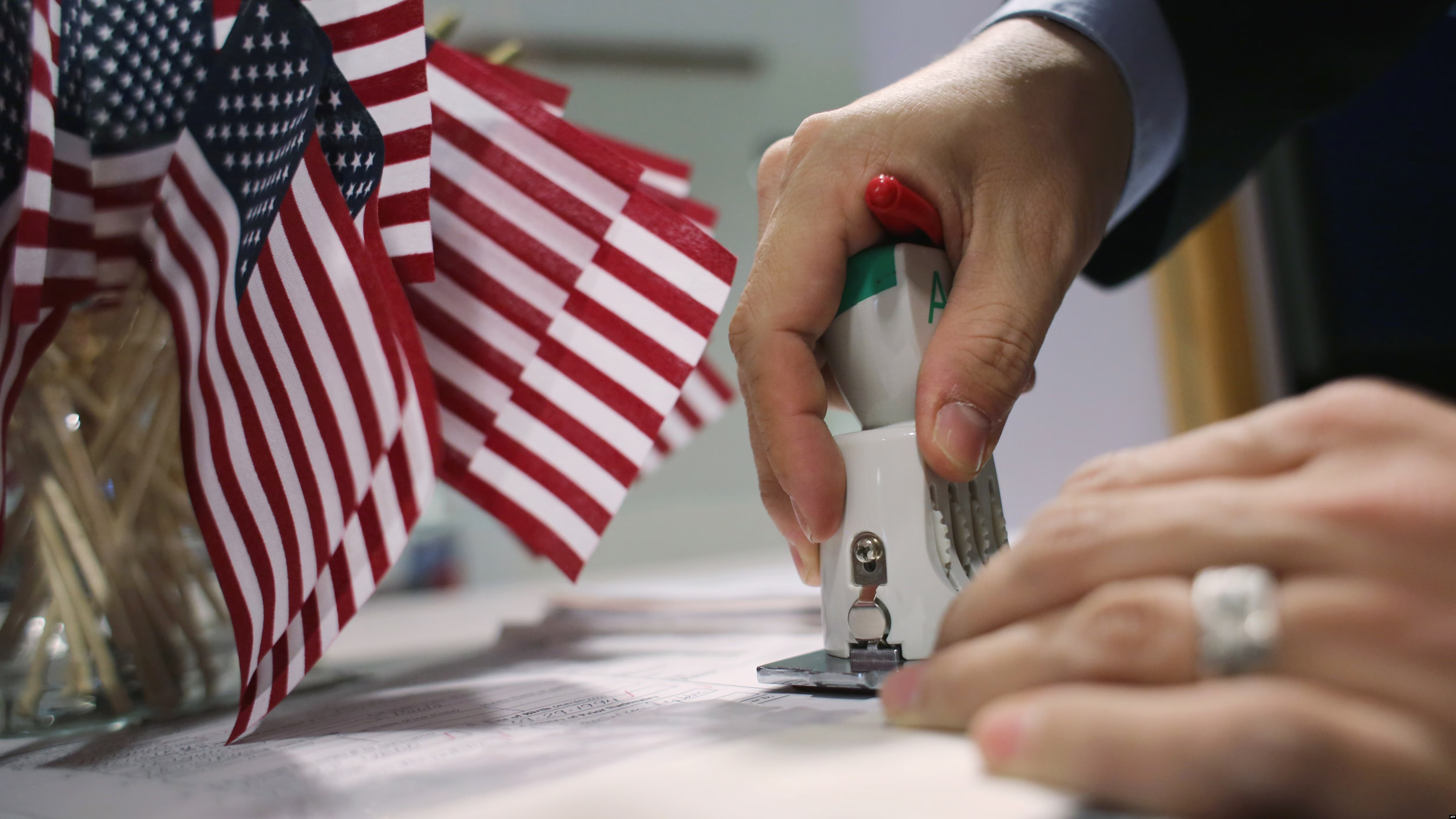
America knows that she is a nation of immigrants, but every now and then forgets about it.
Throughout its history, America needed labor, and on a huge scale. But to say how they like to say now that she was hospitable for immigrants is to sin strongly against the truth.
This amazing fear of the nation of immigrants before immigration and that in fact, America, in order to remain himself, is vital immigration - in economic, political and all other meanings, we spoke in the podcast of “American issues” with Radio Liberty observers Brian Witmore and Valentin Baryshnikov.

But for a conversation about the role of immigration for America, a historical context is needed.
In the first decades of the XVII century, a stream of immigrants from the Old World acquired a stable character. Most of them had in hand the bond contracts, according to the terms of which they worked out the cost of fare and content usually for 3-7 years. Such a migrant was called Indentured Servant - “Located Worker”. In the same period, mass import of slaves from Africa began.
In different periods of its history and for various reasons, the United States tried to limit the influx of undesirable immigrants. Even in the presidency of John Adams (1797–1801), acts of foreigners and incitement to rebellion were adopted. These laws authorized the president to imprison or send subjects of states with which the United States is at war.
The law on naturalization, which for the first time introduced restrictions on the right to US citizenship, was adopted in 1790. In 1795, the qualification of the sedimentation was increased from 2 to 5 years, in 1798 to 14, but in 1809 this last act was canceled. In 1868, the law on the promotion of immigration was canceled, in 1875 and 1882 the first acts on its restriction were adopted, and in 1885 a law prohibiting the import of contracted workers was adopted.
In 1894, a league was established in the United States to restrict immigration, which was the goal of "the exclusion of elements undesirable for citizenship and contradicting our national character." A supporter of the restriction of immigration was Theodor Roosevelt, who claimed that immigration from Italy, Austria and Russia "comes from the most undesirable segments of the population." The 1903 law banned the entry of prostitutes, anarchists and other persons who believe that the US government or any other government should be overthrown by the use of force. " The law for the first time allowed forced deportation of illegal immigrants, and as a preventive measure, it provided for the inspection of courts by American inspectors in European ports. In 1906, a new law on naturalization was adopted, which significantly complicated the procedure for obtaining citizenship. Finally, in 1917, Congress overcame the veto of President Wilson and introduced the law on literacy for immigrants.
The so-called "new immigration" began in the 80s of the XIX century and continues to this day. The peculiarity of the new immigration of the period before the First World War is a high percentage of natives of Austria-Hungary, Russia and Turkey, as well as Italians and Greeks. Already in 1900, nee Americans amounted to less than half of the working class. In 1905, the number of immigrants entered the United States for one year for the first time exceeded 1 million people. The working conditions have changed for the worst, but the new immigrants brought with them the experience of class struggle and radical social ideas. It is to immigrants that Americans owe to achievements in the field of labor law: legalization of trade unions, 8-hour working days, the right to strike.
In the story of 1895, Vladimir Korolenko tells about how, after different adventures, peasants from Volyn are arranged in America. Even before leaving Europe in Hamburg, they meet a countryman-Kabatchik who explains to future immigrants: “A large ship is coming soon, and in the third grade a lot of people from Sweden and Denmark are sent to the servants in America. Because, they say, the Americans are free and proud people, and it is difficult to find servants from them. Young Danes and Swedes earn a good dowry there a year or two. ”
Well, how were immigrants from Russia actually arranged behind the ocean?
In the first 13 years of the XX century, 165 thousand Russians, Ukrainians and Belarusians entered America, and only 5.3 percent had a “capital” of $ 50 or more - the rest of the profit with an empty pocket. Their path lay on industrial enterprises - coal mines, steel shops, logging, construction, at best - to automobile and electrical plants. Labor was paid in the United States much better than in Russia: the average monthly earnings of a laborer in the United States in rubles was 71 rubles, and in Russia - 15 rubles, a mason - 205 and 50, carpenter, respectively, 150 and 50 rubles. But working conditions were extremely difficult. “Although we are paid here for labor here than in our homeland,” wrote the worker Mikhail Solovyov in the American Russian -speaking newspaper New Time in March 1914, “but in America the works are very difficult, dangerous and take our whole strength and health.”
American statistics noted a high level of literacy among Russian workers. In places of compact residence, Russian schools, libraries opened, their doctors and small businessmen appeared. By the beginning of the First World War, about half of the Russian immigrants owned conversational English. The savings of Russian immigrants by the beginning of the war were expressed by such a large amount that the Russian government, wanting to replenish its foreign exchange reserves, opened branches of the State Savings Bank in Russian consulates in the United States.
Restrictive measures ultimately led to a reduction in immigration, but to its transformation from legal into illegal - these are communicating vessels. The smuggling of people in the United States has turned into a profitable business. Illegals have been working on their “debt” for years on orange plantations and underground diagrams according to the sewing of the finished dress. But having paid for the “benefactor”, illegal immigrant does not become a free person. He has no right to live and work in America and therefore leads a semi -legal lifestyle. He often lives under a stranger, according to a fake identity certificate and avoids meetings with the police even as a victim.
Immigration authorities turn a blind eye to the presence of these people in the country - not only because they are not ready for political costs of mass deportations, but also because the American economy can no longer do without them. There is only one way out - legalize them. The last immigration amnesty was held in 1986 by President Reagan. Then the legal status was received by people who illegally entering the country until 1972 - six million people were gaining such. Since then, 12, or even all 20 million illegal immigrants have appeared in the United States.
George Bush Jr. promised to deal with the problem during his presidential campaign. On July 10, 2001, he promised to radically reform the immigration and naturalization service in order to facilitate and reduce the procedure for obtaining American citizenship. But exactly two months later, the planes captured by terrorists rammed the towers of the World Trade Center and the Pentagon building. The immigration and naturalization service lost its independence and became part of the newly established Ministry of Internal Security. Instead of simplifying the naturalization procedure, its complication occurred. Entering the country by a tourist and it became difficult.
The American Tourism Industry, which had suffered heavy losses due to covering the large chiefs of xenophobia, was the first to crouch. American clinics missed patients, universities - students.
Four years later, the president introduced his own version of immigration reform to Congress. It was not a project of amnesty, but he gave illegal hope for legalization. The President’s single -party people, who were then in the majority, met Bush's project in bayonets. The Republican James Sensennbrenner introduced and conducted a bill through the House of Representatives of representatives, which provides for criminal liability not only for employers hiring illegal immigrants, but also for employees of charitable organizations providing them with humanitarian assistance.
I perfectly remember the hearing on immigration reform in the Senate. On behalf of the government, the answer was held by the Minister of Labor, Helen Chao and the Minister of Internal Security, Michael Chertoff, both - Americans in the first generation (she was born in China, he is in Israel). The chaired Senator Arlen Speter, whose grandfathers and grandmothers on both lines were immigrants from the Russian Empire. And the main opponent of the immigration amnesty was an expert named Mark Krikoryan, whose name says that he is also unlikely to a descendant of pilgrim fathers.
But the main events took place on the streets of American cities at the end of April and especially on May 1, 2006. They were flooded by the human sea: illegal immigrants for the first time overcame their fear and went to demonstrations of protest with their compatriots - legal immigrants. The Catholic clergy actively supported its flock. Cardinal Roger Mahoni from Los Angeles said that he was ready to go to the ultrasound, but would not stop helping illegal immigrants ...
It was an impressive sight. Such primary in America is not remembered. Then it turned out that only a tenth of illegal immigrants took to the streets. The time when they sat quieter than the water below the grass was over. Mass speeches for fair reform acquired the scale and scope of the civil rights movement of the middle of the last century.
But even more eloquent were the results of the elections in November 2012. Latin-American voters voted for the Democrats in the vast majority. Immigration reform is really riveted.