
Translated material
Lecture in secular format
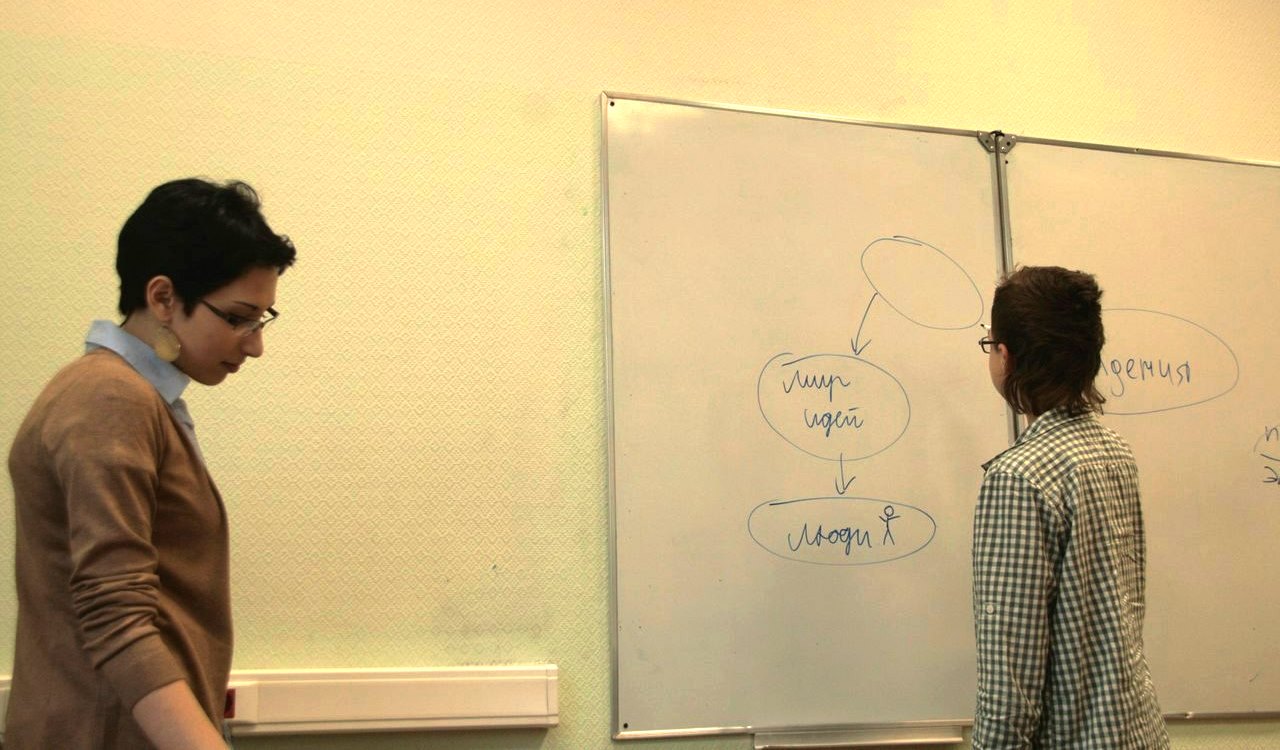
While Russian applicants still prefer humanitarian universities, and students do not even think about studying in graduate school, not considering science as a sphere of successful activity, more and more adults come to public lectures related to science.
In addition, over the past few years, not only the number of sites on which certain knowledge from an authoritative scientist has increased, but the number of organizers of such events has grown-from 100 in 2009 to 2000. In turn, the popularity of public lectures has led to the creation of various Internet projects, mainly the scientific and technical direction.
True, all these resources in Russia are in no way connected with the system of higher education. Perhaps because the traditional format of university teaching does not withstand the test of publicity.
What topics are attracted by voluntary listeners of Radio “Freedom” by the editor-in-chief, founder of the posttnouka publishing house Ivar Maksutov and director, founder of the Internet portal “theory and practice” Askar Ramazanov .
Ivar Maksutov , "Postnuka" :
- A classic lecture in the minds of most people is an hour and a half, when some uncle is not very clear and not very interesting in the ears slander something. But a lecture is a complex genre, and has many different forms. For example, Ted's classic lectures that last 12 minutes, tiny in time. An ordinary public lecture is not more than 40-50 minutes, because further the threshold of attention is rapidly reduced. And in antiquity, the classical lecture could last hours.
In fact, a very important problem arises here: there is an education, but there is an enlightenment, and when these two things are mixed, cadavers arise that give rise to different questions: how to combine work with study, for example. But the problem of combining work with study is that a person no longer needs it. He is trying to shove a certain amount of knowledge that he does not need professionally, he receives a formal crust, but at the same time thinks that, probably, he needs to go to a lecture, find out something, and so on.
In fact, acting in this way, he is professionally deformed, and he receives education in a completely different place, where he works - in an advertising agency, in the architectural bureau, somewhere else. And if you take a traditional educational standard - there are 60 percent of the general educational component. That is, if you are preparing a specialist architect, then it has only 40 percent - professional disciplines, and 60 percent are common, which have nothing to do with its professional formation. Therefore, educational and educational lectures must be separated.
I really do not like all these MassiveopenonlineCourses. In the mass online courses there is an assessment system, and this is our fundamental difference. MOOS gives the illusion that you get an education, they introduce a system of tests, verification work, and so on. We have no task - to form professional specialists. We are engaged in education, not education in the classical sense, but we use similar technologies.
Last week at the EDCRUNCH conference, Anant Agarval, President of EDX, the project that launched MIT Harvard, and he told how much the video they eventually came. The most effective was a 6-minute video. That is, even shorter than ours. We have 12-15 minutes.
Clip thinking is a natural neurophysiological process in the history of culture, so we do not perceive long narratives
We call these short, 15-minute stories lectures. And when we discuss with the authors, we explain that these are lectures, in a monologue format, they are just shorter. We work primarily on the Internet, although our video is also bought for a television show, people use it in different offline formats. But 15 minutes of looking at the Internet - this is a lot! Make people 15 minutes in the format of a monologue to listen to the story about some kind of very exciting story is not an easy task.
Clip thinking is a natural process in the history of culture, neurophysiological, so today we do not perceive long narratives. People who lived during the time of Moses could remember huge oral texts, and all of the folklore are large oral narratives that knew and conveyed. But the size of this narrative was reduced as we learned to store information. If we know that access to information, relatively speaking, two clicks, then why should we store it for so long?
Even if you give a one and a half hour lecture, in fact, if you are an effective lecturer, you tell 9 stories of 10 minutes or better than 18 stories of 5 minutes each. Because if your listener turned off in a conditionally 20th minute, he simply did not have enough memory, he switched, then when he returned, and you continue to tell the story, he did not listen to you for three minutes and the context can no longer restore. Therefore, all effective lecturers tell short stories.
The task of such as "postnasta", resources dealing with scientific knowledge, is to help prolong. As before scientific journalists, since it often happens that the journalist does not retell incorrectly, invades the flesh of a scientific story instead of helping the scientist to convey information to readers, spectators, listeners. And scientists are ready, they only need to help a little. And how they look ... sometimes even better if they are not very combed, cut, powder and so on, because pure science is such.
It is necessary to teach how to tell you, but the story of the scientist in a simple language about what he has been doing for decades destroys all the charm of science. Talking about the complex is a terrible oxymoron, and the task from which people should be released. Because the world and science are complex, and you need to instill a taste for complexity. And we had no problems with the authors. If the scientist knows and understands that you do your content with love that you want to help him tell him what he is doing and convey it to the maximum number of people, he is always ready for cooperation.
Another thing is that universities, scientific institutions have always been sources for such public activity, but not in Russia. In Europe and the States, there are many universities that arrange public lectures for a large audience. The same MOOS-today it is a platform where people get an education, but they arose from the lectures that the universities recorded, at first on the cassettes, they were quite primitive, but then they seemed incredible. Then these lectures were digitized, posted on the Internet, then they began to specially write down. And in Russia, universities did not participate in this wave at all!
Askar Ramazanov , "theories and practice" :
- In 2009, we launched the first version of the “theory and practice”, and this was the schedule of all the lectures that were held in the city and were in general access. Our current format was found in a practical way, since for almost a year we simply made seminars.
On the one hand, professional interest has formed. We, groups of people, had a lack of some knowledge. And the second, our friends came, who talked about something that we do not know about our hobby, for example. For example, Vasily Kuibar, there is such a vision, he knows everything about the clock. And at some point we realized that different events were taking place in the city, someone came, someone was spending huge resources to bring someone, and no one knows anything about it. Therefore, we have made a site with pictures where we write a lecture schedule in a popular media language.
At that time, we often said that there are hermetic universities, institutions, all knowledge in them sits and is not available to anyone, but there are organizers who hold the event available to people. And I must say that since 2009, by the end of the past, their number has increased by 20 times.
the future for a practice-oriented education, when a person studies in the process
Gradually managed to introduce lectures into the secular format. And fashion began - everyone began to give lectures. If earlier exhibitions were held without lectures, now it is necessary with lectures. In our first version of the site, there was not even the word “lecture”, there was simply a rubricator of them: “art”, “science”, “business”, “design”, “architecture”, and something else. And the "science" was then with zero, since the Polytechnic Museum has not yet been updated. We looked at this zero for several months and realized that we had to do something about it. And then we talked with Maria Shutovo, and she helped to make a cycle of lectures "Brain and Behavior." She talked with the editors of scientific journals, and they explained that it is most interesting to find out for the general public about what is happening in our head. There were different lectures, about 10, something about mice, about dolphins, with completely fantastic slides, sounds ... The cycle was very interesting, it collected 500-600 people in small audiences, and thus we painted the number in the “Science” section. Now there are a lot of scientific events, many other formats have appeared, but then Anokhin gave almost the first public lecture, and it was quite difficult for him.
When we started, we actively used the approach, when the organizer could move around the city, give lectures in various accessible places convenient for people. Now there are many such sites. For example, we are on the central telegraph. In the summer, a lot of interesting things happen on the arrow. These are specially prepared places where you can collect a large audience. There were up to 1.5 thousand people on the arrow at the Polytechnic lectures.
But, of course, everything evolves. And a year ago, we launched a service that allows not only organizations, institutions, but also ordinary people to report their educational events. And, having launched it, we received many applied master classes. And they had more than one festival when we drive out 50 master classes on different topics during the day. Such a format is very popular: people come, see at the same time 5-6 master classes, turn on, spend two hours there, participate in at least three applied master classes, completely different. I believe that in general this is good: interests begin to mix, some narrow things become more noticeable and popular, including from the scientific field.
In fact, applied formats are now enjoyed. There is the so -called “pyramid of training”, respectively, at its top - a lecture format, consistent perception of information, further - audiovisual, when you see a demonstration and perception slightly wider, then when you try yourself and the most wide level of assimilation and learning - this is when you learned and learn another, the maximum degree. Maybe the popularity of lectures is declining, master classes, some other format will become more popular, and then, perhaps, the audience will somehow change.
But still in the lectures there will be a need, simply in order to expand the horizons, without losing its specialization. In my opinion, in general, the future is for a practical-oriented education when a person studies in the process. Apple calls this "T-shaped specialization", that is, "stick"- professional knowledge plus a wide horizons, and one does not work without the other.
On the website of “Theory and Practice” there are statistics of almost every Moscow and St. Petersburg University, how many events were published there, how many lecturers are involved, how many materials are written around this, how many courses, various grants, competitions and more are loaded. And according to this statistics, it is clear which of the universities behaves openly. Oddly enough, scientific and technical universities have big problems with this. It is clear that the humanities have more than those that can be taken to the public in a debate form, but scientific and technical universities also have something to present. Moreover, the applicants then have more communications, that is, it works for the prestige of the university is real, but why it is not used - a riddle.