Translated material
Putin and the people
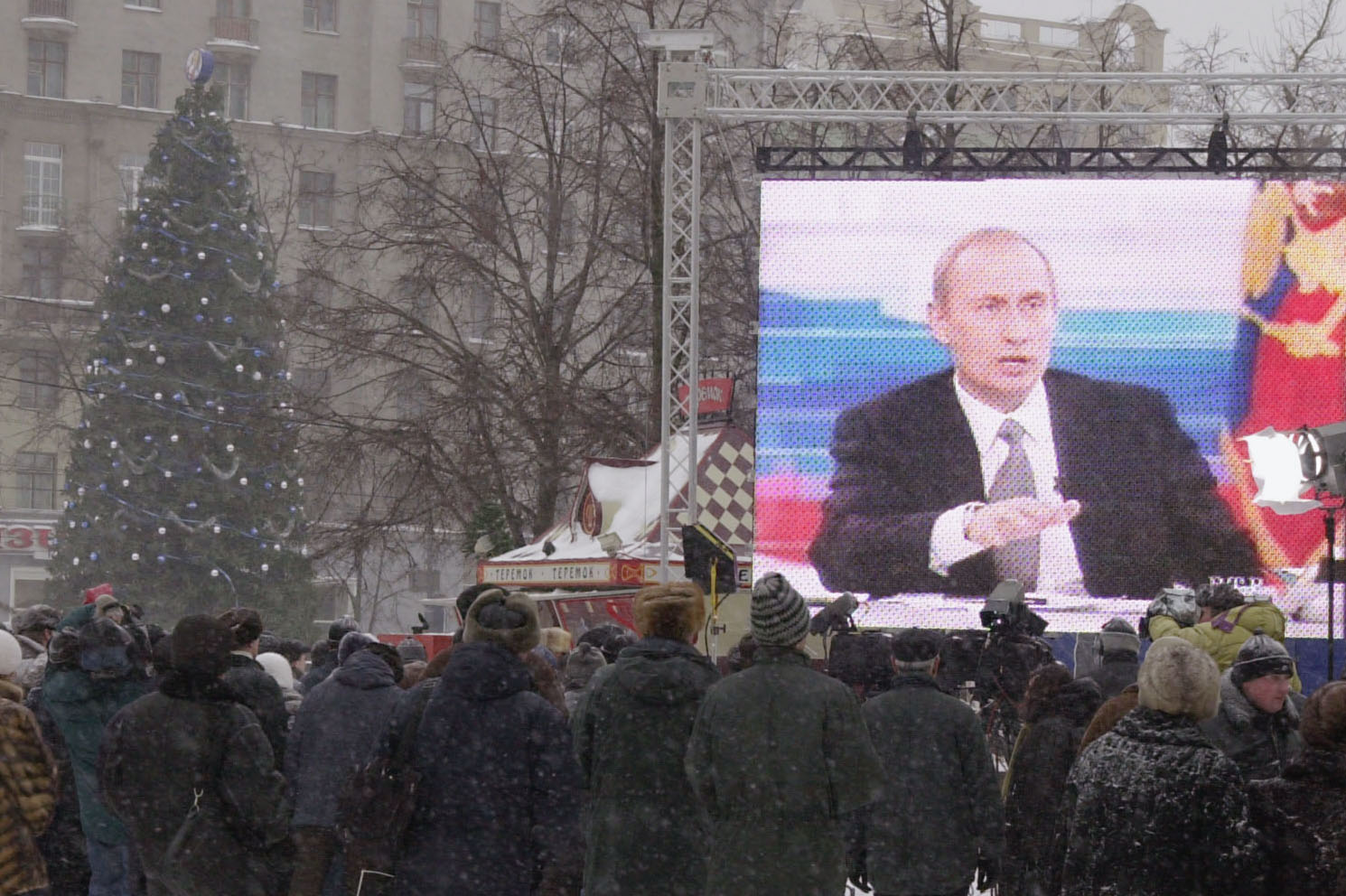
What is the power of the Russian president based on? Discuss Alexander Arkhipov, Sam Green and Ilya Yablokov
- The current Russian government stands not only on violence and coercion, but also on the obvious support of millions of residents of the country.
- In many ways, public opinion, on which Putin is based, is kept thanks to a powerful and aggressive state propaganda machine.
- On the other hand, even before Putin arrived in Russia, there was a request for a certain image of a strong ruler, created by the Russian archaic consciousness.
Sergey Medvedev: "Each nation has the government that deserves," as Joseph de Mestr said. Did Russia deserve Putin’s power? After all, it is obvious that the current regime is kept not only on bayonets and propaganda, but also on mass folk support. What are the economic, emotional, even folklore roots of the support of Vladimir Putin? Who is he in the popular consciousness, does it embody Russia, its society, politics and history?
Video version of the program
President’s non -alternativeness forces to adapt to the current regime
Correspondent: According to the Levada Center (the organization was forcibly recognized as a “foreign agent”), 41% of Russians do not want to see Putin in power after 2024, 20% believe that the president has been sitting, and only 8% want his change due to corruption. But many still do not see the alternatives to Putin. The president’s power is based on the conservative majority-state employees, pensioners, workers of the military-industrial industry and security forces.
In general, the public opinion on which Putin is based on is kept thanks to a powerful and aggressive state propaganda machine. Many experts note that most people are simply not interested in politics and are trying in every possible way to circumvent acute issues, so this attitude is built on indifference and alienation. And the president’s non -alternativeness forces to adapt to the current regime. However, now it becomes clear to many that after pension reform and zeroing, the hope that Putin will lead the country out of a worsening economic situation melting before our eyes.
Sergey Medvedev: In our studio, Alexander Arkhipov , an anthropologist, senior researcher at the steps of Ion Ranchih .
Yesterday in Auchan I heard conversations: prices will rise, and you need to take more sugar. But one elderly woman said: "Putin promised that until September 1 there would be no rise in sugar prices." And people dispersed in relief. Is this really Putin’s place in the public consciousness - such a support of the world order, such a heavenly king that commands sugar prices?
Alexandra Arkhipov: Russians are accustomed to instability. In such a crazy world, I want to have some kind of support point, and this point of the support, as it were, are the words of Vladimir Vladimirovich.
Sergey Medvedev: Is there any basic trust-is the pension reform and other unfulfilled promises are forgotten?
In a crazy unstable world, I want to have some kind of support point, and Putin's words become it
Alexandra Arkhipova: Everything is not so flat. Recently, in Rostov-on-Don, educated people who teach at the university told us: yes, there is a complete disgrace in the country, but Putin does not know about it, they don’t tell him about it. While this matrix makes the world clear and comfortable, it will exist.
Sergey Medvedev: Recently, the Publishing House "Corps" has published the book of Sam Green and Graham Robertson "Who is the power? Citizens, the state and the struggle for Russia." Sam Green , Director of the Institute of Russia at the London Royal College , joins us.
I was interested in your concept of goodwill: people are positively, kindly related to power. Is this another name for conformism?
Sam Green: I will argue with the thesis that the Russians are conformists. The idea of goodwill does not belong to us. This is part of a large design of personal psychology, which is spinning around the main factors of personality development, of which goodwill is just one. If you look at the Western democratic experience, it turns out that people who are more conscientious and conscious are clinging to the rules and legality, more often vote for conservatives. And people, more open to new experience, often vote for more progressive, if not left -wing parties.
We decided to measure this in Russia and saw that the classic American and European experience does not work here, and just a factor of goodwill works, which is associated with a person’s desire to have an even, calm social attitude with his environment.
Sergey Medvedev: This is about the same thing that Sasha is talking about, the feeling of the norm: everyone trusts Putin, and I am part of this universally recognized norm, that is, Putin as a world order.
Sam Green: Putin as a social core of all economic life. This is a pure symbol, in isolation from any economic expectations. And looking at economic expectations, we see that people are at least rhetorically and hope for something from above, but they do not expect it, but build their lives based on those resources that are close.
Everyone trusts Putin, and I am part of this universally recognized norm
Sergey Medvedev: Sasha, this place is Putin as the basis of the world order - this is about the same as Stalin or that Kim Jong -un now occupies in Korea: the sun rises thanks to Putin, the summer replaces the winter, is celebrated on May 9? Such an archaic, mythological world order, in the center of which is a Russian epic white king.
Alexandra Arkhipov: Yes, and no. Still, people in Russia are trying to distance themselves from power, but at the same time sometimes keep in touch with the sacred center.
Here are the last presidential election. Putin performs in Luzhniki, and crowds of people take phones and begin to take pictures hysterically. Why? This photograph proves that you were with him in the same space. This is a very important feature of Russians: on the one hand, the desire to feel this norm, and on the other, a feeling of isolation from power.
When we go on an expedition to the village, they sometimes begin to transfer messages to Putin there, because it is also a way to feel some connection, and not even because Putin will somehow solve these problems.
There are sites where people talk about dreams with Putin. For example, "I'm going in a nightgown in my apartment, suddenly - bam! - I have Vladimir Vladimirovich in my apartment!" Or at the airport, customs officers very harshly search a person, he raises his eyes and sees that the customs officer is Putin. Or a person walks with a girlfriend in the park, and Putin and Medvedev to meet him and say: "Why are your laces unleashed? A mess - tie it immediately!" As a rule, Putin in these dreams does not appear where the Supreme Ruler should be: this is a combination of two worlds.
Sergey Medvedev: But he still acts as a symbol of order. In my opinion, Stalin played about the same role in the mind: Stalin as a linguist, as a best friend of physical education.
People in Russia are trying to distance themselves from power, but at the same time sometimes keep in touch with the sacred center
Alexandra Arkhipov: In many ways - yes. But in Stalin's times, this acquired a cosmic proportion, but now individual.
Sam Green: People say that "Putin is our defender." They were very much offended by the scandal around doping: they say, Putin would not allow us to offend our athletes. We return to what was in the USSR when we were great, and no one dared to talk about us such things. However, if we asked people about how they see their future and the solution of their problems, then it is quite difficult to find optimism here, but even where he was and people told us that they saw the prospects of more prosperity and success, the authorities did not sound. There was no expectation of handouts from heaven typical of a simple Soviet man. Putin was present, but exclusively in the astral, and not in the material plane.
Sergey Medvedev: Ilya Yablokov , historian, media expert, lecturer of the University of Lids join us.
I heard your reasoning that Putin is a kind of market product that propagandists, media and experts created. And Vladimir Ryzhkov, who was in power at the time of the ascent and formation of Putin,recalled that after the 1998 crisis, for all measurements, an incredible request for a security forces, an officer, and a non -man was an incredible request. What, Putin is a certain empty vessel, which since the 98-99th years began to pump up the expectations of the population?
Ilya Yablokov: I think there was a mutual process. On the one hand, marketers and PR managers worked. But on the other hand, there was a request to a certain image, which also changes over time. Of course, there is a certain strategy for creating an image, but Vladimir Putin is a real person. He already gets used to some things, he is adjusted to some and, accordingly, for his part, he also forms some kind of request and a certain message to the audience.
Sergey Medvedev: But all these Mashcht memes of Putin (“From the Dead Poster of the Ears”, “Tearn the dust to swallow”, “Wet in the toilet”, “Break off the teeth”) - is it his own, or are it marketers?
Alexandra Arkhipov: There are purely marketing moves: say, Mashcht photos. But as for speech, it is necessary to separate what is written by professional people, from how Putin spontaneously speaks some phrases in response to questions, obviously in a state of fuse. This is almost impossible to come up with in advance.
Sergey Medvedev: But such Mashcht statements are the same yard, gopnic vocabulary. It is clear that it is connected with the inner world of man, but, on the other hand, is obviously in demand by mass consciousness.
Alexandra Arkhipov: In addition, he speaks two languages to two different audiences: those who perceive the expressions “get off the glass”, “slave on the galleys” and “to wet in the toilet”, and those who are used to speaking a slightly different level of the language. This is very clearly visible in Putin's early performances.
With the help of media celebration, political technology, public temperature is measured and according to it the image of the president changes
Sergey Medvedev: One of the questions that this book asks: Putin Russia or Russian Putin? The current Russia of 2021 was created according to patterns from the head of one person or power corporation, or, conversely, they became an expression of some eternal Russian trends, such reasoning men behind garages: but we will pull them now, but we will show America, but the dust is tortured to swallow ... And all this suddenly becomes state policy.
Ilya Yablokov: Of course, this is Russian Putin. I would not want to reduce everything exclusively to the president or to the Kremlin, although it is clear that this is a certain center of power. These are trends, this is the ability to verbalize problems and requests at some points when the power includes in the crisis period: the effort to find its nuclear electorate and adapt to it. And after all, all these bright phrases will certainly fall into the final news releases, and then they will remain in the minds of citizens, and they will repeat them.
Sergey Medvedev: In any case, the role of media is interesting here. With the help of media celebration, political technology, marketing technologies, public temperature is measured and according to it the image of the president changes-from the president of stability, promising growth, to such a “brother-2” who comes with a carbine behind the shoulders and shows the Americans who is who.
Ilya Yablokov: Yes, but politics will still be made not only at the Kremlin level. That bureaucracy, which is a fairly important element of Russia's management, will still exist according to its own laws. Therefore, at the federal level there will be some kind of work with the image, and real policy will be determined by regional elites, and power elites at the regions level and the level of cities, and so on. This is a complex multi -level process. The president’s image is only one of the elements.
Sergey Medvedev: How much can we talk about Putin’s support, about Putinism in the third decade that Russia enters, and it is not known how many more decades there will be this ruler? Is it possible to talk about some cultural determinism? There are traditional anthropological theories about Russia, the Rankur-laferier- "slave soul of Russia", "Russians need a tough hand" ...
Alexandra Arkhipov: There is an even more wonderful modern theory of swaddling. The eastern Slavs are swaddling very hard, and the child screams, but nothing can do anything. And this was explained by the historically slave Russian soul: from infancy you get used to humility, and no matter what you do, everything is useless. But I am against any such generalizations. This is the approach of the late XIX and early twentieth century. We still live in another world and are used to highlighting some social mechanisms.
Sergey Medvedev: That is, Putin create institutions, not a collective psyche?
Alexandra Arkhipov: Of course, including media institutions and political technologists. But people agree with this collective Putin, because he allows them to build some concept of norm. And in this sense, Putin is a product of aspirations, actions from above and reaction from below, so it is what it is.
Sergey Medvedev: But why is the desire for normal - this is necessarily a king, and not a desire for justice, for freedom?
People agree with this collective Putin, because he allows them to build some concept of norm
Alexandra Arkhipov: The Cossacks-Nekrasovites returned from Turkey to Russia near Rostov-on-Don, they promised them the land, but some were not given it. One old man who tried to get the land went to all kinds of authorities, he was sent. And then he has a dream: he comes to see Putin, and Putin orders him to give this land. Here you are, please, a request for social justice. In this world, real services do not fulfill it, and some perfect ruler fulfills it. The more injustice around, the stronger the ideal social justice in the person of Putin, because it is nowhere else.
Sergey Medvedev: But people do not understand that this is a simulacrum, a policy of "direct lines", when one or twice a year the entire population of the country is going in line at the cameras of direct inclusions, Putin in the Kremlin sits and decides - this is the apartment, this is the construction of the road ... and the traditional Russian exchange of complaints about resources is performed.
Alexandra Arkhipova: And this is the result of the fact that the power of the institutions does not work for us.
Sergey Medvedev: But is there anywhere in this mythological consciousness, the possibility of a rational understanding that daily difficulties in people's lives are associated precisely with the current regime, with Putin’s power, with an unfair distribution of resources? Or Russia, like 500 years ago, lives with hope and hope for the king-father? Where is the place of civil initiative, the concept that the local institutions need to be changed, to demand the election and responsibility of the authorities?
Alexandra Arkhipova: We know by the number of people involved in certain protest actions that these models do not work for everyone.
Sergey Medvedev: But most are still in this archaic mythology.
The simplest explanation: Putin knows nothing, and these are evil boyars
Alexandra Arkhipov: The desire for norm requires a victim. We need to build the world around us not contradictory. Therefore, if officials lie, rob and interfere with living, you must somehow explain this so that this world with the right norm is not destroyed. The simplest explanation: Putin knows nothing, and these are evil boyars. Or, for example, a step to the side. We often ask the descendants of the repressed how they correlate with this. A very small percentage says that "that power is bad, but this one is not better, we must fight it," and the rest are trying to reconcile. And in order to reconcile, they, as a rule, knowing all these horrors that their relatives survived, say that "in fact they were exiled by mistake, the chairman of the collective farm envied it, they informed this, because they wanted to take the cow."
Sergey Medvedev: That is, people stubbornly refuse to see the systematicity of this injustice and violence. What was the Russian Revolution of 1905, 1917? For many decades, all segments of the population have ceased to believe in the goodness of the authorities, the accident of terror and made sure that the structures of the empire were rotten.
Did Russia create Putin or Putin created Russia? Ilya Yablokov believes that Russia with its archaic structures of consciousness, the traditions of faith in the king, creates a massive request for a good "king". Probably, both people, and mythology, and the king - are constructs that create media, Internet, political technologists. Of course, when changing the authorities and in another setting up the media and propaganda field, these constructs will be very quickly destroyed.