
Translated material
Put the "decadent"
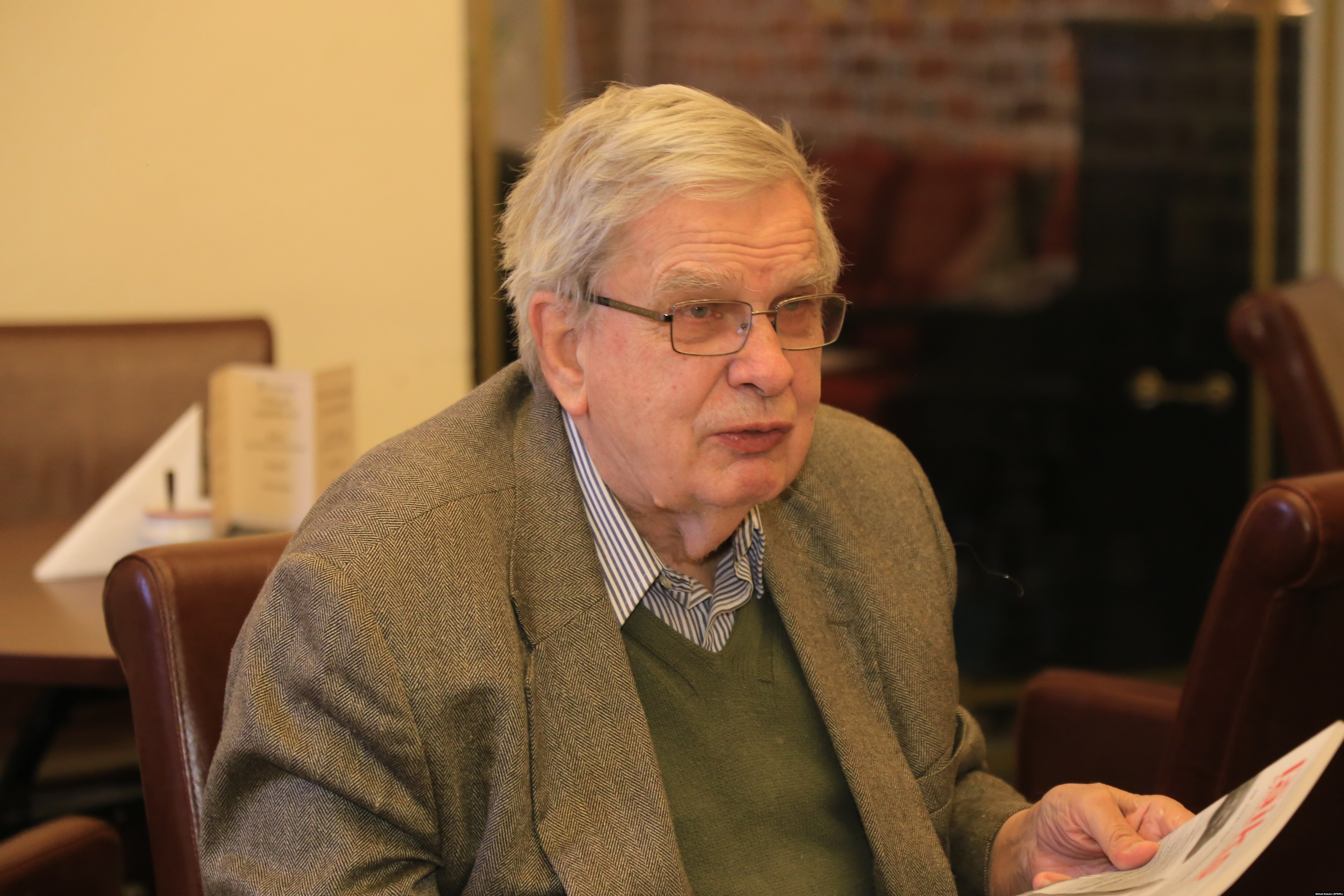
This publication of the KGB document has two heroes and one antihero.
Heroes are Thomas Ventzlova, who will soon be 80 years old (born September 11, 1937), a famous Lithuanian poet, literary critic, essay and dissident, and Lithuanian special archive, Lietuvos Ypatingasis Archyvas ( here is the address on the Internet of the main page with the search ).
And Antherieu is the State Security Committee under the Council of Ministers of the Lithuanian USSR, the Republican Union of the Union body. To represent the KGB, I believe, is not required, the office was sufficiently condemned by itself.
Reconstructed a picture of a parallel, secret life
I would especially like to note Lietuvos Ypatingasis Archyvas. Of all the Union republics of the former USSR, only Lithuania carried out a large and extremely necessary work on the classification and placement of documents on the Internet of the republican secret police. Unfortunately, there is no search here for individual words and phrases, as, say, on the website of the CIA archive , but also what is available, gives exceptional opportunities to study documents related to the "dark" side of Soviet history. Moreover, many documents that fell into the Lithuanian SSR were published by the central apparatus of the KGB of the USSR, and in the Russian Federation these documents are still hidden. The reason for the concealment is simple: the documents do not fit into the dominant concept of history controlled by the “internal party”, and the purpose of control is to classify any facts that demonstrate the details of the functioning of the Soviet totalitarian regime and its secret political police.
Here, in the Lithuanian Special Archive, which is not there: and the certificate of the KGB of Lithuania for 1959 on operational-technical measures, in particular on the per lustration of postal correspondence and the manufacture of fake documents for the operational support of secret operations, and the documents of 1961–1963, showing how they tried to recruit the well-known Jewish singer Neham Lifshitsy, and a letter F. Bobkov dated April 1, 1981 "On the state of agent and operational work on operational surveillance and measures to further improve it," and the order of the chairman of the KGB of the USSR of March 7, 1987 "On approval of the external observation instructions carried out by the state security bodies of the USSR."
As a result, a picture of a parallel, secret life, familiar from the novel "1984", but existing in Soviet reality, is reconstructed in the immediate vicinity of the usual life behind a thin partition.
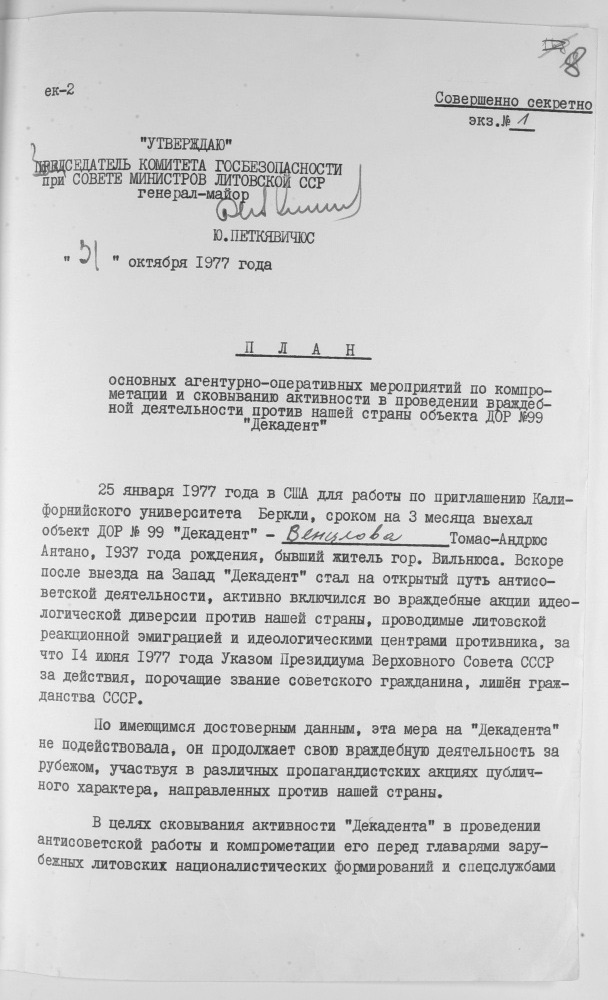
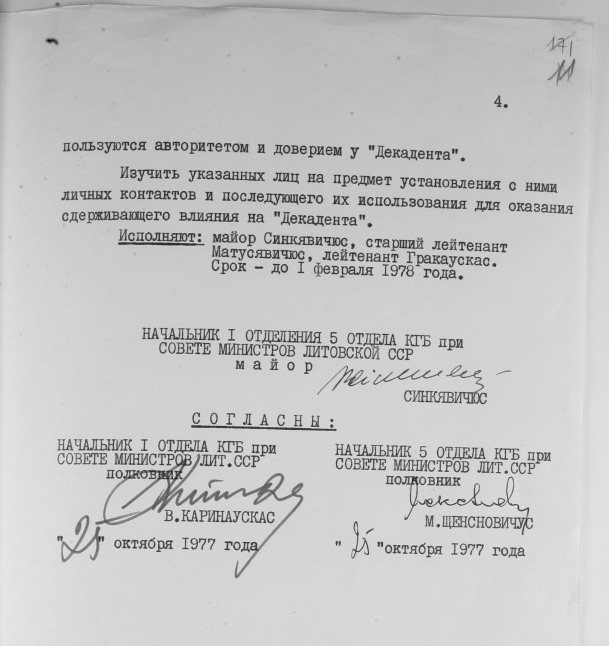
Among these documents, I found a plan of measures to compromise the "decadent" - the object of Dor (cases of operational development) No. 99. Dead Student is Thomas Ventzlova. The plan was dated October 31, 1977 ( Lietuvos Ypatingasis Archyvas . F. K - 35, Ap. 2, b. 202, l. 8–11). Compiled by the head of the 1st branch of the 5th department of the KGB of Lithuania, Major Sinkyavicius.
For Andropovsky KGB, Thomas Ventzlov was, like all dissidents, an ideological saboteur
"Five" (the fifth department of the KGB of the USSR and the fifth departments in regional administrations) were engaged in counterintelligence activities - the fight against the ideological diversions of opponents. For Andropovsky KGB, Thomas Ventzlov was, like all dissidents, an ideological saboteur.
By the way, this is not the only document where Thomas Ventzlova is mentioned. In the certificate of the KGB of Lithuania dated January 8, 1965 on a circle of aesthetics, which existed in 1962–1963. The Vilnius State Art Institute provides data on those who performed at the meetings of the circle. For example, at the second meeting of the circle in December 1963, the musicologist Vitautas Landsbergis visited there, guilty before the Soviet government in that “he told and illustrated the musical notes on the tape recorders about modern areas of modernist music in the West,” “admired the achievements of Western composers in the field of modernist music.”
The data is also given about Thomas Ventzlov, which came to meetings of the circle from Moscow: “The next three meetings, held in January-February 1964, took place with the active participation of Wenzlov Tomas-Andryus, born in 1961, born in 1937. Wenzlov spoke for more than two hours about the two writers of the banks “Joyce and Kafka.
"At the next meeting, held at the end of January 1964, Ventzlova Thomas spoke about the" theory of signs. "In conclusion of his speech, Ventzlov, analyzing the meaning of the printed word and, in particular, newspapers published in our country, noted that there is rarely something new (so!-M.Z.), you know the first continuation and end. This was one of the illustrations for it topic.
On February 28, 1964, at the meeting of this circle, the same Ventzlov Thomas spoke. The theme of his conversation is the direction of drama in the West. To illustrate as an example, the playwright Ionescu, Romanians by nationality, and lived in Paris, was taken. Two of his plays were analyzed: “Lesson” and “Rhino”. The first of them, Ventzlov noticed that one director in Leningrad wanted to put her, but he was forbidden to do this.
In another play, “rhino”, it is thought that people tend to imitate each other in a bad one. Commenting on the contents of this play, Ventzlova said that it figuratively shows how the human person is destroyed, and emphasized that this is characteristic of many societies, and especially ours. And he jokingly urged everyone to “remain as long as possible for himself, and not with a rhino.”
Each meeting of the circle is carefully described by the informer.
13 years later, in 1977, Ventzlov, already known in the USSR, was already known in the USSR, one of the founders of the Lithuanian Helsinki group, which took shape on December 1, 1976, LHG is not reports about Joyce and Ionesko, it is more serious. Hence the events: the deprivation of Soviet citizenship and heroic efforts to compromise, so that in the West Ventzlov is considered an agent of the KGB.
Provocations and misinformation have always been one of the main methods of the office, under whatever the name "Dzerzhinsky soldiers" performed.
Comment by Thomas Ventzlov
On May 9, 1975 (by the way, on a symbolic day), I sent an open letter to the Central Committee of the Communist Party of the Lithuanian SSR, in which I expressed my disagreement with Soviet politics. This disagreement has long been a secret for anyone, and therefore I could not engage in full -fledged cultural activity in the USSR. Based on the Declaration of Human Rights, as well as the then legislation, I asked for permission to leave abroad. For those times, it was a crazy request - they didn’t let anyone go abroad. But the letter (not without reason called open) came not only to the addressee, but also to Western newspapers and radio. The case became widely known, and after a year and a half I was allowed to temporarily leave for the United States at the invitation of the University of Berkeley, which was arranged by the future Nobel laureate Cheslav Milos. The temporary departure turned into permanent, since I was soon deprived of Soviet citizenship (as well as better famous persons - Alexander Solzhenitsyn, Mstislav Rostropovich, Vasily Aksenov ...).
In the West, the possibilities of cultural activity were more extensive than I hoped. I became a Professor-Slavist, published many books in English and other languages, and after the collapse of the USSR began to often visit Lithuania, Russia, Poland and other post-communist countries.
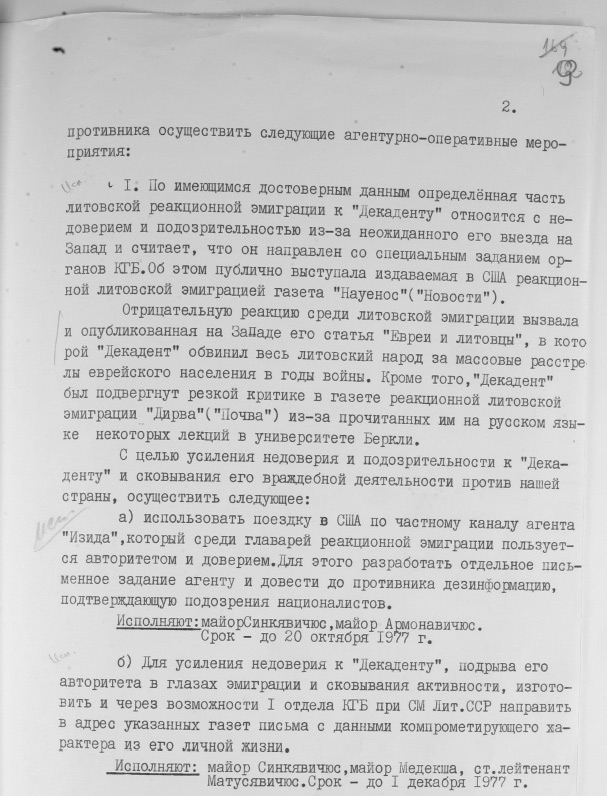
The published materials speak for themselves. I have no idea, but it’s not too interesting to me who is (such?) Isis's agent. A letter with a “personal incrimination” or, as they say, “black PR” was really composed into the KGB and penetrated into the Lithuanian emigrant seal, but it did not make a big impression on me or on anyone.
Several clarifications and explanations:
I "became on the open path of anti -Soviet activities" not soon after leaving to the west ", but long before it, which was also not a secret for the KGB or for everyone else. This activity consisted in protecting human rights and protests against their violation.
The article "Jews and Lithuanians" was first published in the Samizdat magazine "Tarbut" in 1976, then many times reprinted in different languages.
I never accused the “whole Lithuanian people” of crimes against the Jews - I accused and continue to blame only those who are directly engaged in this, who are burnting and losing criminals, as well as those who, in their unseemly interests, distort the picture of crimes (including Soviet power, and, say, some modern Russian propagandists).
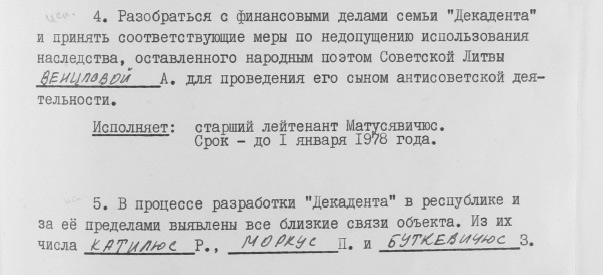
The inheritance left by the father, the famous writer Antanas Ventslova, belonged to my late mother, who, after my departure, continued to live in Lithuania. Being an emigrant, I did not try to use it, and this was not necessary. However, in the "Perestroika" it melted in a few days, but then I could already contain an elderly mother myself.
“Naucenos” and “dirva” - extreme right Lithuanian emigrant newspapers, deprived of serious significance (“Nauchenos”, by the way, has not come out for a long time).
Ramunas Katilus, Pranas Morcus and Zenonas Butkevichus - really my closest friends and like -minded people. Alas, Katilus and Butkevichus are no longer alive. Not one of them was used to have a “restraining influence” to have on me - such an enterprise from the very beginning was hopeless.
Thomas Ventzlova