
Translated material
Russian doping. Whether athletics in Russia rolls down
"Is doping justified? Russian light athletics rolls down" - this is the name of the study of the non -profit project Runrepeat. It is founded by a Danish specialist in statistics and runner Yan Jacob Andersen. The site is known for its ratings and independent assessments of sports shoes. However, in addition, he also conducts research on other topics related to sports. For example, that American marathoners ran the slower in 2016. Or at what age a person most likely, in principle, will run his first marathon.
This time, Runrepeat experts decided to figure out whether the doping helps Russian athletes to show their best results. In order to understand the consequences of doping, researchers analyzed 24 thousand athletic results shown by 400 Russian athletes for 3731 competitions. All these 400 people performed at least once at the Olympic Games. (Although at the 2016 Olympics in Rio almost all Russian athletes performed under a neutral flag, their results were still taken into account.)
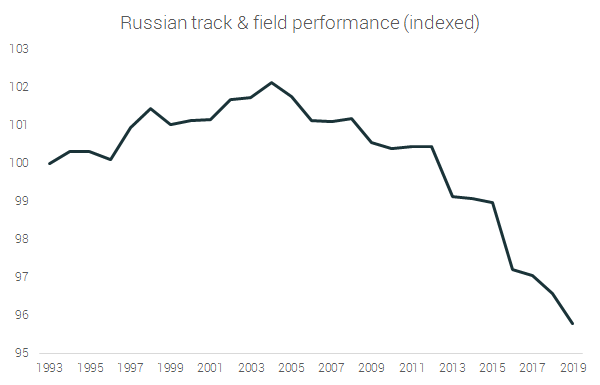
The main conclusion of the study is this: according to Runrepeat, despite the systematic use of doping, the indicators of Russian athletes have only worsen for the past 15 years. Since 2004, 76 percent of disciplines has a tendency to reduce the best annual indicators. Only 5.6 percent of all Russian athletes (those 400 Olympians, the results of which were analyzed in the study) their best results ( traditionally even in Russian this is called Personal Best Or just PB for reduction. - approx. RS) were shown after the use of doping, as they were subsequently disqualified just for doping.
Radio Liberty talked with one of the authors of the study of Iovnoye Subich to understand the methodology and figure out why only Russian athletes were analyzed:
Everyone discussed the topic of doping in Russia
- Initially, when my colleagues and I only discussed the topic (and we started working back in December), we realized that literally everyone writes about Russian doping. Whatever you open - sports sites or twitter - all discussed the topic of doping in Russia. But at the same time, no one analyzed the results of athletes. And we decided to do it. We have in Runrepeat how: if there is an interesting topic that our team wants to work on, then we just take this topic, do research, and then publish. Our main goal was to see what the numbers say. No one ordered this study to us - it is completely independent, and we conducted it purely out of our curiosity.

- Where did you get data for your research?
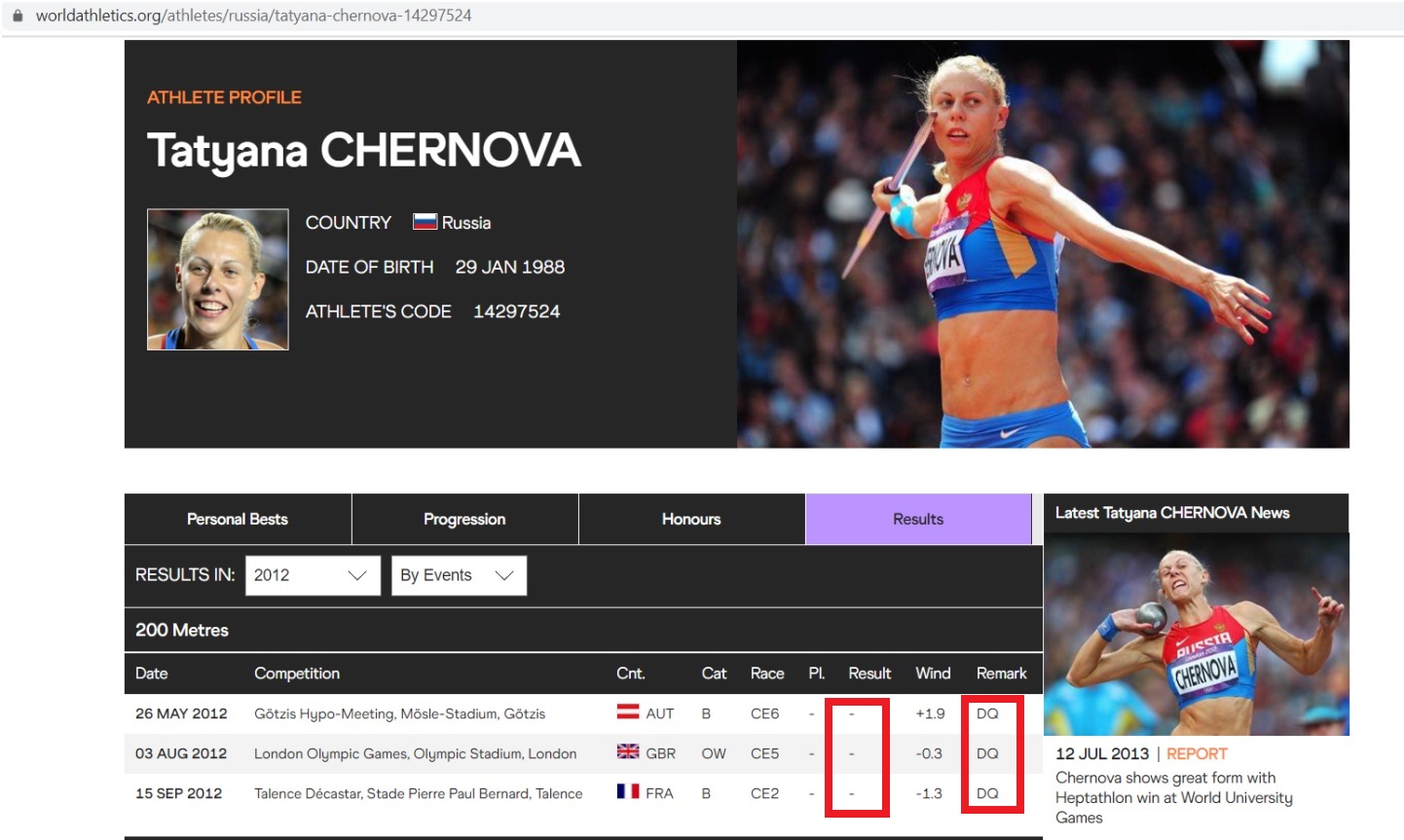
- We took most of the results simply from the World Athletics website, because they have just countless information. For us, a big challenge was that if the athlete would be disqualified by World Athletics, then in the personal profile on the site there is no data left on the result. World Athletics just makes a “disqualified” (dq) margin, and that’s all. But we know that a specific athlete showed such and such a result, but was subsequently disqualified due to doping for two years. In this case, we used the data of the protocols of the All -Russian Athletics Federation (WFLA) - they have the majority on their site. True, we had to use the names of athletes on Cyrillic. You understand what it was for us.
If athletes perform at the Olympics, this means that they are the best representatives of Russian athletics. The best of the best
We wanted to concentrate mainly on the results that Russian athletes showed at the Olympic Games. We thought: if athletes perform at the Olympics, this means that they are the best of the best. Therefore, we did not take into account, say, the results of juniors, which are still only at the regional level.
Thus, we compiled a list of athletes who at least once performed at the Olympics, and gathered their results throughout the career. We had the time frame between 1993 and 2019. The lower border was chosen in this way, because until 1993 there was still a Soviet, not a Russian team. Thus, yes, we analyzed only the results of the Olympians.
- You probably had a working hypothesis when you started analyzing the results? What did you expect to see at the exit and what surprised you most?
- At first we simply did the analysis of the data, and that’s it. The goal was to see what we get as a result. But when we have been doing all this work for several months, when we had already talked with many people, re -read many materials on the topic, read the Rodchenkov book ... We were told that most Russians [athletes] were disqualified from 2010 to 2015. So we expected it to be true. Therefore, we treated this as something obvious. We expected that there would be much more athletes that showed their best results and subsequently disqualified for this. But what we did not expect was to see that the results of Russian athletes will begin to deteriorate since about 2004 (or a little later).
The largest repeated doping and disqualification tests began after 2010. So we rather expected to reduce the results from this moment. But it all began in 2004. And you know, the biggest discovery became ... Russia always had a very strong, even great athletic team. The Russians always fought for medals. And even despite the fact that the results went down since 2004, still Russian athletes performed on the top-level. I will make a reservation that we did not look at what happened to athletes from other countries and their results at this moment - we did not analyze data on the USA, Great Britain or China. Perhaps athletes from other countries also showed a similar deterioration in the results.
- How do you explain for yourself what this deterioration of results is connected with? With the fact that, for example, Wada began to work better and therefore more and more athletes (not only Russian) fall under disqualification and their results are canceled? Or with the fact that since 2015, the VFLA membership in World has been suspended Athletics, so since then, Russian athletes are forced to receive "neutral status" to participate in international competitions? And they receive his units, and as a result, on the top-level, where promising athletes could show their best results, competing with the world elite, they simply do not fall?
The reduction in the results began not in 2015, but in 2004
-You see, an amazing thing that the reduction in the results began not in 2015, but in 2004. What happened in 2004? We know that anti -doping testing has become the subject of international interest since then. But if there was a systematic doping at this level or the substitution of jars of urine, then why did not see any improvements since then? That's what surprises me. And I myself have no answer to this question. I have not been in Russia, I am not an expert in these matters. But still it seems that 2004 is too early for such a pattern.
-On the other hand, in 2004, the generation of those who began to play sports back in the late USSR, and in general then the Soviet training system was still functioning.
- But if generations of the next athletes, who were already brought up in Russian, and not in Soviet sports schools, would be worse or weaker, then how could they win medals? After all, since then, Russia has not rolled up, say, in 20th place in the ranking of world athletics prefabricated. No, Russia is still among the best. But here, probably, many questions arise for world athletics as a whole, and not just to Russia.

- Do you have the hope that your study will show and prove (not only Russia, but also to other countries) that doping is not a panacea and that the use of doping does not guarantee at all that the athlete will show its best results?
- Unfortunately, we do not have absolutely all data to assert this. Ideally, we would also need to know, for example, when and where a specific athlete was tested: before or after, in Russia or abroad. But this data is not in the public domain.
Athletes who use doping are everywhere - not only in Russia
Athletes who use doping are everywhere - not only in Russia. But I would like to hope that other countries will carefully look at what is happening to Russia.
- Yes, this is no secret that the same Kenyans are regularly disqualified. Yes, even to such great runners as, for example, the British Mo Farah, Wada has questions . But in Russia they often say that Vada and World Athletics They are fighting not at all with doping, but with Russia and that this is primarily politics. Are you planning to make similar research in the future for other countries? Say to analyze data on the speeches of the national teams of the USA or China?
“It would be very interesting for us to do it.” And initially we wanted to conduct just such studies. But now understanding how much time the results will take, how much challenges are facing to collect all the data for research (when we started work in Russia, we did not know and did not understand all this), we decided to take a step back and so far we stop there. We would be very happy if journalists, who are interested in this topic, would continue our analysis. We are very interested in the results, but we simply do not have enough strength to do everything ourselves.