
Translated material
Mitya Aleshkovsky
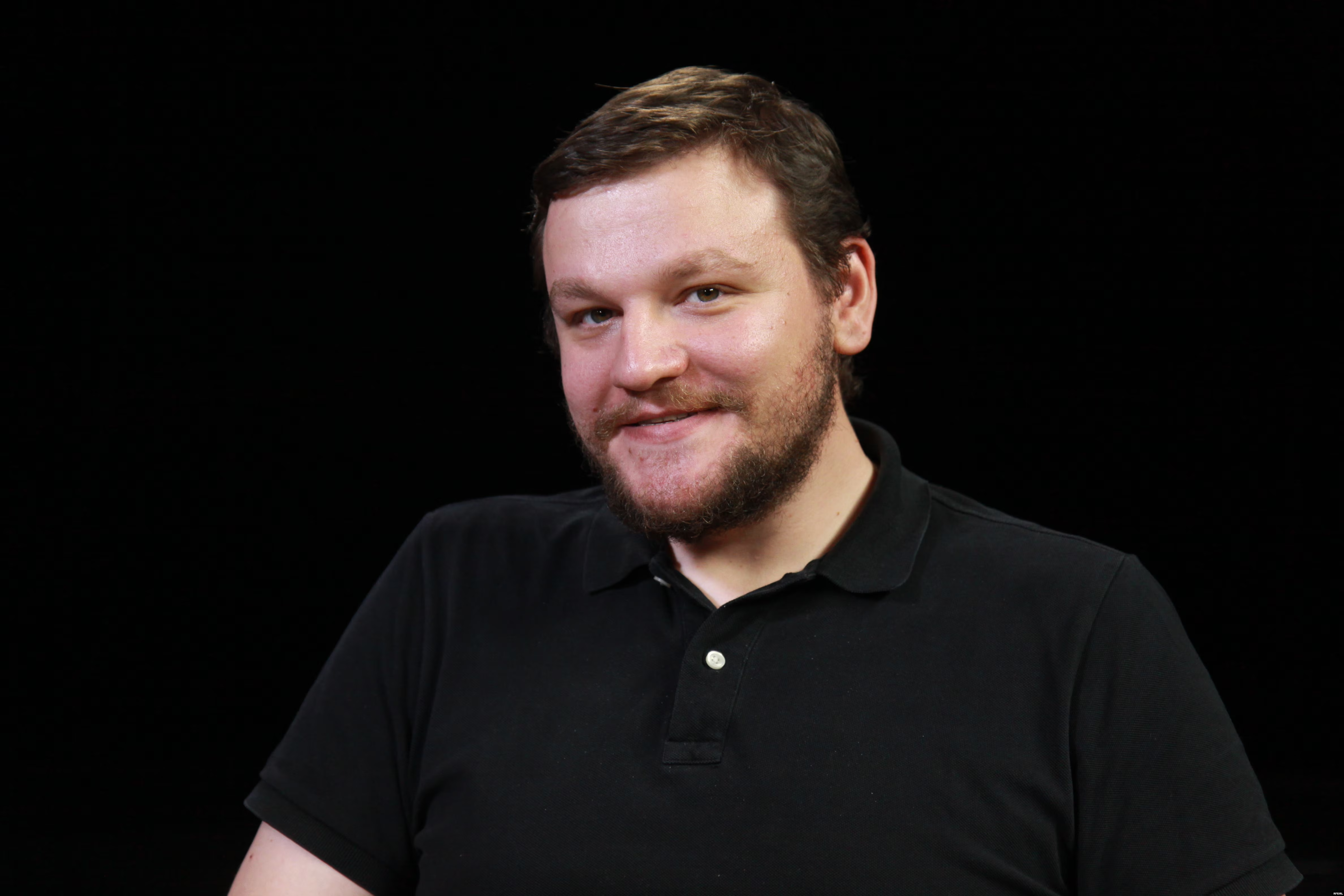
Philanthropist Mitya Aleshkovsky in the program of Leonid Velekhov
Leonid Velekhov : Hello, on the air, freedom is a radio that is not only audible, but also visible. In the studio Leonid Velekhov, and this is the new issue of the program "Cult of Personality", which you also watch on the TV channel "Present time". Our program is not about tyrants, it is about real personalities, their fate, actions, their views on life.
Today I have Mitya Aleshkovsky , a volunteer, a public figure, co -founder and chairman of the Help of Help, the director of the “such affairs” portal. In a word - philanthropist, was called in the past ...
( Video of Mita Aleshkovsky. Success text :
Mitya Aleshkovsky is young, he is 33 years old, but has long been well known - first as a journalist and photographer, then as a volunteer and philanthropist. He is from a famous family. The most famous carrier of the surname, of course, is Yuz Aleshkovsky, this is the uncle of our hero. Father - Peter Aleshkovsky, writer, laureate of the Russian Boker, mother - Tamara Eidelman, Honored Teacher of Russia, grandfather - Nathan Eidelman, historian, brilliant researcher of the Pushkin era. And in the family, several people who left in Russian history and culture are archaeologists, art historians, theaters ... In general, a good genealogical tree, on the top of which, as a fresh branch, now he, Mitya Aleshkovsky.
Six years ago, after the tragedy of Krymsk, flooded by the flood of a small town in the Krasnodar Territory, where he actively raised funds and organizing assistance to the victims, Mitya threw photojournalism and decided to devote himself to philanthropy. He organized the “Help” Foundation, already in the first year of his existence, collecting about a million rubles of donations for charitable goals. According to the results of 2017, according to the information on Wikipedia, the Fund raised about a quarter of a billion rubles. Now this is not just a large charity project, but a fund of funds that supports the activities of 135 charitable organizations throughout the country. It is such a direction of work - the systemic development of charity throughout Russia - Aleshkovsky and his comrades consider the main and the most fruitful. Because there are a lot of compassion people in Russia, and the systems that would help this compassion in the most effective way have not been to be in the most effective way, until recently, and now it is only lining up.
However, let Mitya tell about all this ...)
Studio
Leonid Velekhov : Do you like the word "philanthropist"? After all, in general, for what you are doing, the main and only motivation is love for people, isn't it?
Mitya Aleshkovsky : It seems to me that philanthropist and philanthropy are the most clear description of what, in fact, charity is, than it should be ideal. Because love for a person is the norm of life. Love for a person is the right state of mind, this is the right motivation. In general, a person and his life, respect for this life, an understanding of the values of this life and an attitude to everything through the prism of the value of human life are the key to success, successful development, the key to achieving some great results, the key to a happy life in the country. It seems to me that this is one of the main ones, if not the main problem in modern Russia. And the Soviet Union was the same, and in the Russian Empire. We always have a national idea - "women of new ones give birth."
Leonid Velekhov : Yes, of course.
Mitya Aleshkovsky : A person’s life costs nothing. Therefore, it seems to me that this is exactly what you need to change. And how to change this, if it is not felt on yourself, not confirm by some action? This is the philanthropist, charity and teaches. This is her global mission, and mine, including the fund.
Leonid Velekhov : Great! But where do you, such a young man, come from? Probably, your family in this sense played a large role?
Mitya Aleshkovsky : I don't know! ( Laughter in the studio. ) I have no answer to this question. Of course, my family played the main role in the formation of me as a person. But I came to myself for about 23 years, maybe I somehow began, in principle, to distinguish between the boundaries of the world, permitted, not permitted and so on. Before that, it was just some kind of crazy, crazy man who could do absolutely anything.
Leonid Velekhov : Didn't you think about philanthropy?
Mitya Aleshkovsky : No, what are you?! At 23 years old! My God, never, no!
Leonid Velekhov : I see. Another grandfather was wonderful. With your grandfather you in this world crossed for a short time ...
Mitya Aleshkovsky : Both grandfathers were wonderful.
Leonid Velekhov : I mean us better famous, Nathan Eidelman.
Mitya Aleshkovsky : both Nathan Eidelman and Mark Aleshkovsky, my two grandfathers were wonderful, judging by the stories ...
Leonid Velekhov : Didn't you coincide with another grandfather?
Mitya Aleshkovsky : No. Grandfather Mark died before my birth, and with my grandfather Nathan I saw four years of my life, I remember very bad and very little: some small memories, one image. I remember that we are leaving somewhere, somewhere he performed, in my opinion, in the Herzen Museum. I remember that he leaves the taxi, I look back, he crosses the street. And this old Moscow is then, Soviet, even without advertising, without a large number of cars. He crosses the street, and I see that his grandfather crosses the street. This is what I remember. And one small memory that he came to our house and brought a box of ice cream.
Leonid Velekhov : Box?!
Mitya Aleshkovsky : In my opinion, a box. Well, I was just small, it seemed to me that it was a box. Don't know. I remember that some kind of huge man sits with a huge head in an armchair. So kind and smiles. But, unfortunately, no more.
Leonid Velekhov : Not so little for four years!
Mitya Aleshkovsky : I am very good, as it seems to me, I still understand what my grandfather was. Firstly, because I look at my mother, secondly, because I read his books, I read about him. I have a suspicion that I can still imagine, feel what he was. And then, I listened to his performances, I hear the energy of his words, the pressure, and so on. We still (both my family and I, including) communicate with his classmates, with his friends. In general, he is with me, although I practically did not see him.
Leonid Velekhov : Great! And along another line, there is also a wonderful kinship, wonderful ancestors.
Mitya Aleshkovsky : Yes.
Leonid Velekhov : On both sides of the family-some such cultural cells of Soviet-Russian life.
Mitya Aleshkovsky : And the boy turned out to be a fool. ( Laughter in the studio. )
Leonid Velekhov : Well, it happens! Nature rests on the descendants, as they say.
Mitya Aleshkovsky : Well, yes.
Leonid Velekhov : But, nevertheless, nevertheless, we will understand the boy. You were a journalist, a successful journalist, as I understand it.
Mitya Aleshkovsky : It seems to me that I still remain in many ways.
Leonid Velekhov : You were a reporter, moreover, another photorepector. And this is such a type of activity, which brings up a certain cynicism, the attitude to what is happening that the journalist is engaged in, and even more so the photographer, on the principle - to whom the war is and to whom the mother is relatives. Was it like that?
Mitya Aleshkovsky : It seems to me that cynicism arises at the moment when you begin to treat your work as a conveyor, when you simply begin to be a craftsman, and not a person who produces an independent work of art every time he picks up a camera. And I understood the difference only when I stopped being a reporter. Now I can definitely say that, of course, I did not create a work of art. I had some good photos, I even had my own projects, but what I did when I worked in the news when I shot the news every day ... I am happy now that I am not doing this. In no case do I want to offend my colleagues in the workshop and say that you are stuck, and I flew up. I just want to say that as soon as I was freed from this binding, I had such a Rocket Jump.
Leonid Velekhov : And what, the camera was hanged on a carnation?
Mitya Aleshkovsky : I sold it, I no longer have it.
Leonid Velekhov : Doesn't he pull? Still, such a profession is adrenaline.
Mitya Aleshkovsky : Go to charity, and you will find out what adrenaline profession is.
Leonid Velekhov : I understand that there is no comparison.
Mitya Aleshkovsky : I want to say that when I was a photographer, I saw wars, burned cities, killed people, torment, suffering and so on. And when I began to work in the charity fund, I realized that ordinary life is much worse than all these wars, burned cities, killed people and so on. Killed ... Well, that - he has already died. You can sympathize with him, of course, or his family, but when you see a person who dies for eight years in a row without stopping and cannot die, simply because he is between life and death, and suffers these eight years, it is much worse!
Leonid Velekhov : But this is also necessary to photograph and shoot.
Mitya Aleshkovsky : I understand, yes. Moreover, I am a photograph and shooting. If I need, I rent a camera, I am borrowing from friends, but this happens, maybe once or twice a year. I perfectly understand that this is rather my entertainment and pleasure, and my professional classes are now the organization of the process, the collection of money, the popularization of solving social problems, and communication. In fact, I turned into a producer.
Leonid Velekhov : You have on your portal, I mean, and wonderful photos and wonderful videos, after all, it was also made by randomly pressing the button.
Mitya Aleshkovsky : Of course! This is our wonderful team, which, in fact, does all this.
Leonid Velekhov : photographing, visualizing human misfortune, human drama - this is ...
Mitya Aleshkovsky : Or happiness.
Leonid Velekhov : Happiness is probably easier?
Mitya Aleshkovsky : Yes, okay! ( Laughter in the studio. ) It seems to me that happiness ...
Leonid Velekhov : Happiness is just less often, more misfortune.
Mitya Aleshkovsky : It seems to me that it is easier with misfortune.
Leonid Velekhov : Because he is more.
Mitya Aleshkovsky : You know at least one good poem about happiness or at least one good book about happiness, about love, so that everyone says - yes, a great work?!
Leonid Velekhov : Of course there is. Here you will not catch me.
Mitya Aleshkovsky : Seriously?
Leonid Velekhov : Of course, Pasternak! Absolute optimism, dissolution in happiness, in life. To call the book "My Sister - Life" - this one speaks for itself.
Mitya Aleshkovsky : Well, well, with books, maybe I have not given a very accurate example. But, it seems to me that the sense of someone else's happiness does not cause empathy.
Leonid Velekhov : This is another matter! Certainly.
Mitya Aleshkovsky : And the feeling of someone else's grief, causes someone else's pain.
Leonid Velekhov : Undoubtedly.
Mitya Aleshkovsky : And it seems to me that it is precisely due to this experience, empathy, some kind of constructed compassionate thought and feelings in relation to other people, that this creative genius is obtained.
Leonid Velekhov : I understand. I remembered another name - Alexander Nikolaevich Ostrovsky, playwright. In a letter, some actress writes that she rehearses Katerina and cannot understand how to play it. And he says to her: "You need to suffer in life, mother, then it will turn out."
Mitya Aleshkovsky : Yes.
Leonid Velekhov : Creatively - of course. Through their own suffering, through an understanding of someone else's suffering - this is necessarily, without this, nothing will happen.
Mitya Aleshkovsky : I am very often asked: "And how do you let it all through yourself, what do you work with? How do you deal with this, are you becoming a cynic?" And so on. It seems to me that I remain a person exactly as long as I empathize, I suffer with my heroes or with those whom we help, or with those with whom I communicate. While I see that in front of me is a person with his fate, with his life, with his pain, love, tragedy, happiness and so on, while I am a person as a person, I am a person himself. This is what a person makes us - the fact that we treat others as people, what we think about others. Philanthropy makes us a man, returning to your first question!
Leonid Velekhov : Of course! Although there was such a person not that cynical, but very ironic, Oscar Wilde. In the Portrait of Dorian Gray, he has a phrase that philanthropists, carried away by charity, lose all humanity.
Mitya Aleshkovsky : Yes, this is true. This is very accurate. I know a lot of such philanthropists. I know people who may not kill, of course, for charity, but put you a bandwagon, kick you in the back. Yes, it happens. But it is very convenient for me in this sense, because we are a fund of funds: we are a fund that develops other funds. We make so that in Russia there is its own solution for each problem. We have a certain number of funds in Moscow-50 percent, still 15 percent in St. Petersburg, and the rest are smeared with a thin layer throughout the country, just where the poorest people live, where the most problems are, and where the most population is the most. There is no one to solve problems, there are no public organizations. We, in fact, solve this problem. We make so that there is an organization for every problem. The form of our work itself does not imply competition, because we work for others. And this is absolute happiness!
Leonid Velekhov : Mitya, where did it all start?
Mitya Aleshkovsky : After all, it would seem that completely disenfranchial, limp, we can’t influence anything, we can’t fix anything, we are sitting and Cukuy and think: “That's the horror! We have no prospects. Probably, we need to collect things and fry.” So thinks a huge number of people.
Leonid Velekhov : And not without reason.
Mitya Aleshkovsky : At some point, it turned out that this was not so. I am so seriously confident that we can influence what is happening in our country that we can change it for the better, that we can achieve a huge number of results, and even with absolutely any people: it does not matter what kind of political views, sexual orientations, religions, and genders, anything they want. When I felt for the first time, this happened when there was a flood in Krymsk, the power of public influence that we can turn the mountain ... What is meant by the expression "turn the mountain"? Imagine that you take a shovel and tear off the mountain! I realized that we can do this simply because we took a shovel and torn a mountain or raked the city, or built a bridge, or collected and sent 150 tons of cargo, a thousand volunteers, saved people and so on. These are all the little things compared to what we are doing now. Because now our fund has eighty thousand wards! And we have tens of thousands of people who donate money to us monthly. We work in all regions of the country. I understand that the influence that we provide, it, of course, is incommensurable with some global processes, but we grow and grow in our influence, we grow in our development. When I realized that this can be used for the good of my own country, for the good of our future, for the good of our society, I just ducked into it with my head, as in a dark whirlpool.
Leonid Velekhov : I understand. But it doesn’t turn out that you take on the tasks that the state should have to fulfill? Because nevertheless, building bridges and hospitals is the task of the state. The state looks at this, rubs his hands and says: "Well, very good, Mitya, go on. And we will send troops to Syria, to Ukraine and build our own own residences!"
Mitya Aleshkovsky : There is a key moment. What is the state? The state is all of us.
Leonid Velekhov : In my maxim we will replace the word "state" with the word "power".
Mitya Aleshkovsky : It is very important that you said the word "state". We are just the state: I am the state, you are the state, power - the state, the grocery store - the state, taxi below - the state, and so on. We are all the state! This is the key moment. If we believe that the state is us, not them, then it is in our interests, we must influence something. And as soon as we begin to create a critical mass in a particular issue, then revolutionary changes occur. And they take place without setting fire to tires on the streets, without shooting, without rallies and so on. I am not saying that you do not need to engage in politics, be interested in politics, participate in the elections, and so on. Of course, you need to go to the polls, you need to try to be interested in politics. We just have no political life. Our political field is cleaned. We do not have politicians as such. And how do we influence in a different way? We need to become citizens. We need to become society. We need to become a state so that we are a state! We have a lot of examples that even now, with the current political situation, we can change our way of life, solve serious social problems, because we unite and achieve these changes. There are such examples.
Leonid Velekhov : I understand that there are examples. But regarding the critical mass. Where is Russia in the development of charity in the world?
Mitya Aleshkovsky : at the 110th.
Leonid Velekhov : Yoklmn!
Mitya Aleshkovsky : We climbed ten positions this year.
Leonid Velekhov : I read somewhere that we are still behind all the former Soviet republics.
Mitya Aleshkovsky : Well, not all. Ukraine and Kazakhstan somewhere there ...
Leonid Velekhov : Even worse.
Mitya Aleshkovsky : Happiness is a direction of movement. This is work on yourself in the first place. When we, as a society, begin to work on ourselves, when we do not shift to someone else and say: “I cry taxes, the state should!”, When we say: “This is in my interests, I have to do it!” ...
Leonid Velekhov : In this sense, in fact, I believe that our people are not as bad as you draw. Do you know what basis I judge? By the number of saucers with food for cats at blower holes. I have not seen this in such a world in such a quantity. Another thing is that there are much less homeless street cats, but there are still cats. There are no homeless dogs anywhere in the world, and there are cats in both Europe and America. But how many these saucers we have - this proves that we have a lot of compassion people, people located to participate in what you are doing.
Mitya Aleshkovsky : Bashlachev has the following phrase in Bashlachev in the song “Time of Bells”: “We are waiting for a long time. Everyone walked dirty .// That’s similar, // And in the rain were different.” And it seems to me that this accurately characterizes us, that we generally, people as a whole, are good.
You just need to try to see a person in a person. And when we see a person in a person, when you approach him as a person and just humanly try to build a dialogue, in most cases it turns out.
Leonid Velekhov : As you, I mean your fund, your organizations manage to reach a person and receive ... I am the figures of donations that you collect are admired, although maybe this is not much if you compare with any other countries. But, nevertheless, the successes are impressive! How do you succeed? Is there some kind of know-how?
Mitya Aleshkovsky : Firstly, we are honest. It is not honest that we do not steal money, although we, of course, do not steal it. We are honest that we are what we are. We directly say-why, what, how and why without these tricks, some small print and so on. We build our relations with people who support us and our projects, to awareness. For example, if you arrange a monthly donation on our site, then the next day you will receive a letter, the main task of which is to unsubscribe from this donation. Why? It says: "Do you understand that this money that will be written off on you monthly? Do you understand that they will spend money on this and this? Do you understand who we are, how it works?" and so on. "How can you manage this." The idea is that if a person consciously read all this and said: “Yes, I understand all this,” he stays with us. And if he read and said: “No, here I do not agree with this,” and go with your way. There is no problem!
Leonid Velekhov : How many donors do you have?
Mitya Aleshkovsky : tens of thousands. Regular-thirty with something thousand.
Leonid Velekhov : Who is the majority - young people, elderly, men, women?
Mitya Aleshkovsky : 25–44 years old, more women than men: women about 70 percent. But this, in principle, is not surprising, because there are more women in Russia, and not only in Russia.
Leonid Velekhov : What do people donate more willingly?
Mitya Aleshkovsky : to children, to the aid of children who are sick with incurable diseases or sick with a deadly disease. They sacrifice the most.
Leonid Velekhov : What is the least?
Mitya Aleshkovsky : At the people of our age, that is, everyone who is older than 18 and less than 65, ordinary adults ... like, friend, you are 18, independent, solve your problems yourself. This, of course, is terrible! Our main pain is that people do not sacrifice the problem, and people sacrifice a person. Because the problem is often much cheaper than helping a specific person. But our brain is arranged so that we ... this is called the "effect of the identified victim." I will tell you an example: this is an example from the book "Life that you can save" by the famous Australian philosopher Peter Singer. We recently released it in Russia, and now we are promoting it. It can be bought at any bookstore or on our website. You walk along the street, say, here, to the editor. You are in jeans and boots. And here you see that a puddle is 30 centimeters deep, and a small child is drowning in it, a two -month. Obviously, he will drown: he does not know how to swim, he does not know how to walk. For him, these 30 centimeters are a deadly depth. For you, the question of saving his life is stained boots and trousers, $ 20 for dry cleaning, a thousand rubles. The question is - will you save him?
Leonid Velekhov : There is no question for me.
Mitya Aleshkovsky : Will you save?
Leonid Velekhov : Naturally!
Mitya Aleshkovsky : Great! And if I offer you for the same thousand rubles to save, say, a person’s life in Namibia. What will you do?
Leonid Velekhov : I know how I will do-I will give this thousand rubles. There are no questions.
Mitya Aleshkovsky : And most people at that moment say: "Wait, are we not sure that he needs help. And this will definitely save? And how?" In the first case, there are no questions for you, and in the second case there are many questions. Although, according to Unisef statistics, two thousand children from diarrhea die every day in the world. Diarye in the 21st century ... One could somehow cope with it. But we do not see the child in Namibia, in the Congo or somewhere else, and we see a child here. This is an example of this identified victim.
Leonid Velekhov : As far as I remember, even such a great and sinless woman as Teresa’s mother “sinned” by the fact that she took money from Albanian drug lords. There is some barrier for you here-who from taking money?
Mitya Aleshkovsky : Mother Teresa and Nyuta Federmeser personally taught me this approach. Because when Mother Teresa was accused of taking money from someone ...
Leonid Velekhov : In my opinion, the Albanian drug lords, Kosovo-no matter.
Mitya Aleshkovsky : For example, from the Albanian drug lord she took money. Her journalists accused: "How can you? Why can you take money from these people?!" To which she said: "Who are you to forbid a person to try to get into paradise?!" ( Laughter in the studio. ) And Nyuta Federmeser once told me such a phrase when we met, and this changed my life. We were sitting somewhere together at some event, I say: "Hello! I am Mitya! Here we make a fund, we will help good people, take money only from good people." She looks at me and says: "If" al-Qaeda "comes and brings me money to the hospice and does not ask for anything in return, I will take it." I am: "How?! Can't be?!" She says: "But I will definitely spend this money better than it." You simply, taking the money, reduce, as Valera Panyushkin says, the boiling level in the hellish boiler for this person. You do not forgive him anything, you do not rehabilitate him in any way. And the fact that he does something good for you does not mean that he is forgiven for the bad that he did. No!
Of course, this issue is always associated with that - is it possible to take money in power? Is it possible to take money from Putin? Is it possible to take money from the State Department or from someone else? There is a very important point. This is the so -called case Chulpan Khamatova. We, in fact, are not fighting with Putin and, in fact, we are not fighting with America. We are fighting with death! Therefore, at least with a line of bald we are ready to stand together, nearby, in the struggle against death. I remember, after Crimean, I sat with one deputy, now not a deputy, State Duma. We drank coffee with him. We worked a lot with him then in Krymsk. He was from United Russia. He looks at me like that and says: "Mitya, you understand that many there (referring to the Duma) are unhappy that you and I, such an oppositionist, can sit together and communicate in a human way, work and forget about our disagreements, and do something good together." I say: “I understand. But this will not prevent us with you and me to sit together, drink coffee and, forgetting our disagreements in other matters ... I forgive you that you are a“ unicorn ”? No, I don’t forgive. These are your problems.”
Leonid Velekhov : Mitya, but still you are an oppositionist. Still, your political worldview has been preserved with all your immersion in charity and in the realization that for the sake of saving a child to be friends with a line of bald and so forth and the like. But still, a critical look is an order of magnitude in our country, you have survived.
Mitya Aleshkovsky : I just have critical thinking. This is the basis of sanity, it seems to me.
Leonid Velekhov : Undoubtedly.
Mitya Aleshkovsky : I rather think that you need to be objective. There are some things for which our power can be praised, there are some things that can not be forgiven for her. Say, "The Law of Dima Yakovlev" is that which cannot be forgiven. And you can praise, for example, for the Fund of Presidential Grants, which works brilliantly - both honestly and openly ...
Leonid Velekhov : But the human rights organizations of these grants were missing this year.
Mitya Aleshkovsky : So, they wrote a bad application. The Fund of Presidential Grants earned for himself not just a reputation, not just he bought it with money. He bought it with the result of a long work. Who, in your opinion, evaluates these grants? Any people from the presidential administration? No.
This is evaluated by ordinary people from charitable foundations. These are sector experts. In fact, the sector itself evaluates the sector itself. The president does not make a decision - to whom to give, but to whom - no. Recently I saw a meeting of social activists with the president at the community forum. They say: "Thank you for supporting us that you gave us money!" And this is not his money. This is not he makes a decision. He is like a cartridge of this whole direction, and the money is not his. Firstly, these are our money with you, budget. Secondly, the fund distributes them to the support of socially significant non-profit ...
Leonid Velekhov : Have you received a grant?
Mitya Aleshkovsky : This time - no. We submitted and did not receive.
Leonid Velekhov : And last year?
Mitya Aleshkovsky : Last year they received, yes.
Leonid Velekhov : Well, why did you write a bad application? Or what's the matter?
Mitya Aleshkovsky : They wrote a bad application. I know that we wrote it poorly. I don’t scream anywhere that this is revenge for something or something else! The Russian Orthodox Church or the non -profit organizations associated with it received 55 million grants. Yes, they received it, only this is less than 1 percent of the total funding amount. And then who? Say, the Orthodox Service of Mercy received, in my opinion, 10 million per project to help the homeless. Not on how Kadil and prayer to save a person on the street, but on how to really help the homeless.
Leonid Velekhov : Is this your business for your whole life?
Mitya Aleshkovsky : I thought that you were asking - it is serious or not.
Leonid Velekhov : I know your activity and talk to you today, realizing that this is serious.
Mitya Aleshkovsky : I'm very tired. It hurts me very much, it is very difficult for me. I do not know how enough of me. Прямо сейчас я сижу и думаю о том, что хорошо бы забуриться в тайгу и там посидеть месяцок-другой без телефона, без Интернета. У меня есть штук двадцать книжек, которые мне нужно прочитать. Я просто больше не могу.
Леонид Велехов : Но дело-то поставлено, забуритесь в тайгу. Оно будет работать или развалится?
Митя Алешковский : Нет, не развалится, конечно. У нас чудесный фонд, у нас великолепная команда, у нас прекрасные специалисты работают. Все будет работать. Я не хочу никуда уходить. Я понимаю, что это дело моей жизни. Я в него верю! Я верю в то, что это изменит нашу страну. Я верю в то, что это изменит наше общество. Я верю в том, что мы не просто принесем пользу, что мы, наконец-то, построим фундамент, который даст возможность на нем построить наше будущее, будущее для нашей страны. Потому что мы стараемся думать о том, какую страну мы передадим нашим детям, внукам. Мы стараемся думать о том, что будет дальше. Мы не думаем сегодняшним днем. Мы, конечно, думаем о сегодняшнем дне, но мы пытаемся… Ведь в чем разница нашего подхода и подхода большинства благотворительных организаций в России? Мы работаем проектно. Мы стараемся поддерживать проекты, которые решают проблему, не затыкают дыру точечно, а которые стараются решить проблему. Скажем, мы крупнейший финансовый донор Московского детского хосписа. И мы понимаем, что конкретная часть проблемы – дети с онкологическими заболеваниями, которых нельзя вылечить, но которым можно помочь, – финансирование этой проблемы сейчас нами закрыта. Потому что мы 30 или 40 миллионов в год для Московского детского хосписа собираем. Проблема здесь закрыта. У нас подписаны эти регулярные пожертвования, которые постоянно люди жертвуют и так далее. Можно передохнуть и решить другую проблему, потом еще одну, еще одну и так далее. А если мы собираем деньги по одному человеку, мы никогда никакую проблему не решим: очередь будет вечная.
Leonid Velekhov : I understand.
Митя Алешковский : Поэтому я верю в то, что мы делаем. Я уверен, что мы поступаем правильно. Я уверен, что мы единомышленники со всеми, кто действительно любит нашу страну. Мы единомышленники с любым человеком, который желает ей добра. Мы единомышленники с любым человеком, который хочет хорошего будущего нашей стране. Именно это с надеждой позволяет мне смотреть в будущее. Мы можем объединять не объединяемых людей и объединяться с теми, с кем в обычной жизни ты никогда бы не стал даже разговаривать.
Леонид Велехов : Было какое-то серьезное поражение, провал?
Митя Алешковский : В работе фонда?
Leonid Velekhov : Yes.
Mitya Aleshkovsky : Yes. Этих ошибок очень много. Мы учимся на них. Из последних, я могу сказать, что мы довольно сильно доверились одному крупному донору частному… Просто человек нам жертвовал много денег. И в какой-то момент сказал: "Больше не могу". А мы рассчитывали на него. Это научило нас тому, что…
Леонид Велехов : Он больше не может в силу того, что денег не осталось?
Митя Алешковский : Да, деньги у него кончились. Это научило нас тому, что нужно максимально диверсифицировать свой бюджет и не отдавать одному человеку больше 1–3 процента в твоем бюджете. Это из таких управленческих ошибок. Но это базовая ошибка, это такая простая вещь. А из ошибок этических или моральных… У нас не было таких провалов, когда мы взяли людей, а они оказались жуликами. Но у нас было так, что мы начинали работать с людьми, а они оказывались невменяемыми, условно говоря. По документам вроде все в порядке, по проекту все в порядке, по отзывам все в порядке, а потом когда начинаешь работать и разводишь руками – а что делать-то?! Мы доводим до конца, где можем. Один или два раза у нас так было.
Леонид Велехов : А самое серьезное достижение?
Митя Алешковский : Мне хочется верить, что этих достижений несколько. Во-первых, пять лет назад понятие "регулярное пожертвование" для среднестатистического человека в России было вообще чем-то из космоса.
Леонид Велехов : Абсолютно несуществующим, да.
Митя Алешковский : Оно и сейчас такое, потому что по статистике лишь 1,2 процента населения России жертвуют регулярно в какие-то благотворительные фонды. This is very little. On the one side. С другой стороны, это больше миллиона человек. This is very good. Но мне хочется верить, что мы сделали очень много для того, чтобы популяризировать саму идею регулярной осознанной благотворительности. То есть мне не хочется верить, я это знаю! Я знаю, что это так. Потому что я знаю, что люди приходят к нам на сайт, выбирают себе 5–20 фондов, в которые они будут жертвовать по 30 рублей, по 50 рублей в месяц, и жертвуют. Кстати, я призываю всех наших зрителей и слушателей это сделать. This is the first.
Леонид Велехов : Для того, в том числе, и разговариваем.
Митя Алешковский : Очень важным мне кажется также осознание нашим обществом того, что мы можем решать какие-то проблемы. Потому что действительно есть проблемы, которые мы решаем в общероссийском масштабе. И не менее важные уже в медийном представлении, мне кажется, еще две вещи. Во-первых, то, что мы сделали социальную журналистику доступной и человечной.
Леонид Велехов : Мы эту тему не затронули, а это важная тема.
Митя Алешковский : Потому что раньше это был удел либо активистов, либо специалистов. А мы начали писать об этом как о человеке, мы начали писать о человеке как о человеке. And this is very important. И так начали делать все. Во-вторых, мы одни из первых, кто создали модель финансирования СМИ "Такие дела", мы создали модель, когда мы живем за пожертвования не в том смысле, что нам платят за подписку, а в том смысле, что люди понимают, зачем им это издание. Им нужно издание "Такие дела". И поэтому они его поддерживают рублем. Заметьте, что после этого "Медиазона" начала такой же фандрайзинг, "Новая газета" начала. И вот это именно пример того, что мы показываем обществу – это возможно. Вы можете! То есть независимые СМИ в России возможны, если они вам нужны. Если СМИ выстраивает свой диалог с читателем так, чтобы читатель понимал, зачем ему это медиа нужно, что оно ему дает, почему он должен или может поддерживать его рублем… Мы показали пример в этом направлении. And it seems to me that this is very important. Потому что говорят, что журналистика невозможна в России, свободных медиа в России невозможно создать. Я доказал, мне кажется, и вся наша команда доказала, что это возможно.
Leonid Velekhov : Great! Отлично, Митя! Thank you! Я очень рад нашему разговору!
Митя Алешковский : Спасибо и вам.
Леонид Велехов : Занимайтесь тем, чем занимаетесь…
Митя Алешковский : Но сначала в лес.
Леонид Велехов : Но ненадолго.
Митя Алешковский : Спасибо!
Леонид Велехов : Все вам доброго. God for help!
Митя Алешковский : Спасибо!
Leonid Velekhov : Thank you!