
Translated material
Titans of the Western Front
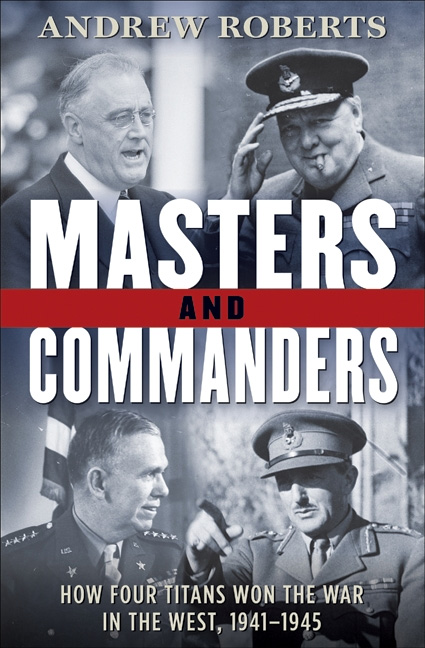
Four titans that the author mean ( Andrew Roberts. Masters and Commanders. How Four Titans Won The War in the West, 1941-1945 ) is the American President Franklin Roosevelt with his main military adviser George Marshall and the English Prime Minister Uinston Churchill with his own Advisor, Field Marshal Alan Brook. The content of the book is the thorny path of mutual disagreements and concessions, mutual irritations and griefs, annoyance and recognition of mistakes, passions and patience, swallowed grievances and self -sacrifice, through which four commanders of the allied armies went to lead to victory. You read and think: how much easier it was Comrade Stalin - no one argued with him.
"One of the most serious disagreements was the dispute about the time and place of the opening of the second front. Marshall and Eisenhower insisted on invasion of Europe in 1942, in extreme cases - in 1943. Both believed that Europe was the only place to defeat. But Churchill and Brooke were extremely high opinions about the combat qualities of the German army (and from the time of the First World War, and according to the first World War The experience of the second one). Success, together with Churchill, they adopted a landing plan in North Africa in the 42nd year, which both military, Marshal and Brook, considered (speaking theatrical language) not a performance, but an insert number. "
Here we must not forget another probable reason for Churchill's unwillingness to open a second front in the 42nd year. He knew about the weak preparedness of the American army and wanted to give her time to mature. It should be added that the fighting in Africa did not result in such an “insert number”. The battle of El Alamine became one of the main battles of the war-especially since it went at the same time with the Battle of Stalingrad (in the fall of 1942) and held in Africa the tank divisions of Rommel, which could be on the Volga without it. These divisions - in the end, remaining without fuel - finished off the American tank army of General Patton who had gained experience.
The next step of the Allies gave rise to new disputes. Churchill and Brooke again objected to landing in France, again convinced Roosevelt and sent allied troops first to Sicily, then to continental Italy. These decisions caused severe irritation in the usually balanced George Marshall. He was afraid that the British would bring the allies with their side operations to any disaster - like the one who suffered themselves in Turkey near Gallipoli in 1915. Marshall wrote:
"Churchill tried to push us even further in the Mediterranean, and this brought me directly to the fury. When at the next meeting he offered to make the next landing to the island of Rhodes, I said that while I am holding my post, not a single American soldier would die for this shitty island."
As you know, George Marshall achieved his plan only in the summer of 1944, when Churchill, still reluctantly, agreed to the Operation Opelelord - a landing in Normandy. Marshall, however, was not allowed to lead the landing, despite his requests: Roosevelt appreciated Marshall too much to risk his life. Andrew Roberts, the author of the book “Leaders and commanders”, believes (and not without reason) that, despite the high professionalism of George Marshall, he was wrong, insisting on an early landing. Looking back, you can understand that in the 42nd year, such a landing would turn into a disaster. In addition, the war in Italy (as in Africa) pulled away dozens of German divisions, which this time could be on the Kursk arc.
In addition to fundamental disagreements, personal sympathies and antipathy were kneaded into strategic discussions: Brook wrote about Marshall that he is "a person, a real gentleman, causes complete trust, but does not shine with his mind." Brook himself all subordinates described as "indifferent, ruthless, categorical person, hot -tempered to rudeness." Among other commanders, he was only the commander of the American naval operations by Admiral Ernest King - who at one of the meetings tried to jump on the table in order to rush to Brook from there.
"The skirmishes of these two commanders could seriously damage the unity of the allies, if it were not for the reconciling influence of one of the unpretentious heroes of the Second World War - the representative of the British military command in Washington, Field Marshal John Dill. A certain of his sincerity, reliability and self -discipline, Dill managed to establish friendly relations with George Marshall and played the most important role in The smoothing of the transatlantic contradictions and conflicts.
“Neither the British nor the Americans,” writes Roberts, “does not belong to the monopoly on military wisdom, although the authors of the books about the war, as a rule, prefer“ leaders and commanders of their nationality ”.
Roberts believes that the allies are largely owed to the united committee of the chiefs of staff of the United States and Great Britain, which was created in 1942, despite the resistance of Alan Bruka, with the final victory on the Western Front. The Committee allowed the strategists of one side to coordinate their plans:
"The total examination of professional strategists made it possible to block unsuccessful plans, including the plans of the leaders. For example, the Committee cooled the enthusiasm of Churchill, who caught in the idea of occupying Norway. The Committee of the United Headquarters gave the allies a huge advantage over the Nazi command, which was forced to subordinate to the crazy Hitler schemes."
There is another curious detail. At the beginning of the book, Roberts states: although all representatives of the highest command describe how harmoniously they worked together during the war, in fact there were many conflicts and friction in their work. And at the end of the book, he admits: although there were friction and conflicts in the work of the Union Command, in general their actions were surprisingly harmonious and productive.
Prepared based on the materials of the program of Alexander Genis "on top of the barriers - the American hour."