
Translated material
"Rose and Cross"
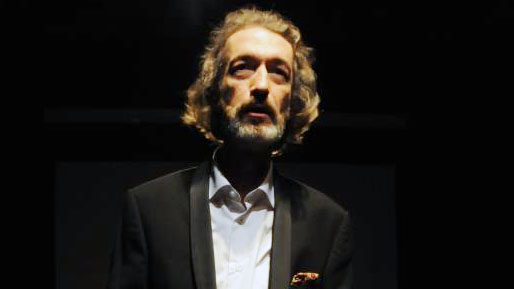
Marina Timasheva: The play "Black and White Cinema" recently appeared in the poster of the Kamburova Theater. He is placed on the verses of Yuri Levitan. Music was written by Larisa Cretan and Oleg Sinkin. He is for piano. On the violin - Tatyana Maslennikova. The roles are employed by actresses, the actresses Elena Kamburova, Elena Veremeenko, Victoria Tikhomirova, as well as Alexander Ponomarev. He - the director of the performance - reads poems and texts from the author. Kamburova invited him to the production.
On the small stage of the theater is a massive old wooden table and a metal bed. They fell into the performance directly from the poems of Levitan: "The bed and the table, and nothing else is needed." Instead of a backdrop - a screen. Personnel of chronicles of different years and modern shooting, stylized for documentary. Previously, the room in which the Kamburova Theater is now located was occupied by the Sports cinema.
"My life, cinema, black and white cinema!
Who was written the script? What a strange dreamer
Is this an equal brilliant and crazy director?
How freely it mounts various pieces
Glee and despair, fun and longing!
He does not forgive the actor played a poorly played role -
Be it a comedian or a tragic, whether it is a jester or a king.
Oh, how difficult it is, how perfectly acting to be a face
In this drama, where just between the beginning and end
Two hours, or even less, only a moment one ... "
Alexander Ponomarev staged many performances based on poetic texts, in this matter he is a real master. But before, the poems of Alexei Kruchenykh (“Victory over the Sun” in Ramt), Veliir Khlebnikov (“Zangezi”), Alexander Vvedensky (“Oppossibly God”), Daniil Harms (Elizabeth Bam) in the theater-Studio “Clear-Neveta” came into the field of vision. The poetic nature of the verses of Yuri Levitansky is different:
Alexander Ponomarev: Do not flirt and say that it is easier to work with complex verses. But I opened the book, read and heard the sincere intonation of Levitan poems, which, against the background of the current, can be said, abominations. He, of course, is amazing, I will not say the great, but these are crystal pure poems ...
Marina Timasheva: One of the main characters in the performance is the old calendar. Leaflets are torn off and burned one by one. A simple, clear metaphor for the speed of life.
(Sounds a fragment of the performance)
Marina Timasheva: Alexander Ponomarev, the leader of the theater company "Chet-School", the author of many wonderful performances, rarely has been working in the theater in recent years, more on the radio "Culture", and with this topic I have been starting a conversation with him.
How many years have passed since you staged the last performance on the Moscow scene, and until you staged the play "Black and White Cinema" in the Kamburova Theater?
Alexander Ponomarev: If we count the “even-unit” theater, which from time to time, like a yellow submarine, pops up, the last was the play “Kandinsky-2” by Sasha Stroganova. Until 2006, he played, the season we managed to hold it out. It was difficult because I left the Open Scene project and did it with my money. 6 years passed, there was a “Snow Maiden” in Saratov and the conversations with Malaya Bronnaya continued, which seemed to ripen in the implementation of two productions.
Marina Timasheva: You really worked little in the theater recently, but all these years worked on the radio and made radio players. Do you remember about how many performances for the radio have done?
Alexander Ponomarev: I did not count, but about a hundred, in my opinion. All this came out of the "clear-inchet" in 94, the first two works are the works of the theater, "Madame Lenin" and, above all, "Zangezi". I am still terribly close to me, I am a happy person, I manage to be in itself in a bicom-giving, amphibian, and the actor and director, but also to engage in fundamentally different theaters: the theater is one, a television system where I also had something-the other, the radio theater is a third.
Marina Timasheva: If we talk about the radio theater, what is the fundamental difference? You read the text in the same way, analyze the text, rehearse with the actors. What is the peculiarity?
Alexander Ponomarev: First of all, the task, the main task. What is the main charm for me? The artists are not visible, the scenography is not visible, nothing is visible. We were all brought up, our generation was brought up and now it is returning, on the records, on the development of imagination. For the listener, there is a chance to build this picture himself, according to the actor's voice. If this is a talented job, of course.
Marina Timasheva: A good artist in the theater and a good artist on the radio - coincides?
Alexander Ponomarev: This does not always match. It is simply not radiation. The actor can at the same time voice his films well, the roles of strangers, to engage in dubbing, but it is not necessary that he can work when he is not visible. It happens just very flat. I will not hide, now I feel less pressure: no, be sure to take a young star. I was sometimes forced to go to this, and my fears were justified that this young star compared to mastodons with which one happiness to work on the radio looks, to put it mildly, pale. I am now more free in choosing the material, they don’t tell me how often in the theater: who needs it now? Here is happiness - the choice of material, the ability to work. Smoktunovsky worked for me - the last role on the radio, Gerdt - the last role on the radio, Kozakov - the last role on the radio, Yuri Vasilievich Yakovlev - God grant him health. And everything is not ashamed to show all the work.
Marina Timasheva: Meanwhile, the need to work in the drama theater does not disappear, despite the fact that in the theater there are things that can not only have a desire to go to these theaters from the viewer, not only for actors to work in these performances, but also for directors.
Alexander Ponomarev: Yes, it does not disappear. Another thing is that I not only put it now, but I also play. In “Black and White Cinema” there is such a text: “And I was rotting and broke, but still I was lucky.” So, I play to myself, it is very easy.
There were such cases when I was on the verge of leaving the country, not just to leave nowhere - they called to the same Germany. I refused, despite the fact that the proposals were received in a difficult period, when here I actually ended with a “clear-notch”, a default occurred. But still, one of the aspects is not only in the acting profession - patience. Now, it seems, work on Malaya Bronnaya begins and is planned at the end of the year, work at the School of Dramatic Art, whose artistic director is Igor Yatsko.
Marina Timasheva: And what - where?
Alexander Ponomarev: On a small Bronnaya play with young actors, which has already been discussed for three and a half years. She came to me from the artist who emigrated to Canada, Miroshnichenko, and there became friends with Larisa Avadis, the translator of the play by Ramble, the modern francoid Canadian, the “cherry priest”. I even received the right to first setting. This, I hope, will come true with Masha Tsigal in the title role and young actors. And scheduled on a large stage, no more or less, like “Six characters in search of the author of Pirandello.
Marina Timasheva: And at the School of Dramatic Art?
Alexander Ponomarev: At the Rosa and Cross School of Drama and the Cross, Blok, exactly a play for the planned premiere, is exactly a hundred years old, which I, honestly, suggested at the Moscow Art Theater. I believe that the Moscow Art Theater did not finish then and did not release this performance because of the objective - the revolution of the struggle. 250 rehearsals were. Blok himself really wanted it to be in the Moscow Art Theater. He started like a ballet libretto, then he saw this whole story as an opera, and then as a play specifically for the Moscow Art Theater. And of course, it was logical for the 150th anniversary of Konstantin Sergeyevich to put '' Rosa and the Cross '' in the Moscow Art Theater. On the other hand, what is happening in the current Moscow Region is ambiguous and problematic, it is mildly said.
Marina Timasheva: The point is that the Moscow Art Theater rehearsed the Rosa and the Cross of Blok - it was 1915.
Alexander Ponomarev: until 17 years old, two years. Then it all collapsed because of the revolution, but not only. I rarely do it, rarely when I coped with poetic material. As a rule, I could not cope. Apparently, this was also one of the reasons why this did not take place. Because there are records of rehearsals, there is an enthusiasm for how he himself read the material of the block, but, apparently, an attempt to “disinfect '' '' and introduced into a scroll bed of the truth of life. Although all the old Mkhatovskiy, who raised me, distinguished between the “truth” '' and the artistic truth, they were not unambiguous about the Stanislavsky system. How it has been viable since the Stalin's times: there is a state system, so we accept this system, no more. This was not in the Moscow Art Theater. Before the revolution, there were experiments, Gordon Craig worked. Meyerhold and Vakhtangs came out of there, the whole theater came out. And when it was turned during the “scoop” into a certain packaging, the so -called “system”, the old people who were partners of Mikhail Chekhov, Dobronravov, worked with Nemirovich and Stanislavsky, they told us that everything was ambiguous.
Marina Timasheva: One theater does not want to take a “rose and a cross”, the other theater does not want to take a “rose and a cross”, you are resting, getting out of your own. Meanwhile, in this work there is nothing to coincide with the current situation. We are talking about the 13th century, there are knights, there are an Albigo campaign, there are rosencrackers, there beautiful trumpeters compose poems and songs to beautiful ladies, there we are talking about love, about honor, and Christian morality. And how does it go to the present? If I stand on the point of view, for example, Oleg Pavlovich Tabakov, then why do you think that this work should and can be delivered, should and can be perceived?
Alexander Ponomarev: I am also not a supporter of Danish performances. Of course, the movement of my interest is not in this, but in the fact that you yourself have now listed accurately quite accurately. Knightship, devotion, Christian idea embodied through the tradition of rosencrasors and even Templars. But the main thing is not even in the Templars and Rosicrucians, of course, this is interesting to me, I am going to encode the Signs of the Templar with the artist, all these roses of Gothic stained -glass cathedrals. But the main thing is the idea: joy is suffering, a disinterested sacrifice in the name of love. It is unique that there are two brilliant roles of male, I myself would have enthusiastically played Gaetan and sang, but Bertrand is unique there. Firstly, this is my age is elderly knights. In its 52, this is just it. Their age, in love with this girl. Bertrane, first of all, I mean, he loves so much that, unlike the half -mystical Haetan, he sacrifices himself, bleeds literally, helping a date, not her date, a young woman, whom he is in love with. How I put the Blue Bird about the disinterested search for a blue bird, the boy is not looking for it for himself. This is the dream of a boy who makes a heroic campaign. And then the dream of a mature knight. This is an eternal topic. I am convinced that now we just have to talk about it. Of course, I will stylize, modernize, in my overcoats I will not go knights.
Marina Timasheva: Why do you think that now you need to talk about these things? You alone think so, in general.
Alexander Ponomarev: I hope not one. You always need to talk about these things. And when they stop talking about them ... I have one friend, who immigrated for a long time, ended up on the discussion of the "new drama" and asked the question: "But what about your positive heroes?" He was dumped, ostracism. On the blue eye: “What is happening with you?” I asked a simple question. “This is a forbidden question about a positive hero, it turns out, you have here?” If the situation has reached this, then all the more we need to do this, I just feel the need. Enough, sorry, shit, the people have already eaten up. I take Blok, Shakespeare ... Who needs it now? Yes, it will always be necessary. I do not open any Americas and do not original. As I can - I do, how it turns out, what comes out. Firstly, I believe that I was not engaged in any avant-garde, I was engaged in classic. Because Khlebnikov is the same classic as Goethe and Pushkin, not only for me, and twisted, by the way, is a kind of Goethe.
So, I did not engage in the vanguard. Firstly, they did not like when they were called the vanguard. They were engaged in archetypes, the original word, the original color, shape, like Malevich. Archetypes are ancient things, primitive drawings, no avant -garde. This is largely different from a bad modern avant -garde. There is good too, I'm not saying that there is nothing now. No. It’s just that my area of interests, as you remember, I generally began the theater from Gogol, the programmatic was '' Nikolai Gogol. The nose "1988, both Khlebnikov and Harms were included there, as if such a starting point.
Marina Timasheva: There are different possibilities or different ways to read poetry. Often in a drama theater, artists are logical of meaning. And the poets themselves, as a rule, read in a pure melody. What does Alexander Ponomarev do?
Alexander Ponomarev: You know, I do not have my own system. I am not a creator of systems, I do not write, maybe this is my inferiority. For example, I like to read the texts of Klim.
Marina Timasheva: Klim, this is the director Vladimir Klimenko, who also worked in creative workshops, and it was in his performances that we first saw Konstantin Lavronenko, the future hero of Andrei Zvyagintsev films. Klim writes wonderful articles about the theater.
Alexander Ponomarev: Just self -valuable works that he sets out as a thinker of the theater. I am a practitioner. I felt poetry, studying at the Moscow Art Theater, about whom he said that the tradition of embodiment of poems is small. I began in my roles with poetic material, King Uzbek in the “happy beggars” in the production of Berman in 81, in the same 81st ”and with you again I“ on behalf of Pushkin, where I read poetry, made friends with Mikhail Mikhailovich Kozakov, with whom he was friendly until the end of his days, not all accepted in his manner of reading, but he did something remarkable as “copper Horseman ", for example, and he miraculously read Brodsky. By the way, more intelligibly than the author himself. Yuri Levitansky read in different periods in different ways, somewhere he read, somewhere he tried to read an acting. He is interesting. Intuitively, not planned, I may read so, not always the same.
Marina Timasheva: And yet Blok, the form of this play?
Alexander Ponomarev: To call just mystery - no. There is an amazing play. Even, I think, those who say - why is it necessary? - Either they did not read at all, or did not re -read. Because it is amazing, this is the Shakespearean tradition - poetic scenes, written in high style, are interspersed with prosaic, fleshy, like Shakespeare, mundane characters. This is the presence of humor, the mismatch of the top and bottom. This is not that eclecticism, although there is a high eclecticism, which Schenite called polystilism. I wave, try to wave, as always, to the full volume of the play, without abbreviations. Why am I glad that I am provided with atrium, the large space of the theater, invented by Vasiliev and Popov? I do not want to reduce this, I want it to be spectacular. Therefore, I pull out from Bulgaria an artist with whom I made Little Tragedies in Bulgaria Khlebnikov on a large stage, and here Don Juan in the “Nebeschet” on a large stage with luxurious scenery. During this time, she became one of the notable European artists. This is Marina Raichinova. I would like the scale of almost epic, which is achieved by Alexander Alexandrovich Blok.
Marina Timasheva: You say, although you are only 52 years old, that you yourself are an elderly knight, do you feel not only “elderly”, but also a knight?
Alexander Ponomarev: Yes, - he answered immodestly. Don with Quixote in the literal sense of the word I do not feel. Nabokov was right, quite skeptical, sharp, sometimes a poisonous person, when he very accurately wrote that there was no more brutal book, such an encyclopedia of cruelty, in fact a parody of a knightly novel. He wrote about a half -crazy. I hope I am not half -sung.
Marina Timasheva: You just talked a phrase from the Blok play. However, it is repeatedly repeated in it: "Joy, suffering - the heart is indispensable." How do you interpret it yourself? Because inside the play, every person repeating it, reproducing, listening, perceives it differently.
Alexander Ponomarev: Such a paradox, it would seem, joy - suffering. In general, the topic of sacrifice is the victim of Bertrand. He is ready to sacrifice himself and a kind of joy to experience. Why do I still think that this should be put, because the themes of sacrifice in the name of disinterested love, deed, and not self -interest are pushed into our periphery. Very modern. We feel the pressing of spiritual folving, and this is almost a little, I am not afraid of this word, not a state task - this is a reason, it is a systematic emasculation of the life of the spirit. If they talk about the spirit, then how Stanislavsky I want to shout: "I do not believe!" Because it is closed by selfish interests. Therefore, chivalry. Yes, I say with an open rack that I declared a war of vulgarity, so I am responsible for what I did, it can be criticized, perceived, accept, not accept, but I am responsible for the authors that I am turning to, they lived in this direction.