
Translated material
'' White on black ''
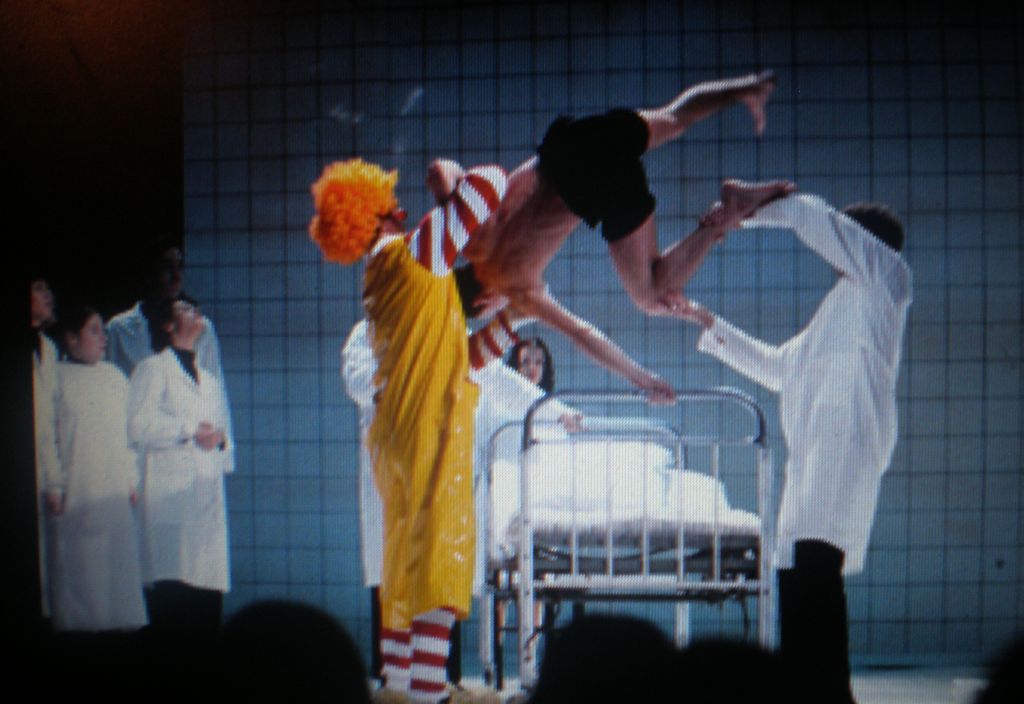
Marina Timasheva: The Free Space Theater from the eagle at the Golden Mask festival showed the play “White on black” by the autobiographical novel by Ruben David Gonzalez Galieo. The book, published in 2002, became the laureate of the Buker Award. I remind you of the story: in 1968 in the USSR, the daughter of the Secretary General of the Spanish Communist Party, a student of Moscow State University, gave birth to a boy, a disabled person, and a diagnosis - cerebral palsy. Venesuel's father left, after some time they said her mother said that her son had died, she also left the USSR. Ruben Gonzalez Galego grew up in the Soviet boarding school for children with disabilities, then he was transferred to the nursing home, to the “survival period”, which did not promise to be long. From there, in the literal sense of the word, a woman, who later became his wife, stole him.
Ruben Gonzalez Galegu himself in an interview said: “There are many forms of communication. For example, dance, music, painting. As a rule, a person prefers one of these forms. One of the best and close to me methods is to communicate through the word, the text. People expressing their attitude to the world through letters -“ textual ”people.
But the director Gennady Trostyanetsky is not a textual, but a theatrical person, and he offered young actors from the eagle other forms of communication: mainly dance and music.
(Sounds a fragment of the performance)
There are not so many words left, the main part of the text is translated into the language of plastics. Here, let's say, an episode when the future wife of Galego with the help of other people throws him through the fence of the nursing home. In the play, he looks like this: she ties the sleeves of his quilted jacket to durable ropes, he releases his hands, and the quilted jacket takes off up. Or we take a fragment of the text in which high school students treat the boy with canned goods and tea. One has no right hand, the other has the left, the third has legs. In order to take the simplest action - to open a can of canned food, they need to turn into a single organism. And on the stage there is a complex plastic composition: the bodies are intertwined as if it are one body. In addition, the image of an absolutely soldered team is born. Another example. Here the book describes how doctors come to the ward, study the unfortunate cripple, and he tells them that he is not an experimental rabbit. In another fragment of the text, we are talking about the indifference of many people to someone else's trouble. In the play, doctors crowd near the child’s bed, mutter something, discuss with a scientific look, and do not notice that the child rolled out of the bed, which he could not climb. The scene takes only a few minutes, but in it - without words - all the same is reported as - with the help of words - is told in the book. At the same time, the actors do not imitate people with disabilities (direct imitation seemed to be falsity and speculation), they translate them into a conditional dance language. And the audience understands: the complexity of the task set by the choreographer before dramatic artists, these are real flowers in comparison with the complexity of the tasks that circumstances set before people who are almost deprived of the ability to move.
(Sounds a fragment of the performance)
Ruben Galego writes: '', a person very often needs to be strong. And kind. Not everyone can afford to be kind ''. And describing the soullessness and some kind of wild cruelty of society in great detail, he allows himself to be kind to everyone who helped him at least something. "Thanks to all the good nannies for teaching me kindness, for the warmth in my soul that I carried through all the trials. Thank you for not expressing words, not calculating on the computer and not measuring." And different people are bred in the play. Here is the orderly, removes, tries, she is not angry, she only says everything that she wants, and it would be better if she was silent - then the child would not know that he was better to die than to suffer like that. And here is the other, a young bastard who is hunger to hunger, to often change his linen. And the third is a nanny, embodied Christian mercy, who prays for these small ones. And somewhere there are ceremonial stands, a festive mass, and Brezhnev with his retinue on the rostrum, and American cinema. And here - strollers without strollers, "stumps" who want to eat, smoke, want women, want to be men, want to live. And all this is in the play. And all the actors play, probably because it is very young, with the degree of sincerity, which you will not meet with fire on a professional stage during the day. And everything is painful, topically, and the theater answers directly: there should be no orphanages, the state that refers to the weakest, does not stand broken penniless, but no one removes responsibility from each of us, because we can, too, must help. There is a direct moral message and a hero. As Ruben Gonzalez Galego himself writes: '' If you do not have any hands or legs, and you also managed to be born an orphan, everything is. You are doomed to be a hero until the end of your days. Or die. I am a hero. I just have no other way out. ''
This is not a whiner from modern plays written by the authors, who only do, that they blame circumstances in their own nullity. And this performance is a real theater. DOD, because it is based on the document, but this is an artistic document - both in the literary and in the theater. And the social theater, which, seems to be terribly yearning for Moscow theater journalists, only they say that in Russia it is not, and advise you to take an example from Europeans, and only my colleague from Novaya Gazeta came from the eagle. As Yuri Shevchuk sang: "They want poor in Miami or Paris, but Sverdlovsk, Ufa (Eagle) - is it prestige." The full, large hall of the Moscow Youth Theater thanked the Orlovites with a very long standing ovation. These were the very people whom journalists accuse of ignorance and the lack of interest in serious problems.
Let us leave the “masks” on the conscience of the experts that the best performance from the province did not enter the competition program of the festival, and we will talk with the director Gennady Trostyanetskiy.
Gennady Trostyanetskiy: There is a certain personal, my own background in the approach to the document on stage. Many years ago, while still a student of the Faculty of Architecture in Rostov on the Don, I began the theater studio. And there we took an article from Komsomolskaya Pravda Konstantin Mikhailovich Simonov and the whole story of the death of Toli Merzlov, who saved the state farm tractor and burned himself. In 1972 there was such a story. I took articles and documents as a basis. And then for the first time in my life I understood the power of the document on stage. Because he incredibly liberates fantasy, such a dialectic arises between, supposedly, a dry fact and the so -called theatricality. And this combination then gave an incredible power effect. Then this approach was very settled in me. In 1984, in the Omsk Theater, I staged a play “The war is not a female” face based on the book of Sveta Alekseevich, taking the document as a basis, and Viktor Gulchenko brilliantly said: “You found that every fact of human life is fraught with the opportunity to be translated into aesthetic reality.” It seems to be a complex formula, but in fact it was very clearly and accurately said. And these two directions, the direction of the gaming theater, harlequinades, or something, and a dry document live in my heart all this time. I was confused, like many of my colleagues, in front of the colossal stream of literature, which poured in the perestroika years that I adored, and which had all us. And then I said to myself: I will try to read the reports of all sorts of bonuses. And when I came across the fact that the book '' White on the Black '' got a buker, I instantly read it and realized that it needed to be done. The acting course of Sasha Mikhailov at the Oryol Institute of Arts was just produced, somehow everything coincided that I proposed this idea, and Sasha immediately agreed. I took Seryozha Puzyrev, the director of this theater, the wonderful choreographer of the Sveta Shchetinin, and we began to work as assistants. They worked as a traditional method for the Russian theater - a sketch method.
Marina Timasheva: Gennady Rafailovich, sorry, does that mean that you did not make staging?
Gennady Trostyanetskiy: Yes, I did not make a staging. Here we just took the book and, as the composition arose, so we worked. There was no completed text.
Marina Timasheva: And Ruben Galego agreed with this method of work, did he not break to write a staging himself or intervene somehow in the work?
Gennady Trostyanetskiy: I did not immediately call Ruben, I thought in a sinful thing: what if it would be possible to drag him? I did not know that his trip from Washington to Switzerland costs 20 thousand dollars. And when I already felt that something interesting was arising, I wrote a letter to him by e-mail, then I went to Skype with him. It was accepted with hostility. And then I said: '' Ruben, this is what the guys began to compose ''. And he began to tell him. And by the end of this conversation, he became our friend. He brilliantly understands computers, he can teach you, he knows three languages, he is a person with Wall Street in the economy, he had three wives, he had amazing two beautiful girls.
Marina Timasheva: So you do not change the name? Is there any figurative meaning for you?
Gennady Trostyanetskiy: Of course. In this name, no less figurative meaning than 'war and peace' '. '' War and the world '' - not because some pages are pro - the war, and others about the world. This is a wild contradiction that lives inside all living things. So here. '' White on black '' is an incredibly multilayer image, although it arises from perfect simplicity. Not black letters on white, but, on the contrary, negativity. And Ruben writes: '' love black color ''. Well, there may be an shocking in this. When they call Ruben and ask: '' How are you? '', Do you know how he answers? He screams: '' still live! '' What to say there! The man who, clenching his teeth, turned himself into a piece of steel in order to survive without losing a living soul. This is the circle of thoughts that owned me when we worked on this book.
Marina Timasheva: You are completely moving away from the physiological, naturalistic series, translating everything into plastic studies.
Gennady Trostyanetskiy: I have a very good two -volume Picasso at home, I turn over him and suddenly run into the reproduction of his brilliant picture '' Acrobat '', where the hand is, so, the leg - the head - in one corner ... And I suddenly understand - here it is, the approach! And an eccentric occurs instantly, a feeling of a strange body arises. This is the famous Brekhtovskoye '' detachment '', the viewer should not notice it, this is an absolutely professional term, but this is a typical 'detachment' '. Living, strong young students are actively working, passing the energy that lives in these people, and at the end (as Anton Pavlovich Chekhov said - `` Take a cheek to the reader '') The phrase: "They were all not walking ''. Picasso prompted plastic. Could I know that he would tell it?
Marina Timasheva : The performance itself ends not how the book ends, but the monologues of people who could not escape, people who remained in this boarding school and died.
Gennady Trostyanetsky: Because the whole book of Ruben is written about what lives so far, the book has not closed the problem, it opened it. Therefore, I end with monologues of people whose fate did not work out like Ruben’s. The front -line soldier who is outraged by the fact that the Second World War is reduced. You see, '' General Secretary of the Communist Party of the Soviet Union Leonid Ilyich Brezhnev '' - we completely pronounced, but the Second World War had to be pronounced briefly, we did not have enough printing paint to write 'The Great Patriotic War' ', or energy to say it. So, the front -line soldier ends with him. I had to push Ruben, who was saved by love and those who remained. And these endless letters, I remember how this image was born, notes, which at the end.
Marina Timasheva: Closer to the final of the performance, a kind of curtain, an ass is lowered, and on it - a huge number of letters.
Gennady Trostyanetskiy: This nanny, whose monologue is in the book by Ruben, she gave herself the word that the name of everyone in the shelter will be nursed, she will write, and everyone will put a candle. And she says: '' There is no money, but I still spend the last pennies on candles and notebooks ''. And we realized that in the finale slowly, slowly should fall such a backdrop, where several thousand of these small letters, a note with names. And, you know, the guys wrote the names for two nights and glued on this back, so that real, not fake, there were notes. And the curtain slowly in the final of the performance is released, creating the background of a small group of people near the bed, where a legless guy is sitting, and a note, behind which, perhaps, all of Russia was thrown to the sidelines of people.
Marina Timasheva: Do you yourself think this performance is social?
Gennady Trostyanetskiy: Well, yes. You know, if we recall our teachers - Efros, Tovstonogov, Yuri Petrovich Lyubimov - well, was not one performance not social? In the same, the height was the Russian theater, in this intersection of many vectors. And '' month in the village '' Efros? Do you think there is no this social layer? Of course, he is, of course. One replica in this performance taught me a lot. When Rakitin (Mikhail Kozakov) left, he said: '' I have an honor! '' It just turned me over. You read the text - '' I have the honor '', that is, '' goodbye '', but in the matter itself - a person has an honor.
Marina Timasheva: And if we return to the situation in society? You say that nothing is changing. Is it really so, is it your deep feeling that nothing is changing?
Gennady Trostyanetskiy: No, of course, Marina, changes, only how does it change? Maybe I’ll say a rather sharp thing now, but my friends, close people who are dear to me with their lives, with their thoughts and some kind of internal position, we understand that the general idea of life has gone. Suppose there was some kind of idea, we can say that it was false, but it existed and gave real forces for a huge number of people, for the incredible power of cinema, for amazing theatrical planets (because otherwise than planets, I will not name Zakharov, Lyubimov, Tovstonogov, Efros), for amazing literature - which are the triphons and bits. The idea of life has gone. And what's in return? Someone says - Orthodoxy. Not true. In life, over the past 20 years, maybe I have seen three truly believers. They can be seen immediately, instantly, an amazing energy comes from them, with them suddenly the impression that the air, the color of the walls, and the season are changing. I say this for sure, absolutely for sure. Orthodoxy did not at all become that idea. The idea of well -being arose, a completely sober idea. After all, Brodsky said that he realized in America that money is the fifth element. Leonid Likhodeev, there was such a publicist in our time, he remarkably wrote in one of the feuilleton that “there is no man without the ideal, without an ideal, a person begins to grunt” '' '. And if this is not, why then the theater? He begins to serve. This idea of life is not, you suffer from this, rush about, and then what? Then everyone begins to look for their own niche. Previously, you go to Peter and understand: without the BDT, Leningrad is impossible. You go around Moscow and understand that without a Taganka and the Lenin Komsomol Theater, Moscow is impossible. It arises, as I call it, '' The principle of web '' '. Imagine a spider webs of several kilometers. This means that the spider in the middle that woven it, he feels that he is shaking on the 12th kilometer. And so - art. Somewhere there, Kamchatka trembled in Petropavlovsk, but here it responds. Otherwise, a thing arises in yourself, an inconspicuous substitution - if I have not seen this, then this is not. That is, in its pure form, virtuality. There is what I see and with what I enter into a relationship. The word is foreign, but the largest virtualists are us. Even Nikolai Vasilievich Gogol understood this, because the main character of his work is a phantom, nonexistent. Dead souls - a phantom, Khlestakov - phantom, nose - phantom, overcoat - phantom. He felt it incredibly sharply. They begin to engage in aesthetic search. I was talking with the actors now, the actors say that they took part in one large festival, and all the participants, and not only them, bewilderment - why the prize received a performance from which the viewer left in crowds. But they are not for the Shirpotreb on the stage there is vulgarity, they are for some fair correspondence to arise, at least. So I happened to take part in one festival, where there were several very famous performances from St. Petersburg and Moscow, but the festival was international, the jury was international, and they did not know that these three or four performances had to pray. They did not even take them into account. That's what a paradox is interesting! These performances were not even among the three winners. And when the awards were announced, the hall unanimously exploded with applause.
They say to me: here is the avant -garde. I see video technology and hear non -normative vocabulary. Is this a sign of avant -garde? 600 people in the hall watch this video and do not believe any acting word. What avant -garde?! The performance of Bob Wilson '' Game of Dreams '' in the Stockholm Theater of the Royal, where academic actors play - goosebumps are running from how they exist. Just incredible! Here is an avant -garde, and not that there is a video or blue cows go there.
Marina Timasheva: Although Wilson has a very 'visual' 'Theater.
Gennady Trostyanetskiy: Anyone can now dial Shakespeare to “You Tube '' in '' 'in' '' Berliner Ensemble '' and see what they did. The most hlying performance is now. Here is the avant -garde. Как существуют актеры, как они читают Шекспира! Каждый сонет это отдельная театральная новелла. 70-летний Боб Уилсон сделал! А подмена «эстетическим» подлинного переживания, она страшно волнует.
Марина Тимашева: А вы верите, что что-то можно поменять в отдельно взятой человеческой душе?
Геннадий Тростянецкий: В это безусловно верю. Я не верю ни в нацию, ни в партию, ни в народ. Я верю в отдельно взятого человека. А если бы не было этой веры, то как? У Глеба Успенского есть замечательный рассказ ''Выпрямила'', когда учитель увидел Сикстинскую Мадонну в подлиннике. Конечно, я в это верю, а как иначе? Вот вам, пожалуйста, пример. Я какое-то время руководил, в начале 90-х годов, Театром на Литейном. Были потрясающие гастроли в США со спектаклем ''Великая Екатерина'', и когда вернулись, это 93-й год, хотелось продолжить это живое чувство, и возникла идея: два театра, Театр на Литейном и додинский Малый драматический, это были театры, имеющие отношение к области...
Марина Тимашева: Областного подчинения.
Геннадий Тростянецкий: И они должны были выезжать в область, то есть в районы, и там давать спектакли. У меня возникла идея: а что, если не 175 выездов в году, а всего дважды, но подолгу - неделя осенью и неделя весной? Но привозить лучшие спектакли. Сели на машину, поехали в Тихвин, в Кириши, там дворцы культуры крупные. Привезли ''Великую Екатерину'', где Оля Самошина играла главную роль. Играли ее в церквушке. Привезли ''Скупого'' с Семеном Фурманом в главной роли. Большущие спектакли. В конце - гала-концерт был. Я попросил из фильмов сделать нарезку. Игорь Горбачев тогда у меня репетировал ''Короля Лира'', а тут - ''Операция ''Трест'' – фрагмент. Он выходит на сцену, зал встает. Город всколыхнулся. И вот Оля Самошина, мой товарищ, замечательная актриса, рассказывает, что в слезах женщина вручает ей цветы и говорит: ''Вы знаете, Оля, у меня дочка погибла за неделю до ваших гастролей. И если бы не ваши спектакли, я бы ушла из жизни сама''. Ради одного этого человека стоило затевать всю эту историю. Если ты спас хотя бы одного человека, то ты спас целый мир. Если относиться серьезно к этой мысли, что человек это есть мир, тогда на многое ты смотришь по-другому.
Марина Тимашева: Напоследок - самое горькое. Спектакль сыграли в Москве в последний раз. Двое артистов, в том числе исполнитель главной роли Артем Исаков, уходят из театра, потому что ( как сказал Тростянецкий) им не прожить на ту зарплату, которую они получают. Московский бомонд клянчит у президента денег для себя любимых, хотя связи этих господ обширны, и они могли бы получить финансирование своих проектов от друзей-олигархов. А за орловский ТЮЗ, как и за другие театры российской провинции, им просить некогда.